Comet NEOWISE Appears in the Morning Sky
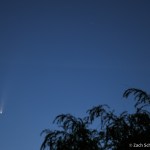
Naked-eye comet alert! Comet C/2020 F3 (NEOWISE), discovered back in March, has brightened to the point where it is visible to the naked-eye in the pre-dawn sky. Both the comet and its tail were easily visible to the naked eye about one hour and fifteen minutes before sunrise this morning:

Comet C/2020 F3 (NEOWISE) at 4:05 am PDT on July 8, 2020 from Yakima County, Washington. (Nikon D750, 260mm, f/5.6, ISO 400, 1.6 sec)
This is the first time in ~20 years of skywatching that I can recall seeing a comet and its tail with the naked eye. (Western Washington’s persistent clouds and 49°N latitude stymied my attempts to see Comet PANSTARRS in 2013.) Such comets are relatively uncommon, making it well worth the effort to get up to see this one.
Here’s how to see it yourself:
Look northeast 75-90 minutes before local sunrise. You’ll need a relatively clear horizon in that direction. For most locations in the United States, the comet will be no more than 10 degrees above the horizon at this time. A large tree 200 yards away was enough to block the view of the comet from my patio, forcing me to take a short stroll through the neighborhood to find a better vantage point. The comet is small, but for at least the next few mornings should be readily visible. Here’s a wide field view to give you a better sense of the comet’s apparent size:

Comet C/2020 F3 (NEOWISE) at 4:02 am PDT on July 8, 2020 from Yakima County, Washington. (Nikon D750, 70mm, f/2.8, ISO 400, 1 sec)
Timing is key. My experience is that the comet is best seen about 75-90 minutes before local sunrise. Too much earlier and the comet will be too low in the sky to see clearly. Too much later and the brightening dawn sky will render it invisible. This morning, by about one hour before sunrise, the comet had become much more difficult to pick out and the tail was barely visible to the naked eye. By 45 minutes prior to sunrise, the comet was no longer visible to the naked eye at all (although it was still visible in binoculars or a camera).
Since you’ll be observing in twilight, light pollution conditions shouldn’t make much of a difference here; this comet should be visible even from urban areas, provided you have a clear northeast horizon and time your attempt correctly. A pair of binoculars greatly enhances the view. For more detailed information on viewing Comet NEOWISE, check out https://earthsky.org/space/how-to-see-comet-c2020-f3-neowise
Now for a bit more on what you are seeing and how the comet’s appearance might change over the coming days and weeks:
Comets are city-sized “dirty snowballs” made mostly of ice and rock. They are leftovers from the formation of our Solar System and orbit the Sun on highly elliptical paths. Comet NEOWISE takes several thousand years to complete one orbit of the Sun. While comets spend most of their time in the cold outer solar system, when they approach the Sun they are heated by solar radiation, causing ices on the comet to begin sublimating (turning from a solid into a gas). This creates a temporary atmosphere surrounding the comet nucleus known as the coma. That’s the bright part of the comet you see in the close-up below. A stream of ionized gas “blown” off the comet by the solar wind can form a tail, while dust particles left behind the comet can form a second tail. As you can see in the close-up, Comet NEOWISE does appear to have two distinct tails at the moment.
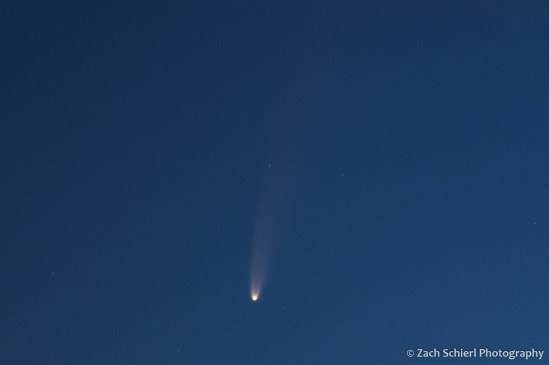
A close up of the coma and twin tails of Comet C/2020 F3 (NEOWISE).
NEOWISE made its closest approach to the Sun back on July 3rd and is now on its way back into the outer solar system. Typically, as comets move away from the Sun’s heat, they dim. So far though, NEOWISE appears to be bucking the trend. This is exciting because while the comet is moving away from the Sun, it is moving closer to us. It will reach its closest point to Earth by about July 22nd. If the comet can maintain its brightness for just another week or two, the show could get even better. Now is still the time to look though. The comet will be visible in the morning sky for just a few more days before it disappears into morning twilight. It will reappear in the evening sky by mid-July. Here’s hoping it is still bright enough to see by then. If so, we can all enjoy its presence without having to get up at 3:30 AM!
Mt. Adams, Mosquitoes, and the Milky Way


Bright Jupiter rises above the summit of Mt. Adams, with the summer Milky Way reflected in the calm surface of Takhlakh Lake, Gifford Pinchot National Forest, Washington.
Mt. Adams is a striking feature of the western skyline from here in the Yakima Valley of Central Washington. Here’s what it looked like from our neighborhood at sunrise a few months back:
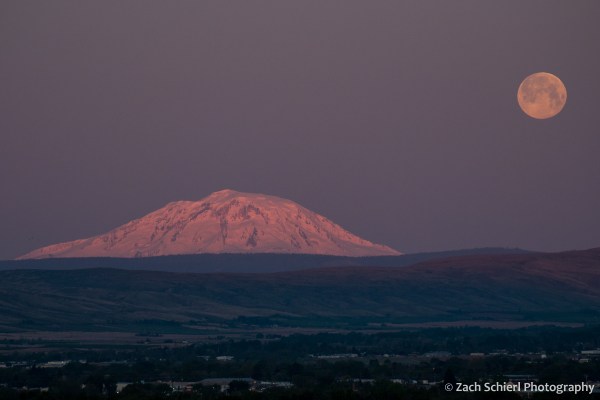
A setting full moon and sunrise light on Mt. Adams as seen from the Yakima Valley.
The towering volcanic cone looks close enough to touch, but in reality, reaching the base of Washington’s second highest peak requires a nearly three hour drive down a labyrinth of Forest Service roads. We’ve been wanting to explore the Mt. Adams area since we returned to Washington last year. With winter’s grip beginning to ease in the higher elevations of the Cascades, earlier this week we finally got the chance.
Mostly clear skies, calm wind, and a dark moon made for some great photo opportunities. While it may be debatable, I think some of these were worth their weight in mosquito bites. Several small ponds dot the lower flanks of Mt. Adams and snowdrifts still lingered in the shadier patches of forest, making the entire landscape somewhat damp. Consequently, the mosquitoes were ferocious! Sadly, our mosquito “repellent” only seemed to attract more. I was quickly reminded that a vastly underrated aspect of living in the southwest is the lack of bugs!

Mt. Adams reflected in Takhlakh Lake, Gifford Pinchot National Forest, Washington. (Not pictured: immense swarms of mosquitoes.)
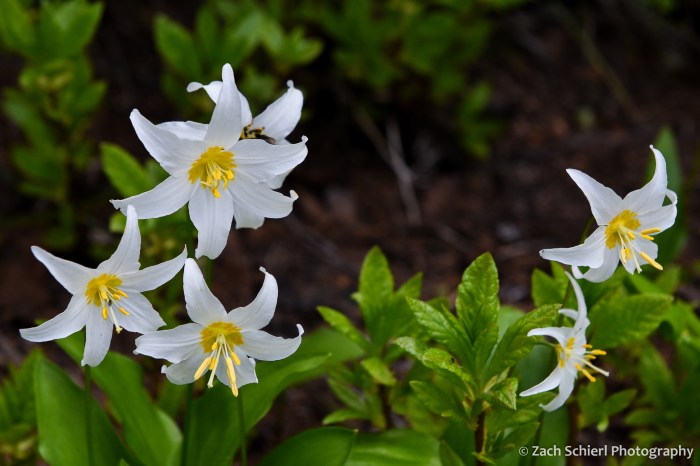
White avalanche lily (Erythronium montanum), one of the first wildflowers to emerge from the swampy ground as the snow melts away.

Mt. Adams reflected in Takhlakh Lake at sunset.
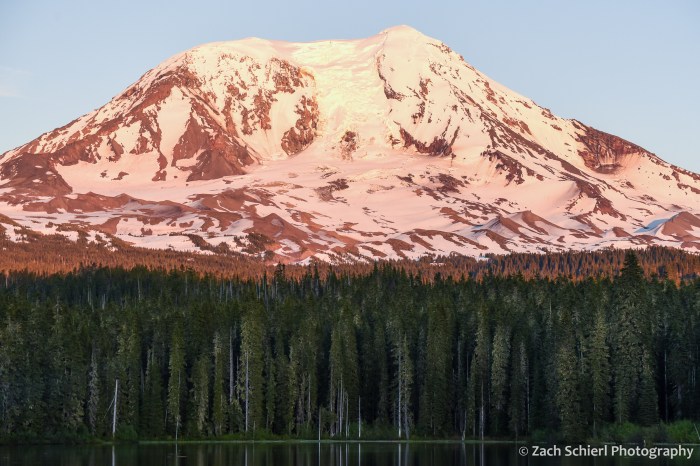
The forests just to the west of Mt. Adams happen to be located nearly in the center of the four large active stratovolcanoes of the south Cascades: Mt. Adams, Mt. Rainier to the north, Mt. St. Helens to the west, and Mt. Hood just across the Columbia River to the south in Oregon. A variety of relatively short but steep hikes in the area ascend lesser peaks, resulting in fantastic views of all four volcanoes, plus the dense forests of the Cascades:
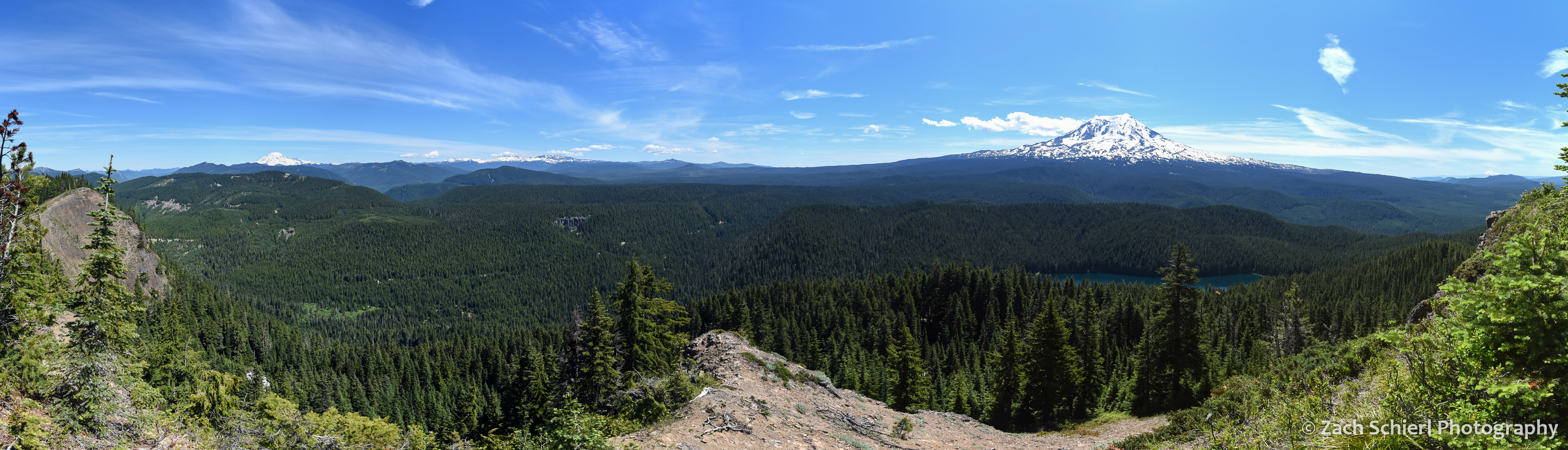
Panorama from Council Bluffs. Three Cascade Range stratovolcanoes (and the remains of a fourth) are visible (click to enlarge): Mt. Rainier (far left), the remains of the Goat Rocks volcano (center left), Mt. Adams (right), and Mt. Hood (far right). The upper portion of Mt. St. Helens’ eviscerated cone was also visible through the trees to the west.
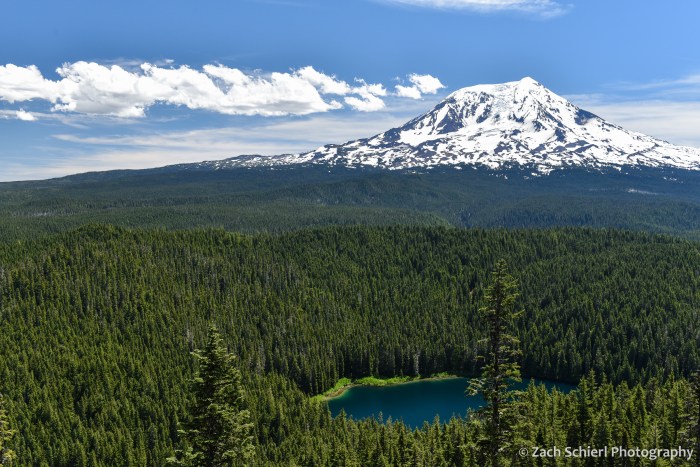
The dense forests on the west flanks of Mt. Adams. Council Lake at bottom.
The real fun came after nightfall. Dark skies are much harder to find in Washington than in Utah, and this was my first good look at the Milky Way since last summer. The calm weather allowed me to capture the Milky Way’s reflection in Takhlakh Lake. Jupiter was kind enough to rise directly above the summit of Mt. Adams. And I got lucky and captured the brightest meteor of the evening in one exposure. This was certainly a case of being in the right place at the right time! (One might argue that the “right time” would have been a few months from now, when all the mosquitoes are dead, but then the Milky Way would not have been positioned so perfectly.)
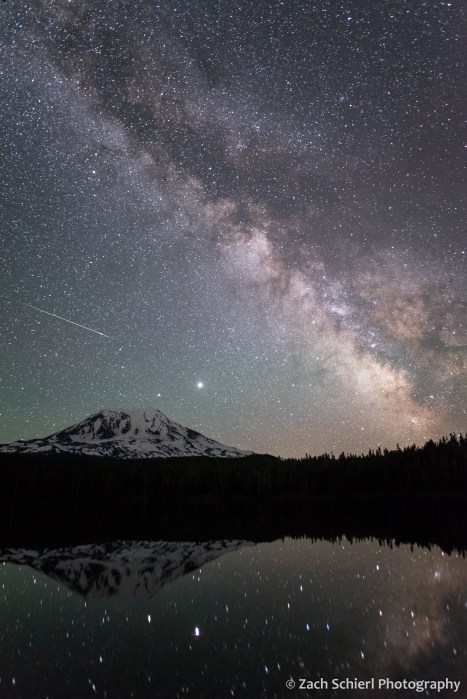
A meteor takes aim at Jupiter as Mt. Adams and the Milky Way are reflected in Takhlakh Lake.

The Milky Way begins to emerge from evening twilight.
Sunset to Sunrise at Bryce Canyon


Sunrise light illuminates rock formations at Bryce Canyon National Park
Sunset, nighttime, and sunrise are probably the three most exciting times for photography, and I got to hit all three on a quick trip to Bryce Canyon National Park this past weekend. I experienced a brilliant sunset, hiked into the Bryce amphitheater by moonlight, joined the masses for sunrise, and was back in my own home less than 24 hours after walking out the front door. I feel incredibly lucky to live close enough to such wonders that trips like this are possible. This impromptu trip was facilitated by the unseasonable heat wave currently gripping Southern Utah. On Sunday night, the overnight low at Bryce barely dropped below freezing (about 15 degrees above average for this time of year) making a quick camping trip a reasonable proposition.
This was actually my first trip to Bryce Canyon in the winter months. While snow has made itself scarce in Southern Utah the last few weeks, and most of the snow had melted away from the hoodoos, there was still quite a bit of the white stuff left on the north facing slopes, making for a gorgeous complement to the ruddy hoodoo hues.
Before hitting the trail for sunset, I took time to drive out to some of the overlooks at the south end of the park. Bryce Canyon may be known for hoodoo hiking, but south of the main amphitheater lie some truly mind-blowing views of the Grand Staircase and Colorado Plateau. The Paunsaugunt Plateau on which Bryce Canyon sits rises to elevations of more than 9,000 feet, allowing commanding views of the surrounding terrain. I truly believe that the view from Yovimpa Point is one of the best on the planet (albeit difficult to photograph), with a viewshed stretching from the North Rim of the Grand Canyon, to Navajo Mountain and Lake Powell near Page, to the 11,000 monolith of Powell Point and the Aquarius Plateau.
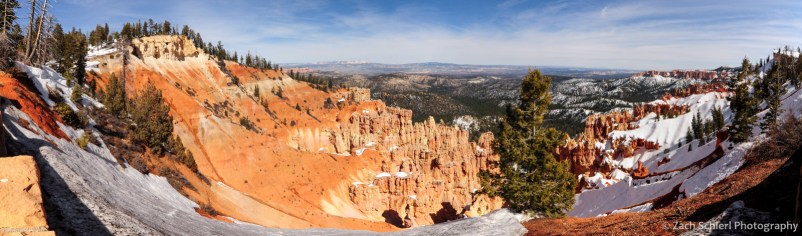
Looking east from Farview Point. Note how all the snow has melted from the south facing slopes, but much remains on the north aspects
As the sun dropped lower, I headed out on the trail to Tower Bridge. In hindsight I should have taken a picture of the mud, but I guess I was too preoccupied trying not to lose a boot to the bright orange morass. With winter freeze/thaw cycles still in full swing, the trails were all littered with fragments of rock fallen from the cliffs and hoodoos above, a good reminder of the primary process responsible for creating this unique landscape.

Late afternoon sun illuminates hoodoos, fins, and walls along the trail to Tower Bridge at Bryce Canyon National Park
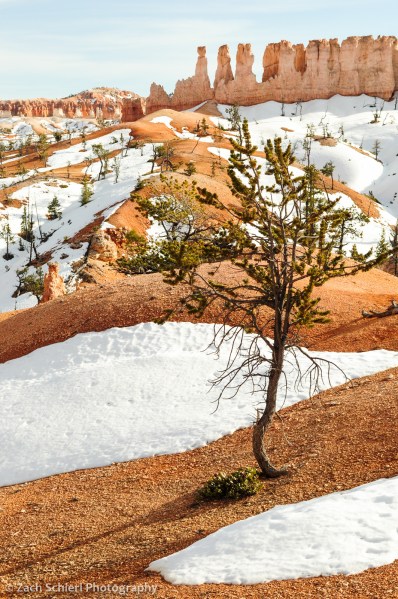
A scraggly Bristlecone Pine (Pinus longaeva) between residual snow patches along the trail to Tower Bridge

A classic Bryce view at sunset: looking northeast towards Powell Point (10,188′) and the Aquarius Plateau
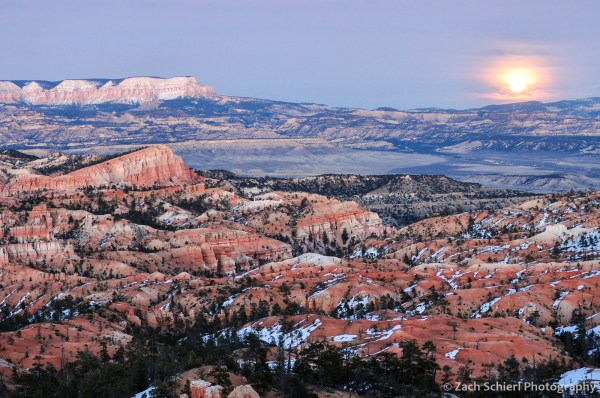
The full moon rising over Powell Point and the Sinking Ship
My visit happened to coincide with a full moon so Milky Way photographs were out of the question. The light made it quite easy to navigate the trails looking for interesting photo opportunities. In several hours of wandering around the amphitheater, I don’t think I turned my headlamp on once. It was seriously bright out there.

The constellation Orion hovers over the hoodoos of Bryce Canyon National Park

Star trails above Thor’s Hammer, Bryce Canyon National Park
With the photo above, I was hoping for longer star trails but after just half an hour, my camera battery died. After scrambling to replace it, I discovered that someone (who shall remain unnamed…) had forgotten to charge their spare camera battery. With only enough power on the spare for a few dozen more exposures, I decided to pack it in for the evening rather than continuing with the star trials, and save my remaining juice for sunrise…which turned out to be a good call.
While Bryce is beautiful at any time of day, sunrise is truly the golden hour. Because most of the amphitheater faces east, sunlight creates so many interesting light patterns among the hoodoos that one almost can’t decide where to look. This was the 2nd morning since the switch to daylight savings, and the crowds reflected the fact that sunrise was now at a quite palatable 7:30 AM.

A famous and tenacious Limber Pine (Pinus flexilus) at Sunrise Point observes yet another sunrise
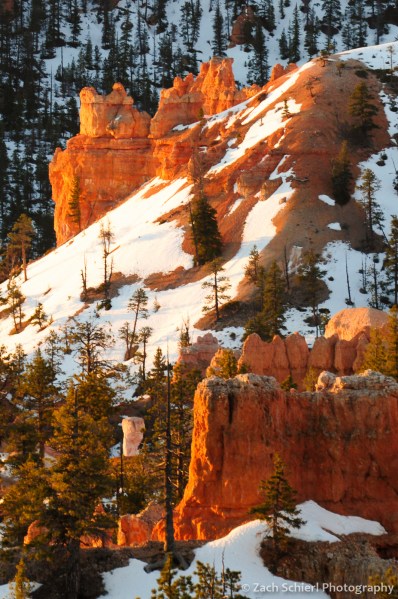
Hoodoos at sunrise, Bryce Canyon National Park

The crowds assemble for sunrise at Bryce Canyon National Park
 Zach Schierl Photography