Speechless in the San Juans: A Day at Ice Lake

It’s no secret that I love mountains. It’s also not much of a secret that the San Juan Mountains of Colorado are my favorite mountains. I love the San Juans for a number of reasons. One of them is geology. Look at a map and its easy to lump the San Juans in with the rest of the Rockies, but geologically speaking, they’re a whole different ballgame. Formed not by uplift but by some of the largest and most violent volcanic eruptions in Earth’s history (think Yellowstone only MUCH, MUCH larger…), the San Juans have a personality all their own. They are tall (12 peaks above 14,000 and 314 above 13,000), large (more than 10,000 square miles, as opposed to the long but skinny ranges that dominate the rest of Colorado), and so steep that only three ski resorts exist here.
I also love the San Juans for the solitude they can offer. 5+ hours from major metropolitan areas (*cough*Denver*cough*), escaping the crowds here is much easier than in the rest of the state’s mountains (*cough*Aspen*cough*).
As of last weekend though, my number one reason to love the San Juans is that the San Juans contain Ice Lake, which might be the most beautiful location I’ve visited on Earth to date.

Ice Lake reflecting Vermillion Peak, Golden Horn, and Pilot Knob
Ice Lake is a glacial tarn located at 12,300 feet not too far from the mining town of Silverton. Fortunately, it’s one of the few major destinations in the San Juans that you can’t get anywhere close to with a jeep, which drastically limits the number of people that you see and the number of engines that you hear. Instead, it is accessed via a steep 3.5 mile hike from a trailhead along South Mineral Creek. It’s been on my list of places to go for several years now and my girlfriend Michelle and I recently got a chance to spend a few days in the San Juans and make the short but steep trek up to the lake. Hiking in Colorado’s high mountains in the summertime can be challenging. Near daily vicious afternoon thunderstorms make it hard to spend any appreciable time above tree line. Despite the fact that a good chunk of this hike was above treeline, we didn’t hit the trail until a little after 8am but fortunately the weather gods cooperated on this day.
While the scenery along the trail is spectacular, all is forgotten once you catch your first glimpse of Ice Lake. One look at the brilliant neon blue water and you suddenly feel as if you’ve been hiking through a prison yard for the last few hours. I’ve never seen water so vividly colored; some of the hot springs in Yellowstone are the only things that come even remotely close. The color is caused by the presence of “rock flour” in the lake, extremely fine sediment left over from the days when large glaciers scoured out Ice Lake Basin and ground the fragile volcanic rocks into a powder. These sediment particles are so small that they remain suspended in the water, scattering blue light toward the eyes of every astounded hiker and backpacker that reaches the basin.
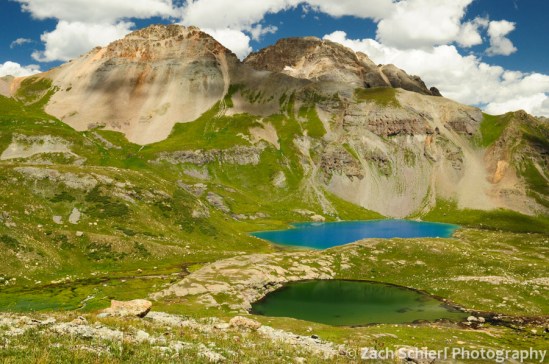
Ice Lake (blue) and unnamed lake (green) with U.S. Grant Peak (13,767′) towering overhead.
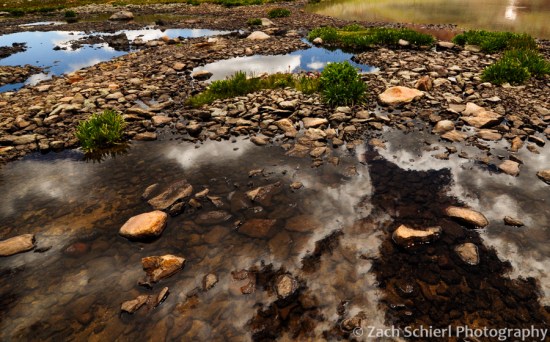
Late afternoon clouds reflected in a small pond in Ice Lake Basin
Unlike many of the other high alpine basins in the San Juans, Ice Lake Basin is HUGE! Covering nearing five square kilometers, the basin contains several other named and unnamed lakes as well as some of the most impressive wildflower fields I have ever seen. White, red, pink, and yellow varieties of paintbrush, elephant ears, asters, and columbines blanketed the basin. Wildflower season in the lower elevations has long past but up at 12,000 the show is just reaching it’s zenith!
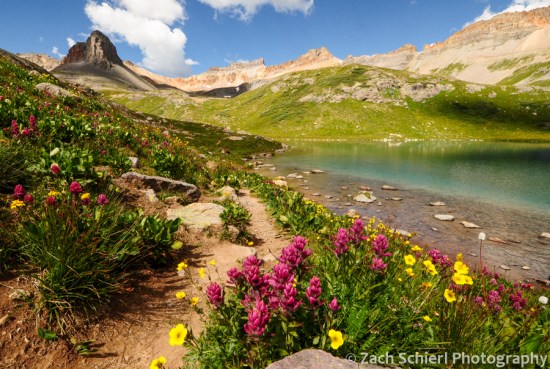
One of many colors of Paintbrush found in Ice Lake Basin.
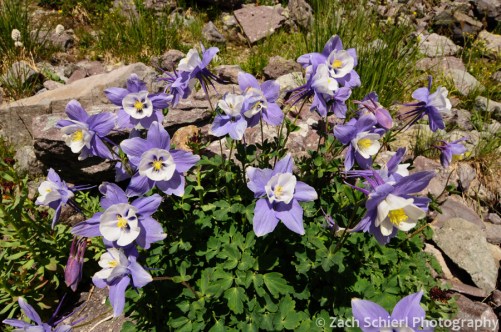
Hey look! Colorado’s state flower, the Rocky Mountain Columbine!
Interestingly, the other lakes in the basin were not nearly as brilliantly colored, but rather a more drab blue-ish green that was nevertheless spectacular, especially when the wind calmed and the waters began to reflect the ring of peaks surrounding the basin. We lucked into a day where the thunderstorms had trouble developing and so we were able to spend 5-6 hours exploring the basin, crossing fields bursting with wildflowers, and relaxing by the lakes. We were hoping to get a glimpse of the mountain goats that often frequent such basins, but we had to settle for a handful of marmots and a trio of llamas which another party had used to pack their overnight gear into the basin.

Unnamed lake below Vermillion Peak (13,894′)
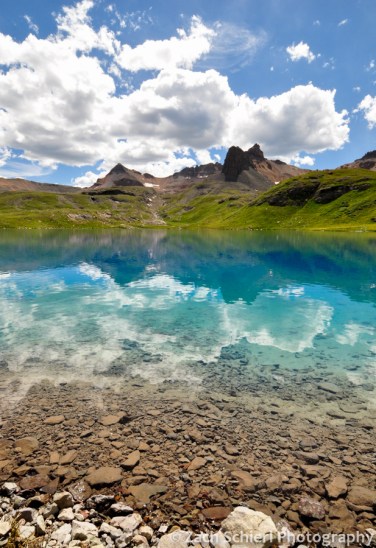
Golden Horn (13,769) reflected in Ice Lake.

Some of the views on the way up to Ice Lake. Here Corn Lily grows rampant in Lower Ice Lake Basin.
It’s not an exaggeration to say that this was one of the most beautiful landscapes I’ve ever seen. Walking through the basin, I was reminded of Robin Williams’ famous quip about Glacier National Park: “If this isn’t God’s backyard, then he certainly lives nearby.” Apparently God has now purchased a summer home in the San Juan Mountains because the scenery here is truly second to none.

Can’t remember ever being this sad about having to hike back to the car. Will have to come back and spend the night someday!
A Photographic Journey Down Chuckanut Drive

Chuckanut Drive, a.k.a. Washington State Route 11, is one of the premier attractions here on the extreme northwestern fringe of the U.S. “The Nut”, as I like to call it, winds for just over 21 miles between Bellingham and Burlington. Hemmed in by the Chuckanut Mountains to the east and numerous scenic bays, inlets, and islands on the west, it offers a stunning variety of scenery for such a short stretch of road. Chuckanut Drive has truly been a gift to me the last year and a half, because I can be cruising down it (well, as least what passes for “cruising” in a 16 year old Corolla…) and taking photos within 5 minutes of leaving my house. I’ve done this several times recently, now that the Sun is once again gracing us with its presence past 4pm.
Chuckanut Drive is chock full of destinations that make you feel further from civilization than you actually are, places that are perfect for occasions when time is in short supply. One of my favorite such spots is the beach walk at Chuckanut Bay. Fortunately for me, it also happens to be one of the closest, sitting just barely inside Bellingham city limits. Close enough for me to walk if I was feeling ambitious. Nearly inaccessible at high tide, once the water level drops a couple of feet, a few hundred yard stroll to the northwest shore of the bay puts you in the middle of spectacular and bizarre rock formations sculpted out of the Chuckanut Sandstone by freezing sea spray that accumulates along the margin of this sheltered cove. This is also a great place to see honeycomb weathering features along the shore, as is adjacent Teddy Bear Cove.
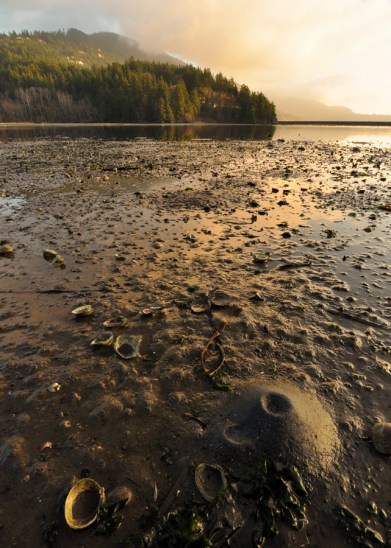
I’m not sure what sort of critter makes these little volcano-like structures, but they are all over the place at low tide in Chuckanut Bay, one of my favorite local spots for photography.

Some of the intriguing and bizarre rock formations along the Chuckanut Beach Walk.
Chuckanut Drive is heaven for the geologically inclined for a couple of reasons. For one, the road itself is built on layers of weak sandstone that slope precariously towards the sea. When it rains, water seeps into the spaces between the layers, dramatically decreasing something called the coefficient of static friction, which is normally responsible for keeping the rock intact. In other words, the water essentially lubricates the surface between rock layers, causing causing large chunks of the hillside to frequently slough off, making Chuckanut Drive one of the most landslide prone highways in the state. Last winter, it seemed like the road was closed at least every few weeks in order to repair large gashes in the pavement caused by falling boulders.
Two, the sandstone exposed here, a rock unit known as the Chuckanut Formation, is chock full of fossilized ferns, palm fronds, gingko leaves, wood, and bark, relics from a time when the Pacific Northwest was just as wet as today, but a whole lot warmer. An exposure of this same rock unit an hour to the east even turned up a footprint of a giant Eocene flightless bird a few years back, which is now on display at Western Washington University.
A few miles further south of Chuckanut Bay is Larrabee State Park, the first state park in Washington, whose landscapes and marine life I’ve documented previously and continues to be a favorite spot to catch the sunset:

The Sun dips behind the San Juan Islands as seen from Larrabee State Park.

- Winter brings frequent morning fog to the coast of NW Washington, but it usually starts to burn off around mid-day. 10 minutes after I took this photo, the fog was gone, replaced by sunshine and a clear blue sky.
Heading south from Larrabee State Park, the road becomes increasingly curvy and narrow as it clings to the hillside passing oyster bars, cascading waterfalls, and smattering of million-dollar homes. (You never actually drive along the coast proper, that route is reserved for the Burlington Northern Railroad, but the views are even better as a result.) Keep your eyes on the road and wait for one of the plethora of pull-offs where you can take it all in without running the risk of driving off a cliff.
A short but steep hike from near the route’s southern end puts one at Samish Overlook, which offers unparalleled views of the San Juan Islands, the Skagit River Valley, Olympic Mountains, and even Mt. Rainier on a clear day. On days when the winds are right, this is a launching point for local paragliders. It’s also a cool place to go during a foggy spell; at nearly 1300 feet above sea level, the Overlook sits above the fog deck most days making for spectacular sunsets and less than spectacular dark and foggy hikes back to your car.

A colorful winter sunset from Samish Overlook, nearly 1300 feet directly above Chuckanut Drive. The tops of a few of the San Juan Islands are visible protruding above the fog.
The last nine miles of the route angle away from the mountains and coast and traverse the flat lands and fields of the Skagit River Valley. But just a few miles west of the Drive, along Bayview-Edison Road, you’ll find the Padilla Bay National Estuarine Reserve, which operates an excellent interpretive center with exhibits about the coastal ecosystems of the Puget Sound area and a small aquarium. This is also a great place to spot a number of the bald eagles that visit the Skagit River Valley and surrounding area each winter to feast upon dying salmon. Padilla Bay (actually an estuary) is so shallow that at low tide, mudflats extend for hundreds of yards away from the coast.

Spring brings large quantities of nesting Bald Eagles to the Skagit River Valley. We saw four eagles within five minutes of exiting the car at the Padilla Bay Interpretive Center.

Ripples in the muck reflect a cold, windy, and colorful sunset out on the mudflats at Padilla Bay.
Eventually, Chuckanut Drive meets up with I-5 in Burlington, just a few miles north of the infamous I-5 bridge that collapsed into the Skagit River last year. From here it’s a quick 15-20 minutes drive back to Bellingham along the interstate. Or if you feel like braving that bridge, I hear there are a few good breweries in Mt. Vernon….
Boulders to Bullion: A Tour Through the Mayflower Gold Mill
Spend enough time driving or hiking around western Colorado and you will inevitably be introduced to the rich mining history of the area. This is especially true in the San Juan Mountains where it’s hard to hike for more than a few miles without running into an assortment of old and dilapidated mining structures, ranging from head frames covering mine shafts that plunge hundreds or thousands of feet into the mountains, to bunkhouses that still contain the metal skeletons of the rickety old beds slept upon by early 20th Century miners. Most of these buildings have been abandoned; left to slowly decay and disintegrate under the weight of the dozens of feet of snow that accumulate in the mountains each winter. However a handful have been preserved or restored by local historical societies, such as the Mayflower Gold Mill just a few miles outside of Silverton, Colorado.
A mill is an integral part of any mining operation. While Hollywood seems to think that western gold rushes involved a handful of old grizzled, bearded men fishing fist-sized gold nuggets out of streams with their gold pans, the reality is that most of the rock mined in Colorado had concentrations of gold and silver that were best measured in parts per million, and concentrations of other metals like copper or zinc that were only somewhat higher. The purpose of a mill like the Mayflower was to take in this low-grade ore and spit out material concentrated in gold, silver, and a plethora of other valuable metals while leaving the rest of the rock, known as “gangue”, behind.
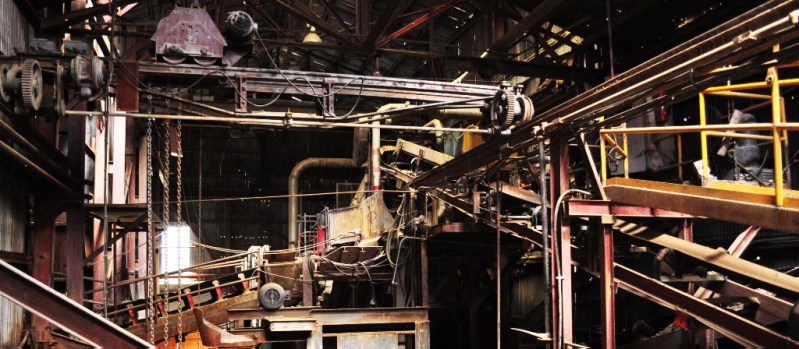
The crushing room inside the Mayflower Gold Mill.
The Mayflower Mill opened its doors in 1929 and was a technological marvel for its time. It was the last of the San Juan mills to close, in 1991, long after most of the mines in the area had ceased production. Ever since 1991, while the exterior of the mill has undergone stabilization at the hands of the San Juan County Historical Society, the interior of the mill has been left more or less untouched. The mill closed suddenly; one day it was open for business, the next it was shuttered for good as the prices of gold and silver plummeted and no one ever came in to clean up. Piles of partially crushed ore still lie on stationary conveyor belts, waiting patiently to continue their trip through the mill. Pairs of rubber gloves still lie on counters and railings, now covered with a thick layer of dust. Calendars with pictures of scantily clad women still hang from rusty thumb tacks in offices and control rooms. If all this wasn’t eerie enough, the power went out about five minutes after I entered the mill and from then on the only light source other than sunlight streaming through a handful of windows was the flashlight in my hand. Walking through you would never guess that it’s been closed for only 22 years; the place looks like its been abandoned for a good half-century and much of the equipment looks much older, yet somehow advanced for its age.
The tour through the mill is self-guided and costs $8 which at first seemed steep but ended up being well worth it. Not for the quality of the interpretive signs dispersed throughout the mill (despite the extremely friendly and helpful staff, the signs could use some serious work) but merely for the pleasure of exploring the mill itself, one of the most fascinating man-made structures I’ve ever been inside. My computer is telling me I have something like 48,000 photos on my hard drive at the moment. I’m willing to bet more than 95% of those were taken outside. Why? Well to be honest, I don’t generally find man-made buildings that fascinating so I’ve never been that much of an indoor photographer. Once in a while, I find myself somewhere like the Mayflower Mill that changes that, at least temporarily 😉

Piles of iron balls were bounced around in large drums to help mutilate the ore into pieces as small as a grain of sand!
While milling ore to produce gold and other metals may seem somewhat alchemistic, in essence the process consists of two phases: crushing the rock into very, very, VERY small pieces, and then using a variety of noxious chemicals to separate the metal from the rock based on their physical properties. Ore would arrive at the mill in large metal buckets that zipped downhill along an aerial tramway that connected the mill to the Mayflower Mine several miles and several thousand feet above the Mill in Arrastra Basin:
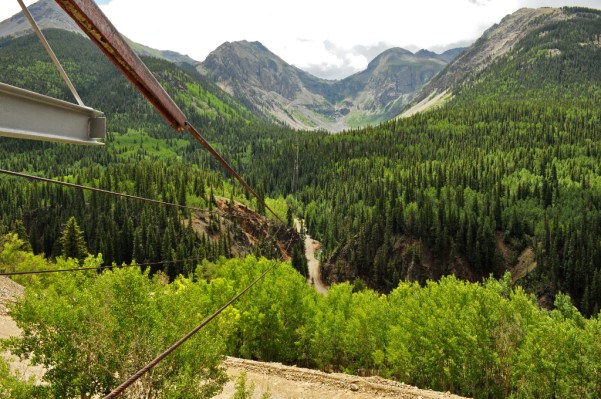
A view of the aerial tramway originating from the Mayflower Mine in Arrastra Gulch. The miners would often ride to work in the empty buckets headed back up to the mine. Hard to imagine a commute with a better view!
The crushing is then accomplished using a variety of progressively diabolical looking devices that to this day are covered in rock dust and surrounded by little piles of partially crushed ore that fell off of one of the many conveyor belts snaking through the mill. Normally there are buttons that you can press which turn on some of these devices for a short period of time but this was thwarted due to the aforementioned power outage. This was the device that I would have most liked to see in action:
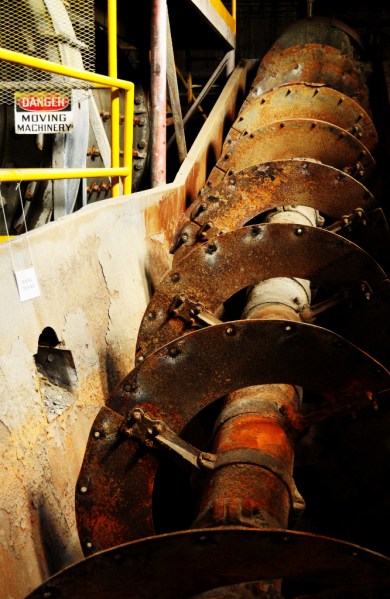
A spiral classifier, used to separate different sized pieces of crushed ore.
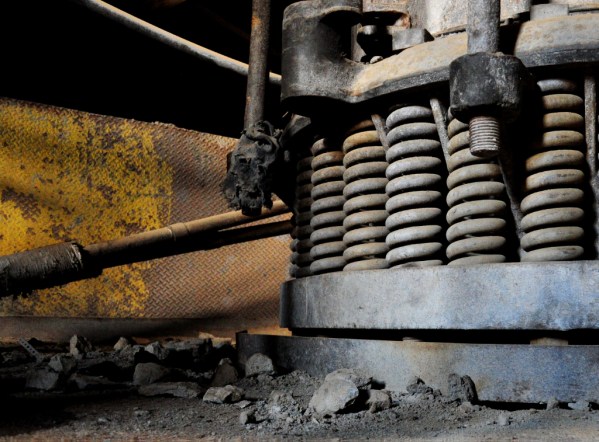
Pieces of partially crushed ore scattered around the base of an enormous jaw crusher.
The separation occurred in a series of tanks and vats that, while not visually impressive, still seemed to reek of the boiling concoction of lead and cyanide they once contained. My gut feeling was that hanging around this part of the mill for a long time would probably be a bad idea. The final product was rich-enough in gold that access to the areas where the final stages of separation took place was restricted to only a handful of employees who were continuously monitored by a network of security cameras. Unbelievably, even after all this, the ore would still need to be sent to a smelter for further purification and processing before pure gold bullion, or other metals were obtained.
Here are a few more random pictures from inside the Mayflower, which truly is a photographer’s dream, ESPECIALLY when the power is out. I was so caught up in taking pictures inside that I completely forgot to get a picture of the mill from the OUTSIDE!

Every size drill bit imaginable!

Piles of old equipment in a dark corner of the mill. Actually, since the power was out when I visited, just about the whole place was dark…
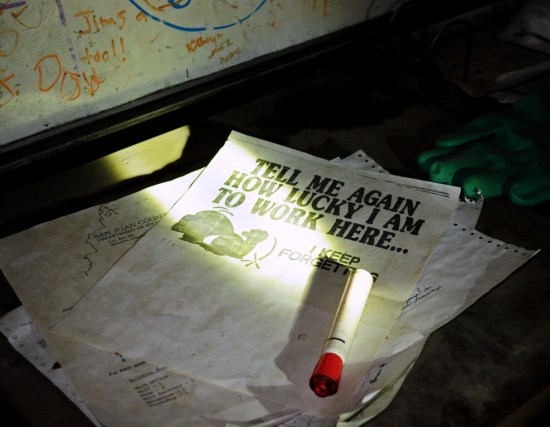
A little workplace humor for good measure!
 Zach Schierl Photography