Backpacking the Olympic Coast

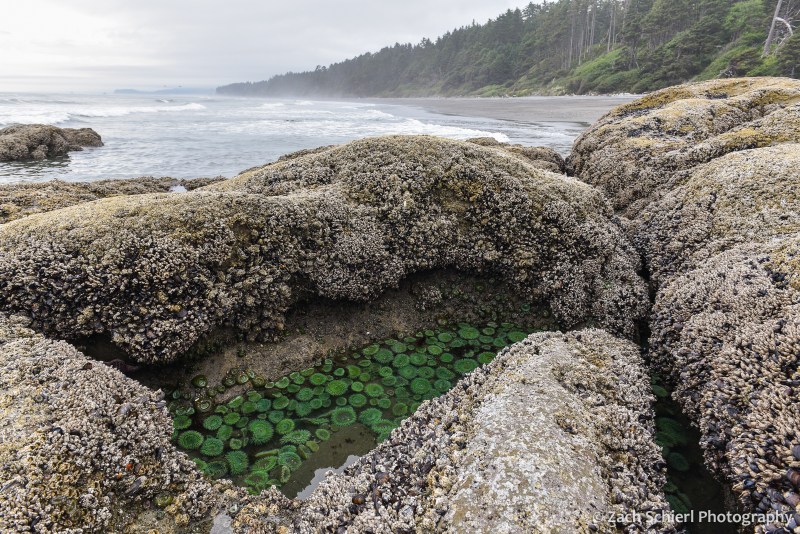
A tidepool filled with giant green anemones (Anthopleura xanthogrammica) along the coast of Washington in Olympic National Park.
Living in the desert of central Washington, it can be easy to forget that we live in a state with over 3,000 miles of coastline. While the high volcanic peaks of the Cascades are visible from our backyard (and thus remind us of their presence daily), the damp shores of the Pacific remain out of sight and out of mind most of the time.
Our most recent summer trip took us all the way to Washington’s western edge for a short backpacking trip along the coast in Olympic National Park. Coastal backpacking comes with a few unique challenges. For starters, predicting the weather along the coast is notoriously difficult, in part due to the relative lack of surface weather observations over the eastern Pacific and Gulf of Alaska, where most of our storm systems approach from. This fact ended up rearing its head on the final night of our trip.
Perhaps even more importantly, safe coastal backpacking requires that you know how to read a tide chart. The Washington coast experiences a fairly large tidal range, up to 10-12 feet during certain parts of the month. That’s enough to make vast sandy beaches completely disappear. A successful trip requires acute awareness of the timing and magnitude of the twice-daily high and low tides. The coast features many headlands (rocky outcroppings that jut out into the sea, often without any sort of “beach” whatsoever) that can only be traversed when the tide is below a certain level. Getting the timing wrong can (at best) result in having to sit on the beach for hours waiting for the tide to go out or (at worst) getting trapped in a dangerous situation as the tide rises and cuts off your escape route.
As this would be our first coastal backpacking trip, we obtained a permit for a fairly short and straightforward route beginning at Rialto Beach, heading north past the famous Hole-in-the-Wall, and eventually camping for two nights on the beach near the Chilean Memorial, the site of a shipwreck that killed 18 sailors all the way back in 1920. The terrain along this section of the coast was quite variable, ranging from long stretches of soft, sandy beach, to the slightly more annoying cobble and pebble beaches, to large boulder fields and headlands that were somewhat difficult to navigate with a heavy backpack:
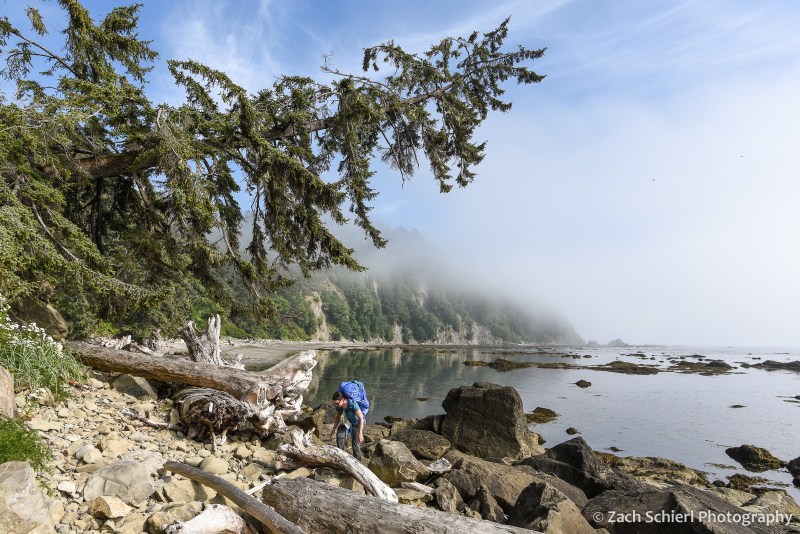
Picking our way along the rocky Olympic coast en route to our campsite at Chilean Memorial.
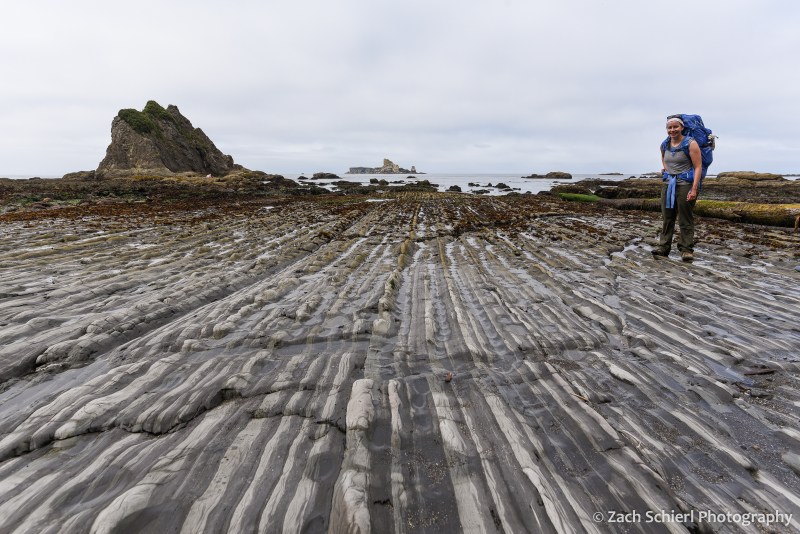
Tilted layers of sediment have been planed off by wave action near Hole-in-the-Wall, Olympic National Park, Washington.

Cape Johnson, Olympic National Park, Washington. With not much beach to speak of, this is a great example of a spot where being aware of the tide situation is essential!
After a little more than four miles of hiking, we arrived at the small, unnamed cove home to the Chilean Memorial and found a campsite just above the high-tide line among large pieces of driftwood. This sheltered cove made for a relatively quiet and peaceful camp, as the myriad rocks and sea stacks just offshore caught the brunt of the surf, limiting the amount of wave action reaching the beach. We enjoyed watching the landscape of the cove change over the next few days as the mist and tides repeatedly swallowed up and revealed the sea stacks and small rocky islands. We quickly discovered that the largest sea stack (pictured below) was connected to the mainland via a rocky isthmus at low tide, and ended up hiking out to it one evening to look back on our campsite.
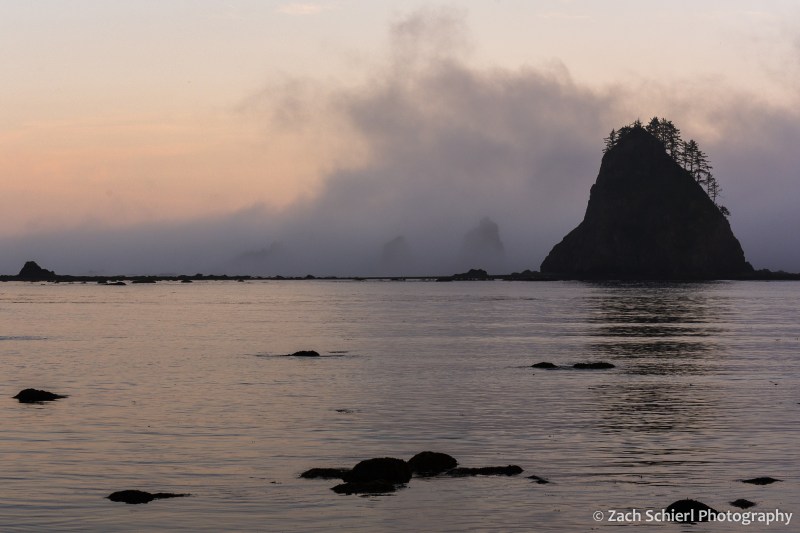
View out into the Pacific Ocean at sunset from our campsite on the Chilean Memorial beach in Olympic National Park, Washington
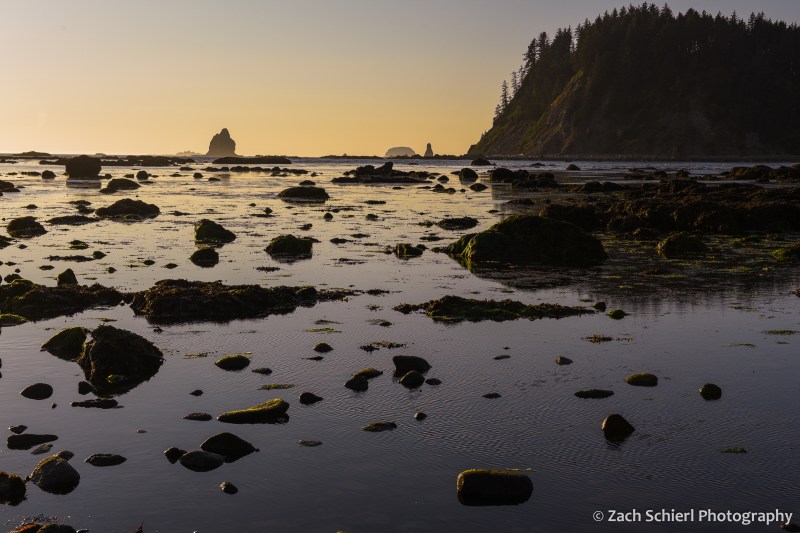
Looking back toward the Chilean Memorial beach and Cape Johnson from the base of the large sea stack in the previous photo.
While we had our fair share of clouds and mist, it did clear up enough on one evening to reveal the night sky. The moon was just past full, so the Milky Way was only barely visible, but it was still fun to see the southern stars rise and set over the Pacific:
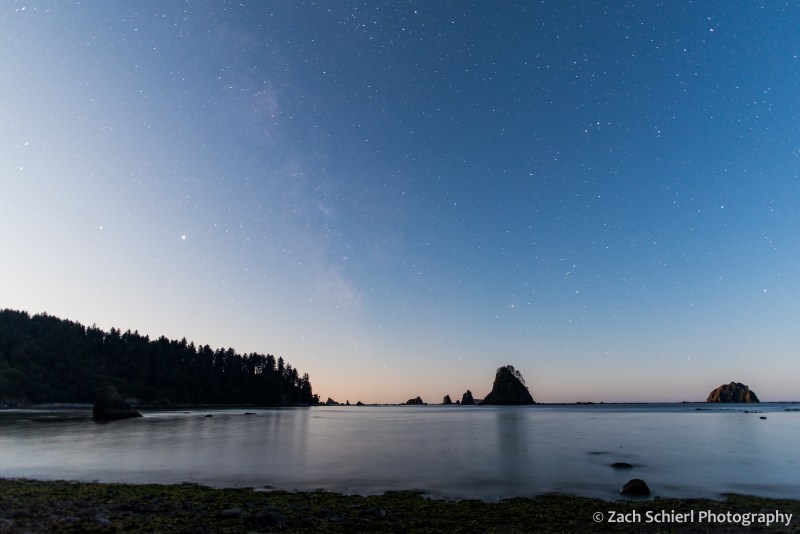
A faint hint of the Milky Way reveals itself despite the light cast by the rising moon (just behind the trees at left).

Enjoying a driftwood campfire on the beach.
Our trip came just a few days after the full moon, meaning that the low tides were some of the lowest of the month. These so-called “negative tides” are the best for exploring tide pools along the coast, as they reveal a greater variety of sea squishies:

Two giant green anemones in a tidepool in Olympic National Park, Washington.
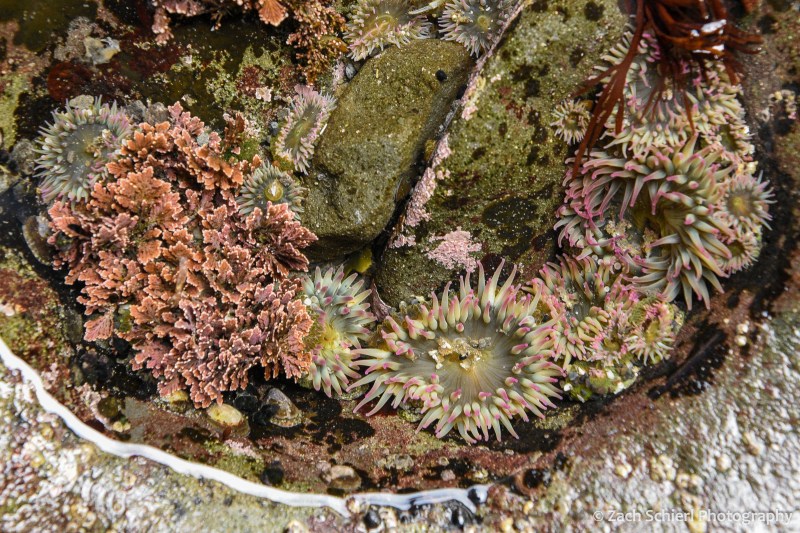
A crowded tidepool containing multi-colored aggregating anemones (Anthopleura elegantissima) in Olympic National Park, Washington
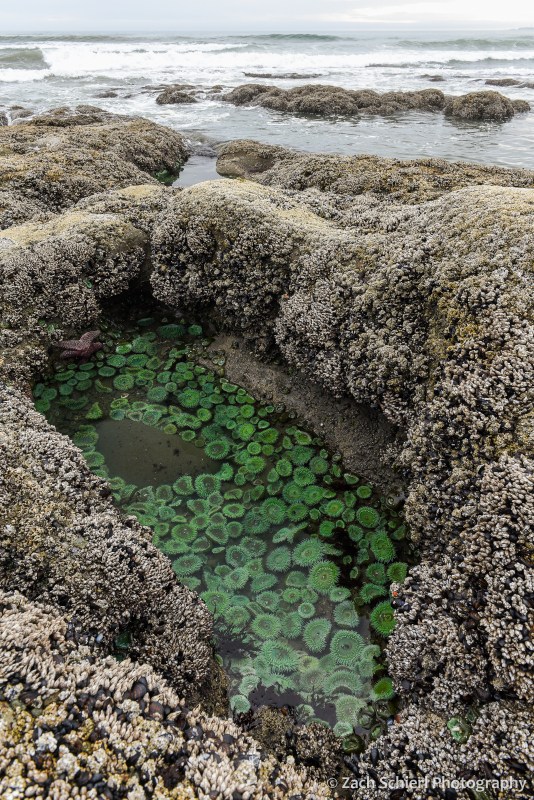
A tidepool filled with giant green anemones along the coast of Washington in Olympic National Park.
In addition to the living tidepool organisms, we also observed large quantities of dead jellyfish (at least three different species) washed up on the beaches, including several massive (~2 foot wide) lion’s mane jellies:

A deceased (?) lion’s mane jellyfish (Cyanea capillata) washed up on the beach in Olympic National Park, one of many, many such jellies we found on our trip.
For our third and final night, the original plan was to hike most of the way back to the car and camp along Rialto Beach near Hole-in-the-Wall. Prior to departure, the weather forecast for this night had called for a fairly robust storm coming in off the Pacific. With an ailing tent that has become somewhat more, shall we say, permeable than one would desire, we briefly debated whether to just call it quits to avoid the chance of getting soaked. Surprisingly, we were able to get enough cell service on the beach to check an updated weather forecast, which showed a drastically reduced chance of rain and little precipitation expected. Consequently, we decided to stick with the original plan and set up camp in the trees at the north end of Rialto Beach. Our decision to stay was quickly validated as we observed a number of whales spouting and breaching throughout the afternoon just offshore.

Our final campsite along Rialto Beach. From this vantage point, we saw a number of whales (likely humpbacks) spouting and breaching off-shore throughout the afternoon and evening.
12 hours later, at 3 AM, when I was emerging from the tent for the third time to re-secure our tarp and shelter in the face of driving rain, wind, and large, deafening waves crashing up against the bluff just a few feet from our tent, I wasn’t so sure. A great example of the fickle coastal weather I suppose, and a good character building experience as Calvin’s dad would say.
While intense, the storm was brief, and by morning the skies were clearing, making for a pleasant stroll down Rialto Beach back to the car. All in all, the trip was a refreshing change of scenery from our predominantly mountain-based adventures the rest of the summer!

Benign clouds greeted us in the wake of the storm for our short hike out to the car on the final morning.
Alaska (Part Three)

Morning clouds partially obscure the Exit Glacier, Kenai Fjords National Park, Alaska
The last destination on our Alaskan journey was the Kenai Peninsula and the town of Seward. After a few days respite from the wildfire smoke in Wrangell-St. Elias, it returned with a vengeance as we headed back to Anchorage and down to the the coast:

Wildfire smoke obscures the Chugach Mountains en route to Anchorage
After baking in the heat of the Alaskan interior for the last week, the marine climate of Seward was a welcome change. We even had a bit of rain for one of the few times in our entire trip.
While temperatures in Seward we’re somewhat more mild, the coastal location meant the humidity was not. On our first day in Seward, we partook in a brutal hike up to the Harding Icefield in Kenai Fjords National Park. The hike itself was not abnormally difficult, but we were definitely not used to the combination of heat and humidity, leaving me feeling physically ill at several points during the slog up the mountain. The day had started off overcast, but as we climbed, the clouds evaporated leaving us with stellar views of the rapidly retreating Exit Glacier and the Harding Icefield from which it originates. An icefield is essentially a large mass of interconnecting glaciers. The Harding Icefield is the largest — and one of only four — remaining icefields in the United States. The Exit Glacier itself has retreated more than a mile in the last 200 years, leaving trees and other vegetation to begin re-occupying it’s former valley.
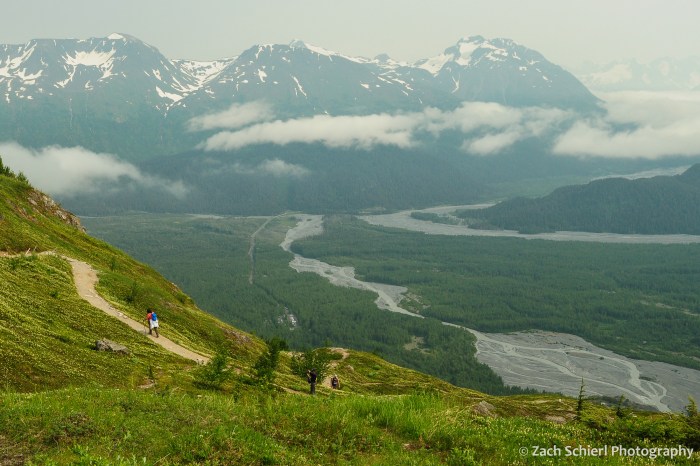
Looking down the valley partially occupied by the Exit Glacier just a few hundred years ago.
The white and blue ice of the glacier made for a stellar contrast with the lush green vegetation of the alpine zone:
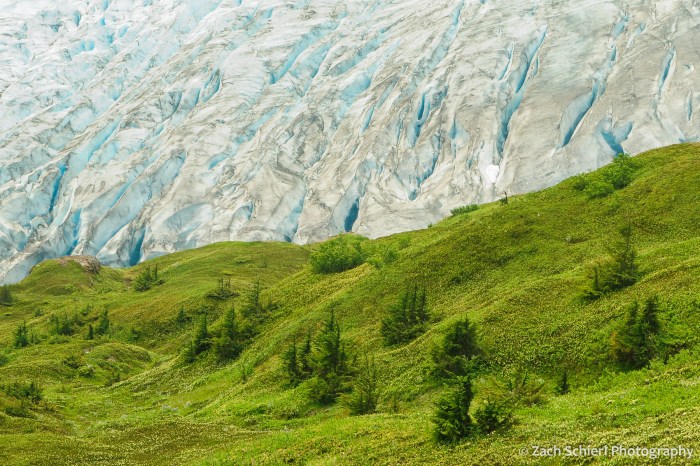
Exit Glacier, Kenai Fjords National Park, Alaska

Looking out over the Harding Icefield, Kenai Fjords National Park, Alaska
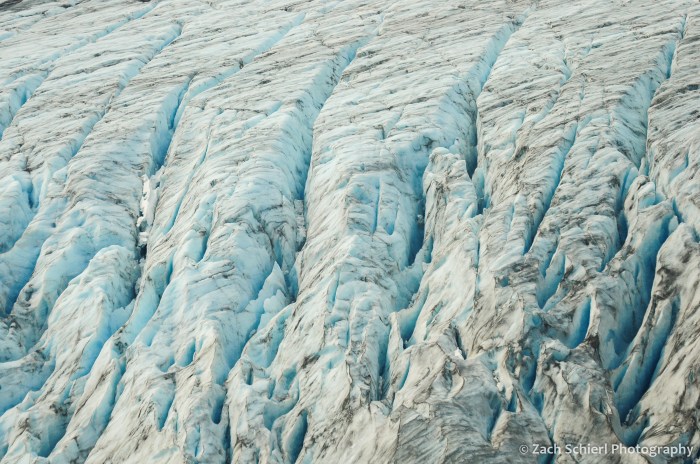
Crevasses in the Exit Glacier, Kenai Fjords National Park, Alaska
The wet climate of coastal Alaska results in extremely heavy snowfalls, making this one of only a handful of places in the world where glaciers flow all the way down to sea level to meet the ocean. Known as tidewater glaciers, these glaciers exhibit complex patterns of advance and retreat that, unlike standard alpine glaciers, are not purely the result of variations in climate. While warmer temperatures or prolonged drought can certainly reduce their mass, the movement of tidewater glaciers is also subject to complex interactions between the ice, the geomtery of the ocean floor, and the depth of the water into which they flow.
On our second day in Seward, we took a water taxi into the heart of Kenai Fjords National Park and then kayaked to within about a quarter mile of the terminus of Holgate Glacier. Tidewater glaciers have a tendency to “calve”, in which large chunks of ice break off the glacier and fall into the ocean, necessitating a safe distance. Glacier “social distancing” if you will. It is not hard to find videos on YouTube of people getting too close to calving tidewater glaciers, with quite predictable results. From our safe distance, we observed and heard several calving events in the few hours we were kayaking around the bay, but unfortunately I was not adept enough at kayaking into position quickly enough to actually capture one on camera.
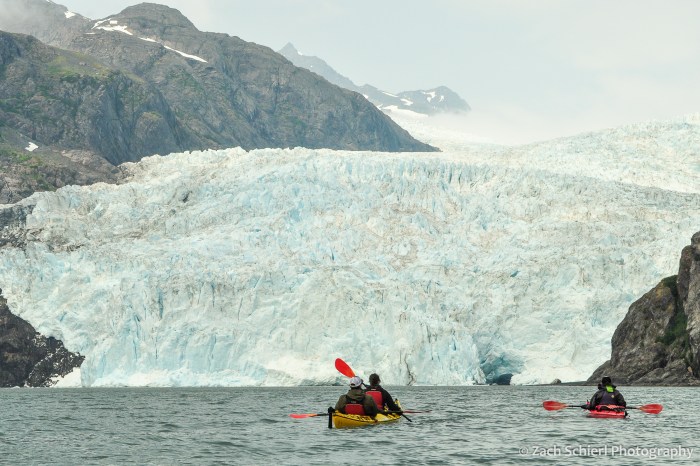
Kayaking toward the terminus of the Holgate Glacier, Kenai Fjords National Park, Alaska

Tiny iceberg, Kenai Fjords National Park, Alaska
Our boat ride back to Seward through Resurrection Bay also resulted in sightings of sea lions, seals, puffins, and even two pods of orcas: an exciting end to the trip!
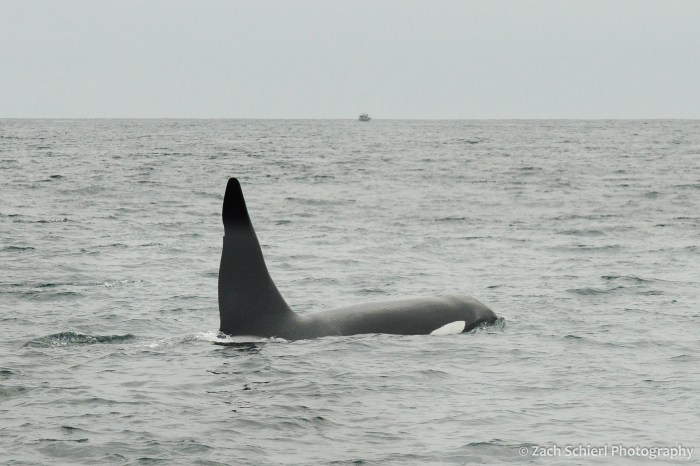
Orca, Resurrection Bay, Alaska
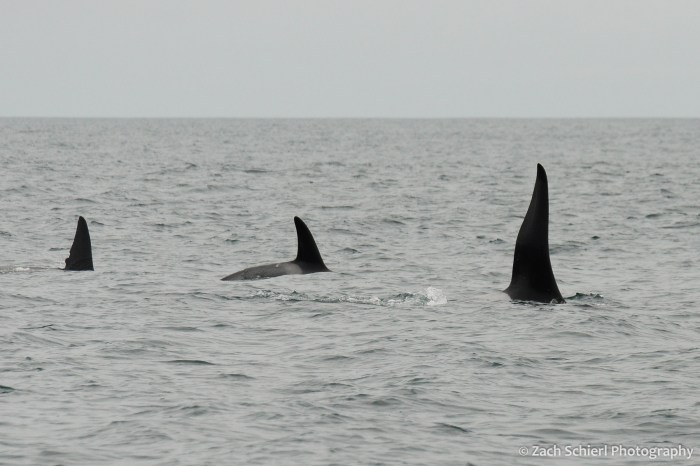
Orcas, Resurrection Bay, Alaska

Horned Puffin (from the Alaska Sealife Center in Seward, because the photo was better than the wild ones…)
Alaska (Part Two)

Exploring the Root Glacier, Wrangell-St. Elias National Park & Preserve, Alaska
The second stop on our Alaska trip of 2019 was Wrangell-St. Elias National Park & Preserve. The largest national park in the United States, Wrangell-St. Elias spans more than 13 million acres in the wilderness of southeast Alaska. Our destination was the old mining town of Kennecott, situated deep in the park’s interior between the volcanic Wrangell Mountains and the coastal St. Elias Range.
Due to the tire issues mentioned in my last post, we opted not to take our Subaru down the 60-mile long McCarthy Road, the main access route into the park. In hindsight, we probably would have been fine, as the road was in excellent condition (at least relative to the roads we’d been used to driving in Utah. The similar-in-length Hole in the Rock Road makes the McCarthy Road look like a recently-paved superhighway). Fortunately, we were able to book a last minute van shuttle from Kenny Lake, AK to the end of the McCarthy Road. Regardless of your mode of transportation, you then walk across a footbridge spanning the glacial silt-laden Kennicott River into the town of McCarthy. (The only vehicle access to McCarthy is via a private, and very expensive, bridge a bit further downstream.) Kennecott is another 5 uphill miles by shuttle, bike, or foot:

Kennecott, Alaska. The 14-story wooden concentration mill is seen in the background.
Strangely, reaching Kennecott would have been much easier in 1919 than it was in 2019. The McCarthy “Road” is actually an old railroad grade originally built in 1909 to bring supplies in and ore out of the famous Kennecott Copper Mines. From 1911 through the late 1930s, the Kennecott mines shipped millions of tons of copper ore to Cordova on the Alaska coast via the Copper River and Northwestern Railway. The town had state of the art amenities at the time, including one of the best hospitals in the territory as well as the first X-ray machine in Alaska. While the mines closed in 1938, Kennecott Copper remains one of the larger copper-producing companies in the world, perhaps best known for the massive Bingham Canyon Mine just outside of Salt Lake City.
Following the closure of the mines, Kennecott lay mostly deserted for decades before beginning to draw tourists in the 1980s. Much of the land and buildings within the town were acquired by the National Park Service in 1998 and added to Wrangell-St. Elias National Park and Preserve. Restoration and stabilization of historic buildings in Kennecott is ongoing. Today, you can actually explore many of these buildings, including the town power plant (photo below) and the massive concentration mill (photo above), a 14-story wooden structure where copper ore was crushed and then mechanically and chemically concentrated into the high grade ore that was eventually shipped out via the railroad.
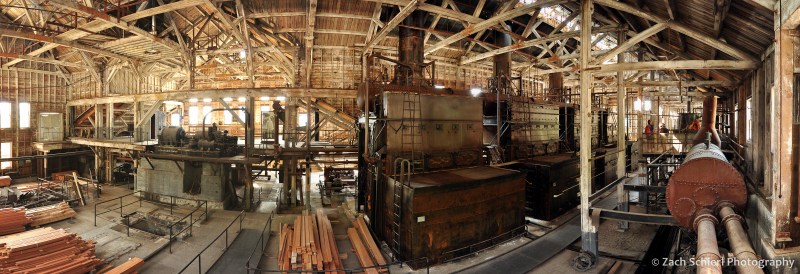
The interior of the Kennecott Power Plant, with massive boilers used to produce electricity and steam heat for the mines and town residents.
History aside, the natural landscape of Kennecott is really what makes it stand out as one of the most stunning places I’ve ever visited. The town is perched on the flanks of Bonanza Ridge, with rocky peaks towering more than 4,000 feet above and what remains of the Kennicott Glacier below. At first glance, it is not apparent (even to a geologist) that the mounds of rubble in the valley below ARE a glacier, but ice does lay beneath the veneer of debris. Like most of the world’s alpine glaciers, the Kennicott Glacier has retreated dramatically since the town’s heyday in the early 1900s, when its surface was level with or even above the elevation of the town. Today, you look down several hundred feet on to what remains of the glacier and the detritus it has brought with it out of the mountains. The origin of the glacier, and the dominant feature of the northern skyline, is the massive Mt. Blackburn, the fifth highest peak on the United States at 16,391 feet:

Old mining buildings in Kennecott cling to the slopes above the debris-covered Kennicott Glacier, which originates on the slopes of Mt. Blackburn, seen in the background.
A few miles north of Kennecott, the Kennecott Glacier is joined by the Root Glacier, a somewhat more “normal” looking glacier that we spent nearly an entire day exploring. The experience was rather surreal given that the air temperature was nearly 90 degrees. Climates amenable to the formation of glaciers don’t often produce days where a swim in the frigid glacial melt water actually sounds appealing as opposed to horrifying, but that was certainly the case on this day.
As spectacular as the glacier was, there is something quite unsettling about walking around on one in a T-shirt. The signs and symptoms of a warming climate were all encompassing. We walked along deep gouges (surprisingly reminiscent of Utah slot canyons) carved into the ice by strong currents of melt water…

The Root Glacier, Wrangell-St. Elias National Park and Preserve, Alaska

The Root Glacier, Wrangell-St. Elias National Park and Preserve, Alaska
encountered many sublime pools filled with deep, electric blue pools of glacial melt water…
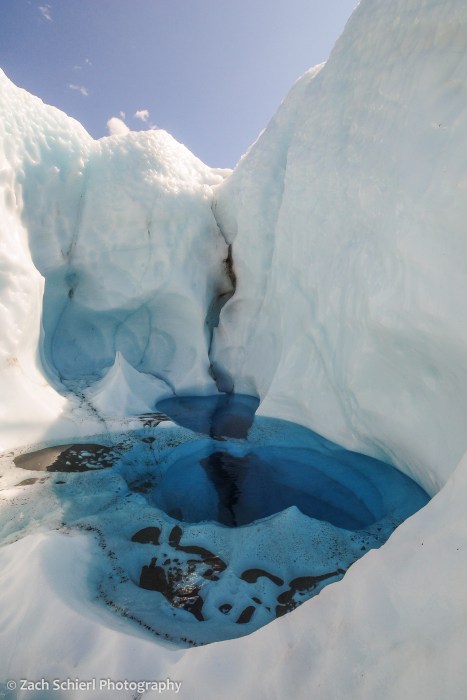
The Root Glacier, Wrangell-St. Elias National Park and Preserve, Alaska
and carefully avoided deep shafts, known as moulins, that carry cascades of melt water into the internal plumbing of the glacier. In many places, we could hear the dull roar of the melt water boring tunnels through the ice beneath our feet. Glaciers like Root won’t survive many more summers with too many days like this one.

Meander in a meltwater channel, Root Glacier, Wrangell-St. Elias National Park and Preserve, Alaska

Patterns of sediment in the ice, Root Glacier, Wrangell-St. Elias National Park and Preserve, Alaska
Despite the best efforts of the interpretive signs displaying historical photographs, and the park film showing the sights and sounds of the past, the sheer remoteness of Kennecott in 2019 makes it difficult to imagine the Kennecott of 1919: a busy town immersed in the deafening roar of copper mining, with a glacier not yet ravaged by climate change dominating the horizon.

Clusters of fireweed overlooking the Kennicott Glacier, Wrangell-St. Elias National Park & Preserve, Alaska
 Zach Schierl Photography