A Sandstone Wonderland: Snow Canyon State Park
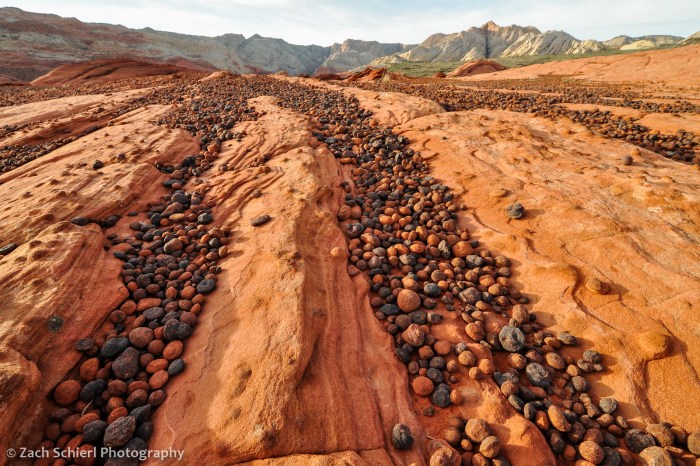
Thousands of moqui marbles, concretions of iron oxide minerals, accumulate in small troughs eroded into the Navajo Sandstone, Snow Canyon State Park, Utah
Southern Utah is a mecca for tourists from around the world, and most of that blame can be placed on the shoulders of a single layer of rock: the Navajo Sandstone. Quite possibly one of the most famous geological formations in the world, the Navajo Sandstone is responsible for the soaring cliffs of Zion National Park, the monoclines of Capital Reef, and the undulating, swirling, entrancing patterns of the The Wave in Arizona and Grand-Staircase Escalante National Monument in Utah. The Navajo Sandstone also rears its beautiful head in lesser known gems, such as Snow Canyon State Park just a few minutes northwest of St. George, Utah.
Snow Canyon is actually several canyons in one, all cut into the Navajo Sandstone. The original Snow Canyon existed up until about one million years ago, when it was rudely filled in by a series of basaltic lava flows originating from the northeast. Water, being the couch potato that it is, doesn’t like to carve through hard volcanic rock, so the stream that had excavated Snow Canyon promptly jumped ship to find some more Navajo Sandstone, and thus began establishing a new canyon slightly to the west. The stream went about its business carving Snow Canyon #2 until about 10,000-20,000 years ago, when it was thwarted by yet another lava flow. True to history, the stream changed course a second time, and is now busily carving Snow Canyon #3 even further to the west. The result is a multi-tiered canyon, with the remnants of the canyon-filling lava flows forming the tread of each step.

360 degree panorama of Snow Canyon State Park from the top of a “turtleback” of Navajo Sandstone, a small knob of rock that was surrounded by basaltic lava flows that diverged around it during eruptions 10,000-20,000 years ago. The small dark black patch just to the left of center is the entrance to a lava tube. The current iteration of Snow Canyon is seen at left.
The Navajo Sandstone itself is a colossal formation, several thousand feet thick in places, representing the lithified remains of a large Jurassic sand dune sea (known as an erg), likely analogous to the modern day Sahara desert. If you think Southern Utah is hot and dry today, imagine being there 180 million years ago when the climate was hot and hyper-arid. Add some dinosaurs and you’ve got yourself a fun day in the Jurassic desert. Over time, mineral-rich fluids percolated through the sand, depositing mineral cement in between the sand grains, binding them together into stone. The Navajo Sandstone is known for its spectacular aeolian (fancy geology-speak for “wind-blown”) cross-bedding, inclined layers that form when winds blow sand up the shallow face of a dune, only to have it tumble down the steep slip face on the other side.
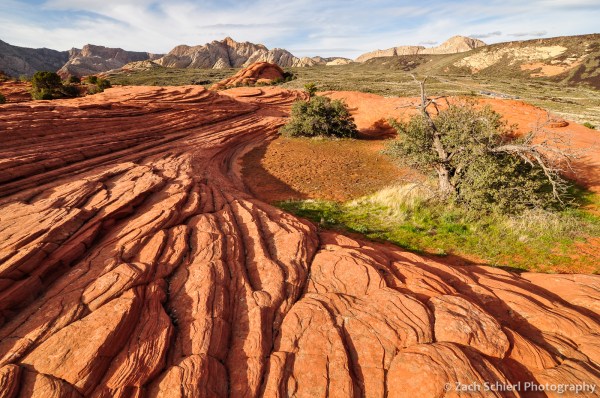
Cross bedding in the Navajo Sandstone becomes even more pronounced as sunset nears and shadows lengthen

Looking south across swales and ridges of Navajo Sandstone from the Petrified Dunes trail in Snow Canyon State Park, Utah
A especially peculiar property of the Navajo Sandstone is the presence of occasional beds containing abundant spherical concretions of sand held together by the iron oxide minerals goethite and hematite (see photo at top of page). Commonly known as “moqui marbles,” these small spherules are slightly harder than the rest of the sandstone, so as the rock weathers away, the concretions are left behind to accumulate in large quantities on the surface of the rock. Moqui marbles can be found in many locations throughout Utah. And on Mars. The discovery of nearly identical hematite concretions by the Opportunity rover was some of the first definitive evidence that liquid water once flowed on the red planet, since the formation of the marbles requires groundwater to dissolve, and then re-precipitate iron minerals in the subsurface. If you are intrigued by my incredibly vague and simplistic description, you can find much, much more on the moqui marbles and their mode of formation here. If not, you are hereby forgiven and are welcome to enjoy the final photo without guilt:
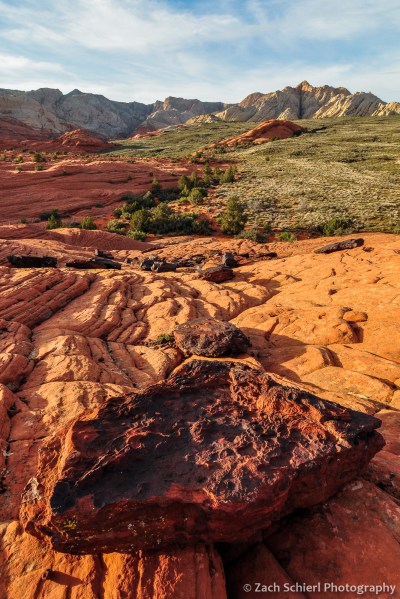
Hematite rich beds in the Navajo Sandstone are more resistant to weathering & erosion, forming large brown, black, and red boulders that are scattered across the landscape
Giants of the Desert(s)

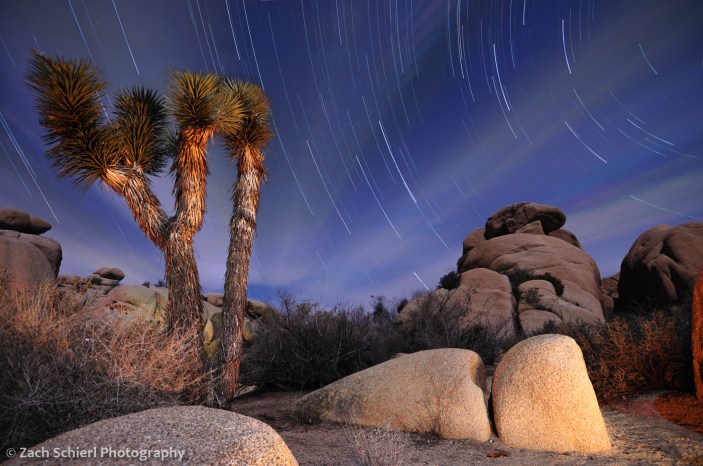
Star trails and high clouds from Jumbo Rocks Campground, Joshua Tree National Park
Driving across the southwestern United States, one could be forgiven for thinking that all deserts are the same. However, differences in elevation, temperature, topography, and precipitation make them distinct in ways that are often hard to comprehend from a fast-moving car.
For all their differences though, both the subtle and the striking, the Mojave and Sonoran Deserts share one thing in common; the most visible symbol of each is a large, majestic, and photogenic plant perfectly suited for the harsh conditions in which it evolved to inhabit.

A spectacular winter sunset at Joshua Tree National Park
For the Mojave Desert, that plant is the Joshua tree (Yucca brevifolia). Not actually a tree but rather, as the scientific name betrays, a species of Yucca, early settlers bestowed the befuddling name upon this plant after noticing that the contorted arms resembled the prophet Joshua raising his arms to the sky in prayer.
Today, the Joshua tree is considered an indicator species for the Mojave Desert, as many other inhabitants of the Mojave (two-legged, four-legged, and winged alike) depend on it for survival. The Joshua tree grows through portions of western Arizona, southeastern California, and southern Nevada, but some of the largest and healthiest stands are protected within the boundaries of Joshua Tree National Park and Mojave National Preserve.


Sunset colors illuminate the landscape at Joshua Tree National Park

A nearly full moon hovers over a Joshua tree at sunset
For the Sonoran Desert, the symbolic plant is the saguaro cactus (Carnegiea gigantea). Despite the nearly ubiquitous use of the saguaro as a symbol of the American Southwest, this excruciatingly slow growing cactus actually only grows in a small portion of the Sonoran Desert extending from extreme northwestern Mexico into south-central Arizona.

Sunset from the Gould Mine Trail in Saguaro National Park. On the horizon is Kitt Peak, home to one of the largest astronomical observatories in the United States
Like the Joshua tree in the Mojave, the saguaro is an integral part of the Sonoran Desert ecosystem. Birds such as the Gila woodpecker nest within the flesh of the cactus while the fruits and flowers provide a source of food for many other species, including humans. When the end finally comes for a saguaro (which can take well over 100 years), the flesh rots away to reveal an internal structure consisting of a series of wooden ribs, which often remain standing long after the saguaro dies:
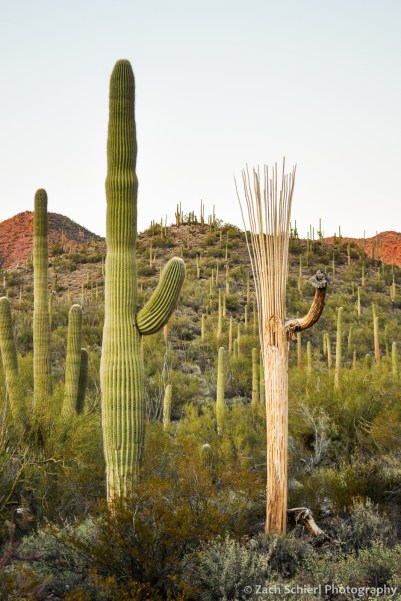
A young saguaro mimics a neighbor who has seen better days
Both the saguaro and Joshua tree face serious threats; in the long term from a climate that may change faster than they are able to migrate, and in the short term from a loss of habitat due to rapidly ballooning human populations in the desert regions that these giants inhabit.
Into the Valley of Death (Part 3): Canyon Combing


“Canyon of Color”: A walk through lower Gower Gulch reveals rocks in nearly every color of the spectrum
No tour of Death Valley would be complete without a peek into the myriad of mysterious canyons that slice abruptly into the mountain ranges surrounding the valley. When rain does bless Death Valley, it often arrives quickly and in large quantities, which can quickly turn a storm from a blessing into a nightmare. With little soil and few plants to soak up the water, most precipitation ends up rapidly draining into creeks and streams. Canyons that are bone dry 99% of the year can almost instantaneously find themselves channeling deadly flash floods, mudflows, and debris flows. Each time this happens, the canyons get slightly deeper (and the mountains slightly smaller) as the water picks up and transports bits of rock down to the valley floor where it dumps them in large piles known as alluvial fans. If the mountains weren’t continually being uplifted by tectonic forces (which most of the ranges in Death Valley are), this process would quickly erase the mountains from the landscape.
In October 2015 (just a few months before our visit), portions of Death Valley received several inches of rain in just a few hours, a nearly unprecedented storm for such a dry environment. Many roads were damaged or wiped out completely by floods and debris flows and portions of the park remained closed even several months later.
One of the most interesting canyons in Death Valley is Gower Gulch, located just south of Furnace Creek. Until recently, Gower Gulch was a small, run-of-the-mill canyon carved into the soft, buff-colored badlands of the Furnace Creek Formation. Things took a dramatic turn in the 1940s when the waters of the nearby (and much larger) Furnace Creek Wash were deliberately diverted into Gower Gulch in an attempt to prevent them from flooding populated areas downstream. With the drainage area of Gower Gulch enlarged by over 16,000%, periodic floods began to incise Gower Gulch at an alarming rate. The Gulch has deepened by more than 20 feet in just the last several decades, an erosion rate nearly unheard of in the geological world. The rapid erosion rate has caused some unintended consequences to overlooks, roads, and other park infrastructure but has simultaneously provided geologists with a fascinating window into what happens when you make a stream too big for its own britches.
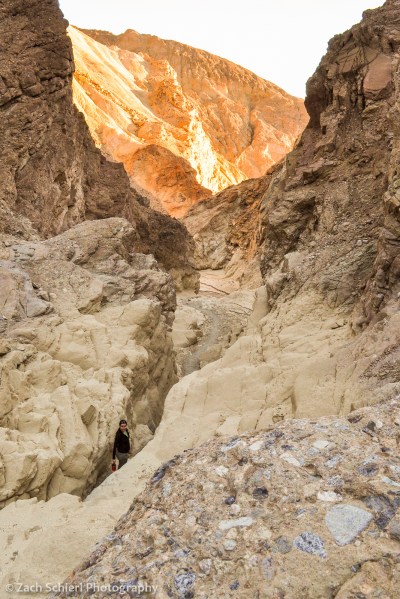
Late afternoon sunlight bathes the cliffs above Gower Gulch in golds, pinks, and oranges. Note the mud line on canyon wall.
Gower Gulch had experience once of these erosive floods just a few months prior to our visit. The lower walls of the canyon were still coated in a thin layer of tan mud left behind by the October 2015 floods. In many cases, the mud line was 10-15 feet high. Little imagination was needed to realize that Gower Gulch would be a terrifying place to be during such an event!

Two different types of flood deposits in Gower Gulch; multicolored gravel originating from Furnace Creek Wash, and buff-colored mud from the badlands surrounding the gulch.
An hour north of Gower Gulch is Mosaic Canyon. Cut into the Panamint Mountains the rise to the west of Death Valley, Mosaic Canyon also experiences mudflows and debris flows during intense rains. The bedrock of the canyon is ancient dolomites, limestones, and marbles; in many places, these rocks have been polished to a shine by floodwaters roaring through the canyon.
The highlight and namesake of the canyon though are the spectacular deposits of breccia (a sedimentary rock made of coarse-grained, angular rock chunks cemented together by a finer-grained matrix) that have been pasted onto the canyon walls by repeated debris flows. The high carbonate content of the rocks allows percolating water to quickly cement the debris flow deposits together into a solid layer that can adhere to the canyon walls. The fragments of rock within the breccia are a representative sample of those that comprise the Panamint Mountains, and thus vary widely in color making the breccia appear like a complex fresco created by a powerful force of nature.

Mosaic Canyon gets its name from the colorful breccias that coat much of the canyon wall.

More breccia in Mosaic Canyon, Death Valley National Park

Colorful breccia fills a depression carved into the polished marble walls of lower Mosaic Canyon, Death Valley National Park
One can hike up Mosaic Canyon (some moderate scrambling required) for about a mile and a half, admiring the rock formations, before coming to a ~50 high cliff (a waterfall during wet periods) that inhibits further upstream travel. Hiking up Mosaic Canyon is truly spectacular, each bend reveals a new assortment of geological treasures, only some of which are pictured here.

A hike up Mosaic Canyon ends here unless you have a rope; behind me is a 50′ dry waterfall
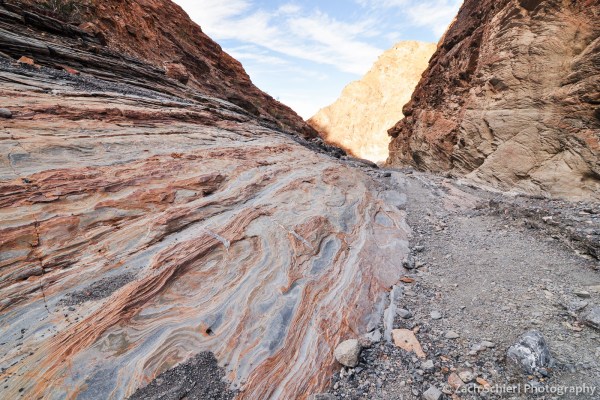
The character of Mosaic Canyon change with every bend!
 Zach Schierl Photography