Sunset to Sunrise at Bryce Canyon


Sunrise light illuminates rock formations at Bryce Canyon National Park
Sunset, nighttime, and sunrise are probably the three most exciting times for photography, and I got to hit all three on a quick trip to Bryce Canyon National Park this past weekend. I experienced a brilliant sunset, hiked into the Bryce amphitheater by moonlight, joined the masses for sunrise, and was back in my own home less than 24 hours after walking out the front door. I feel incredibly lucky to live close enough to such wonders that trips like this are possible. This impromptu trip was facilitated by the unseasonable heat wave currently gripping Southern Utah. On Sunday night, the overnight low at Bryce barely dropped below freezing (about 15 degrees above average for this time of year) making a quick camping trip a reasonable proposition.
This was actually my first trip to Bryce Canyon in the winter months. While snow has made itself scarce in Southern Utah the last few weeks, and most of the snow had melted away from the hoodoos, there was still quite a bit of the white stuff left on the north facing slopes, making for a gorgeous complement to the ruddy hoodoo hues.
Before hitting the trail for sunset, I took time to drive out to some of the overlooks at the south end of the park. Bryce Canyon may be known for hoodoo hiking, but south of the main amphitheater lie some truly mind-blowing views of the Grand Staircase and Colorado Plateau. The Paunsaugunt Plateau on which Bryce Canyon sits rises to elevations of more than 9,000 feet, allowing commanding views of the surrounding terrain. I truly believe that the view from Yovimpa Point is one of the best on the planet (albeit difficult to photograph), with a viewshed stretching from the North Rim of the Grand Canyon, to Navajo Mountain and Lake Powell near Page, to the 11,000 monolith of Powell Point and the Aquarius Plateau.
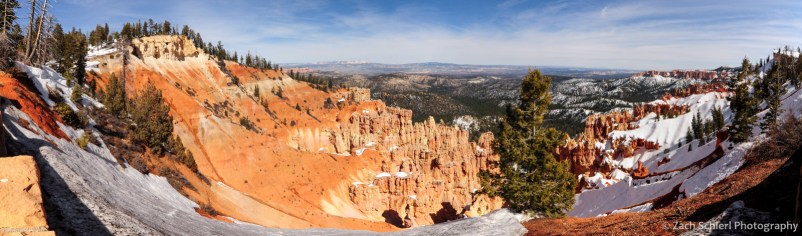
Looking east from Farview Point. Note how all the snow has melted from the south facing slopes, but much remains on the north aspects
As the sun dropped lower, I headed out on the trail to Tower Bridge. In hindsight I should have taken a picture of the mud, but I guess I was too preoccupied trying not to lose a boot to the bright orange morass. With winter freeze/thaw cycles still in full swing, the trails were all littered with fragments of rock fallen from the cliffs and hoodoos above, a good reminder of the primary process responsible for creating this unique landscape.

Late afternoon sun illuminates hoodoos, fins, and walls along the trail to Tower Bridge at Bryce Canyon National Park
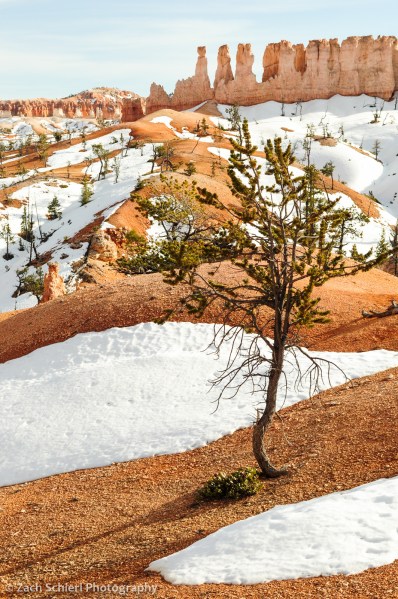
A scraggly Bristlecone Pine (Pinus longaeva) between residual snow patches along the trail to Tower Bridge

A classic Bryce view at sunset: looking northeast towards Powell Point (10,188′) and the Aquarius Plateau
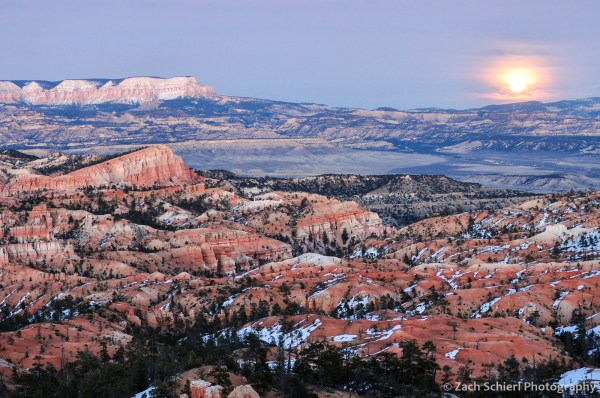
The full moon rising over Powell Point and the Sinking Ship
My visit happened to coincide with a full moon so Milky Way photographs were out of the question. The light made it quite easy to navigate the trails looking for interesting photo opportunities. In several hours of wandering around the amphitheater, I don’t think I turned my headlamp on once. It was seriously bright out there.

The constellation Orion hovers over the hoodoos of Bryce Canyon National Park

Star trails above Thor’s Hammer, Bryce Canyon National Park
With the photo above, I was hoping for longer star trails but after just half an hour, my camera battery died. After scrambling to replace it, I discovered that someone (who shall remain unnamed…) had forgotten to charge their spare camera battery. With only enough power on the spare for a few dozen more exposures, I decided to pack it in for the evening rather than continuing with the star trials, and save my remaining juice for sunrise…which turned out to be a good call.
While Bryce is beautiful at any time of day, sunrise is truly the golden hour. Because most of the amphitheater faces east, sunlight creates so many interesting light patterns among the hoodoos that one almost can’t decide where to look. This was the 2nd morning since the switch to daylight savings, and the crowds reflected the fact that sunrise was now at a quite palatable 7:30 AM.

A famous and tenacious Limber Pine (Pinus flexilus) at Sunrise Point observes yet another sunrise
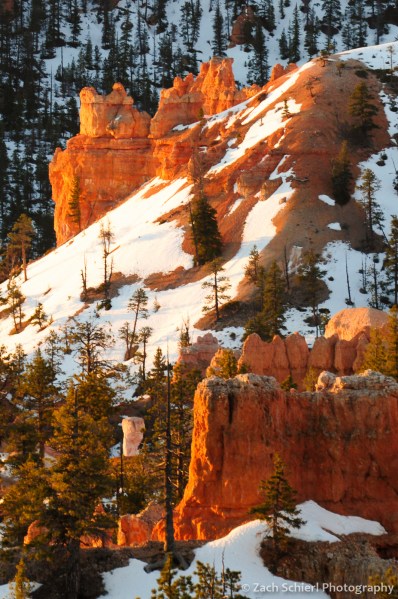
Hoodoos at sunrise, Bryce Canyon National Park

The crowds assemble for sunrise at Bryce Canyon National Park
The “Caves” of Cathedral Gorge State Park


The badlands of Cathedral Gorge State Park, Nevada
Next time you find yourself in extreme eastern Nevada with time to spare, I highly recommend checking out Cathedral Gorge State Park. This gem lies tucked away on the floor of Meadow Valley, about halfway between Las Vegas and Great Basin National Park, not far from the bustling hub of Panaca, Nevada. In other words, for a place fully accessible by paved roads, Cathedral Gorge is about as off-the-beaten path as you’re going to get.
Despite its under-the-radar status, Cathedral Gorge was established all the way back in 1935, and was one of Nevada’s four original state parks (along with the more well-known Valley of Fire north of Las Vegas). The highlight here is a shallow valley excavated out of a layer of soft lake sediments by Meadow Valley Wash and numerous small tributary streams. The sediment was originally deposited in a freshwater lake that called Meadow Valley home during wetter times in the Pliocene epoch (~2.5-5 million years ago). This area has been the epicenter for some pretty extensive volcanic activity over the past few dozen million years, so the sediment that accumulated in the lake was rich in volcanic ash.
Today, with the lake gone, the exposed sediment is so soft that it erodes extremely rapidly. Few plants can gain a foothold in earth that is crumbling so rapidly, so the water (and to a lesser extent, wind) have created a intricate landscape of badlands along the margin of the valley. The scenery is bizarre and not all that unlike what you might find in the famous badlands of South Dakota and the Great Plains. It definitely feels out of place in the sagebrush expanses of the Great Basin. While Cathedral Gorge bakes in the summertime, during our visit it was cold, windy, and virtually empty. We saw not another soul on a four mile loop hike around the perimeter of the valley.

Miller Point Overlook, Cathedral Gorge State Park, Nevada

The terminus of one of the narrow “mud slot canyons” in Cathedral Gorge State Park, Nevada
While the loop hike around the valley was enjoyable (if a bit windy), we didn’t stumble upon the highlight of our visit until we started poking around the rock formations adjacent to the trailhead parking lot. In a matter of minutes, we found ourselves exploring a landform that I still don’t have the right words to describe.
At the edge of the valley, runoff has carved a series of deep, extremely narrow, and almost perfectly vertical crevices into the soft sediments. The park calls them “caves” but the words cave, crevice, gully, crevasse, gorge, and ravine all fail to accurately capture their bizarre and truly unique nature. Perhaps the best way to describe them is as “slot canyons of mud.”
They evoke the sandstone slot canyons of Utah in the sense that they were so narrow that in many spots only a tiny sliver of blue sky could be seen overhead. Unlike most slot canyons though, whose delicate curves are clearly the result of flowing water, the walls here were angular and almost perfectly vertical. It was as if someone had carved huge blocks out of the mud with a chainsaw and then splattered the walks with mud to cover their tracks. Each little mud slot terminated abruptly in a roughly circular chamber whose walls were lined with linear grooves etched into the mud, extending all the way up to the rim. These chambers were clearly the work of waterfalls that spill into the canyons with each heavy rain.
As fragile and precarious as the mud walls looked, there were surprisingly few signs of catastrophic collapse. We explored about a half dozen of these little canyons, all of which were located right along the main road into the park. There were surely more that we missed, good enough reason to make the drive back to Meadow Valley another day.

Water flowing into the gullies erodes and redeposits mud, creating intricate shapes and patterns that line the walls.

Light streaming into a deep “mud slot canyon” in Cathedral Gorge State Park, Nevada
A Hidden Geologic Gem: Ashdown Gorge


Inside a spectacular alcove along Ashdown Creek. Alcoves such as these are numerous along Ashdown Gorge where the stream has eroded laterally into soft rocks near the canyon bottom. The perspective here makes the alcove appear a little deeper than it actually is, but the entire creek bed lies beneath the overhanging cliffs.
Not far from the increasingly overrun splendors of Bryce and Zion is a canyon frequently overlooked when discussing the many attractions of Southern Utah. The stunning Ashdown Gorge lies just a few miles from Cedar City off of Highway 14, yet I’ve seen a grand total of three other people on a pair of weekend hikes up the gorge this summer & fall. The solitude likely stems from the fact that there is no marked trail or trailhead for this hike; Ashdown Creek is the trail for a spectacular jaunt up the canyon. One must also scramble down the steep toe of an active landslide strewn with old vehicles, guardrail fragments, and asphalt chunks just to reach the creek bed from the highway. Once this has been accomplished though, it is fairly easily walking for many miles up the gorge as the water in the creek is typically only ankle deep except during spring snow melt and after heavy rains.

Beautiful colors in a narrow section of Ashdown Gorge.
Ashdown Gorge has a very different character than many canyons in Southern Utah, starting with the color of its walls. Not red or pink – the famous layers of Zion and Moab are well below the surface here – but rather varied shades of grey, tan, and yellow. The majority of the gorge is carved into the Cretaceous Straight Cliffs Formation, an impressive unit formed when southwestern Utah was a swampy coastal plain trapped between a disintegrating mountain range to the west and the shallow Cretaceous Interior Seaway to the east. Periodic but short lived rises in sea level are marked by occasional beds that contain almost nothing but fossilized oysters and other marine organisms.
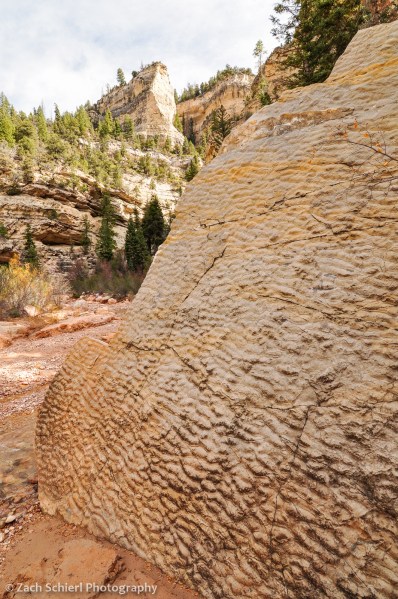
Not far from the junction of the gorge and Highway 14 is a gigantic boulder of the Straight Cliffs Formation displaying some of the best preserved ripple marks I’ve ever seen!
Ashdown Gorge is not quite a slot canyon, although it tries in places. Despite this, the walls for much of its length are several hundred feet high and there are many locations where you would NOT want to find yourself during a flash flood, so take a close look at the weather forecast before attempting to explore the gorge! Unlike the relatively hard sandstone that forms most of Utah’s famous slot canyons, the Straight Cliffs Formation is rather soft and crumbly. The creek has taken advantage of this by eroding laterally in many places. The result of this erosion is perhaps most spectacular around the outside edges of the many tight meanders of Ashdown Creek. Here the creek has carved into soft layers near the canyon bottom, undercutting harder layers of sandstone near the rim, creating vast alcoves that completely cover the creek bed.

Inside another alcove further downstream. Beneath this one were a plethora of large, partially pulverized blocks of grey rock that had clearly fallen quite recently (they had not yet been covered in the orange mud like most of the rocks in the creek bed) from the overhang above. We chose not to stick around in this one for long…
While walking along the creek, one thing that is striking is the color of the boulders upon which you walk. Not grey and tan like the canyon walls, but rather varying shades of orange, pink, and red. This is because Ashdown Creek drains the vast amphitheater of Cedar Breaks National Monument upstream to the east. The soft limestones and siltstones of Cedar Breaks are easily eroded, and Ashdown Creek can turn bright orange during even minor rains.
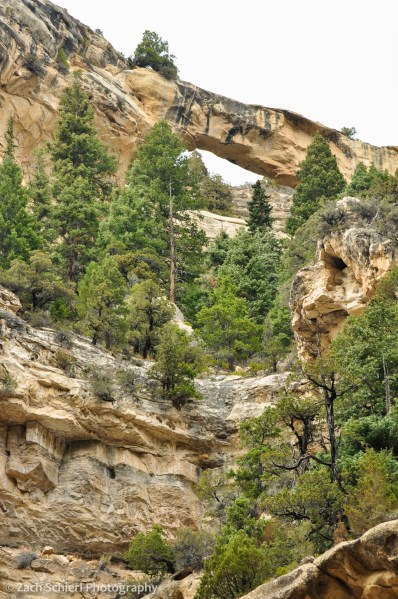
Flanigan Arch from Ashdown Gorge
Another highlight of a hike up Ashdown Gorge is a good view of Flanigan Arch, an impressive span (reputable estimates of its length are hard to find, but most seem to say ~60 feet) that is difficult to access or even see from any other location.
In addition to the lack of crowds, the high elevation of Ashdown Gorge (7000-8000′) makes it a wonderful day hike (or potential overnight trip) for escaping the heat in summer (just watch for flash floods…) Ponderosa Pine, spruce, and fir are the most commonly seen large trees in the gorge which has a very “mountainous” feel to it. When we hiked it in late October, the temperatures were actually getting a little too cool to fully enjoy the numerous required stream crossings. In June when it was 80 degrees, the creek crossings were heaven!

Some small riffles along Ashdown Creek.
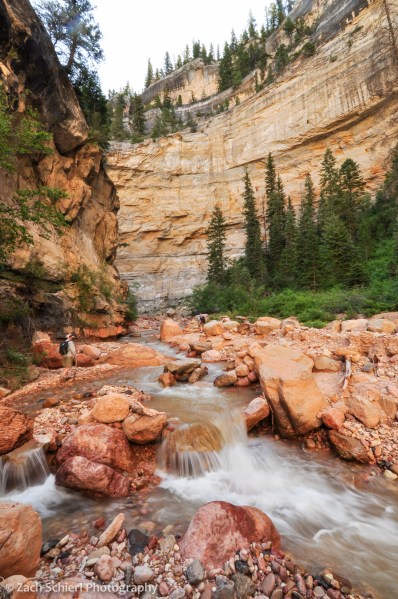
Hiking up the gorge is fairly easy, a few small riffles and waterfalls can be easily scrambled around.
 Zach Schierl Photography