The Heart of Utah: Capitol Reef National Park

Hickman Natural Bridge, Capitol Reef National Park, Utah
The least visited and most isolated of Utah’s five national parks, Capitol Reef hosts what is perhaps the quintessential Utah landscape. It is as if someone took small portions of the other four parks and mashed them into one; here you can find a plethora of arches and natural bridges, deep snake-like canyons, soaring Navajo and Wingate Sandstone cliffs, and even a few hoodoos thrown in for good measure.
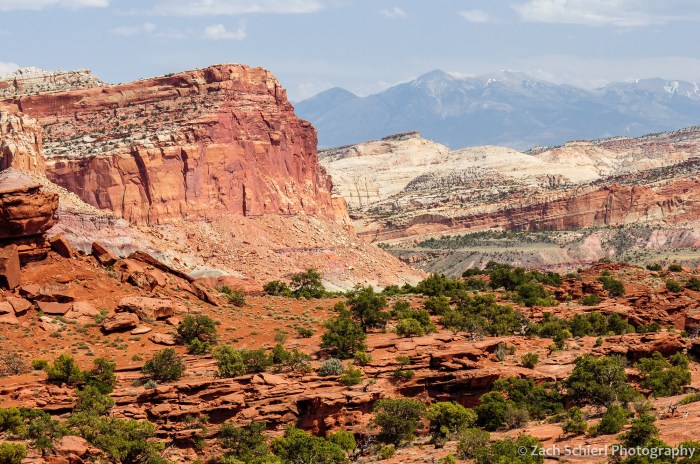
Looking east across the Waterpocket Fold toward the Henry Mountains, the last mountain range in the lower 48 to be mapped and named, and their high point: 11,522′ Mt. Ellen.
The skinny sixty mile long park was originally established as a national monument in 1937, but became a national park in 1971. The odd shape stems from the inherent nature of the feature it protects: the Waterpocket Fold, a 100+ mile-long kink in the Earth’s crust known as a monocline. Creeks and rivers have dissected the fold over millions of years to reveal what is quite possibly the most colorful and diverse array of rock layers in Utah.
Capitol Reef is far from just about everywhere (which made the flat tire we experienced on the way that much more annoying). To the east and south lie the last major mountain range and river, respectively, to be mapped and added to the map of the lower 48 states. Not until the 1960s did a paved highway cross the Waterpocket Fold through Capitol Reef. In the northern part of the park, the Fremont River slices a narrow canyon through the Waterpocket Fold, its water creating one of the few habitable areas in the entire region. Petrogylphs attest to the importance of this year-round water source to ancient inhabitants. In 1880, Mormon settlers established the settlement of Fruita along the banks of the Fremont. The remains of this historic farming community and the abundant, lush green orchards and fields seem out of place in the otherwise stark central Utah canyonlands but add to the allure of the park.
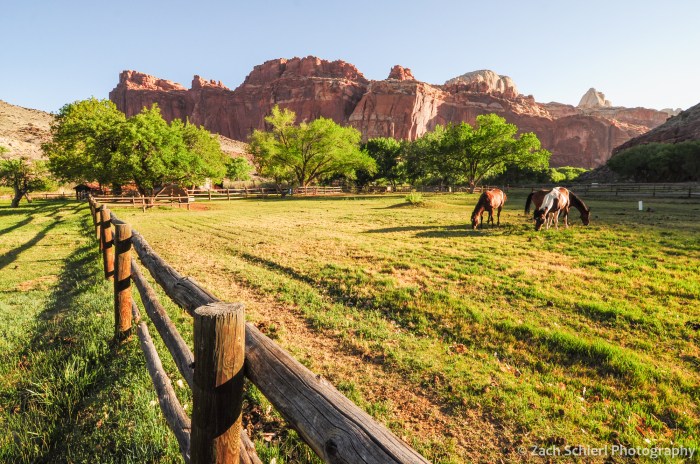
Early morning in the Fruita orchards and pastures

Bighorn sheep petrogylphs along the Fremont River, Capitol Reef National Park, Utah
Here are some of the sights from our quick trip to Capitol Reef this past weekend:
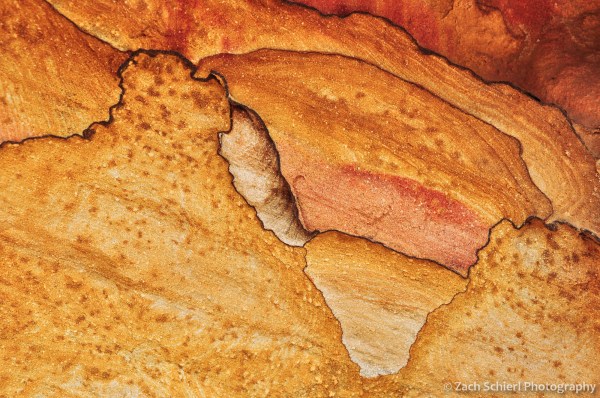
On a hike through Capitol Gorge, we encountered a bed within the Navajo Sandstone with some unbelievably complex and colorful patterns:

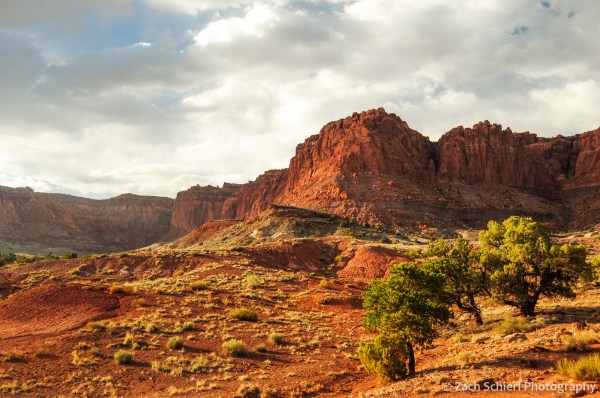
For the most part, the landscape at Capitol Reef is quite open, allowing vast views and superb light at sunset:

Chimney Rock, a tower of soft Moenkopi Formation mudstone capped by harder sandstone belonging to the Shinarump Member of the Chinle Formation

Late afternoon scene along the Chimney Rock Trail, Capitol Reef National Park, Utah
More sunset scenes

Hiking among crumbling cliffs of Wingate Sandstone, Capitol Reef National Park, Utah

A nearly full moon made it hard to do much stargazing at Capitol Reef, which is world-renowned for dark night skies.
Not far from the park campground and visitor center are the remnants of an old trail leading up a sandy wash, then up a short but steep talus slope before arriving at a hidden basin containing hoodoos and other strange rock formations. Unfortunately it was just about noon and the light was about as direct and harsh as possible, but it was cool to explore an area off-the-beaten path yet still in sight of the tour buses below:

Ascending the talus…

Gravity-defying hoodoos were the reward!

Hoodoos in the Chinle Formation at Capitol Reef National Park, Utah
Colorful Geology at Valley of Fire State Park


Compaction bands in multi-colored Aztec Sandstone, just one of many geologic wonders in Valley of Fire State Park, Nevada
One of the great things about living in Southern Utah is the abundance of different climates within a small geographic area. When temperatures rise into the 90s and 100s in the low-elevation valleys, we can be in cool alpine meadows at 10,500′ in less than an hour. When snow, slush, and mud cover the trails in winter, vast portions of the Mojave and Great Basin Deserts are within a day’s drive. One of these desert areas is Valley of Fire State Park in southern Nevada, not far from I-15 between St. George and Las Vegas.
Perhaps not surprisingly, upon arrival at Valley of Fire one is greeted with an array of whimsically sculpted red rock formations. Now red rocks are hardly unique in this part of the country, and the crimson cliffs here are no more notable than those found anywhere else in Utah or Arizona. But head into the interior of the park and you soon realize the allure of the Valley of Fire. After cresting the red cliffs, the hues begin to multiply exponentially and before long you are surrounded by just about every color of sandstone imaginable.

A layer-cake of spectacular colors in Valley of Fire State Park, Nevada
To put it bluntly, the colors at Valley of Fire are simply ridiculous…and attributable to its unique geologic location. The rocks here are mostly equivalent to those found throughout southwestern Utah and the Colorado Plateau. The Aztec Sandstone, the dominant rock unit exposed in the park, is the equivalent of the Navajo Sandstone that makes up the cliffs of Zion National Park. Geologists just assign it a different name when it appears in Nevada and the Great Basin. Perhaps the distinct name is appropriate though, given that the sandstone seems to take on a life of its own here.
Valley of Fire State Park lies within the Basin and Range province, a vast region covering Nevada and portions of half a dozen other western states where the Earth’s crust is being slowly but violently stretched apart. As the writer John McPhee once noted, so much stretching has occurred here that 20 million years ago, Salt Lake City and Reno would have been more than 60 miles closer together. Faults are abundant in this land, and fluids associated with some of these faults have at various times leached iron compounds from the originally all-red sandstone, causing some layers to become bright white, and re-deposited them in other layers, leading to the wide variety of colors.
Some of the most impressive colors are found just to the west of the “Fire Wave” feature near the northern terminus of the park’s scenic drive:

Vibrant colors in the Aztec Sandstone in Valley of Fire State Park, Nevada

A feature known as the “Fire Wave,” Valley of Fire State Park, Nevada
While there are numerous hiking trails, there is also lots of off-trail terrain to explore. Some of the most spectacular scenery can be found by parking at one of the numerous pull offs and just wandering out into the rock wonderland. One particular geologic feature of note is what are known as “shear-enhanced compaction bands,” thin brittle fins of rock that rise almost vertically out of the ground and often run continuously for dozens to hundreds of yards. At first glance, these features look like mineral veins, but upon closer examination they are composed of the same material as the surrounding sandstone, but are obviously slightly harder than the host rock. In many places there are two perpendicular sets of the bands, forming a checkerboard like pattern superimposed on the sandstone.
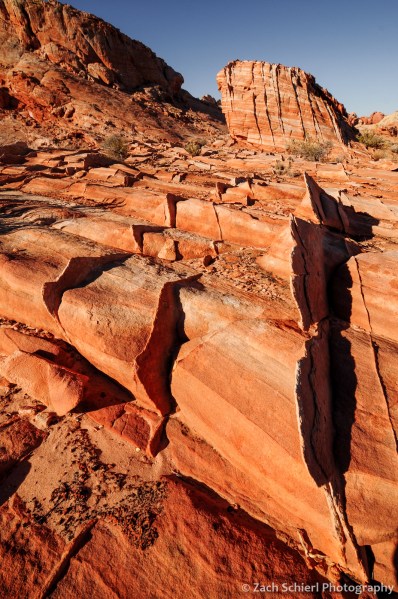
Compaction bands in the Aztec Sandstone, Valley of Fire State Park, Nevada
The bands are the result not of stretching, but of compressional forces that predate the formation of the Basin and Range. Stresses associated with an earlier mountain building episode (known as the Sevier orogeny) created these funky bands by essentially “squeezing” together (and even breaking) the sand grains that make up the rock, eliminating much of the empty space between the grains and forming a miniature layer of tougher, harder, and more compact sandstone that is slightly more resistant to weathering and erosion. As a result, the bands tend to just out from the surrounding slickrock by several inches, and even several feet in some locations. For such a seemingly obscure feature, many papers have been written about these compaction bands (and similar ones in a few other locations in the region). However my understanding of the structural processes behind their formation is limited and the most recent articles about them appear to be behind a paywall. If anyone reading this has more insight into these things, I would love to hear from you.
As mentioned before, these bands are quite thin, in most less than a centimeter thick and thus, sadly, quite brittle. They are easily broken by an errant boot step so if you find yourself among them, tread carefully so that future visitors will be able to experience this unique and colorful landscape.
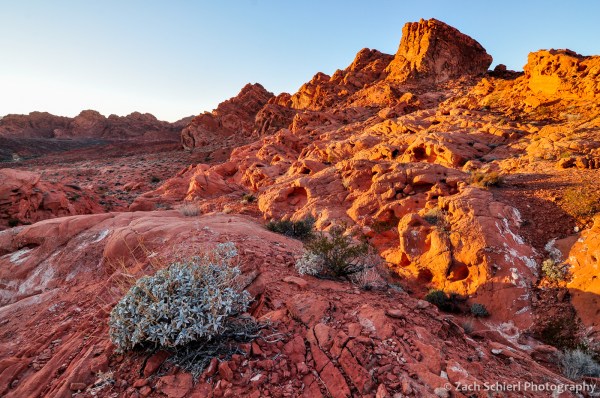
Sunset from the Old Arrowhead Road in Valley of Fire State Park, Nevada
The “Caves” of Cathedral Gorge State Park


The badlands of Cathedral Gorge State Park, Nevada
Next time you find yourself in extreme eastern Nevada with time to spare, I highly recommend checking out Cathedral Gorge State Park. This gem lies tucked away on the floor of Meadow Valley, about halfway between Las Vegas and Great Basin National Park, not far from the bustling hub of Panaca, Nevada. In other words, for a place fully accessible by paved roads, Cathedral Gorge is about as off-the-beaten path as you’re going to get.
Despite its under-the-radar status, Cathedral Gorge was established all the way back in 1935, and was one of Nevada’s four original state parks (along with the more well-known Valley of Fire north of Las Vegas). The highlight here is a shallow valley excavated out of a layer of soft lake sediments by Meadow Valley Wash and numerous small tributary streams. The sediment was originally deposited in a freshwater lake that called Meadow Valley home during wetter times in the Pliocene epoch (~2.5-5 million years ago). This area has been the epicenter for some pretty extensive volcanic activity over the past few dozen million years, so the sediment that accumulated in the lake was rich in volcanic ash.
Today, with the lake gone, the exposed sediment is so soft that it erodes extremely rapidly. Few plants can gain a foothold in earth that is crumbling so rapidly, so the water (and to a lesser extent, wind) have created a intricate landscape of badlands along the margin of the valley. The scenery is bizarre and not all that unlike what you might find in the famous badlands of South Dakota and the Great Plains. It definitely feels out of place in the sagebrush expanses of the Great Basin. While Cathedral Gorge bakes in the summertime, during our visit it was cold, windy, and virtually empty. We saw not another soul on a four mile loop hike around the perimeter of the valley.

Miller Point Overlook, Cathedral Gorge State Park, Nevada

The terminus of one of the narrow “mud slot canyons” in Cathedral Gorge State Park, Nevada
While the loop hike around the valley was enjoyable (if a bit windy), we didn’t stumble upon the highlight of our visit until we started poking around the rock formations adjacent to the trailhead parking lot. In a matter of minutes, we found ourselves exploring a landform that I still don’t have the right words to describe.
At the edge of the valley, runoff has carved a series of deep, extremely narrow, and almost perfectly vertical crevices into the soft sediments. The park calls them “caves” but the words cave, crevice, gully, crevasse, gorge, and ravine all fail to accurately capture their bizarre and truly unique nature. Perhaps the best way to describe them is as “slot canyons of mud.”
They evoke the sandstone slot canyons of Utah in the sense that they were so narrow that in many spots only a tiny sliver of blue sky could be seen overhead. Unlike most slot canyons though, whose delicate curves are clearly the result of flowing water, the walls here were angular and almost perfectly vertical. It was as if someone had carved huge blocks out of the mud with a chainsaw and then splattered the walks with mud to cover their tracks. Each little mud slot terminated abruptly in a roughly circular chamber whose walls were lined with linear grooves etched into the mud, extending all the way up to the rim. These chambers were clearly the work of waterfalls that spill into the canyons with each heavy rain.
As fragile and precarious as the mud walls looked, there were surprisingly few signs of catastrophic collapse. We explored about a half dozen of these little canyons, all of which were located right along the main road into the park. There were surely more that we missed, good enough reason to make the drive back to Meadow Valley another day.

Water flowing into the gullies erodes and redeposits mud, creating intricate shapes and patterns that line the walls.

Light streaming into a deep “mud slot canyon” in Cathedral Gorge State Park, Nevada
 Zach Schierl Photography