Comet NEOWISE Appears in the Morning Sky

Naked-eye comet alert! Comet C/2020 F3 (NEOWISE), discovered back in March, has brightened to the point where it is visible to the naked-eye in the pre-dawn sky. Both the comet and its tail were easily visible to the naked eye about one hour and fifteen minutes before sunrise this morning:

Comet C/2020 F3 (NEOWISE) at 4:05 am PDT on July 8, 2020 from Yakima County, Washington. (Nikon D750, 260mm, f/5.6, ISO 400, 1.6 sec)
This is the first time in ~20 years of skywatching that I can recall seeing a comet and its tail with the naked eye. (Western Washington’s persistent clouds and 49°N latitude stymied my attempts to see Comet PANSTARRS in 2013.) Such comets are relatively uncommon, making it well worth the effort to get up to see this one.
Here’s how to see it yourself:
Look northeast 75-90 minutes before local sunrise. You’ll need a relatively clear horizon in that direction. For most locations in the United States, the comet will be no more than 10 degrees above the horizon at this time. A large tree 200 yards away was enough to block the view of the comet from my patio, forcing me to take a short stroll through the neighborhood to find a better vantage point. The comet is small, but for at least the next few mornings should be readily visible. Here’s a wide field view to give you a better sense of the comet’s apparent size:

Comet C/2020 F3 (NEOWISE) at 4:02 am PDT on July 8, 2020 from Yakima County, Washington. (Nikon D750, 70mm, f/2.8, ISO 400, 1 sec)
Timing is key. My experience is that the comet is best seen about 75-90 minutes before local sunrise. Too much earlier and the comet will be too low in the sky to see clearly. Too much later and the brightening dawn sky will render it invisible. This morning, by about one hour before sunrise, the comet had become much more difficult to pick out and the tail was barely visible to the naked eye. By 45 minutes prior to sunrise, the comet was no longer visible to the naked eye at all (although it was still visible in binoculars or a camera).
Since you’ll be observing in twilight, light pollution conditions shouldn’t make much of a difference here; this comet should be visible even from urban areas, provided you have a clear northeast horizon and time your attempt correctly. A pair of binoculars greatly enhances the view. For more detailed information on viewing Comet NEOWISE, check out https://earthsky.org/space/how-to-see-comet-c2020-f3-neowise
Now for a bit more on what you are seeing and how the comet’s appearance might change over the coming days and weeks:
Comets are city-sized “dirty snowballs” made mostly of ice and rock. They are leftovers from the formation of our Solar System and orbit the Sun on highly elliptical paths. Comet NEOWISE takes several thousand years to complete one orbit of the Sun. While comets spend most of their time in the cold outer solar system, when they approach the Sun they are heated by solar radiation, causing ices on the comet to begin sublimating (turning from a solid into a gas). This creates a temporary atmosphere surrounding the comet nucleus known as the coma. That’s the bright part of the comet you see in the close-up below. A stream of ionized gas “blown” off the comet by the solar wind can form a tail, while dust particles left behind the comet can form a second tail. As you can see in the close-up, Comet NEOWISE does appear to have two distinct tails at the moment.

A close up of the coma and twin tails of Comet C/2020 F3 (NEOWISE).
NEOWISE made its closest approach to the Sun back on July 3rd and is now on its way back into the outer solar system. Typically, as comets move away from the Sun’s heat, they dim. So far though, NEOWISE appears to be bucking the trend. This is exciting because while the comet is moving away from the Sun, it is moving closer to us. It will reach its closest point to Earth by about July 22nd. If the comet can maintain its brightness for just another week or two, the show could get even better. Now is still the time to look though. The comet will be visible in the morning sky for just a few more days before it disappears into morning twilight. It will reappear in the evening sky by mid-July. Here’s hoping it is still bright enough to see by then. If so, we can all enjoy its presence without having to get up at 3:30 AM!
Colorful Geology at Valley of Fire State Park


Compaction bands in multi-colored Aztec Sandstone, just one of many geologic wonders in Valley of Fire State Park, Nevada
One of the great things about living in Southern Utah is the abundance of different climates within a small geographic area. When temperatures rise into the 90s and 100s in the low-elevation valleys, we can be in cool alpine meadows at 10,500′ in less than an hour. When snow, slush, and mud cover the trails in winter, vast portions of the Mojave and Great Basin Deserts are within a day’s drive. One of these desert areas is Valley of Fire State Park in southern Nevada, not far from I-15 between St. George and Las Vegas.
Perhaps not surprisingly, upon arrival at Valley of Fire one is greeted with an array of whimsically sculpted red rock formations. Now red rocks are hardly unique in this part of the country, and the crimson cliffs here are no more notable than those found anywhere else in Utah or Arizona. But head into the interior of the park and you soon realize the allure of the Valley of Fire. After cresting the red cliffs, the hues begin to multiply exponentially and before long you are surrounded by just about every color of sandstone imaginable.

A layer-cake of spectacular colors in Valley of Fire State Park, Nevada
To put it bluntly, the colors at Valley of Fire are simply ridiculous…and attributable to its unique geologic location. The rocks here are mostly equivalent to those found throughout southwestern Utah and the Colorado Plateau. The Aztec Sandstone, the dominant rock unit exposed in the park, is the equivalent of the Navajo Sandstone that makes up the cliffs of Zion National Park. Geologists just assign it a different name when it appears in Nevada and the Great Basin. Perhaps the distinct name is appropriate though, given that the sandstone seems to take on a life of its own here.
Valley of Fire State Park lies within the Basin and Range province, a vast region covering Nevada and portions of half a dozen other western states where the Earth’s crust is being slowly but violently stretched apart. As the writer John McPhee once noted, so much stretching has occurred here that 20 million years ago, Salt Lake City and Reno would have been more than 60 miles closer together. Faults are abundant in this land, and fluids associated with some of these faults have at various times leached iron compounds from the originally all-red sandstone, causing some layers to become bright white, and re-deposited them in other layers, leading to the wide variety of colors.
Some of the most impressive colors are found just to the west of the “Fire Wave” feature near the northern terminus of the park’s scenic drive:

Vibrant colors in the Aztec Sandstone in Valley of Fire State Park, Nevada

A feature known as the “Fire Wave,” Valley of Fire State Park, Nevada
While there are numerous hiking trails, there is also lots of off-trail terrain to explore. Some of the most spectacular scenery can be found by parking at one of the numerous pull offs and just wandering out into the rock wonderland. One particular geologic feature of note is what are known as “shear-enhanced compaction bands,” thin brittle fins of rock that rise almost vertically out of the ground and often run continuously for dozens to hundreds of yards. At first glance, these features look like mineral veins, but upon closer examination they are composed of the same material as the surrounding sandstone, but are obviously slightly harder than the host rock. In many places there are two perpendicular sets of the bands, forming a checkerboard like pattern superimposed on the sandstone.
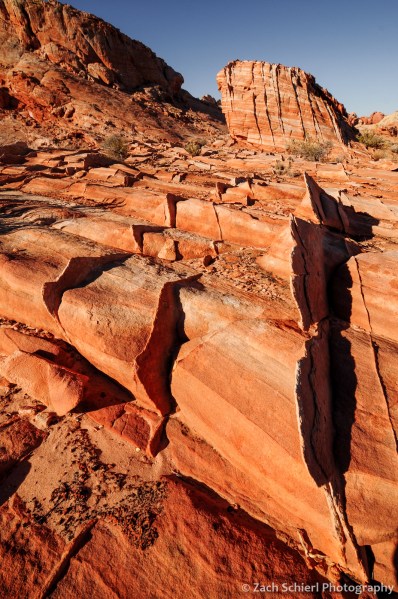
Compaction bands in the Aztec Sandstone, Valley of Fire State Park, Nevada
The bands are the result not of stretching, but of compressional forces that predate the formation of the Basin and Range. Stresses associated with an earlier mountain building episode (known as the Sevier orogeny) created these funky bands by essentially “squeezing” together (and even breaking) the sand grains that make up the rock, eliminating much of the empty space between the grains and forming a miniature layer of tougher, harder, and more compact sandstone that is slightly more resistant to weathering and erosion. As a result, the bands tend to just out from the surrounding slickrock by several inches, and even several feet in some locations. For such a seemingly obscure feature, many papers have been written about these compaction bands (and similar ones in a few other locations in the region). However my understanding of the structural processes behind their formation is limited and the most recent articles about them appear to be behind a paywall. If anyone reading this has more insight into these things, I would love to hear from you.
As mentioned before, these bands are quite thin, in most less than a centimeter thick and thus, sadly, quite brittle. They are easily broken by an errant boot step so if you find yourself among them, tread carefully so that future visitors will be able to experience this unique and colorful landscape.
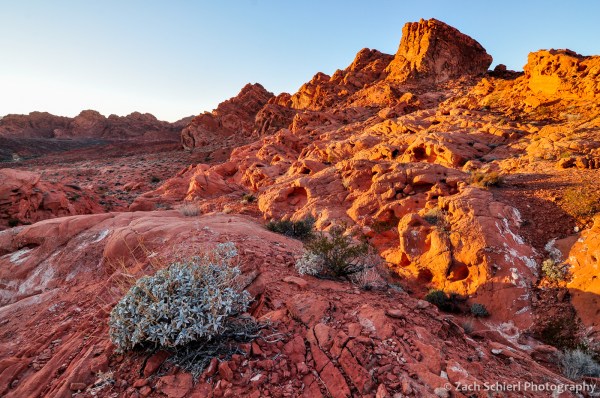
Sunset from the Old Arrowhead Road in Valley of Fire State Park, Nevada
(Petrified) Forests of Stone

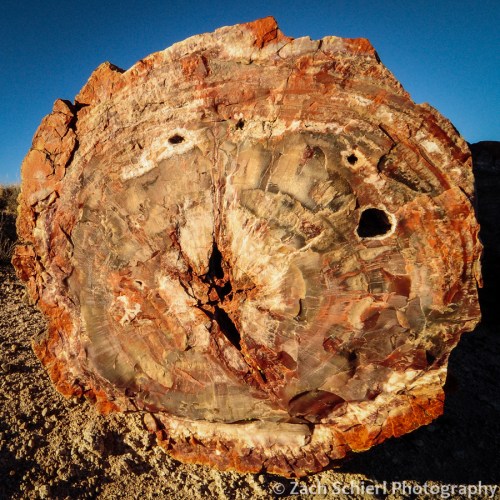
Despite being comprised almost entirely of quartz, trace amounts of elements like iron and manganese give petrified wood its myriad of colors.
I grew up about 90 minutes away from Petrified Forest National Park and, aside for a quick lunch stop about 10 years ago, had never visited before last week. While this is nowhere near as inexcusable as living in Arizona for decades and never visiting the Grand Canyon (yes, such individuals exist…I’ve met many), it still seemed like a bit of an oversight on my part. Or it could simply be a reflection of the inordinate number of outdoor activities that exist in northern Arizona; even living in the area for 10+ years isn’t enough time to hit everything. Either way, after finally venturing into the Petrified Forest, I can emphatically say that it should be mentioned with the best that northern Arizona has to offer.
Located amongst the vast Painted Desert of northeastern Arizona, the main attraction of Petrified Forest is of course the petrified wood. The formation of petrified wood is initiated when downed trees are quickly buried by sediment. Once entombed in the sediment, the lack of oxygen prevents the logs from decaying as they normally would when exposed directly to the atmosphere. In this case, the logs (none of which remain standing, despite the name “Petrified Forest”) were likely brought here in massive logjams along an ancient river system that existed during the Triassic period. A combination of sediment from the river and ash from nearby volcanoes buried the logs, not to be seen again for more than 200 million years. During this time, as the logs became buried under an increasingly deep pile of overlying sediment, dissolved silica began to crystallize in the pore spaces of the wood as quartz, eventually replacing all of the organic material while maintaining the original shape and structure of the log.

A brilliantly colored petrified wood fragment.
Petrified wood is not particularly rare. Good examples abound in Yellowstone National Park, Washington state, Utah, Colorado, Oregon, Alberta, New Zealand…the list goes on and on. What makes Petrified Forest National Park unique is the quantities found here. Due to the aforementioned Triassic log jams, large quantities of wood were concentrated in small areas. In a location known today as Jasper Forest (see photos below), movement was not possible without walking over a nearly uniform carpeting of small petrified wood fragments and frequently having to clamber over 2-3 foot diameter logs. Truly stunning!

Petrified wood in the Jasper Forest, Petrified Forest National Park.

Overlooking the Jasper Forest at sunset.
Another unique aspect of Petrified Forest is the colorful canvas on which the wood is found. The wood is eroding out of a rock unit known as the Chinle Formation, which essentially consists of all of the river sediment and volcanic ash the buried the trees in the first place. More than 1000 feet thick in the park, the Chinle Formation is composed primarily of extremely soft mudstones, clays, and volcanic ash. Water is able to easily sculpt the soft rock into fantastically colored and oddly shaped badlands that make a spectacular backdrop for the logs.
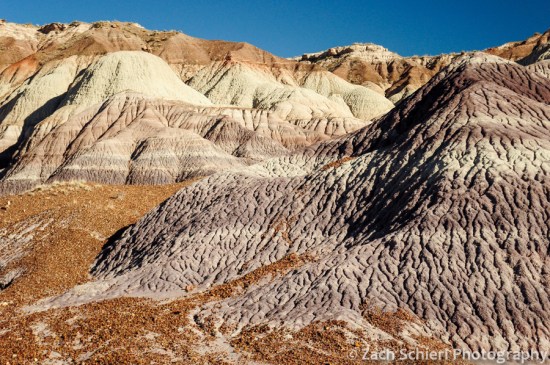
The soft muds and clays of the Chinle Formation are easily eroded, forming badlands-like topography throughout the Painted Desert.

Colorful badlands in the Chinle Formation at Blue Mesa.
Petrified Forest National Park faces an issue not encountered by most other national parks, namely, the wholesale theft of the very resource it was established to protect. For this reason, the park is only open during daylight hours (from 8-5 in the winter) to minimize opportunities for looting. It strike me as very sad that such measures are necessary. With a little geological perspective, it becomes clear how incredibly lucky we are to experience a landscape like Petrified Forest at this moment in time. So easily eroded is the Chinle Formation that in many locations, several inches of it are removed each year. This may not sound like much, but geologically speaking, that’s a veritable bullet train of erosion. While it took tens of millions of years for the Chinle to be deposited, it will be erased from our planet by the unceasing forces of weathering and erosion in a tiny fraction of that. The petrified logs, being comprised mostly of silica, are harder and will last a little longer, but are still brittle and will eventually be washed into the Little Colorado River and swept downstream along with the colorful Chinle badlands.
What all this means is that the colorful Painted Desert/Petrified Forest landscape we see today is one that is extremely temporary. While this is true of most landscapes we see on Earth today—our planet likes to re-build, re-arrange, re-shape, and remove constantly—the Painted Desert is even more ephemeral than most. While mountain ranges comprised of harder, erosion-resistant granite or quartzite (like most of the Rockies) can stand the test of time to some degree, the longevity of the Painted Desert, its soft sediments, and its brittle petrified wood is comparatively brief. Stealing this treasured natural resource only abbreviates our time with the Petrified Forest even more.

Pieces of petrified wood accumulate in small hollows in the extensively gullied Chinle Formation.

The soft sediment surrounding the logs is easily transported away by small streams and washes.

Relatively hard chunks of petrified wood and quartz protect the softer sediment of the Chinle Formation from erosion, forming pedestals small…

…and large!
 Zach Schierl Photography