Obituary for a DSLR
My trusty Nikon D70 died today after nearly 35,000 shutter actuations, in a beautiful place no less; more than 10,000 feet above sea level along the West Fork of the Cimarron River, high in the ice-sculpted pinnacles of the San Juan Mountains of southwestern Colorado. Given that it had pluckily survived numerous 5+ foot drops onto hard, rocky surfaces, many torrential downpours, hitchhiking across the sheep-filled land known as New Zealand, and being partially submerged in mineral-rich water as I uncontrollably floated down Havasu Creek, it seems odd that a light bump against a ratty-looking old lodgepole pine is what ultimately brought it to what in hindsight seems a rather ignominious end. Alas, this accidental tap caused the camera’s shutter to cease operating, casting the camera’s 6.3 megapixel CCD chip into a state of eternal darkness, never again to capture the majestic photons emitted by the incomparable scenery of this great Earth.

The final shot…
Not even the most exquisitely crafted prose can capture the stunning allure of the natural setting in which the D70 ultimately met its demise. Its final hours were spent summiting the rocky, yet green and verdant slopes of 12,152 foot Courthouse Mountain, a impressive edifice that is but a mere foothill to the soaring 14,000 foot peaks of the San Juan’s above. Despite it’s striking appearance, more than 1200 other peaks in the state of Colorado exceed it in height, although after today’s passing, none will exceed it in sentimental significance. A more glorious and perfect day could nary have been found; the weather gods were beaming upon the landscape below, basking the D70 in warm, unintterupted sunlight as it ascended the mountain, strapped to the shoulders of its loving owner.
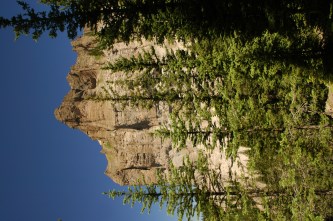
The south face of Courthouse Mountain, composed of layer upon layer of volcanic tuff and breccia.

Courthouse Mountain Trail

The last photo with a human being in it…
From the summit, the D70 faithfully recorded its final panorama; a wide swath that included the jagged crags of Dunsinane Mountain and Precipice Peak, the dark green lodgepole stands of the Uncompahgre Wilderness, and the distant summits of Uncompaghre Peak and Mt. Sneffels, gripping tightly to their last vestiges of winter snow. To the north, beyond the exquisitely layered deposits of Chimney Rock belaying its violent volcanic history, lay the verdant Uncompahgre Valley, home to the towns of Ridgway, Montrose, and Delta. Along the eastern base of the mountain lay the valley carved by the West Fork of the Cimarron River, on an arrow straight path north to eventually meet the mighty Gunnison River.

Panoramic View from Courthouse Mountain, looking east into West Fork Cimarron River valley. Chimney Rock and Silverjack Reservoir visible at left, Precipice Peak at right.

View from Courthouse Mountain looking south and west towards San Juan Mountains.
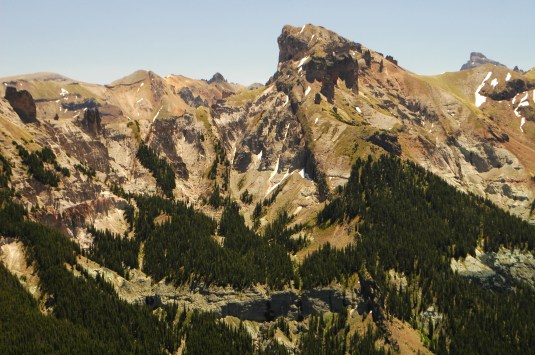
The perilous promontory of Precipice Peak
Until such time that a suitable replacement can be procured, the D70 will be replaced by a small, yet capable Canon point-and-shoot camera. In lieu of flowers, please send Amazon.com or B&H Photo gift cards.
A Crater Lake Comparison
College and blogging go together about as well as tofu and….well…about anything. Keeping up with this site, which by definition requires photographs, is even more challenging. Apart from several thousand photographs of Whitman Mission National Historic Site (where I volunteer and write another photography blog), I take very few photos during the semester, given that pictures of classrooms are boring and I don’t often take to lugging a DSLR around to weekend frivolities.
It was a visit to Crater Lake in the summer two years ago that prompted me to start this website in the first place. Somehow though, that attempt went fallow and I never got past creating an account and drafting a first post. That post, with the awe-inspiring title of “Photography Challenges at Crater Lake National Park”, and packed with 576 words of my mind-numbingly painful drivel, still sits in my “Drafts” folder to this day, staring at me with sad eyes much like whatever this is.
Happily, I now have a second Crater Lake visit to share photos from. If you’ve ever wanted to see snowdrifts engulfing multi-story buildings, you should visit Crater Lake NP in the early spring. Driving up Oregon Hwy 62 from Medford, my thought progression went something like this: “Hmm…not very much snow yet”, “Strange, I thought we’d be getting into some snow by now”, “Wow, maybe we’ll actually be able to hike around a little at the lake”, “Holy crap, the snowbanks are taller than the car”, “Whoa, now they are taller than my 6′ 3″ housemate!” I truly have never seen such quantities of snow in my life. Entering the few remaining open buildings required travel through snow tunnels in order to access the doors. The road to the rim of the lake is kept open year-round, and after seeing the massive snowbanks and realizing how much manpower must be required to accomplish this, I had to ask the question “why”? The volunteer ranger on duty didn’t really have a clear cut answer, mumbling only something about “politics” and “tradition.” We were also informed that this winter had been “a dry one” and that the fact that we were even able to see the lake was rather fortuitous, as more than 50% of winter days are so cloudy that the lake surface is not even visible from the rim.
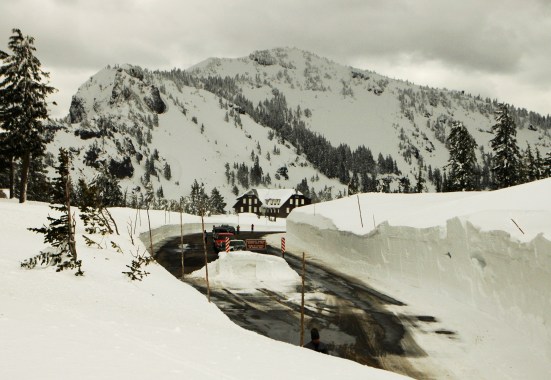
Crazy snow.
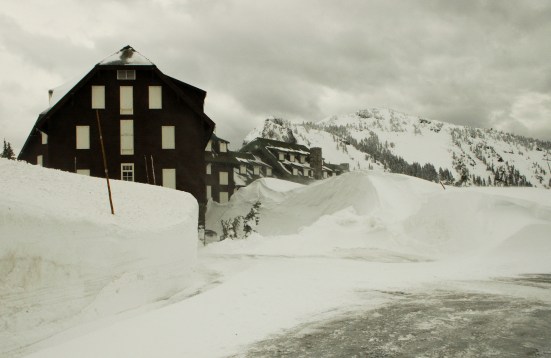
Crater Lake Lodge, closed for the season
Wandering around the shuttered Crater Lake Lodge area felt eerily like a scene from The Shining (filmed at the nearby Timberline Lodge on Mt. Hood) with the Crater Lake Lodge buried up to the 4th floor by snowdrifts. One advantage to the snow was the lack of the oppressing clouds of mosquitoes that plagued us during the summer visit.
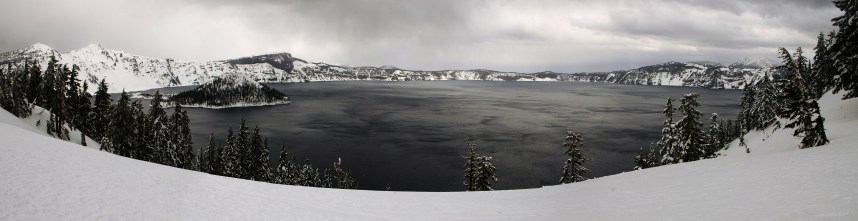
Crater Lake Panorama, March 2012
For comparison purposes, here are some images from that July 2010 visit, starting with a shot taken from almost the exact same vantage point at the first photo in this post (note the position of the peak towering over the lodge). The only difference in that here I’m not standing on top of thirty feet of snow.
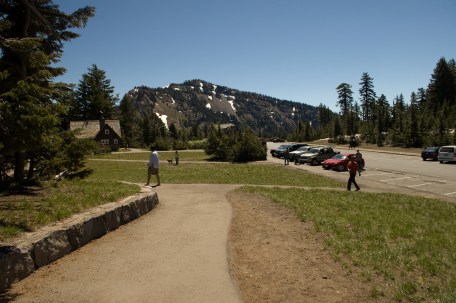
Crater Lake Lodge, sans 30' snow drifts
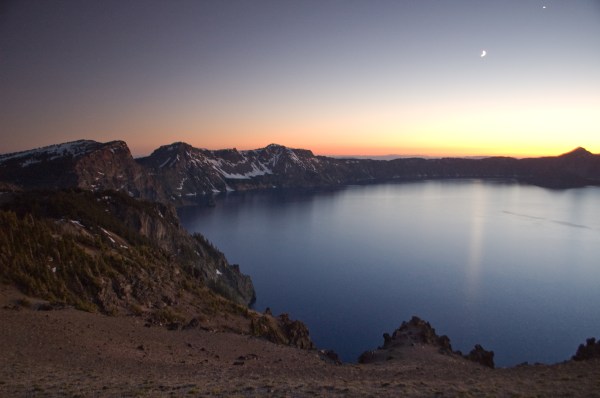
The Moon and Venus setting behind Crater Lake

Crater Lake Panorama, July 2010
I clearly remember being surprised on that visit at how much snow remained present, even in mid-July. Several trails were still closed. After last week, this no longer seems extraordinary. If anything it seems a small miracle that it ever melts at all and that Crater Lake is not covered by some sort of permanent glacier.
el Cañón del Colorado
According to my calculations, it has been 865 days since I last visited the Grand Canyon. Having grown up about an hour away from the Big Ditch, this seems sort of, well, unnatural. It’s been even longer since I’ve visited in the winter, which is sad because winter tends to be the only that that a visit to the Grand Canyon doesn’t make you feel like you’re fighting your way through your friendly local neighborhood Super Wal-Mart.
One of the things that has always amazed me about the Grand Canyon is the fact that you can literally be standing 20 feet from the edge and have no idea that it even exists. Unlike many of our other semi-urbanized natural wonders, you can’t really see it that well, if at all, from the parking lot. The Canyon was “discovered” by European settlers with horrendous depth perception in 1540 . A soldier named Cárdenas was searching for the Seven Cities of Cibola under the command of his boss, Francisco Vásquez de Coronado when he and his small regiment stumbled upon the canyon. Cárdenas were either inherently godawful at judging distance and depth or they were really really drunk at the time because they thought that the river at the bottom was only 6 feet wide. Dangerously low on water, Cárdenas sent several soldiers down into the canyon, thinking that they could reach the river, obtain water, and return to the rim within a few hours. The erroneous nature of that estimate soon became clear and whatever horror stories Cárdenas’ men told the rest of their party were apparently bad enough to keep any other Europeans from visiting the canyon for more than 200 years.

The hordes gather at Mather Point

A raven surveys the canyon from Hermit's Rest

Looking west from Desert View, the last rays of sunlight stream into the canyon
People watching at the Grand Canyon is always a fun little activity this time of year. On one side of the spectrum you’ve got people in shorts who are flabbergasted at the fact that the canyon rim is covered in a foot of snow and are then forced to purchase very overpriced souvenir sweaters from the gift shop. On the other side we find the individuals (read: Phoenecians) who are dressed down like Randy from A Christmas Story (I can’t put my arms down!) even though it’s actually like 40 degrees outside.
Due to the snow, trails down into the canyon are notoriously treacherous this time of year so we stuck to the rim for the day. One of my favorite places on the South Rim is a little-known overlook called Shoshone Point. It’s unsigned and doesn’t appear on any park service maps yet can be rented out for weddings and other special events during the summer. It’s about a one-mile walk from the main park highway on a dirt road. Since the park service pretty much refuses to acknowledge that it exists this time of year, not only is it one of the most spectacular viewpoints, but you basically get it all to yourself as well. Unless other people see you parked on the side of the road in an entirely non-descript patch of forest and decide to check things out for themselves. Then you might have a bit of company. But hey, still better than dealing with 8 billion tour buses!

Mid-afternoon panorama from Shoshone Point

Watchtower at Desert View
 Zach Schierl Photography
