Snails of a Different Color

Up until a few days ago, I would have felt extremely confident saying that I’ve seen more fossilized sea snails in my life than I have real ones. After all, teaching a lab that revolves around sedimentary rocks for two quarters will put one in close contact with more dead gastropods than one ever thought possible. And when you spend a lot of time staring at multi-million-year-old fossils, it’s often easy to forget that lots of the little buggers have closely related relatives still trolling the high seas today. Just a few of the many, many, MANY different colored and patterned varieties of nucella lamellosa, the Frilled Dogwinkle
A few days ago though, I stumbled upon a sea snail breeding ground of epic proportions at a place called Point Whitehorn Marine Reserve. I had gone there with the express purpose of looking at rocks and I remain convinced that the snails made their dramatic appearance in order to force me to confront the inherent irony in going to a marine reserve to look at rocks. Near the low-tide line, a couple of bright orange striped shells grabbed my attention, sticking out marine creamsicles amidst the backdrop of drab green algae and seaweed, dull brown barnacles, and grey sky reflected in the waves. I soon realized that I was surrounded (in a benign and not even remotely threatening way) by hundreds upon hundreds of sea snails exhibiting a dazzling array of different colors and patterns.
Now, my knowledge of sea snail taxonomy is limited, but it appears that despite the disparate appearance of these snails, they are all part of the same species: nucella lamellosa, also known as the Frilled Dogwinkle or Frilled Whelk (if anyone has information to the contrary, please let me know). Most of the snails in these photos are smooth; they have lost their ridges or frills that normally run along the length of their shell. This is apparently a common fate of nucella lamellosa that choose to spend their lives in places like Pt. Whitehorn which experience very rough surf during the winter. The frills literally get worn away, not at all surprising when you consider that the shells are made out of calcium carbonate, a substance that in it’s crystalline form is only a we bit harder than drywall.
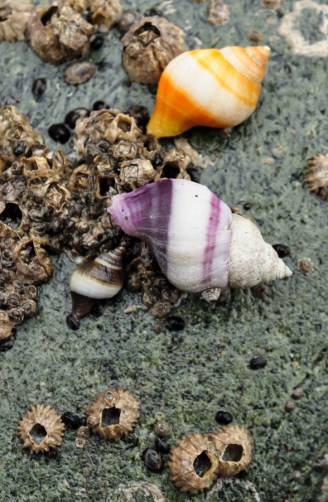
Purple was the rarest color I encountered; orange, black, grey, and pure white seemed to be the most prevalent.
Many rocks were encrusted with dozens of the snails, varying in size from babies barely larger than a pea, to a few gargantuan snails nearly four inches long. This species hatches in late winter and early spring, so this is a good time to get a sneak peak at the next generation. A female sea snail can apparently lay thousands of eggs each year, although like most species who opt for quantity over quality when it comes to reproduction, only a small percentage survive to adulthood. In the case of nucella lamellosa, that number is estimated at a paltry 1%. Upon reading this, I realized in horror that the occasional sharp “crunch” heard from underneath my boots while I was taking these photographs was nothing other than the sound of my contribution to this rather depressing and morbid statistic. But with any luck, those shell fragments I (inadvertently) created will get weathered, transported, buried, and fossilized, eventually re-surfacing in the collection of some enterprising geologist a few million years from now, a fate that can only be described as THE ultimate honor for any ambitious gastropod.

The only decent shot I got of the innards of these snails.

A handful of the less gaudy looking but substantially larger snails. The largest one here is almost three inches long.

A variety six-pack of nucella lamellosa munching on some barnacles.
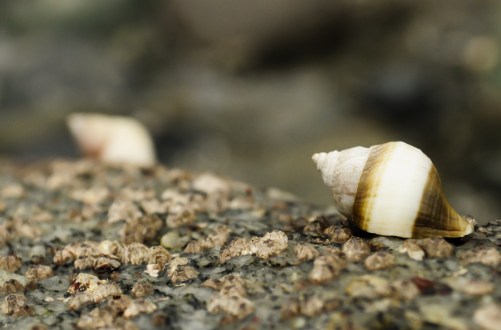

A Photographic Journey Down Chuckanut Drive

Chuckanut Drive, a.k.a. Washington State Route 11, is one of the premier attractions here on the extreme northwestern fringe of the U.S. “The Nut”, as I like to call it, winds for just over 21 miles between Bellingham and Burlington. Hemmed in by the Chuckanut Mountains to the east and numerous scenic bays, inlets, and islands on the west, it offers a stunning variety of scenery for such a short stretch of road. Chuckanut Drive has truly been a gift to me the last year and a half, because I can be cruising down it (well, as least what passes for “cruising” in a 16 year old Corolla…) and taking photos within 5 minutes of leaving my house. I’ve done this several times recently, now that the Sun is once again gracing us with its presence past 4pm.
Chuckanut Drive is chock full of destinations that make you feel further from civilization than you actually are, places that are perfect for occasions when time is in short supply. One of my favorite such spots is the beach walk at Chuckanut Bay. Fortunately for me, it also happens to be one of the closest, sitting just barely inside Bellingham city limits. Close enough for me to walk if I was feeling ambitious. Nearly inaccessible at high tide, once the water level drops a couple of feet, a few hundred yard stroll to the northwest shore of the bay puts you in the middle of spectacular and bizarre rock formations sculpted out of the Chuckanut Sandstone by freezing sea spray that accumulates along the margin of this sheltered cove. This is also a great place to see honeycomb weathering features along the shore, as is adjacent Teddy Bear Cove.
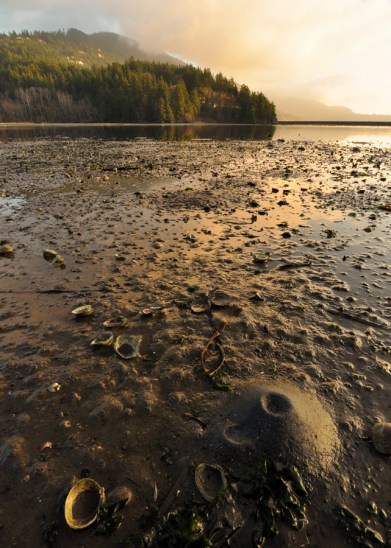
I’m not sure what sort of critter makes these little volcano-like structures, but they are all over the place at low tide in Chuckanut Bay, one of my favorite local spots for photography.

Some of the intriguing and bizarre rock formations along the Chuckanut Beach Walk.
Chuckanut Drive is heaven for the geologically inclined for a couple of reasons. For one, the road itself is built on layers of weak sandstone that slope precariously towards the sea. When it rains, water seeps into the spaces between the layers, dramatically decreasing something called the coefficient of static friction, which is normally responsible for keeping the rock intact. In other words, the water essentially lubricates the surface between rock layers, causing causing large chunks of the hillside to frequently slough off, making Chuckanut Drive one of the most landslide prone highways in the state. Last winter, it seemed like the road was closed at least every few weeks in order to repair large gashes in the pavement caused by falling boulders.
Two, the sandstone exposed here, a rock unit known as the Chuckanut Formation, is chock full of fossilized ferns, palm fronds, gingko leaves, wood, and bark, relics from a time when the Pacific Northwest was just as wet as today, but a whole lot warmer. An exposure of this same rock unit an hour to the east even turned up a footprint of a giant Eocene flightless bird a few years back, which is now on display at Western Washington University.
A few miles further south of Chuckanut Bay is Larrabee State Park, the first state park in Washington, whose landscapes and marine life I’ve documented previously and continues to be a favorite spot to catch the sunset:

The Sun dips behind the San Juan Islands as seen from Larrabee State Park.

- Winter brings frequent morning fog to the coast of NW Washington, but it usually starts to burn off around mid-day. 10 minutes after I took this photo, the fog was gone, replaced by sunshine and a clear blue sky.
Heading south from Larrabee State Park, the road becomes increasingly curvy and narrow as it clings to the hillside passing oyster bars, cascading waterfalls, and smattering of million-dollar homes. (You never actually drive along the coast proper, that route is reserved for the Burlington Northern Railroad, but the views are even better as a result.) Keep your eyes on the road and wait for one of the plethora of pull-offs where you can take it all in without running the risk of driving off a cliff.
A short but steep hike from near the route’s southern end puts one at Samish Overlook, which offers unparalleled views of the San Juan Islands, the Skagit River Valley, Olympic Mountains, and even Mt. Rainier on a clear day. On days when the winds are right, this is a launching point for local paragliders. It’s also a cool place to go during a foggy spell; at nearly 1300 feet above sea level, the Overlook sits above the fog deck most days making for spectacular sunsets and less than spectacular dark and foggy hikes back to your car.

A colorful winter sunset from Samish Overlook, nearly 1300 feet directly above Chuckanut Drive. The tops of a few of the San Juan Islands are visible protruding above the fog.
The last nine miles of the route angle away from the mountains and coast and traverse the flat lands and fields of the Skagit River Valley. But just a few miles west of the Drive, along Bayview-Edison Road, you’ll find the Padilla Bay National Estuarine Reserve, which operates an excellent interpretive center with exhibits about the coastal ecosystems of the Puget Sound area and a small aquarium. This is also a great place to spot a number of the bald eagles that visit the Skagit River Valley and surrounding area each winter to feast upon dying salmon. Padilla Bay (actually an estuary) is so shallow that at low tide, mudflats extend for hundreds of yards away from the coast.

Spring brings large quantities of nesting Bald Eagles to the Skagit River Valley. We saw four eagles within five minutes of exiting the car at the Padilla Bay Interpretive Center.

Ripples in the muck reflect a cold, windy, and colorful sunset out on the mudflats at Padilla Bay.
Eventually, Chuckanut Drive meets up with I-5 in Burlington, just a few miles north of the infamous I-5 bridge that collapsed into the Skagit River last year. From here it’s a quick 15-20 minutes drive back to Bellingham along the interstate. Or if you feel like braving that bridge, I hear there are a few good breweries in Mt. Vernon….
From the San Juans to the San Juans
They are separated by more than 1600 kilometers. One barely rises above sea level while the other boasts six peaks exceeding 14,000 feet in elevation. One is most easily accessed by kayak or porpoise, while in the other it is difficult to escape the incessant drone of Jeeps, dirt bikes, and ATVs that trawl the vast network of old mining roads. One is beset by a deluge of by rain eight months out of the year, whereas the other is inaccessible except by ski, snowshoe, or helicopter for six. To the untrained eye, the San Juan Islands of NW Washington and the San Juan Mountains of SW Colorado couldn’t be more different. My current job situation has me living about an hour away from the mountains for 3 months out of the year, and an hour or less away from the islands for the other 9 months. And viewed through the lens of a camera, I have discovered that there are more similarities that you might expect. The first of which will probably be rather obvious:
They both posses stunning scenery:

View from Deception Pass State Park on Fidalgo Island looking southwest across the water towards the Olympic Peninsula.
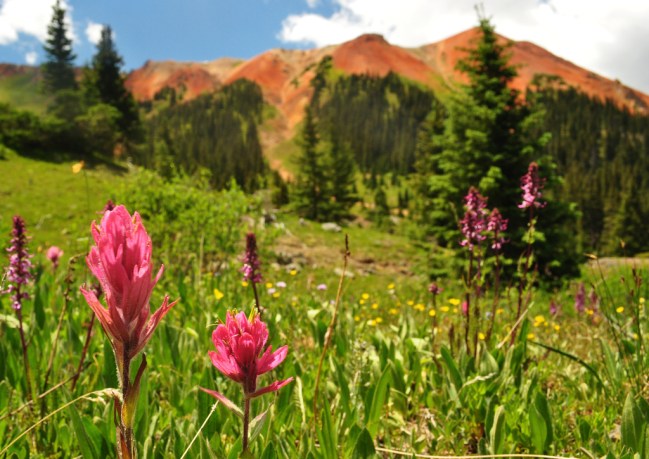
Rosy Paintbrush in an alpine meadow near Red Mountain #1 (yes, nearby can be found Red Mountain’s #2 and #3. The old miners were a creative bunch.) in the San Juan Mountains.
Both offer opportunities for “extreme” sports:
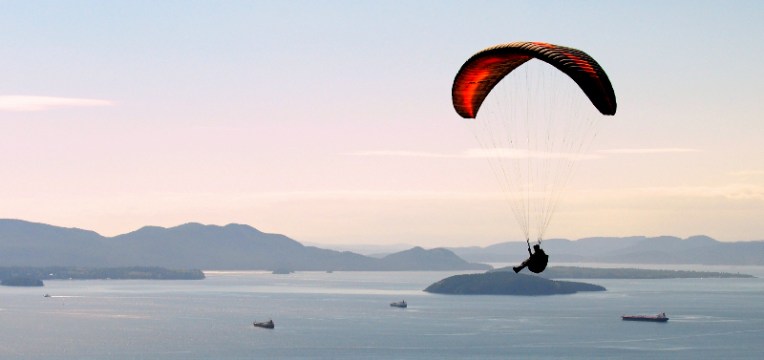
A paraglider enjoys a serene aerial view of the San Juan Islands and several tankers headed for the oil refineries in Anacortes, WA.
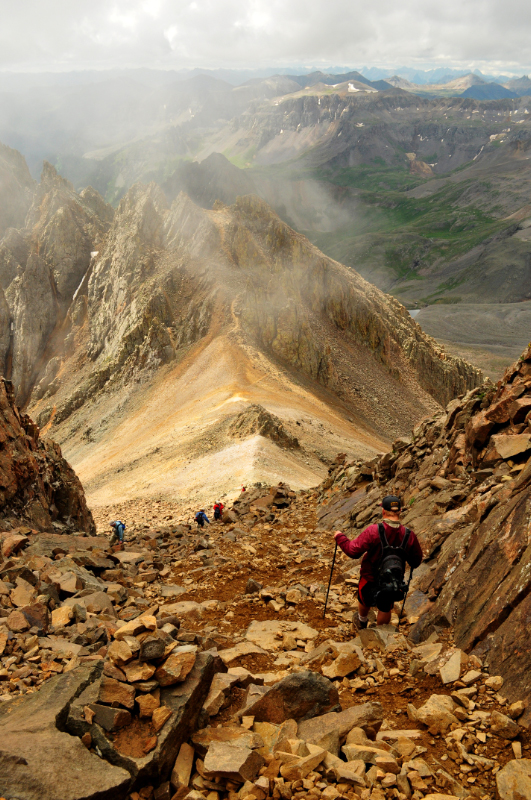
Descending a scree-filled colouir after summiting 14.150′ Mt. Sneffels in the San Juan Mountains. While most of the climb is straightforward and requires only a hefty amount of scrambling, there is one tricky section near the summit during which a fall would likely mean the end of one’s mountain climbing days…or any other days for that matter.
Both were shaped and sculpted by vast quantities of ice:
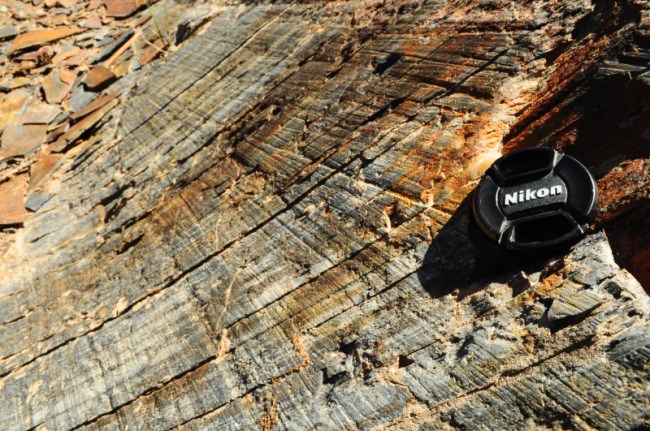
Glacial striations in slate high above the Uncompahgre Gorge in the San Juan Mountains. The parallel grooves in the rock were carved by rocky debris trapped along the base of a long-gone glacier that was partially responsible for scouring out the gorge.
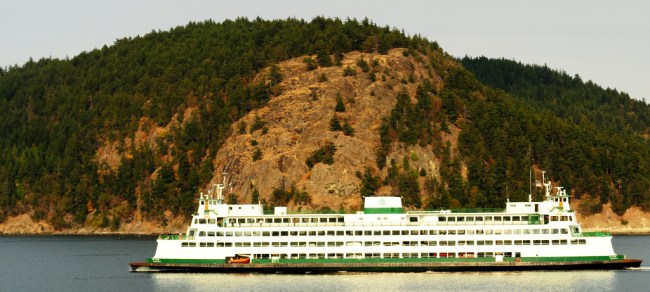
A Washington State Ferry passes a cliff of glacially scoured rock in the San Juan Islands. Glacial striations identical to those in the previous photo are ubiquitous throughout the San Juan Islands, evidence that the area was buried beneath more than a mile of ice during the peak of the last glaciation, about 15,000 years ago.
And finally, both are home to curious wildlife:
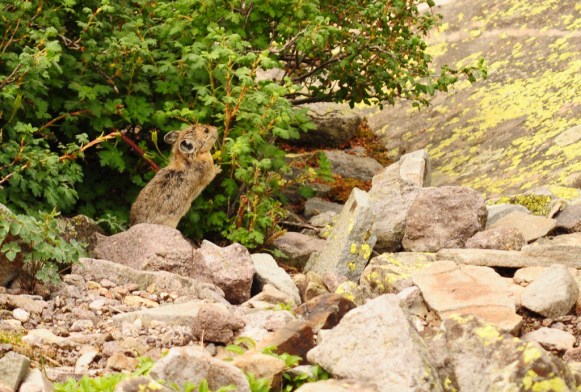
An American Pika investigates a bush at 11,000 feet in the San Juan Mountains.
 A Blood Star investigates a California mussel below sea level in the Strait of Juan de Fuca.
In case you didn’t know, that’s what starfish look like when they are curious.
 Zach Schierl Photography