The “Less” White One: Mt. Baker and the Ever-Shrinking Easton Glacier

View of Mt. Baker (right), the Easton Glacier, and the Black Buttes (left) from the Railroad Grade moraine, evidence of the former extent of the Easton Glacier.
You’ll notice that the Sun is shining brightly in all of these photos which should immediately tip you off to the fact that I’m several months behind in posting, since getting pictures this radiant at the present time would require either a a 200-mile drive east, or a 500-mile drive south. I’ll gripe more about that in a future post, rest assured.
One of the consequences of the copious winter precipitation here in the Pacific Northwest is the simply massive quantities of snow that pile up in the Cascades, just a half hour or so to the east of my current, comparatively temperate residence. In many areas, not all of that snow can melt the following summer and having more snow than you can melt is one of the key ingredients for a glacier. Almost all of Washington state north of Seattle has been covered by glaciers or ice sheets at some point in the last 20,000 years but nowadays the only glaciers remaining in WA are those high in the North Cascades and Olympics, and the tendrils of ice that snake down from the summits of the mightiest Cascade Range peaks; Mt. Rainier, Mt. Adams, Mt. St. Helens, Glacier Peak, and Mt. Baker. Although the amount of glacial ice in Washington is getting ever smaller (Mt. St. Helens’ Crater Glacier is actually one of the few in the U.S. that is actually getting larger. Can you guess why?), according to the USGS Washington remains the 2nd most extensively glaciated state, 2nd only to Alaska. And they’re WAY further north so that’s sort of like cheating anyways.

The Easton Glacier descending from the summit of Mt. Baker.
The Easton Glacier on the southern slopes of Mt. Baker is one such glacier that has undergone rapid retreat over the past century. Covered by more than a dozen glaciers, Mt. Baker is an active volcano that was known by the Lummi as Koma Kulshan, which roughly translates to “Great White One”. Mt. Baker experiences some of the largest annual snowfalls anywhere in the world, including a U.S. record 1,140 inches (that’s 95 feet!) during the winter of 1998-1999 according to NOAA. So how could its glaciers possibly be getting smaller with that much snow? To understand that, we need to understand a bit more about how glaciers work. If you groaned at that last sentence and would rather skip ahead to the pictures at this point, go ahead. I won’t be offended. In fact, since this is a website, I won’t even know. But you’ll be missing a really great analogy that I use in just a bit here so you should probably just stick with me for another paragraph or two. Plus glaciers are really cool. Pun wholeheartedly intended.
Here’s the (very) quick and (very) dirty version: A glacier is a body of ice that flows downhill. During the winter, snow accumulates on the glacier, temporarily adding to its mass. When temperatures warm the next summer, the snow on the lower, warmer portion of the glacier will melt (as will some of the ice) but some of the snow on the upper, colder portions will survive and turn into ice, replenishing the glacier. If more ice is added in the upper part of the glacier than can melt in the lower part, then our glacier gets larger. If less ice is added than is lost, the glacier gets smaller. If they two equal, the glacier stays put. As hard as it might be to believe given the massive snowfall on Mt. Baker, rising global temperatures mean that in most years, the Baker glaciers lose more mass during the summer due to melting then they gain during the long, dreary, snowy winters. In geology speak, this is known as a “negative mass balance” and, if left unchecked, it spells doom for a glacier. Now, its completely normal for a glacier to have a negative mass balance year every once in a while. No biggie. Rather, it’s when negative becomes the new normal that the glacier will begin shrinking and will continue to shrink unless something changes to bring it back into balance.
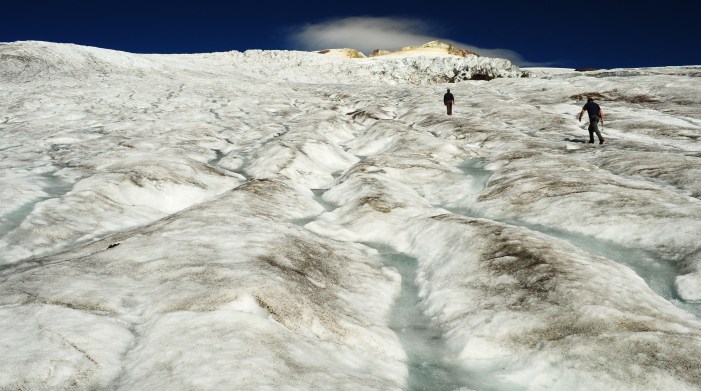
Meltwater flowing down the surface of the Easton Glacier in September.
Think of it this way: let’s say you wake up really hungry tomorrow morning and you decide to make yourself some bacon. Before you know it, you’ve gone right ahead and eaten that entire package of bacon all by yourself. I’m sure you can all empathize with THAT feeling. Anyways, while that may not be the healthiest breakfast you’ve ever had, doing so once probably isn’t going to have much of an effect on your long-term health. You’ll go for a run the next day and burn those calories right back off, much like a glacier might experience a low-snowfall year followed by a record breaking snowfall the next year to make up for it. (Note: by now you’ve hopefully noticed that this analogy starts to break down when you consider that a glacier LOSES weight during a negative mass balance year…) But if you start eating an entire package of bacon by yourself every few days, or even once a week, well….sad as it is to say, you might start having some serious health issues. Same is true for a glacier. If you lose mass one year, it probably won’t be that noticeable. But if temperatures increase, if the summer melting season becomes longer and you start losing mass year after year after year, then regardless of how much snow falls in the winter, it won’t take long before you start shrinking, and shrinking fast.
For example, here is a more expansive view of what the Easton Glacier and its surroundings looks like today:
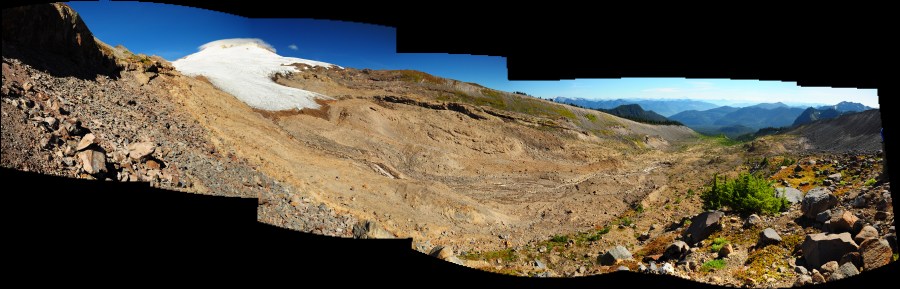
The long valley or trough stretching across the image represents the path carved out by the ice when the glacier was much larger than it is today. Just 25 years ago, much of the trough you see in the immediate foreground would have been filled with ice. The prominent ridge on the opposite side of the trough is a feature known as a “lateral moraine” (rhymes with “romaine” as in romaine lettuce, which I can emphatically say is far less tasty than bacon). A moraine consists of loose sediment that was once trapped within the ice. When a glacier is stable, i.e. when it doesn’t shrink or grow but rather sits in the same for an extended period of time, all that sediment gets deposited in large piles around the edges of the glacier when melting occurs. The presence of a moraine here tells us that the Easton Glacier once filled the entire trough to the level of the far ridge, and did so for a prolonged period of time. Considering that the ridge crest is more than 200 feet above the floor of the trough, we can see that not only is our glacier retreating, but that it was also once much thicker than it is today.
One way to get an estimate of how long the glacier has been gone from a particular area is to look at the vegetation (or lack thereof). While the time it takes for vegetation to sprout up in an area uncovered by a glacier varies widely (depending on factors such as soil development, climate, and species), often times smaller plants will begin to reestablish themselves within about 20 years or so of the glacier’s exit. In this case, much of the bare, brown/orange colored land in the center of the image was covered by ice as recently as the 1980s. Even more amazing: follow the valley downhill to the right. Look how far down we have to go before we encounter even the slightest sign of grasses, much less trees. Scale is a little tricky in this picture but see that greenery way way down at the downhill end of the trough? That point is over a mile away from where the picture was taken and it happens to mark the approximate terminus of the glacier in the mid 1800s, near the end of a cool period known as the Little Ice Age. The Bellingham Herald has a nice article on the retreat of the Easton Glacier over the past 100 years, with spectacular photos comparing the modern glacier to how is appeared in 1912, here. As you can see, it is now a shell of its former self. Other glaciers on Mt. Baker are in a similar predicament.
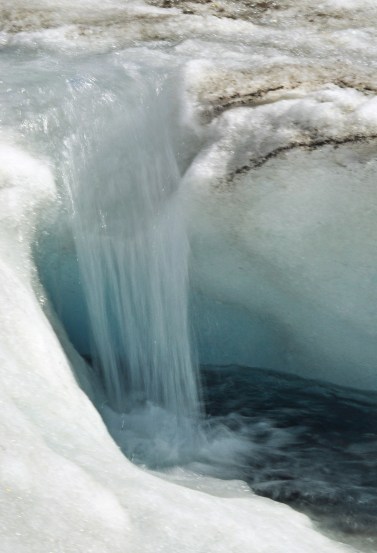
Easton Glacier remains one of the easiest glaciers to access anywhere in the continental U.S. The toe of the glacier can be reached by hiking for about 2 miles along a moderately strenuous but well-maintained hiking trail. Eventually this trail crosses a wooden swing-bridge over the meltwater creek that issues from the glacier. From here, you simply head off trail and hike up the old glacial trough for an additional mile and a half or so (at the time of publication at least…) until you hit ice. This part of the hike is decidedly more strenuous but as you can see from these photos, the scenery is spectacular! Exploring the terminus of the glacier is fascinating! Huge piles of mud and debris deposited by the melting glacier cover the ice near the toe, masking the ice and making travel treacherous. A large meltwater stream emerges from the base of the glacier through one of these piles as if by magic. The ice near the terminus is heavily crevassed so one must tread carefully when hiking on the ice itself.
So next time you’re in the area, check it out before it’s gone entirely. Who knows, maybe you’ll even burn off the calories from that pound of bacon you ate for breakfast!

Hiking back down the moraine towards the trailhead. Glacier Peak visible on the horizon at center-left.
Mountains of Sand

Sunset over the Great Sand Dunes. Note the sunlight catching the thin layer of sand being blown across the surface, no more than a few inches above the ground. Saltation in action!
I’ve been to my fair share of sand dunes; St. Anthony Dunes and Bruneau Dunes in Idaho, Oregon Dunes on the Pacific Coast, Coral Pink Sand Dunes in southern Utah, Juniper Dunes near Walla Walla, and a handful of dunes in New Zealand that I don’t remember how to pronounce much less spell. By comparison though, the Great Sand Dunes in south-central Colorado truly deserve their title. In fact, one feels somewhat uncomfortable using the term “dune” due to its complete and total inability to convey the grandiose scale of this geological wonder. A weary traveler approaching them might be liable to exclaim “That’s no dune!” (if you didn’t catch that cleverly placed Star Wars pun, you should watch this short video clip immediately) upon the realization that these are no ordinary dunes. No, they are perhaps better described as a small mountain range made of sand. When one first looks upon the dunes, it seems inconceivable that the entire massif could be made of sand. After slogging my way to their summit though, I assure you that they are.

Approaching the dunes from the south…Sangre de Cristo Mountains in the background.
Before beginning to ascend the dunes, one must first cross Medano Creek, a small stream originating in the Sangre de Cristo Mountains that flows between the mountains and the dunes. Due to the abnormally low snowfall in the Colorado mountains this past winter, by the time I visited in mid-June, this was a non-issue. The creek was only a few inches deep and therefore easily traversed. Medano Creek is nevertheless just one of many features that makes the Great Sand Dunes stand out from their sand dune brethren around the world. The presence of a reasonably reliable water source along the base of the dunes creates a beach-like environment that, judging by the number of families with small children, is very conducive to building sand-castles.
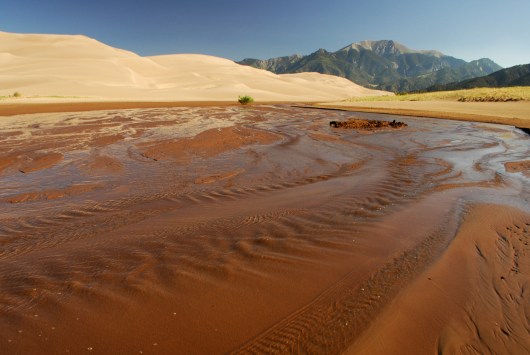
Medano Creek meanders its way across the sand flats
The hike up to High Dune (which confusingly is NOT the highest dune; that title belongs to nearby Star Dune which is about 100 feet higher) is well-traveled yet there is no official trail so everyone ends up taking a slightly different route making it difficult to find footprint-free sand for good photographs. Hike past High Dune though and you are almost immediately alone in the midst of many, many square miles of untrodden, pristine, windblown sand. Anyone who has ever hiked up a sand dune before knows that you have to expend quite a bit of energy to extract your sinking foot from the sand after each step. The somewhat demoralizing thing about hiking through sand dunes is that what takes you an hour to hike up, you can run down in less than a minute. Given that the running down part is thoroughly enjoyable; hiking the sand dunes is, in a way, analogous to waiting in line at Disneyland for two and half hours in order to go on Splash Mountain for two minutes. The analogy fails in that Splash Mountain doesn’t leave you picking sand out of every part of your body for the next three months and you don’t get an on-ride photo running down the sand dunes. However, even hiking up the dunes, while difficult, is still a very enjoyable experience.

A lone hiker trudging up a small foredune on the way to High Dune provides an excellent sense of scale

Hikers cross the final ridge to High Dune underneath a 3rd quarter Moon
Wow, I’ve written three entire paragraphs without even MENTIONING geology yet! This must stop now before they make me give my degree back. Anyhoo, most of the sand originates in the San Juan Mountains to the west, is transported to the edge of the vast San Luis Valley and then blown eastward by prevailing winds for many miles before the sand slams into the Sangre de Cristo Mountains and accumulates in a ginormous pile at their base. The color of the sand is a bit difficult to describe. During the day, it appears slightly off-white, cream, or ivory you might even say. However look at the sand closely and you’ll see that it consists of many orange to pink to yellow colored grains; colors which are brought out in all their glory at sunset. In a few spots on my hike/run down the dunes, the innards of the dunes were visible, exposing the intricate bedding pattern that results from sand being blown up the shallow side of the dune and then cascading down the slipface.
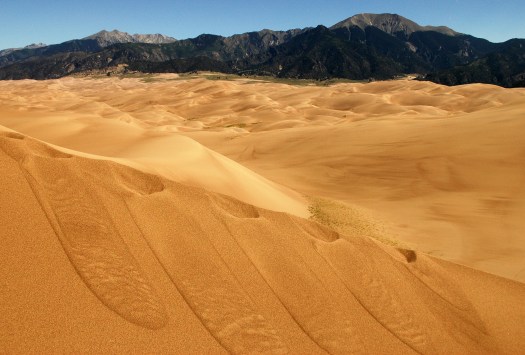
A series of 1-m scale sand avalanches slide down a steep slipface

A rare outcrop of sand reveals the layering that underlies the sand dunes
Sunset in the dunes was one of the most indescribable experiences I’ve ever…umm…experienced. Never mind that positioning yourself correctly on the dunes allows you to watch the sunset half a dozen times if you start at the top and slowly move your way downhill, the colors and patterns in the dunes brought out by the Sun setting through the smoke and haze in the western sky (much of it regrettably emanating from wildfires in New Mexico fires) were spectacular. The low angle of the sun revealed the small-scale dunes that are ubiquitous yet nearly invisible in the harsh mid-day lighting (see photo at top of page).

Looking north towards the Sangre de Cristo Mountains at sunset.
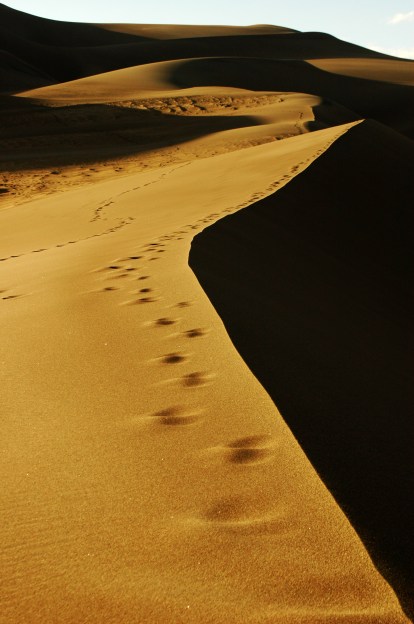
Walking along the dune crests at sunset.
Since this has already ballooned to one of my longer entries, let’s go ahead and make this Part 1 of 2. The dunes are just one of many attractions in the San Luis Valley/Sangre de Cristo region. The other attractions that I will detail soon may or may not include an alligator farm…
And that my friends, is called a “cliffhanger.”

Where the Rivers Run Orange: Remnants of a Colorado Silver Rush
The San Juan Mountains have a way of making you feel uneasy. Perhaps this has something to do with the fact that the most infamous cannibal of our time, one Alferd Packer, consumed five of his fellow prospectors here during the winter of 1873-1874. But while the alpine scenery rivals or exceeds that of any mountain range I’ve ever visited, the fact that many of the streams cascading down the steep slopes run with a neon, metallic orange color that coats every last pebble along the streambed in a golden veneer lets you know that something is wrong.
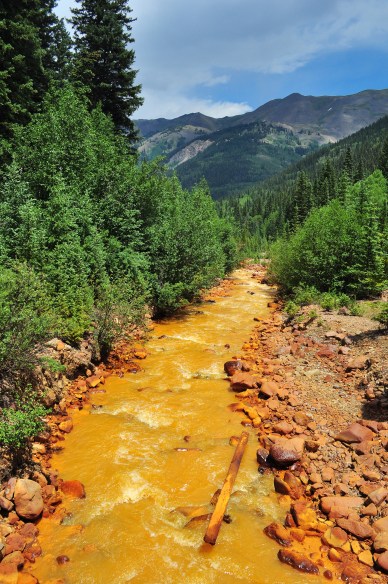
A very orange and acidic Red Mountain Creek
While you might think that someone dumped a truckload of kool-aid into the mountains, in reality it’s because the San Juan’s used to be gold and silver country. Looking at a topographic map of the San Juan’s is like looking at some sort of twisted and tortuous treasure map, with literally thousands upon thousands of tiny crosses marking the locations of long defunct mine shafts, many of them waiting to swallow up the unaware hiker. The majority of these mines were established in the later 1800’s when silver in previously unheard of concentrations was discovered in the mountains, along with smaller amounts of gold, zinc, copper, and other heavy metals. Like an enormous hardrock gopher mound, the San Juan’s are riddled with underground mining tunnels. It is possible to travel between the towns of Silverton and Telluride, several hours apart by road, without ever setting foot on the surface of the Earth. While few active mines still exist, the imprint that the mining had on the land is readily apparent to anyone traveling between Ouray and Silverton on U.S. Highway 550, commonly known as the Million Dollar Highway (for reasons which are disputed…) which, due to the persistent lack of guardrails along its more perilous stretches, is not for the faint of heart.
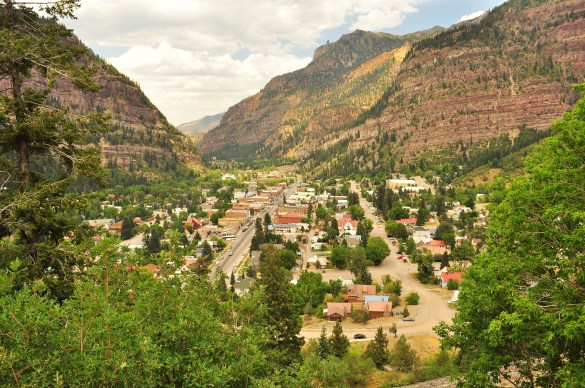
Ouray, Colorado: founded as a mining town in 1876 and the self-proclaimed “Switzerland of America”

Ouray County Road 31 heads into the mining district with Red Mountain looming in the background
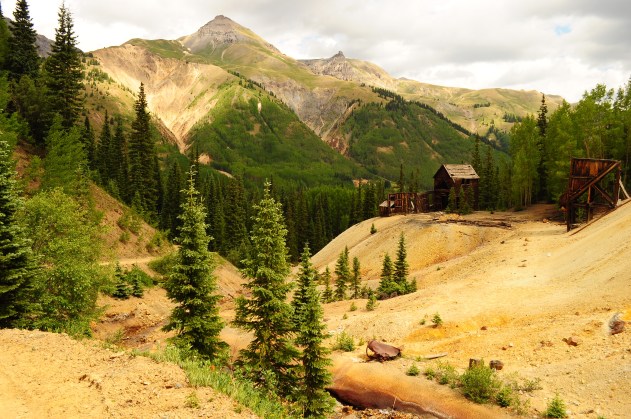
Remnant buildings and tailings of the Guston Mine
Ouray County Road 31 branches off of Hwy 550 about halfway between Ouray and Silverton and winds through the Red Mountain Mining District for several miles. This area, located about 10,000 feet above sea level, was home to a number of rowdy mining towns during the its heyday in the 1800’s. Since I am rarely (ok, never) mistaken for a history buff, an excellent history of the Red Mountain District written by people who know what they are talking about more than I do can be found here. The road is marked as a 4WD on maps road but seemed very well maintained. I ventured that I could have gotten my trusty Toyota Corolla down it when dry, but probably not at a rate much faster than I could walk it. As a result, I parked my car along the highway and struck out on foot. In hindsight this was both a good and a bad idea. Bad in that the skies of Colorado decided to unleash their first drops of moisture in months, when naturally I had left my rainjacket at home. Thankfully, old mine buildings make for decent shelter if you can find one that doesn’t look like it will collapse in the slightest gust of wind. However this was good considering that the road basically turned into a clay bog as soon as it started raining which means that I would have been S.O.L had I decided to drive instead of walk.
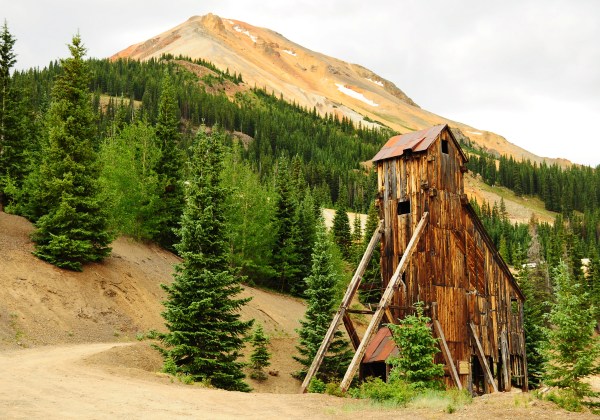
The mainframe of the Yankee Girl Mine, one of the most productive and lucrative silver mines in the San Juan’s
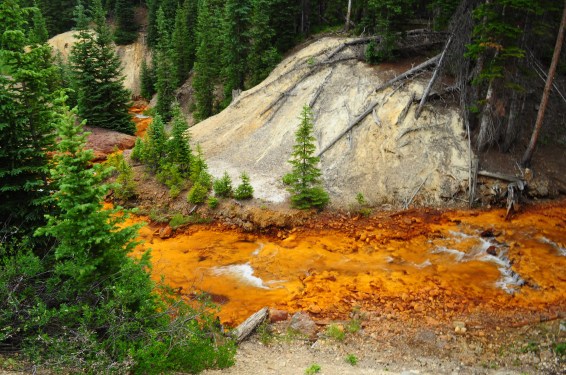
Acid mine drainage along a creek near Red Mountain
A short walk in along Road 31 and it becomes immediately apparent that the land has been completely and utterly gutted by the silver mining process. It is the bright orange creeks and streams catch your eye first. This phenomenon is known as acid mine drainage, and occurs when rainwater or snowmelt comes into contact with metal-rich rocks, such as the rock that composes the tailings piles that surround all of the old mines. The water leaches metals, most commonly iron, out of the rock and into to the water. The iron then oxidizes resulting in the highly acidic, bright orange water that flows throughout the region. Perhaps even more pervasive than the orange creeks though is the smell. Nearly all of the mines and tailings piles are accompanied by a metallic, musty odor that leaves you with the funny feeling that it would probably be a bad life decision to inhale the air for an extended period of time. The smell is truly difficult to describe, the closest analogy I can think of is the hydrogen sulfide so commonly associated with the geysers and hot springs of Yellowstone, although this still falls short. This smell was much less sulfurous and disagreeable, and while I wouldn’t go as far as to say it was pleasant, it wasn’t bad enough to make me cover my airways with a bandanna or seek refuge somewhere else.
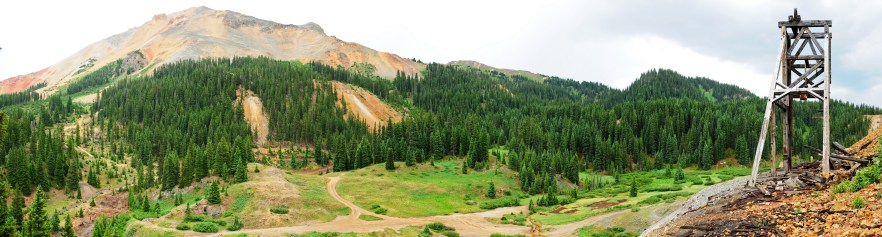
The National Belle Mine overlooks the former site of Red Mountain Town
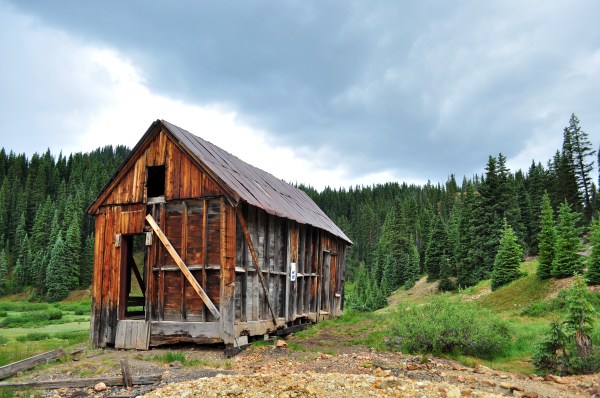
One of the last remaining structures in Red Mountain Town
Stop number two for the day was the remains of another 19th century mining camp: Ironton. Unlike the Red Mountain District, which was so extensively mined that it is essentially located on a barren hillside that has been mostly stripped of trees, Ironton and its associated mines, such as the Colorado Boy seen below, are nestled deeper within the forest. A well marked trail leads to Colorado Boy but many of the other sites in the area are located along routes that have been nearly completely reclaimed by the forest, making them difficult to find without a good map and good sense of direction since GPS devices don’t work worth a darn in the dense woods.
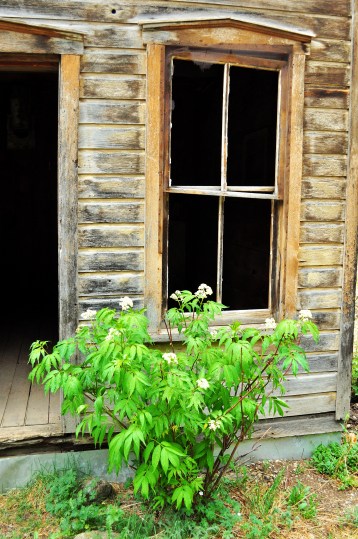
One of about a dozen structures still standing in Ironton

Mainframe of the Colorado Boy Mine
Just south of Ironton, spanning a large gully known as Corkscrew Gulch, lies a bridge that I am convinced was the inspiration for the rickety wooden span in Shrek that Donkey and Shrek traverse in order to cross the boiling lake of lava. Oddly, this interesting relic isn’t listed on any maps of the area and I was unable to find many pictures of it online, yet it was one of the highlights of the day. I initially spotted the bridge from below, it wasn’t even obvious that it was a bridge at first but being the curious cat that I am, I was naturally intrigued. After about a half hour of bushwhacking my way up the ridge on the west side of the gulch, I located the trace of an old, overgrown wagon road that eventually led me to the edge of the canyon and the bridge abutments. Now this bridge, missing as many planks as it was, would have been completely impassable regardless but for whatever reason, one of the two cables spanning the gulch had been cut causing the span of the bridge to hang like a limp wet noodle across the canyon. The bridge is in such bad shape that the weight of a house fly alighting on the remaining cable would likely cause the remainder of the structure to plummet several hundred feet to the streambed below. Interestingly, upon further research, this bridge was at one point the longest suspension bridge in Colorado. To this day, it holds the unofficial title of “sketchiest bridge in Colorado” and I don’t envision it relinquishing this title any time soon.
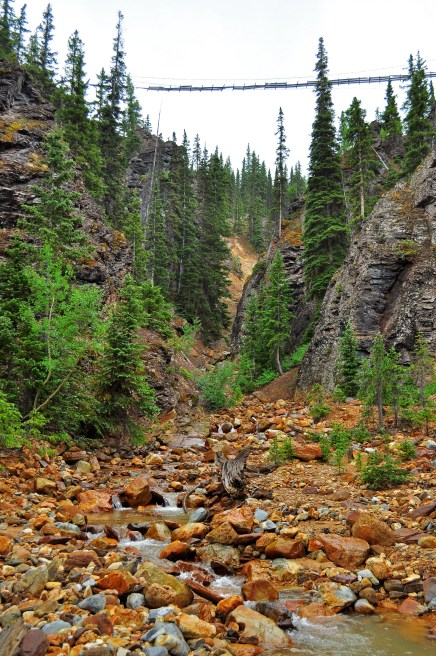
Sketchy bridge from the bottom of Corkscrew Gulch
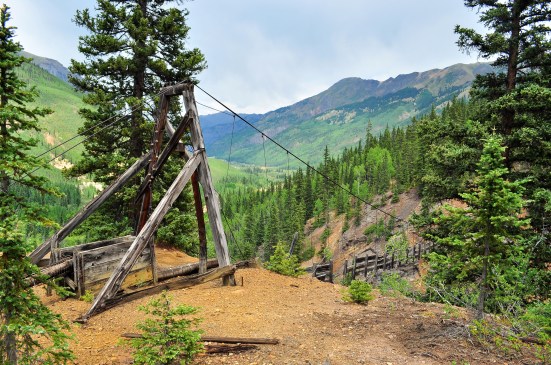
View of the bridge from slightly uphill

A closer and more detailed view of the sketchiness
Despite the glaring environmental ramifications and water quality issues associated with the mining that took place here, , spending an afternoon exploring the mines was a fascinating step back into the exciting history of the San Juan Mountains and southwestern Colorado. The mines are so prevalent and such a seemingly integral part of the landscape here that it is sort of difficult to imagine the San Juan’s without them. Just don’t drink the water….
 Zach Schierl Photography