Larch Hunting in the North Cascades
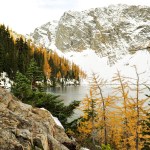

Golden Larches at Blue Lake in the North Cascades.
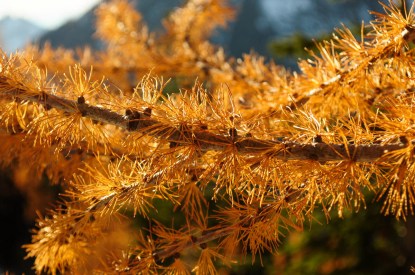
Still reeling from the disappointment of having to leave Colorado a mere fortnight before the world’s largest Aspen forests exploded into their annual displays of color, I was determined to find some similar photo opportunities in Washington this fall. The “Aspen of the Pacific Northwest” is arguably the Western Larch. Most common in the Northern Rockies, a handful of Western Larch stands can be found east of the Cascade Crest in Washington state. Tall but unassuming for 50 weeks out of the year, and then drop-dead spectacular for two, the Western Larch looks all for the world like an evergreen, but it is decidedly deciduous. Most high-altitude Pacific Northwest forests are all evergreen, so unless seeing dead and decaying brown pine-needles pile up on the forest floor is your thing, autumn up in the high Cascades isn’t anything to get too excited about. Add larch though and it’s a different story. The yellowish-green needles of the larch go out with a bang, turning a glittering golden-yellow for just a few short weeks in the late fall before leaving the tree buck naked until the following spring.

Golden larch season in the Cascades is an event that generally attracts hordes of needle-peeping Seattleites to the mountains. My hope was that the several feet of early-season snow the mountains had received in late September would be deep enough to temper the crowds. I was wrong. The parking lot at the Blue Lake Trailhead off of Highway 20 in the Okanogan National Forest was completely full, forcing us to park alongside the highway. Fortunately, photographers are born with an innate desire to bask in late-afternoon light which meant we were headed up the trail to Blue Lake late enough that most other folks were already on their way down. One advantage to having lots of folks on the trail was that we were alerted to the presence of a solitary mountain goat scrambling along a rocky gully a few hundred feet above the trail.
The lower portion of the trail was snow-free, but by the time we reached the goat and the larch groves, it was several feet deep. The main trail was hard-packed snow and ice due to all of the foot traffic but wandering off trail trying to take pictures of the larches sans people would definitely have been easier with a pair of snowshoes. The larches were nothing short of spectacular, especially against the snowy-white backdrop. In the late afternoon sun, the color of the needles was so resplendent that you could have painstakingly coated each needle in gold leaf and not known the difference. Individual larches on mountain ridges miles away could easily be picked out, their needles back lit by the sun, shining like beacons in a sea of mountains.

A surprisingly sunny and warm October afternoon in the North Cascades is perfect for larch hunting.
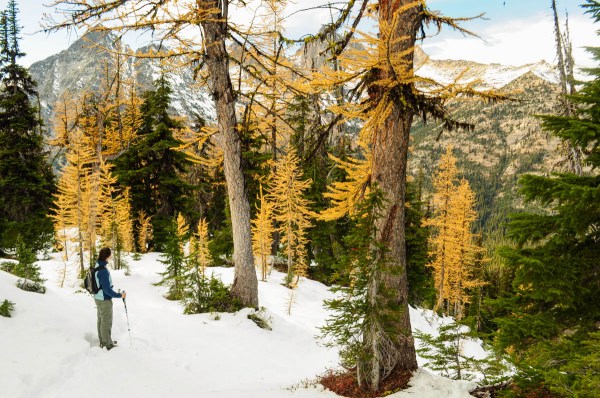
Exploring off trail, gazing out at the Cascades through the larches.
Later in the evening, headed to a lower-elevation (read: warmer) camping spot, I was able to catch the very last rays of sunlight on Liberty Bell Mountain. And just in case larches and a spectacular sunset weren’t enough, the clear skies and nearly full moon were ideal conditions for some nightscapes of the North Cascades!

Sunset along the North Cascade Highway.
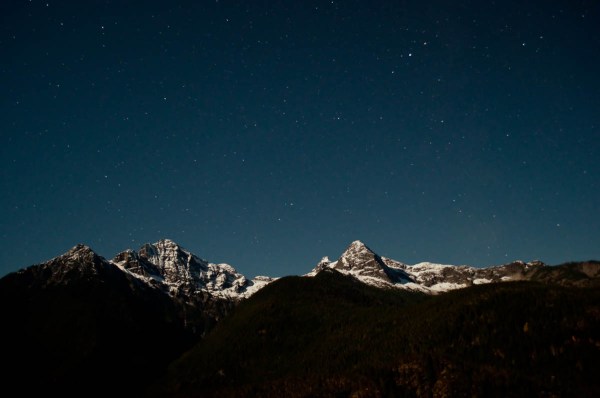
The constellation of Aquila sets over North Cascade peaks illuminated by the Full Moon .
New Life for the Elwah
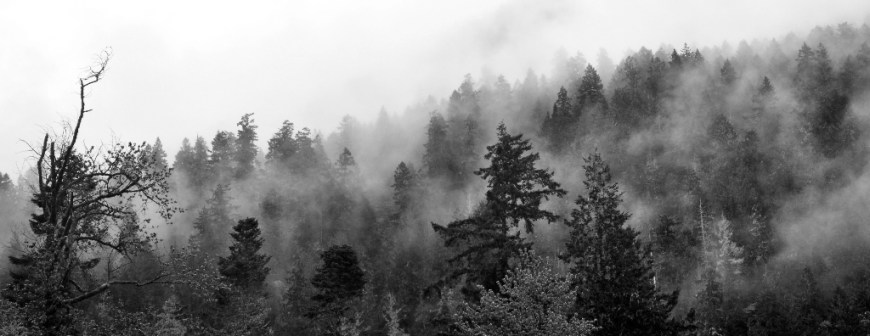
Remnants of early morning fog along the Elwah River
In 1910, the Elwah River on the Olympic Peninsula in Washington State underwent some changes. Big changes. Power was needed to support the burgeoning timber industry in and around Port Angeles, WA. A dam would be built. A 108 foot high dam that would transform the river upstream of it from from a wild, roaring river teeming with five different species of native salmon, into a flat and placid reservoir, filled not with salmon but with sediment. With no fish ladders, these salmon would be denied access to their spawning grounds upriver by a massive concrete block known as the Elwah Dam. Within a few decades, any fish that managed to miraculously jump over the 108 foot high dam would have a second nasty surprise waiting for them just a few miles further upstream, the 210 foot high Glines Canyon Dam, built in 1927.
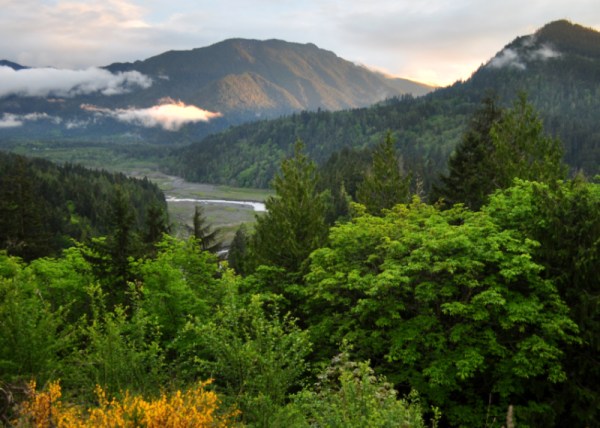
Sunset over the Elwah Valley from Highway 101, just west of Port Angeles, WA
Fast forward nearly a century, and big changes are occurring yet again. In just a few short months, these two barriers will have been completely and permanently removed and the Elwah River will once again flow, uninterrupted, from the permanent snowfields and glacier of the Olympic Mountains all the down to sea level and the Strait of Juan de Fuca. Even now (June 2013), only a small remaining stub of Glines Canyon Dam is preventing the salmon from moving back up into their traditional spawning grounds, and nearly 24 million cubic yards of sediment trapped behind the dams from moving down to the river’s mouth. To give you a sense of just how much material that is, 24 million cubic yards would be enough to bury an American football field under so much sediment that not even seven Empire State Buildings stacked on top of each other would reach the top of the pile. While numerous dams have been decommissioned and removed around the world over the past several decades, none have been as large as Elwah and Glines Canyon. Nor have any been as controversial, as indicated by the fact that Congress passed legislation to remove the dams in 1992, yet demolition did not begin until 2011.

The former site of the Elwah Dam, now occupied again by the free-flowing channel of the Elwah River

Groundwater containing dissolved iron was trapped beneath the reservoir for decades. With the reservoir gone, this water can escape and the iron rapidly oxidizes as it is exposed to oxygen in the air.
Controversy aside, it is not often that one gets the opportunity to walk along the bottom of a reservoir without fear of drowning. As removal of the two dams enters its final stages, there exists a fantastic opportunity to watch an entire ecosystem attempt to return to its natural state. I visited the Elwah River valley on a cloudy, yet pleasant by Olympic Peninsula standards, weekend in May to see the effects of dam removal first hand. My first stop was the former site of Lake Aldwell, the narrow, yet shallow reservoir, 4 km long and 30 meters deep, that once existed behind the Elwah Dam. Lake Aldwell was the lower of two reservoirs on the Elwah (the other being Lake Mills behind Glines Canyon Dam), just five miles upstream from where the river ends its 45-mile long journey from the mountains to the sea. It was also the first to be drained, in 2011, and consequently has already had an entire growing season to begin recovering from over a century of submersion. Assisted by planting efforts, so far, “recovery” consists of some small alders, grasses, and a handful of wildflowers that have taken root in the layers of extremely fine grained sediment that accumulated on the bottom of the reservoir from 1910 to 2011.
Prior to the construction of the dams, the Elwah River valley contained spectacular old growth forests, the proof of which can once again be seen today. It is is the stumps of these gargantuan trees that are perhaps the most impressive sight at Lake Aldwell. Giant cedar stumps, the result of early 20th century loggers who were understandably eager to harvest the enormous trees on land slated for inundation, have been exposed as the river rapidly washes away the layer-cake of sediment that piled up at the bottom of Lake Aldwell. The size of the stumps are humbling and they are shockingly well preserved; many of them still contain the deep, horizontal notches cut for logger’s springboards, some so fresh in their appearance that it’s hard to believe that they weren’t felled just a few years ago, a testament to the preservation power of the meters of silt and dozens of meters of water that covered them for a century.
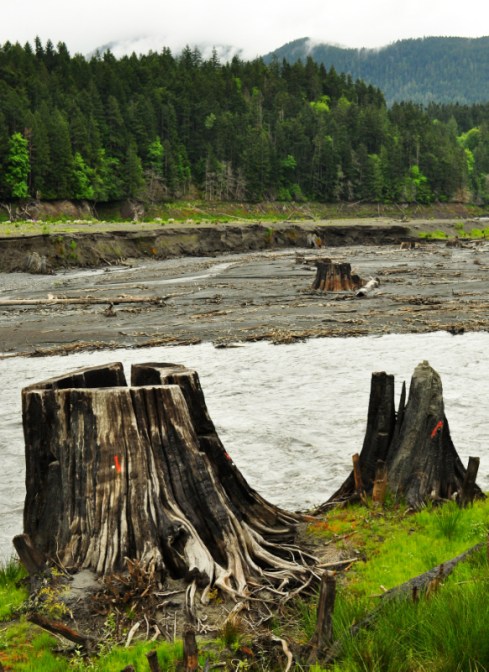
Giant Cedar stumps on the floor of Lake Aldwell. The former level of the reservoir can be clearly seen on the far bank.
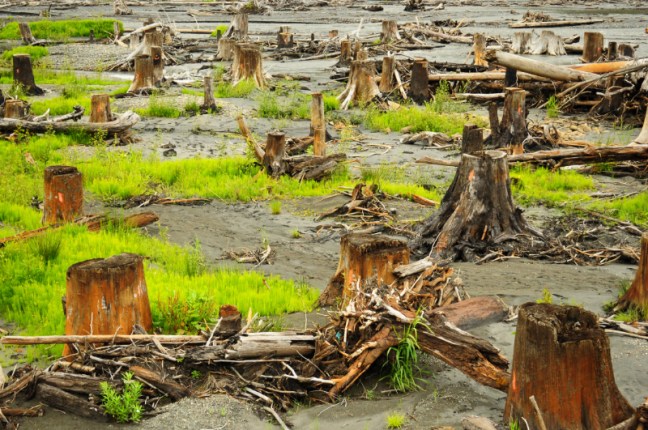
Century old stumps are joined by new vegetation just beginning to take root in the lakebed sediments.
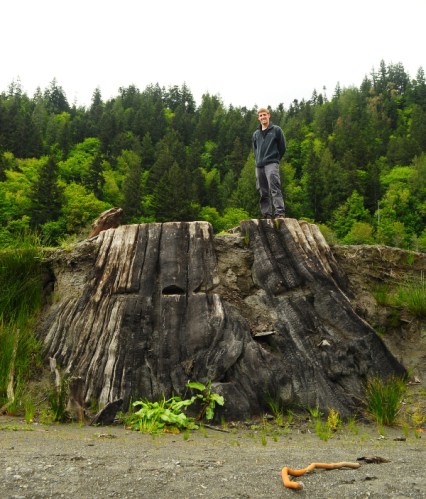
A stump that has been only partially exhumed from the sediment, with the six-foot tall photographer for scale.
The most powerful location from which to contemplate the restoration of the river is undoubtedly the site of the former Lake Mills. Unlike Lake Aldwell which is located right along US Hwy 101, Lake Mills requires a little bit of effort to get to. Located within the confines of Olympic National Park, the head of the now drained reservoir is reached only by driving up a narrow, one lane dirt road that winds through the rainforests of the Olympic Peninsula several hundred feet above the course of the Elwah. Near the end of this road, a narrow footpath leads down to what was once the lake’s edge.
Being the uppermost of the two reservoirs, Lake Mills was where nearly a centuries worth of sediment accrued, scoured out of the Olympic Mountains just as it had been for thousands of years, by storm after storm after storm blowing in off the Pacific, dousing the mountains in rain, and sweeping the sediment into rivulets, tributary creeks and streams, and eventually the cold, swift, and turbulent Elwah. Once Glines Canyon Dam was built in 1927, the whole system just shut off. Vast quantities of silt, sand, and gravel sediment that would normally create a delta at the mouth of the river began creating a delta in Lake Mills instead.
Immediately upon breaking out of the trees, one is taken aback by the sense that something drastic has happened here. Over a thousand vertical feet of dense, dark green, damp forest immediately transitions to a landscape that looks like it belongs on Mercury or the Moon rather than the lush Olympic Peninsula. One is greeted by a staircase of spectacular gravel terraces leading down to the river’s edge, terraces cut by a river eager to make up for 100 years of lost time. The river’s path is changing on a near daily basis as it cuts down through the canyons of sediment. The only sound that accompanies the roar of the river is the constant and somewhat unsettling sound of miniature rockfalls breaking loose and sending pebbles, cobbles, and sometimes boulders scurrying down slope, the sounds of a landscape still changing by the minute as the river tries to re-establish its old course through the valley.

Terraces carved out of delta sediments by the resurrected Elwah River as it runs through the valley formerly occupied by Lake Mills.
The erosive power of the Elwah can be seen just by observing its color as it runs through its former delta. When the river first exits the confining gorge of Rica Canyon and explodes out into the wide valley once occupied by Lake Mills, it shines with a brilliant aquamarine color, almost tropical in its hue, due to the presence of extremely fine grained sediment suspended in the river. The river does not retain this color for long though. For decades, any coarse sediment brought here by the river would be abruptly dropped at the entrance to Lake Mills, as the energy level of the river dropped precipitously entering the tranquil reservoir. Now, with the reservoir gone, all that sediment is there for the taking and the river quickly takes full advantage. Just a few hundred yards later, the river has turned the color of a late-afternoon summer thunderstorm, a deep and foreboding dark gray, as the Elwah picks up coarse sediment and begins moving it downstream where it naturally belongs.

While the dams may be gone, and the fish have already shown signs of returning, the story of the Elwah is, in reality, just beginning. All the effects, both positive and negative, of such a large scale experiment won’t be known for many decades. I encourage you to go see it for yourself; as I mentioned earlier, opportunities to experience a landscape changing at such a rapid rate are rare, much less one in as spectacular of a setting as the Elwah River.
More information about the Elwah River Restoration project can be found here. To get a better idea of the changes that have occurred so far, I strongly recommend checking out slideshows and time-lapse videos made from a series of webcams that have been monitoring the progress here.
Monterey, California: Famous for the Coast, Famous for the Cheese
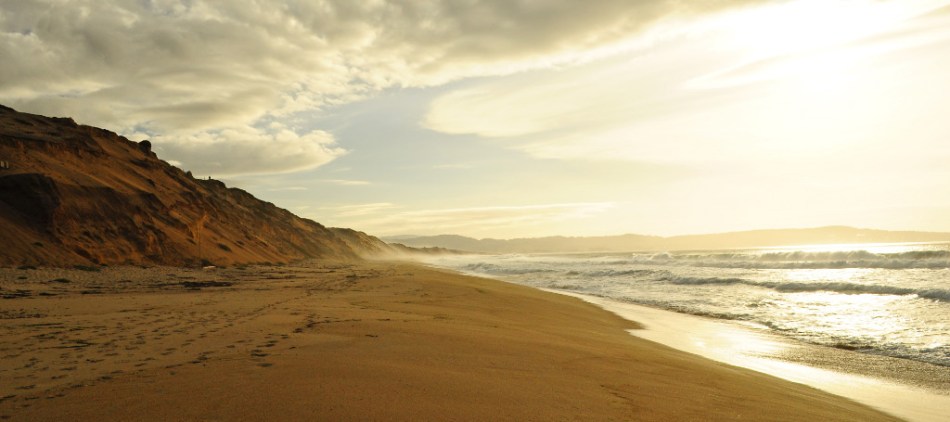
Sunset at Fort Ord Dunes State Park
Did you know that Monterey Jack cheese takes it’s name from the city where it was first made by Spanish settlers and then later first commercially marketed by a Scottish immigrant? Neither did I. That is, until I came across a lovely, if somewhat small and water-logged (and apparently created on a home inkjet printer…) interpretive sign informing me of that fact on a recent hike to the top of the peak that now bear’s Jacks’ name:

The Sign
Located just outside of Monterey, CA, Jacks Peak is the highest point in Monterey County topping out at a whopping 1,068 feet above sea level. The sign left me curious, and wanting to learn more about this mysterious Jacks fellow and his delicious cheese. After much additional research, I am now able to present you with the following information:
1. There is actually a fair bit of ongoing, spirited debate over who exactly should be credited with first making “Monterey jack” cheese. And Julius Caesar is involved…somehow.
2. According to the Monterey County Historical Society, Monterey jack is one of just four varieties of cheese to have been invented (created? first made? can one really “invent” cheese?) in the United States. In other words, while the U.S. may be top dawg at spitting out fancy new electronic devices that start with a lower case “i”, we are seriously lacking when it comes to new innovation in the field of dairy products.
3. Due to it’s creamy texture, Monterey Jack is excellent for making grilled cheese sandwiches.
I probably could have kept this list going for a while but reading page after page about cheese made me hungry. Lacking any authentic Monterey jack, I instead “settled” for a large hunk of Tillamook aged medium white cheddar, a piece of cheese that was so tasty I seriously considering including a picture of it right after this period. In fact, I still am considering it.
Monterey is also famous for a number of other attractions, nearly all of which, sadly, have little or nothing to do with the cheese that so admirably and bears the city’s name. Most of them do, however, involve the ocean in some way or another which is a pretty good consolation prize if you ask me.
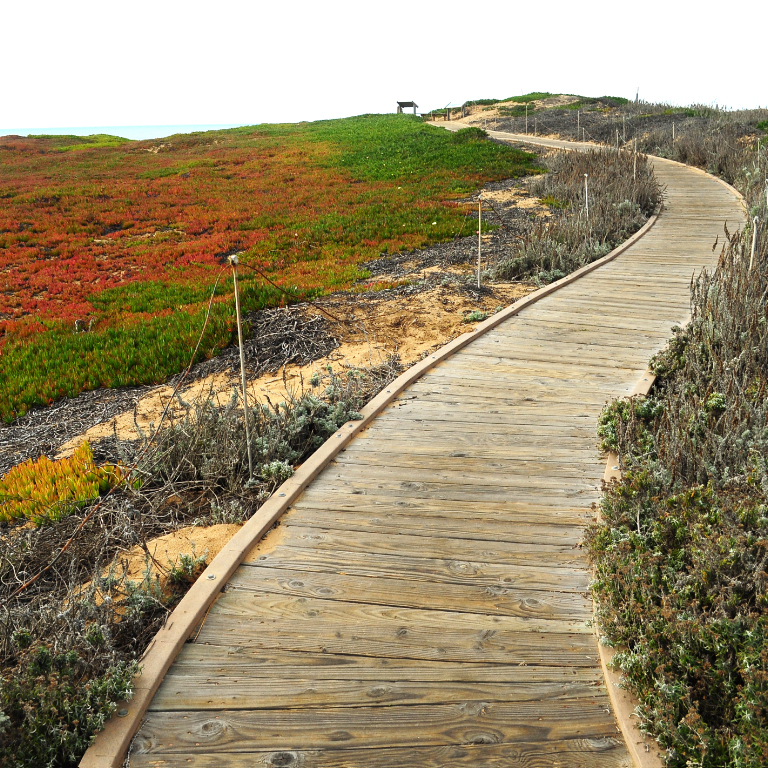
A boardwalk snakes through a field of invasive ice plant at Fort Ord Dunes State Park
Fort Ord Dunes State Park is one of the newer such attractions. Not new in the sense that the beach or the dunes itself are new (they’re quite old actually) but new in the sense that the land it occupies was for many years part of the Fort Ord U.S. Army post. In 1994, the Fort was closed and since then much of the land has been reclaimed and opened to recreational use. Over 10,000 acres were set aside by President Obama as Fort Ord National Monument 2012. A small strip of the beach and adjacent dunes just north of Monterey became Fort Ord Dunes State Park (pictured above) in 2009.
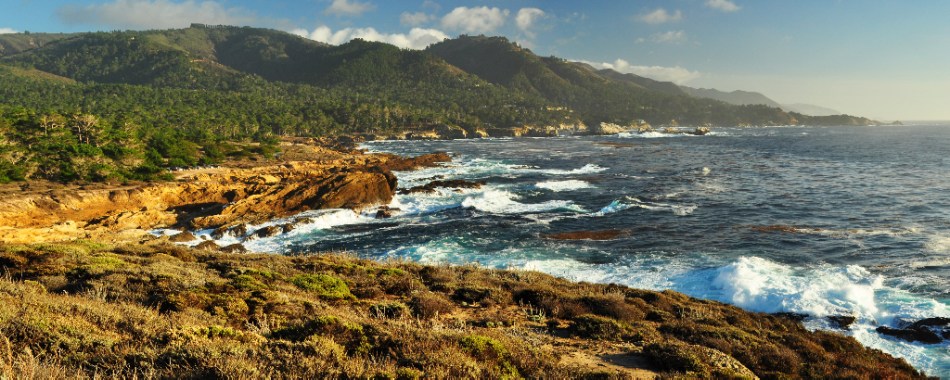
Looking south along the California coast from Point Lobos State Reserve
Clear on the other side of town is Point Lobos State Reserve, also part of the California State Park System. The scenery at Point Lobos is breathtaking to put it mildly. In slightly more concrete terms, it was WELL worth the drive back into town to withdraw some cash so we could pay pay the cash-only $10 entry fee to the park. Now, you can also park on the highway and walk in for free but in my humble opinion, $10 is a small price to pay to keep one of the most spectacular stretches of coastline in the world preserved for all to see. Like the nearby, and arguably more famous, 17-mile-drive and Pebble Beach area, the Point Lobos reserve protects rugged and rocky stretches of coastline, sheltered coves home to seals, sea lions, and sea otters, and one of the last remaining stands of Monterey cypress. What you won’t find here though is multi-million dollar mansions and immaculately manicured golf courses dotting the coast which in my view improves the scenery to a level that is beyond my ability to communicate via words.
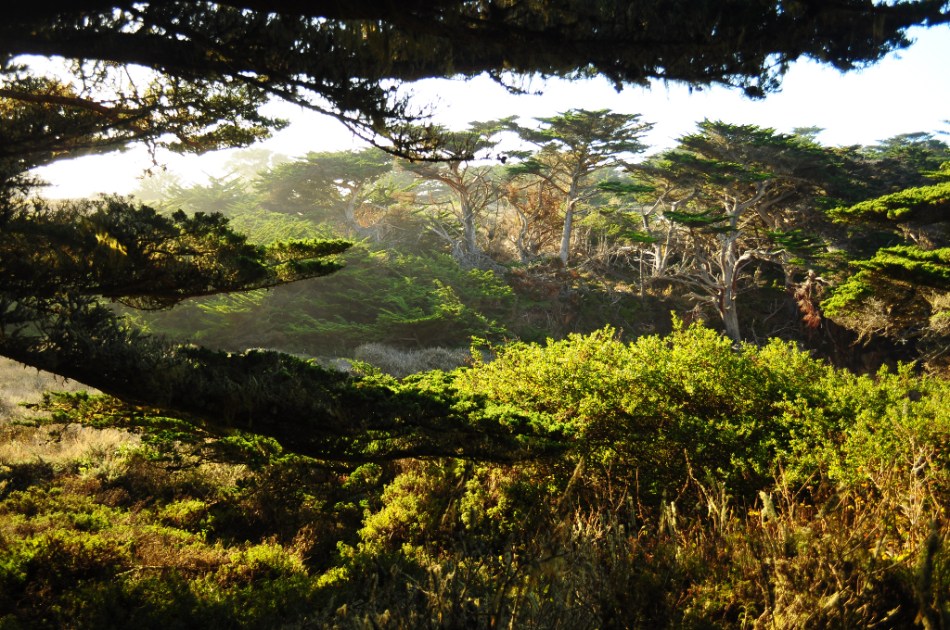
One of only two remaining groves of Monterey cypress (Cupressus macrocarpa) trees on Earth, Point Lobos State Reserve
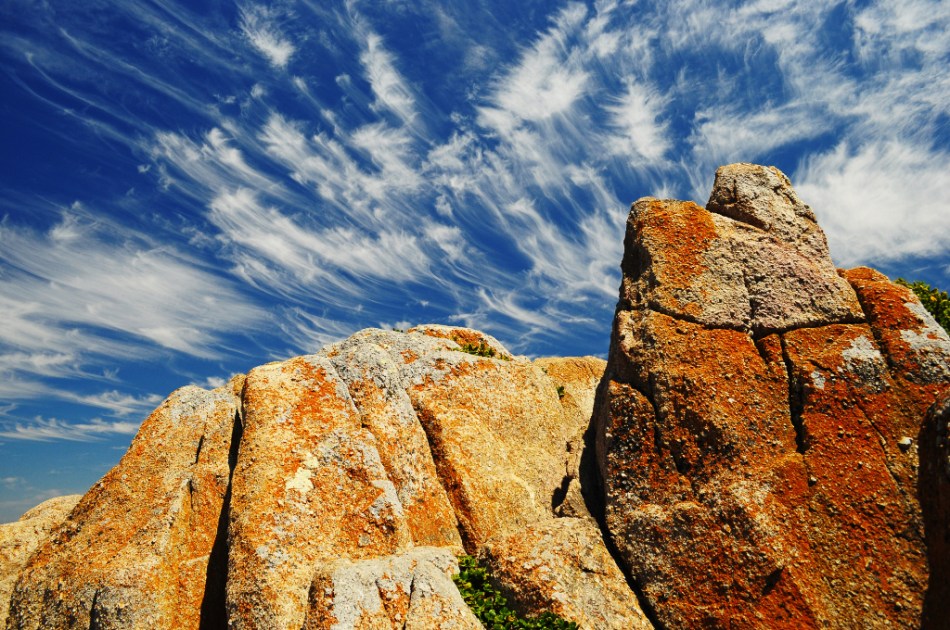
Wispy cirrus clouds hover above Lover’s Point in Monterey, CA

The hoards enjoy a beautiful winter sunset from Carmel Beach
Last but not least is Carmel Beach, located in the small hamlet of Carmel, which is distinctive in that it eschews street lamps and prohibits the wearing of shoes with heels higher than two inches. It is also one of the few towns in the U.S. to forgo street numbers. While you mull on that for a bit, take note that Carmel Beach is oriented almost directly towards the late afternoon sun, making it an ideal location to spend the end of your day watching our local nuclear fusion reactor dip below the apparent horizon of the Earth (that’s a more astronomically correct way of saying “sunset”). Note also that you won’t be alone. No matter though, just bring a blanket, a box of crackers, and some cheese and enjoy the show!
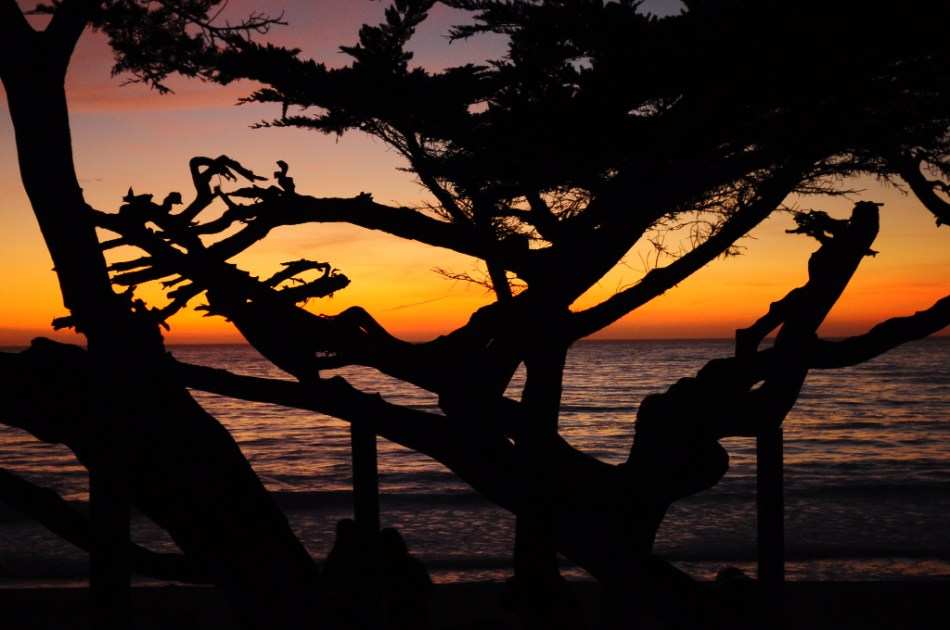
Sunset at Carmel Beach
 Zach Schierl Photography