Desert in Bloom

Southern Utah isn’t typically known for its wildflowers, but one particular family of plants puts on an annual show that rivals the rocks in brilliance and diversity of hues. While snow still lingers in the mountains, the lower elevations are bursting with color as a plethora of cacti are currently in bloom. For most of the year, the abundant low-growing prickly pear and hedgehog cacti hardly stand out in a landscape chock-full of sharp, spiny plants that collectively make cross-country hiking miserable. Right now though, it is hard not to take notice of these hardy plants. So electric are the colors that simply keeping ones eyes on the road is difficult given the rainbow peeking out from the desert scrub:

Florescent pink Beehive Cactus (Escobaria vivipara) flowers, San Francisco Mountains, Utah
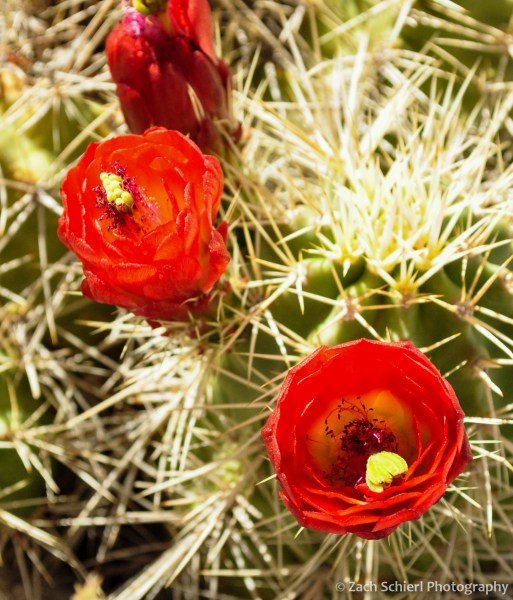
Claret Cup Cactus (Echinocereus triglochidiatus) flowers, San Francisco Mountains, Utah

Beautiful orange, almost salmon-y, flowers of the Desert Prickly Pear (Opuntia phaeacantha), Pipe Spring National Monument, Arizona. This is the first time I’ve seen flowers this color on a prickly pear…perhaps some sort of hybrid?

Dense spines and bright pink flowers of the Mojave Prickly Pear (Opuntia erinacea), Beaver County, Utah

A stately row of pink Desert Prickly Pear (Opuntia phaeacantha) flowers, Washington County, Utah

Red and yellow flowers of the Desert Prickly Pear (Opuntia phaeacantha), Washington County, Utah

Engelmann’s Hedgehog (Echinocereus engelmannii) flower, Red Cliffs Desert Reserve, Utah

Electric pink flowers of the Golden Prickly Pear (Opuntia aurea), Washington County, Utah. I realize it looks like I just jacked up the saturation on this photo, but the vibrancy of these flowers is truly that stunning, almost tropical in nature.
While the cacti may be the main event, a supporting cast of other wildflowers contribute as well:

Mylitta Crescent (Phyciodes mylitta) butterfly on Desert Marigold (Baileya multiradiata), Red Cliffs Desert Reserve, Utah

Straggling Mariposa Lily (Calochortus flexuosus), Red Cliffs Desert Reserve, Utah
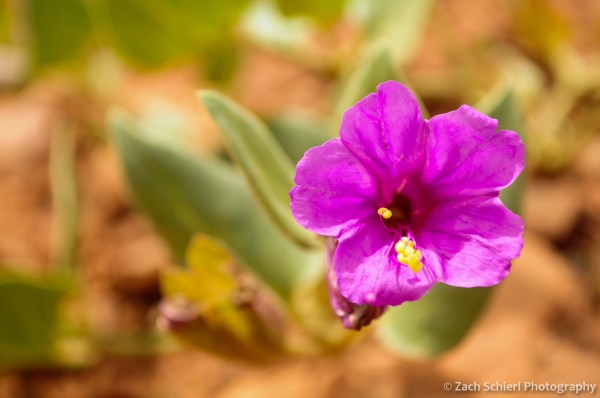
Desert Four-O’Clock (Mirabilis multiflora), Pipe Spring National Monument, Arizona
Giants of the Desert(s)

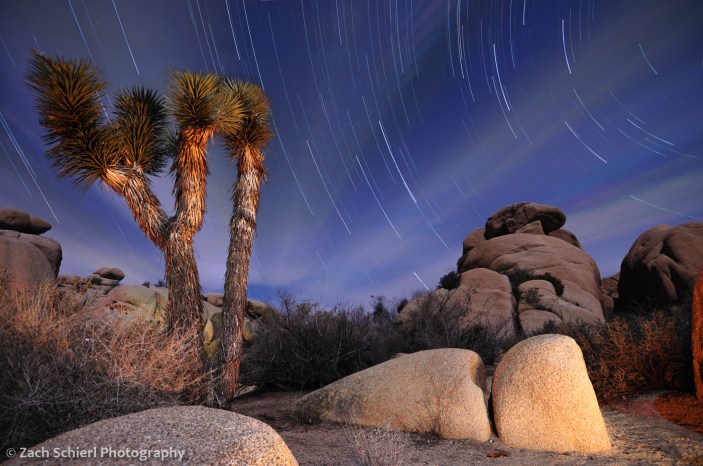
Star trails and high clouds from Jumbo Rocks Campground, Joshua Tree National Park
Driving across the southwestern United States, one could be forgiven for thinking that all deserts are the same. However, differences in elevation, temperature, topography, and precipitation make them distinct in ways that are often hard to comprehend from a fast-moving car.
For all their differences though, both the subtle and the striking, the Mojave and Sonoran Deserts share one thing in common; the most visible symbol of each is a large, majestic, and photogenic plant perfectly suited for the harsh conditions in which it evolved to inhabit.

A spectacular winter sunset at Joshua Tree National Park
For the Mojave Desert, that plant is the Joshua tree (Yucca brevifolia). Not actually a tree but rather, as the scientific name betrays, a species of Yucca, early settlers bestowed the befuddling name upon this plant after noticing that the contorted arms resembled the prophet Joshua raising his arms to the sky in prayer.
Today, the Joshua tree is considered an indicator species for the Mojave Desert, as many other inhabitants of the Mojave (two-legged, four-legged, and winged alike) depend on it for survival. The Joshua tree grows through portions of western Arizona, southeastern California, and southern Nevada, but some of the largest and healthiest stands are protected within the boundaries of Joshua Tree National Park and Mojave National Preserve.


Sunset colors illuminate the landscape at Joshua Tree National Park

A nearly full moon hovers over a Joshua tree at sunset
For the Sonoran Desert, the symbolic plant is the saguaro cactus (Carnegiea gigantea). Despite the nearly ubiquitous use of the saguaro as a symbol of the American Southwest, this excruciatingly slow growing cactus actually only grows in a small portion of the Sonoran Desert extending from extreme northwestern Mexico into south-central Arizona.

Sunset from the Gould Mine Trail in Saguaro National Park. On the horizon is Kitt Peak, home to one of the largest astronomical observatories in the United States
Like the Joshua tree in the Mojave, the saguaro is an integral part of the Sonoran Desert ecosystem. Birds such as the Gila woodpecker nest within the flesh of the cactus while the fruits and flowers provide a source of food for many other species, including humans. When the end finally comes for a saguaro (which can take well over 100 years), the flesh rots away to reveal an internal structure consisting of a series of wooden ribs, which often remain standing long after the saguaro dies:
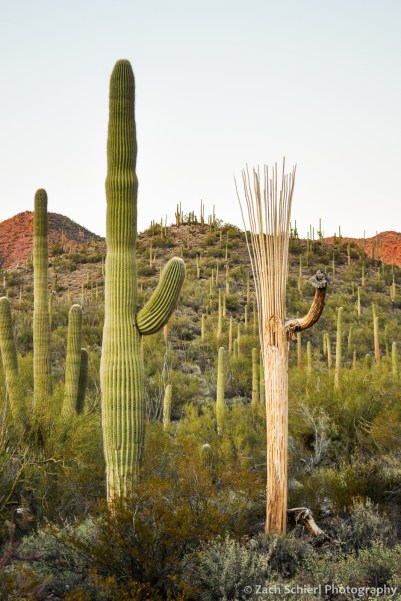
A young saguaro mimics a neighbor who has seen better days
Both the saguaro and Joshua tree face serious threats; in the long term from a climate that may change faster than they are able to migrate, and in the short term from a loss of habitat due to rapidly ballooning human populations in the desert regions that these giants inhabit.
(Petrified) Forests of Stone

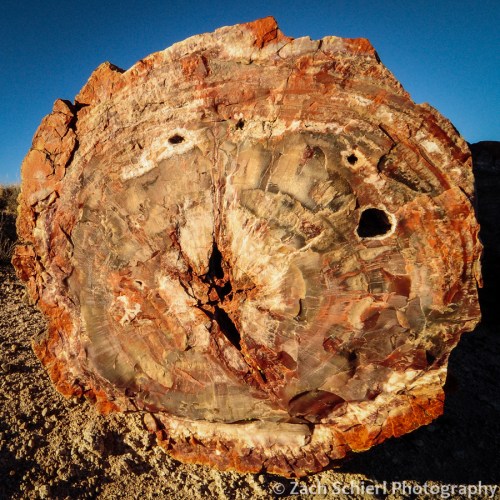
Despite being comprised almost entirely of quartz, trace amounts of elements like iron and manganese give petrified wood its myriad of colors.
I grew up about 90 minutes away from Petrified Forest National Park and, aside for a quick lunch stop about 10 years ago, had never visited before last week. While this is nowhere near as inexcusable as living in Arizona for decades and never visiting the Grand Canyon (yes, such individuals exist…I’ve met many), it still seemed like a bit of an oversight on my part. Or it could simply be a reflection of the inordinate number of outdoor activities that exist in northern Arizona; even living in the area for 10+ years isn’t enough time to hit everything. Either way, after finally venturing into the Petrified Forest, I can emphatically say that it should be mentioned with the best that northern Arizona has to offer.
Located amongst the vast Painted Desert of northeastern Arizona, the main attraction of Petrified Forest is of course the petrified wood. The formation of petrified wood is initiated when downed trees are quickly buried by sediment. Once entombed in the sediment, the lack of oxygen prevents the logs from decaying as they normally would when exposed directly to the atmosphere. In this case, the logs (none of which remain standing, despite the name “Petrified Forest”) were likely brought here in massive logjams along an ancient river system that existed during the Triassic period. A combination of sediment from the river and ash from nearby volcanoes buried the logs, not to be seen again for more than 200 million years. During this time, as the logs became buried under an increasingly deep pile of overlying sediment, dissolved silica began to crystallize in the pore spaces of the wood as quartz, eventually replacing all of the organic material while maintaining the original shape and structure of the log.

A brilliantly colored petrified wood fragment.
Petrified wood is not particularly rare. Good examples abound in Yellowstone National Park, Washington state, Utah, Colorado, Oregon, Alberta, New Zealand…the list goes on and on. What makes Petrified Forest National Park unique is the quantities found here. Due to the aforementioned Triassic log jams, large quantities of wood were concentrated in small areas. In a location known today as Jasper Forest (see photos below), movement was not possible without walking over a nearly uniform carpeting of small petrified wood fragments and frequently having to clamber over 2-3 foot diameter logs. Truly stunning!

Petrified wood in the Jasper Forest, Petrified Forest National Park.

Overlooking the Jasper Forest at sunset.
Another unique aspect of Petrified Forest is the colorful canvas on which the wood is found. The wood is eroding out of a rock unit known as the Chinle Formation, which essentially consists of all of the river sediment and volcanic ash the buried the trees in the first place. More than 1000 feet thick in the park, the Chinle Formation is composed primarily of extremely soft mudstones, clays, and volcanic ash. Water is able to easily sculpt the soft rock into fantastically colored and oddly shaped badlands that make a spectacular backdrop for the logs.
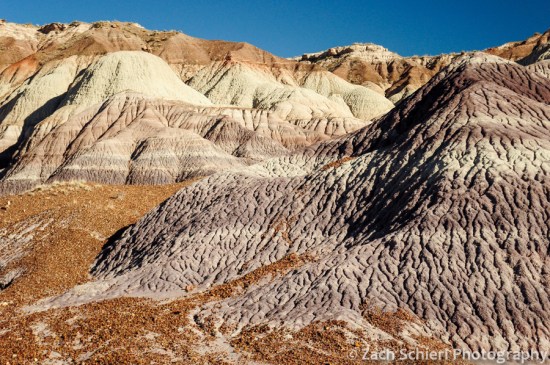
The soft muds and clays of the Chinle Formation are easily eroded, forming badlands-like topography throughout the Painted Desert.

Colorful badlands in the Chinle Formation at Blue Mesa.
Petrified Forest National Park faces an issue not encountered by most other national parks, namely, the wholesale theft of the very resource it was established to protect. For this reason, the park is only open during daylight hours (from 8-5 in the winter) to minimize opportunities for looting. It strike me as very sad that such measures are necessary. With a little geological perspective, it becomes clear how incredibly lucky we are to experience a landscape like Petrified Forest at this moment in time. So easily eroded is the Chinle Formation that in many locations, several inches of it are removed each year. This may not sound like much, but geologically speaking, that’s a veritable bullet train of erosion. While it took tens of millions of years for the Chinle to be deposited, it will be erased from our planet by the unceasing forces of weathering and erosion in a tiny fraction of that. The petrified logs, being comprised mostly of silica, are harder and will last a little longer, but are still brittle and will eventually be washed into the Little Colorado River and swept downstream along with the colorful Chinle badlands.
What all this means is that the colorful Painted Desert/Petrified Forest landscape we see today is one that is extremely temporary. While this is true of most landscapes we see on Earth today—our planet likes to re-build, re-arrange, re-shape, and remove constantly—the Painted Desert is even more ephemeral than most. While mountain ranges comprised of harder, erosion-resistant granite or quartzite (like most of the Rockies) can stand the test of time to some degree, the longevity of the Painted Desert, its soft sediments, and its brittle petrified wood is comparatively brief. Stealing this treasured natural resource only abbreviates our time with the Petrified Forest even more.

Pieces of petrified wood accumulate in small hollows in the extensively gullied Chinle Formation.

The soft sediment surrounding the logs is easily transported away by small streams and washes.

Relatively hard chunks of petrified wood and quartz protect the softer sediment of the Chinle Formation from erosion, forming pedestals small…

…and large!
 Zach Schierl Photography