Exploring the Earth and Sky of the West

Latest

Snails of a Different Color

DSC_8370

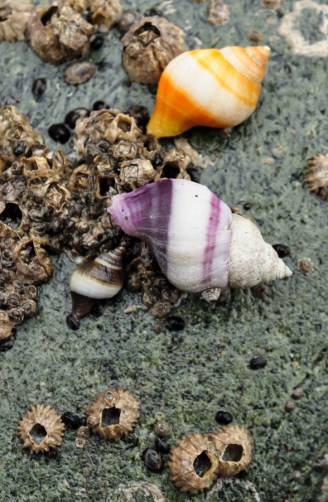
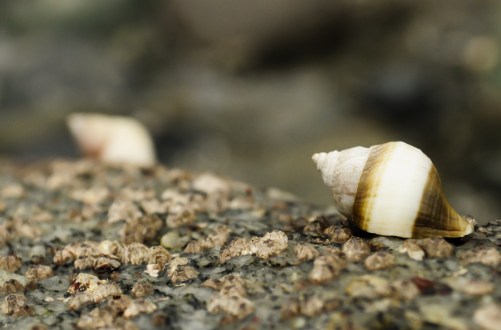
Up until a few days ago, I would have felt extremely confident saying that I’ve seen more fossilized sea snails in my life than I have real ones. After all, teaching a lab that revolves around sedimentary rocks for two quarters will put one in close contact with more dead gastropods than one ever thought possible. And when you spend a lot of time staring at multi-million-year-old fossils, it’s often easy to forget that lots of the little buggers have closely related relatives still trolling the high seas today.DSC_8284Just a few of the many, many, MANY different colored and patterned varieties of nucella lamellosa, the Frilled Dogwinkle

A few days ago though, I stumbled upon a sea snail breeding ground of epic proportions at a place called Point Whitehorn Marine Reserve. I had gone there with the express purpose of looking at rocks and I remain convinced that the snails made their dramatic appearance in order to force me to confront the inherent irony in going to a marine reserve to look at rocks. Near the low-tide line, a couple of bright orange striped shells grabbed my attention, sticking out marine creamsicles amidst the backdrop of drab green algae and seaweed, dull brown barnacles, and grey sky reflected in the waves. I soon realized that I was surrounded (in a benign and not even remotely threatening way) by hundreds upon hundreds of sea snails exhibiting a dazzling array of different colors and patterns.

Now, my knowledge of sea snail taxonomy is limited, but it appears that despite the disparate appearance of these snails,  they are all part of the same species: nucella lamellosa, also known as the Frilled Dogwinkle or Frilled Whelk (if anyone has information to the contrary, please let me know). Most of the snails in these photos are smooth; they have lost their ridges or frills that normally run along the length of their shell. This is apparently a common fate of nucella lamellosa that choose to spend their lives in places like Pt. Whitehorn which experience very rough surf during the winter. The frills literally get worn away, not at all surprising when you consider that the shells are made out of calcium carbonate, a substance that in it’s crystalline form is only a we bit harder than drywall.

DSC_8378

Purple was the rarest color I encountered; orange, black, grey, and pure white seemed to be the most prevalent.

Many rocks were encrusted with dozens of the snails, varying in size from babies barely larger than a pea, to a few gargantuan snails nearly four inches long. This species hatches in late winter and early spring, so this is a good time to get a sneak peak at the next generation. A female sea snail can apparently lay thousands of eggs each year, although like most species who opt for quantity over quality when it comes to reproduction, only a small percentage survive to adulthood. In the case of nucella lamellosa, that number is estimated at a paltry 1%. Upon reading this, I realized in horror that the occasional sharp “crunch” heard from underneath my boots while I was taking these photographs was nothing other than the sound of my contribution to this rather depressing and morbid statistic. But with any luck, those shell fragments I (inadvertently) created will get weathered, transported, buried, and fossilized, eventually re-surfacing in the collection of some enterprising geologist a few million years from now, a fate that can only be described as THE ultimate honor for any ambitious gastropod.

DSC_8443

The only decent shot I got of the innards of these snails.

DSC_8371

A handful of the less gaudy looking but substantially larger snails. The largest one here is almost three inches long.

DSC_8294

A variety six-pack of nucella lamellosa munching on some barnacles.

DSC_8316

DSC_8355

A Photographic Journey Down Chuckanut Drive

Chuckanut Drive, a.k.a. Washington State Route 11, is one of the premier attractions here on the extreme northwestern fringe of the U.S. “The Nut”, as I like to call it, winds for just over 21 miles between Bellingham and Burlington. Hemmed in by the Chuckanut Mountains to the east and numerous scenic bays, inlets, and islands on the west, it offers a stunning variety of scenery for such a short stretch of road. Chuckanut Drive has truly been a gift to me the last year and a half, because I can be cruising down it (well, as least what passes for “cruising” in a 16 year old Corolla…) and taking photos within 5 minutes of leaving my house. I’ve done this several times recently, now that the Sun is once again gracing us with its presence past 4pm.

Chuckanut Drive is chock full of destinations that make you feel further from civilization than you actually are, places that are perfect for occasions when time is in short supply. One of my favorite such spots is the beach walk at Chuckanut Bay. Fortunately for me, it also happens to be one of the closest, sitting just barely inside Bellingham city limits. Close enough for me to walk if I was feeling ambitious. Nearly inaccessible at high tide, once the water level drops a couple of feet, a few hundred yard stroll to the northwest shore of the bay puts you in the middle of spectacular and bizarre rock formations sculpted out of the Chuckanut Sandstone by freezing sea spray that accumulates along the margin of this sheltered cove. This is also a great place to see honeycomb weathering features along the shore, as is adjacent Teddy Bear Cove.

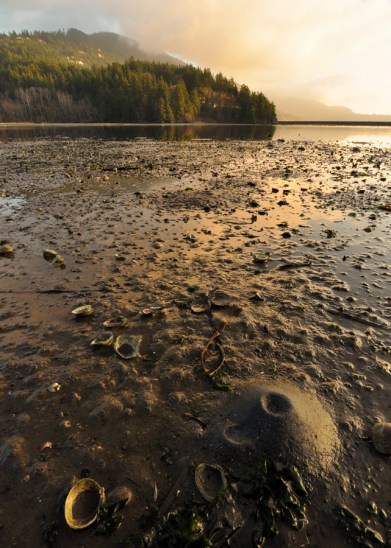
Low tide critters at Chuckanut Bay

I’m not sure what sort of critter makes these little volcano-like structures, but they are all over the place at low tide in Chuckanut Bay, one of my favorite local spots for photography.

Rock formations along the Chuckanut Bay Walk

Some of the intriguing and bizarre rock formations along the Chuckanut Beach Walk.

Chuckanut Drive is heaven for the geologically inclined for a couple of reasons. For one, the road itself is built on layers of weak sandstone that slope precariously towards the sea. When it rains, water seeps into the spaces between the layers, dramatically decreasing something called the coefficient of static friction, which is normally responsible for keeping the rock intact. In other words, the water essentially lubricates the surface between rock layers, causing causing large chunks of the hillside to frequently slough off, making Chuckanut Drive one of the most landslide prone highways in the state. Last winter, it seemed like the road was closed at least every few weeks in order to repair large gashes in the pavement caused by falling boulders.

Two, the sandstone exposed here, a rock unit known as the Chuckanut Formation, is chock full of fossilized ferns, palm fronds, gingko leaves, wood, and bark, relics from a time when the Pacific Northwest was just as wet as today, but a whole lot warmer. An exposure of this same rock unit an hour to the east even turned up a footprint of a giant Eocene flightless bird a few years back, which is now on display at Western Washington University.

A few miles further south of Chuckanut Bay is Larrabee State Park, the first state park in Washington, whose landscapes and marine life I’ve documented previously and continues to be a favorite spot to catch the sunset:

Sunset at Larrabee State Park

The Sun dips behind the San Juan Islands as seen from Larrabee State Park.

Sunlight streams through the fog along Chuckanut Drive
Winter brings frequent morning fog to the coast of NW Washington, but it usually starts to burn off around mid-day. 10 minutes after I took this photo, the fog was gone, replaced by sunshine and a clear blue sky. 

Heading south from Larrabee State Park, the road becomes increasingly curvy and narrow as it clings to the hillside passing oyster bars, cascading waterfalls, and smattering of million-dollar homes. (You never actually drive along the coast proper, that route is reserved for the Burlington Northern Railroad, but the views are even better as a result.) Keep your eyes on the road and wait for one of the plethora of pull-offs where you can take it all in without running the risk of driving off a cliff.

A short but steep hike from near the route’s southern end puts one at Samish Overlook, which offers unparalleled views of the San Juan Islands, the Skagit River Valley, Olympic Mountains, and even Mt. Rainier on a clear day. On days when the winds are right, this is a launching point for local paragliders. It’s also a cool place to go during a foggy spell; at nearly 1300 feet above sea level, the Overlook sits above the fog deck most days making for spectacular sunsets and less than spectacular dark and foggy hikes back to your car.

Sunset from Samish Overlook, with fog and San Juan Islands in the background.

A colorful winter sunset from Samish Overlook, nearly 1300 feet directly above Chuckanut Drive. The tops of a few of the San Juan Islands are visible protruding above the fog.

The last nine miles of the route angle away from the mountains and coast and traverse the flat lands and fields of the Skagit River Valley. But just a few miles west of the Drive, along Bayview-Edison Road, you’ll find the Padilla Bay National Estuarine Reserve, which operates an excellent interpretive center with exhibits about the coastal ecosystems of the Puget Sound area and a small aquarium. This is also a great place to spot a number of the bald eagles that visit the Skagit River Valley and surrounding area each winter to feast upon dying salmon. Padilla Bay (actually an estuary) is so shallow that at low tide, mudflats extend for hundreds of yards away from the coast.

A bald eagle sits in a tree at the Padilla Bay National Estaurine Reserve

Spring brings large quantities of nesting Bald Eagles to the Skagit River Valley. We saw four eagles within five minutes of exiting the car at the Padilla Bay Interpretive Center.

Ripples in the sand catch the last light of Sunset at Padilla Bay

Ripples in the muck reflect a cold, windy, and colorful  sunset out on the mudflats at Padilla Bay.

Eventually, Chuckanut Drive meets up with I-5 in Burlington, just a few miles north of the infamous I-5 bridge that collapsed into the Skagit River last year. From here it’s a quick 15-20 minutes drive back to Bellingham along the interstate. Or if you feel like braving that bridge, I hear there are a few good breweries in Mt. Vernon….

Top 10 Images from 2013

So this is a taaaaad late, again, but since my shameless self-promotion retrospective was somewhat popular last year, I figured it was worth making another post highlighting my favorite images from the past year, even if it is now nearly a month into the new one. In honor of 2012, I chose my 12 favorite photos. This year I’ve chosen just ten, so as not to head down a road where this post gets ever so slightly longer and more agonizing to read each year.

As was the case last year, some of these photos you may have seen already if you follow me. Including some new images wasn’t difficult though, considering that I took an average of 1478 photos per month this past year, yet averaged just 1.5 posts per month. That adds up to 17,736 photos in the past year (a 221% increase over last year!). With the end of grad school in sight, hopefully I’ll be able to share photos more frequently this coming year, but for now I now humbly present my favorite (not necessarily for technical quality) 0.05% of the photos I took in 2013:
DSC_0195

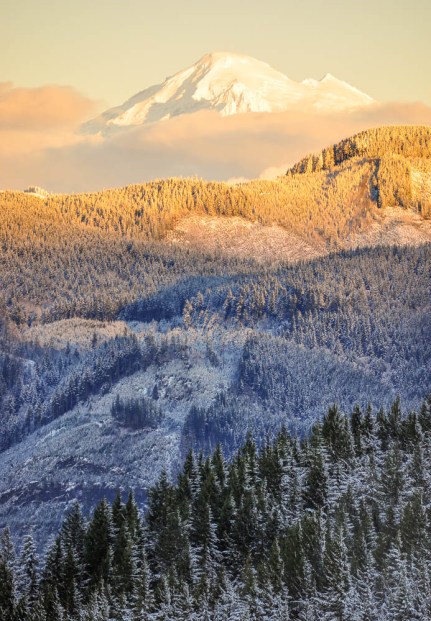
1. Mt. Baker, Washington.

One of the things I dislike about the Pacific Northwest is that there are so many damn trees everywhere that even hiking to the crest of ridges and mountains in search of an expansive view is often a futile endeavor, especially in the lowlands. Unless that is, your summit has had the pleasure of being clear-cut in the past decade or so, in which case you can see halfway to Alaska (if it’s clear…).  I was surprised to find myself in one of these clearings on a January hike outside Bellingham following one of our biggest snowfalls of the year and took advantage by taking in a nice view (and some photos) of Mt. Baker and the foothills, alas one complete with more of the aforementioned clear cuts in the foreground.
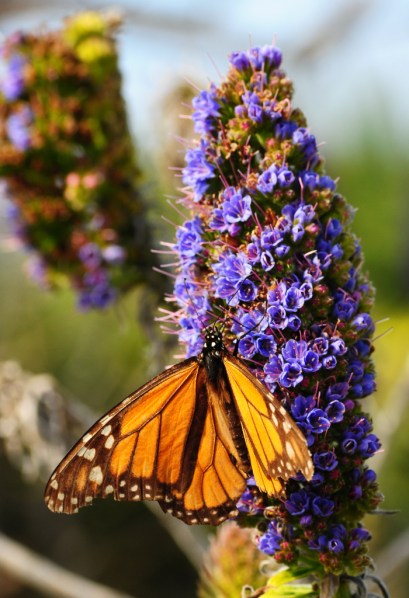
Pacific Grove Monarch Butterfly

2. Monarch Butterfly, Pacific Grove, California. 

The town of Pacific Grove, California loves their butterflies. Monarch butterflies specifically. So much so that an image of one can be found on every street sign. In March I visited the official Monarch Grove Sanctuary where thousands of monarchs flock to reproduce each year. While I don’t doubt this claim, on my visit I saw about a dozen butterflies, none of which where in range of my camera. I found this one downtown, along the beach, in a much more accessible location. I’m not sure what this guy is eating but it looks delicious.

Golden Gate Bridge in the fog

3. Golden Gate Bridge Fog and Sunset, San Francisco, CA.

This was one of the few shots on this list that actually had some degree of planning behind it. I had recollections of a good vantage point of the bridge from trips to San Francisco made pre-camera toting days. Fog had been rolling in and out of San Francisco all day but it  seemed to be a thin layer and I surmised that if I could get above the clouds, I might be treated to a dramatic view of the bridge’s towers poking up above the fog where they could intercept the last rays of sunlight.  As you can see, that’s pretty much exactly what happened. It’s incredibly satisfying when hunches work out that perfectly. I only wish I had possessed one of these suckers so that I could have increased my exposure time and smoothed out the rapidly moving fog. If anyone is looking for a belated Christmas present or a donation, hint hint…
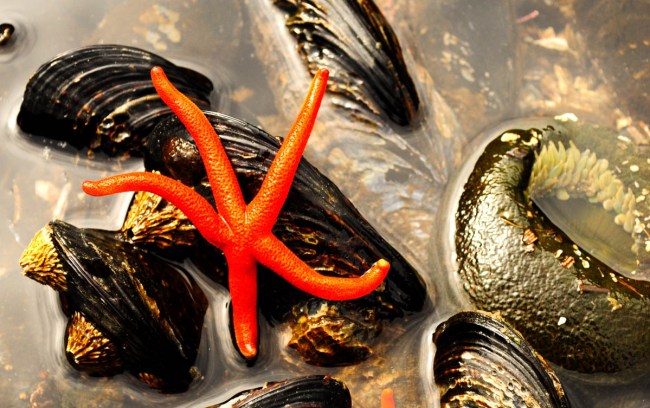
Blood Star at low tide

4. Blood Star, somewhere on the Olympic Peninsula, Washington.

While I like this picture enough to have a 5×7 framed on my bookshelf, it was the experience associated with it that makes it worthy of inclusion on this list. Back on Memorial Day weekend, I headed out to the Olympic Peninsula (oddly enough, not to look at sea stars but rather the Elwah River restoration project) and happened to stumble across some epic tide pools one misty morning. We’re talking sea stars comparable in size to small children, anemones and urchins the size of bowling balls, and masses of gargantuan mussels sufficient in size to keep the aforementioned sea stars fat and happy. Despite it being a holiday weekend and one of the lowest tides of the year, there were only a smattering of people wandering around the tidal zone.  I spent several hours taking photos in a steady rain while balancing the need to keep my camera dry AND myself from slipping on kelp and splitting my skull open on jagged basalt. Several groups approached me during this time and asked me if I was local and how I had found about this place. After responding “Uhh, not really…” and “the Internet”, I proceeded to have a few nice conversations about the incredibly diversity of marine life in front of us. What was interesting was that each and every group urged me to keep this location a secret before continuing on their way. And given that other spectacular tide pools in Washington have suffered from over-popularity, I’m going to honor that request.
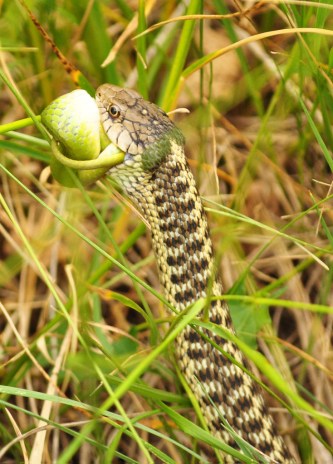
Snake-3

5. Snake eat Snake.

Any year in which you get to photograph wildlife eating other wildlife is a darn good year in my book, even if it is only two snakes rather than say, a mountain lion taking down a deer in full stride.
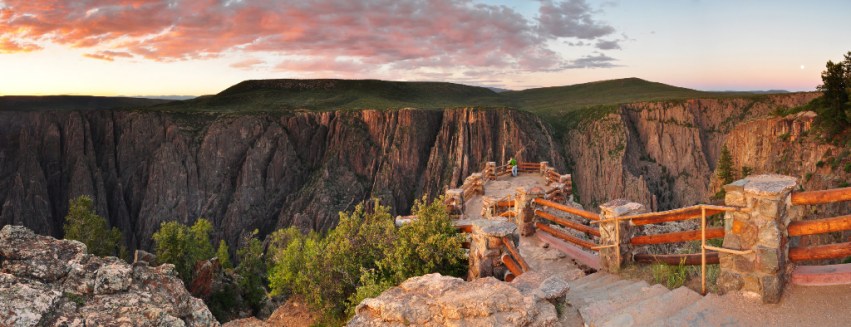
Sunset at Black Canyon on the Eve of the 2013 Supermoon

6. Sunset at Gunnison Point, Black Canyon National Park, Colorado.

If you ever want to visit a National Park in the summer and don’t want to feel like you’re at Disneyland, you’d be hard pressed to find anywhere more spectacular than Black Canyon. Think you could go to the Grand Canyon or Yosemite and have a major overlook all to yourself at sunset in mid-summer? Think again. In case you didn’t notice, lurking just above the far right horizon in this photo is the 2013 Supermoon for an added bonus.
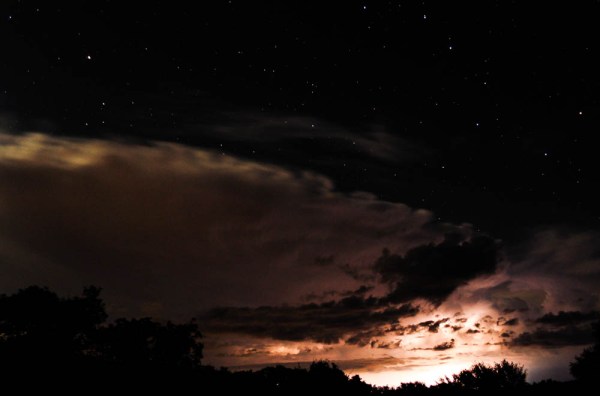
Lightning and the Big Dipper

7. Lightning and the Big Dipper.

I had to include at least one night sky shot in this list (its part of my contract). Neither subject here (lightning and the Big Dipper) is particularly interesting on it’s own, but I think together they make a nice pair. I really would have loved a wider-angle lens on this one; I had to wait about an hour longer than I would have liked for the Big Dipper to rotate into the field of view of the cloud tops, and by then the best of the lightning storm was past. I also wish there was something more interesting in the foreground but achieving that would have meant leaving my front porch, something that I was very loath to do on this particular evening for obvious reasons. As nice as a intriguing foreground would have been, being alive to share this photo is even sweeter.
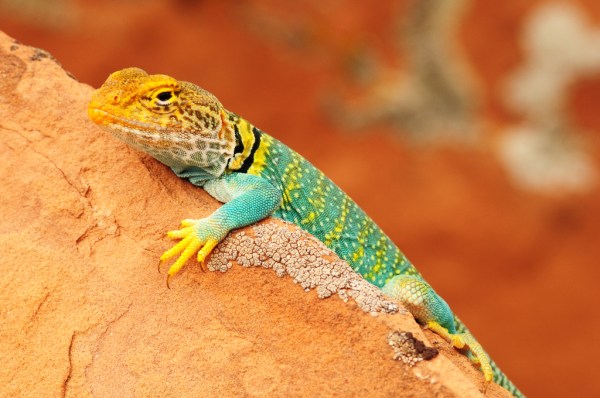
A colorful Collared Lizard in Dominguez Canyon, Colorado

8. Collared Lizard, Dominguez Canyon, Colorado.

I’ve come across these flamboyant lizards more than a few times in the southwest. Normally they peace out as soon as you get within 10 yards or attempt to intimidate you from coming closer by launching into their patented push-up routine. This one seemed to want his picture taken though. Almost motionless for several minutes, I reeled off a couple dozen shots trying to get the focus just right.
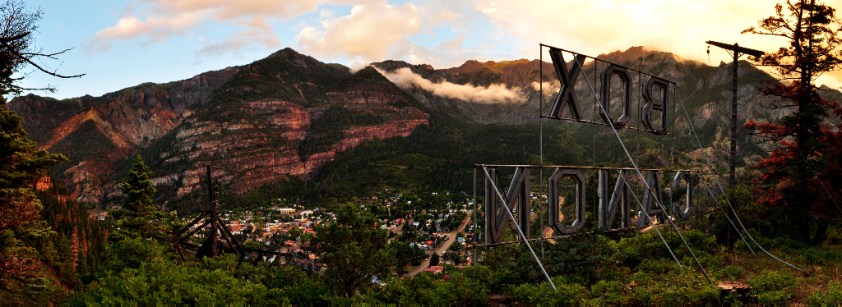
Sunset from the Box Canyon sign above Ouray, CO

9. Sunset from the Sign, Ouray, Colorado.

Another shot that involved a fair bit of planning. Ouray, CO might be about the most picturesque town this side of the Alps. Back at the beginning of the 20th century, some yahoos thought that a big metal, light-up marquee advertising one of Colorado’s most famous natural wonders (Box Canon) would somehow be a good idea. Thankfully, the lights on this metal monstrosity have since gone dark and nowadays the sign is barely visible from town unless you know where to look. But the sign’s location on a precipice above town makes for a great sunset vantage point, especially following an intense summer thunderstorm which left some wispy clouds hanging around the amphitheater to catch the last rays of sunlight.

Golden Western Larches in the North Cascades

10. (Golden) Western Larches, North Cascades, Washington.
Since I just wrote about this trip a few months ago, I won’t say much here…other than that I hope you enjoyed these photographs, and I would love to hear your comments or criticism in the comments below! Happy (belated) New Year!