A Photographic Journey Down Chuckanut Drive

Chuckanut Drive, a.k.a. Washington State Route 11, is one of the premier attractions here on the extreme northwestern fringe of the U.S. “The Nut”, as I like to call it, winds for just over 21 miles between Bellingham and Burlington. Hemmed in by the Chuckanut Mountains to the east and numerous scenic bays, inlets, and islands on the west, it offers a stunning variety of scenery for such a short stretch of road. Chuckanut Drive has truly been a gift to me the last year and a half, because I can be cruising down it (well, as least what passes for “cruising” in a 16 year old Corolla…) and taking photos within 5 minutes of leaving my house. I’ve done this several times recently, now that the Sun is once again gracing us with its presence past 4pm.
Chuckanut Drive is chock full of destinations that make you feel further from civilization than you actually are, places that are perfect for occasions when time is in short supply. One of my favorite such spots is the beach walk at Chuckanut Bay. Fortunately for me, it also happens to be one of the closest, sitting just barely inside Bellingham city limits. Close enough for me to walk if I was feeling ambitious. Nearly inaccessible at high tide, once the water level drops a couple of feet, a few hundred yard stroll to the northwest shore of the bay puts you in the middle of spectacular and bizarre rock formations sculpted out of the Chuckanut Sandstone by freezing sea spray that accumulates along the margin of this sheltered cove. This is also a great place to see honeycomb weathering features along the shore, as is adjacent Teddy Bear Cove.
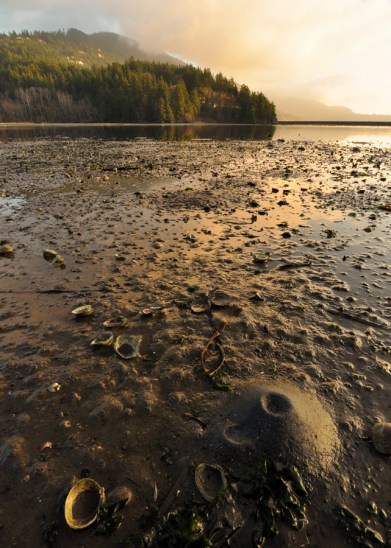
I’m not sure what sort of critter makes these little volcano-like structures, but they are all over the place at low tide in Chuckanut Bay, one of my favorite local spots for photography.

Some of the intriguing and bizarre rock formations along the Chuckanut Beach Walk.
Chuckanut Drive is heaven for the geologically inclined for a couple of reasons. For one, the road itself is built on layers of weak sandstone that slope precariously towards the sea. When it rains, water seeps into the spaces between the layers, dramatically decreasing something called the coefficient of static friction, which is normally responsible for keeping the rock intact. In other words, the water essentially lubricates the surface between rock layers, causing causing large chunks of the hillside to frequently slough off, making Chuckanut Drive one of the most landslide prone highways in the state. Last winter, it seemed like the road was closed at least every few weeks in order to repair large gashes in the pavement caused by falling boulders.
Two, the sandstone exposed here, a rock unit known as the Chuckanut Formation, is chock full of fossilized ferns, palm fronds, gingko leaves, wood, and bark, relics from a time when the Pacific Northwest was just as wet as today, but a whole lot warmer. An exposure of this same rock unit an hour to the east even turned up a footprint of a giant Eocene flightless bird a few years back, which is now on display at Western Washington University.
A few miles further south of Chuckanut Bay is Larrabee State Park, the first state park in Washington, whose landscapes and marine life I’ve documented previously and continues to be a favorite spot to catch the sunset:

The Sun dips behind the San Juan Islands as seen from Larrabee State Park.

- Winter brings frequent morning fog to the coast of NW Washington, but it usually starts to burn off around mid-day. 10 minutes after I took this photo, the fog was gone, replaced by sunshine and a clear blue sky.
Heading south from Larrabee State Park, the road becomes increasingly curvy and narrow as it clings to the hillside passing oyster bars, cascading waterfalls, and smattering of million-dollar homes. (You never actually drive along the coast proper, that route is reserved for the Burlington Northern Railroad, but the views are even better as a result.) Keep your eyes on the road and wait for one of the plethora of pull-offs where you can take it all in without running the risk of driving off a cliff.
A short but steep hike from near the route’s southern end puts one at Samish Overlook, which offers unparalleled views of the San Juan Islands, the Skagit River Valley, Olympic Mountains, and even Mt. Rainier on a clear day. On days when the winds are right, this is a launching point for local paragliders. It’s also a cool place to go during a foggy spell; at nearly 1300 feet above sea level, the Overlook sits above the fog deck most days making for spectacular sunsets and less than spectacular dark and foggy hikes back to your car.

A colorful winter sunset from Samish Overlook, nearly 1300 feet directly above Chuckanut Drive. The tops of a few of the San Juan Islands are visible protruding above the fog.
The last nine miles of the route angle away from the mountains and coast and traverse the flat lands and fields of the Skagit River Valley. But just a few miles west of the Drive, along Bayview-Edison Road, you’ll find the Padilla Bay National Estuarine Reserve, which operates an excellent interpretive center with exhibits about the coastal ecosystems of the Puget Sound area and a small aquarium. This is also a great place to spot a number of the bald eagles that visit the Skagit River Valley and surrounding area each winter to feast upon dying salmon. Padilla Bay (actually an estuary) is so shallow that at low tide, mudflats extend for hundreds of yards away from the coast.

Spring brings large quantities of nesting Bald Eagles to the Skagit River Valley. We saw four eagles within five minutes of exiting the car at the Padilla Bay Interpretive Center.

Ripples in the muck reflect a cold, windy, and colorful sunset out on the mudflats at Padilla Bay.
Eventually, Chuckanut Drive meets up with I-5 in Burlington, just a few miles north of the infamous I-5 bridge that collapsed into the Skagit River last year. From here it’s a quick 15-20 minutes drive back to Bellingham along the interstate. Or if you feel like braving that bridge, I hear there are a few good breweries in Mt. Vernon….
The Golden Gate (Bridge)
San Francisco.
I’ve always thought that it would be one of the few large cities where I could actually stand to live. Never mind the fact that my current and projected foreseeable future income levels will not permit me to live in any of the parts of the city to which the above statement applies. Or the fact that the next major rupture of the San Andreas or Hayward faults is going to make things look…shall we say…”less attractive”. Ignore those minor details for now. All I mean to say is that it seems like a nice place to live, which is a thought that perplexes me, given that in general, the idea of living in the same metropolitan area as several million other human beings makes me want to look up job listings for “hermit” and run away into the hills screaming. San Francisco though seems to have a charm and a combination of positive attributes though that most other cities do not.
For starters it is located in one of the most scenic environs of any city in the country. Rolling grassy hills, redwood groves, long stretches of sandy and rocky beaches, rugged coastline, appealing architecture, fortified islands, all within an hours drive of the city center. Hard to match that. Seattle comes close (the view of Mt. Rainier on a clear day? ahhhhhhh) but it gets marked down because it gets, on average, 14 more inches of rain each year. Salt Lake City has gorgeous mountains but it is covered in snow for part of the year and tends to get smothered by thick layers of pollution that get rammed up against the western flanks of the Wasatch. And all cities east of the Rockies are automatically disqualified because they’re east of the Rockies. To some Phoenix might seem sort of scenic, what with the 50 foot high cacti and mountains and all, until you realize that in reality it is a sizzling hell hole with literally no sustainable water source and is totally unfit for large quantities of human habitation. At least San Francisco has Yosemite just a few hundred miles away that it can poach water from. Also, it sort of seems like everything in San Francisco is painted either white or a nice bright pastel color. Painting everything white does wonders for a city; it makes it feel larger, cleaner, less claustrophobic, and lends a nice airy, ethereal quality to everything.
San Francisco also has what in my opinion is one of the few man-made creations that actually contributes to the beauty of a place rather than besmirching it: the Golden Gate Bridge. In case you’re not familiar with the bridge, it is one of the few things in San Francisco not painted white or pastel, but rather a bright burnt orange (actually “international orange” for those of you who want to go out to your local Home Depot and pick up a gallon). The “Golden Gate” for which the bridge is named (and not vice-versa) is a narrow strait that connects the Pacific Ocean to San Francisco Bay. In a somewhat eery coincidence, U.S. Army Captain and explorer extraordinaire John C. Fremont bestowed the now famous name upon the strait in 1846, two years BEFORE the strait was used as the point of arrival for millions of millionaire wannabees seeking riches in the newly discovered gold fields east of Sacramento. Fremont had given it the name Golden Gate because he recognized the area’s potential importance in opening up trade with the Orient, completely unaware (obviously) that the discovery of real gold in California is what would cause the population of the city just to the south of the strait, San Francisco, to multiply by 18,000% in just six years, and make the Golden Gate known worldwide. In the 1920s, fed up with the 20 minute ferry ride across the strait, some folks decided it would be a bright idea to build a bridge across it, apparently thinking that sitting in traffic for more than 20 minutes waiting to cross the strait while constantly having to yell at the driver in front of you to stop futzing with their iPhone and drive would somehow be more pleasant than the leisurely ferry crossing.
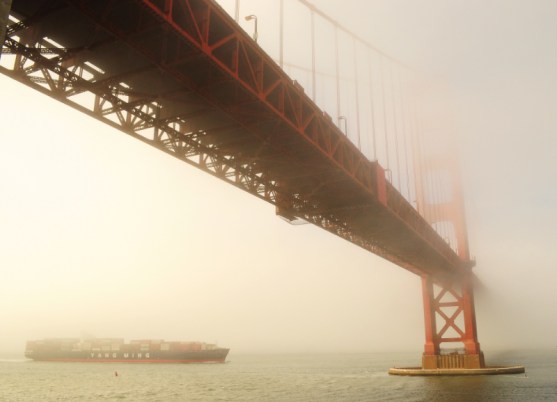
Yang Ming container ship is greeted by the Golden Gate Bridge
An unique perspective on the 1.7 mile-long suspension bridge can be obtained by going beneath it. If you don’t have a boat, fear not, in another stunning coincidence, the U.S. Army conveniently constructed a masonry fortification, Fort Point, on the point right beneath the south end of the bridge in 1853*:

Under the Bridge: the remains of Fort Point, built in 1853 to secure San Francisco Bay from enemy attack.
*Actually the Army did no such thing. You know, seeming as how the technology to build a massive metal suspension bridge across a deep, windy, 1.3 kilometer wide strait didn’t exactly exist in 1853. The engineers in charge of building the bridge eighty-odd years later did however build the bridge directly above the fort (they wanted to remove the Fort entirely but cooler heads prevailed), and so the Fort, being the rather inanimate object that it is, remains there to this day, providing a nice spot to stand and look out over the bay while holding on to your hat and listening to rush-hour traffic crawl past on the bridge high over your head.
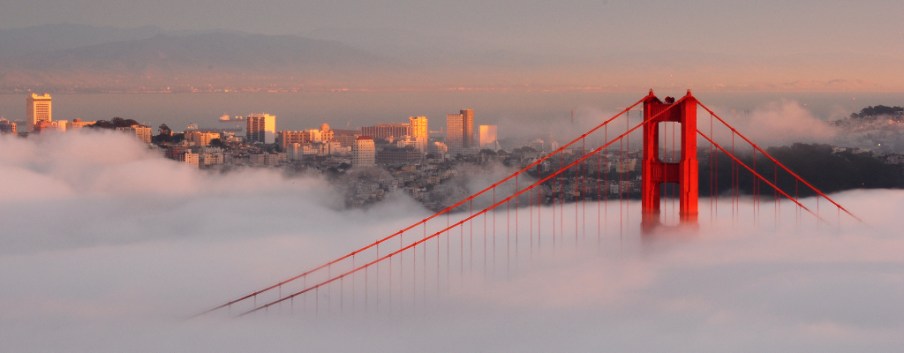
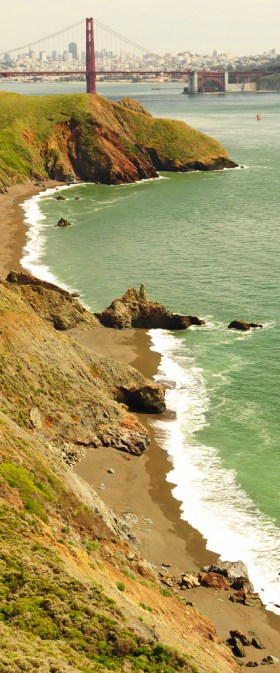
Arguably the best, although not most unique, views of the bridge can be found north of town, just off of Highway 101 in the Marin Headlands where a number of overlooks along Conzelman Road provide spectacular vantage points from which to observe or photograph the bridge. These overlooks aren’t a secret though, the ones closest to Highway 101 are predictably packed with people and it can be impossible to find a parking spot. However, the bridge is also partially obscured here, head further and higher up the road for more expansive views that, while still busy, become less so the further from the highway you get. and. The number of tripods also increases steadily as you get further and further from the interstate which I interpreted as a good sign since one of my goals was to get some photos of the bridge at sunset. As you can see in the picture at the top of the page, these overlooks are often slightly above the fog that socks in the coast from time to time.
Most people seem to stop and turn around at the one-way-road/18% grade sign that appears along Conzelman Road just before it begins to wind its way back down through the headlands to the coast. If you proceed onwards though, you will be rewarded by getting to shift your car into low gear, and also by a plethora of quieter and more secluded, albeit more distant, views of the bridge. The road ultimately deposits one at the trail leading to the Point Bonita Lighthouse, located at the northern entrance to the Golden Gate. The lighthouse was built in 1853, and yet several hundred ships still managed to wreck themselves in this area during the influx associated with the California Gold Rush, a testament to the ability of the area’s trademark thick fog to obscure any sign of the coast until its too late.
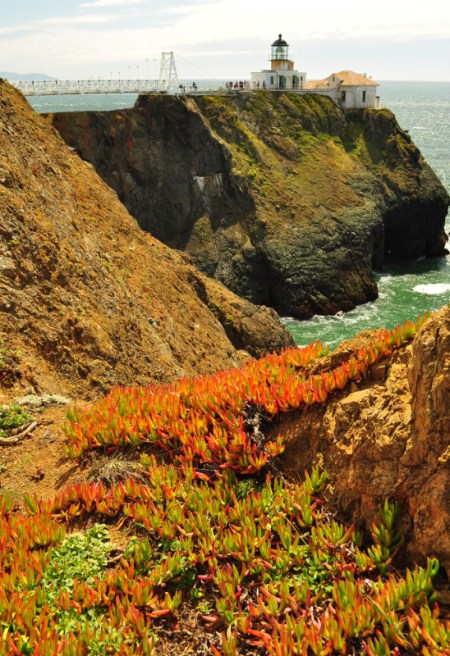
Point Bonita Lighthouse, Marin County, California
More pictures of the local flora and fauna hopefully coming soon, including the biggest group o’ Grebes you’ve ever seen in one photograph.
Larrabee State Park in Photos

Sundown along Samish Bay
Larrabee State Park is located just a few miles south of Bellingham, WA and holds the honor of having been the first state park in Washington, being designated as such shortly after a local family donated the land to the state in 1915. Several short trails lead from Highway 11 down to beaches that are positioned perfectly for spectacular sunsets…when the sun is visible that is. These photos were taken in late summer, before the gray and gloom set in for the winter. I guess you could say I’m posting them now in an attempt to relive the sunnier days of yore. Or because the photos on the park webpage leave a lot to be desired…
At low tide, the beaches are lined with tide pools that make for an excellent way to kill time waiting for the sun to dip below the horizon while other trails lead into the Chuckanut Mtns. to the east where one can find views of the San Juan Islands and Bellingham itself.

Saltwater sea spray eats away at the Chuckanut Sandstone creating spectacular honeycomb weathering formations along the coast

Low tide reveals abundant anemones and other sea critters
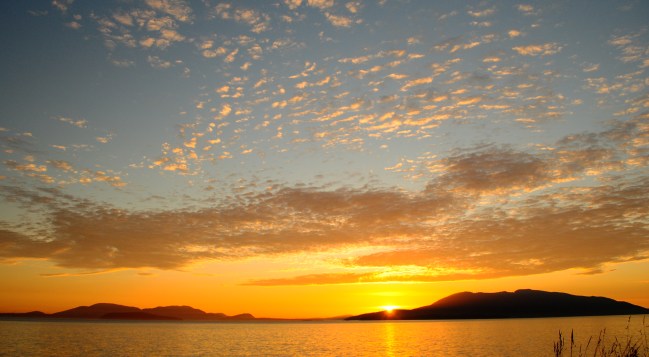
Sunset over Orcas Island (left) and Lummi Island (right)
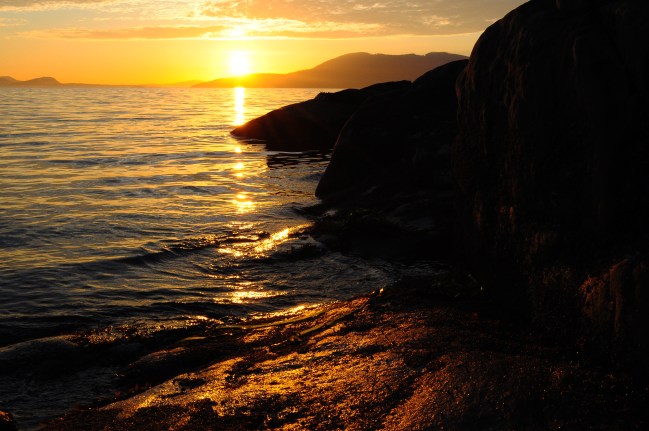
Sunset at Larrabee State Park
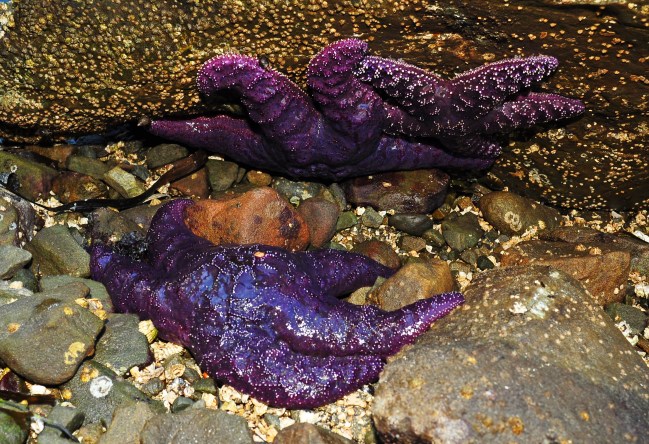
Danger lurks beneath the rocks…
 Zach Schierl Photography