The Spectacular San Juans: A Trip to Yankee Boy Basin

Taking in the scenery
Note: I’m reaching back into the archives here. I have about 10 posts in my drafts folder, all in various stages of completion and many from this past summer, that I’ve decided it’s finally time to post. This is one of them. And yes I know this is my 2nd consecutive post with glacial and geological undertones. I’m not sorry, glaciers are totally radical man!
On my lifetime list of most spectacular landscapes, Yankee Boy Basin in the San Juan Mountains ranks quite high. I’ve seen expansive fields of wildflowers with different species spanning every color of the rainbow plus some. I’ve seen 100 foot high waterfalls that have undoubtedly been the setting for numerous Coors commercials. I’ve seen craggy, majestic mountain peaks and pinnacles sculpted over millions of years by the work of a posse of many abrasive glaciers. I’ve seen aqua blue lakes appear seemingly out of nowhere as they fill from the meltwater of a lobate rock glacier. I’ve seen ribbons of crystal clear snow melt water plunging in an endless stream of cascades straight down the side of a mile wide glacier cirque. Never though have I seen all these things in one place. Yankee Boy Basin truly has it all. It rivals anything I ever saw in the mountains of New Zealand. Throw in the fact that I saw up-close and in person just about every glacial and periglacial feature I learned about in geomorphology class and it doesn’t get much better. Miraculously, you can actually get here with minimal effort, especially if you have a 4WD vehicle (or, in our case, the ability to rent one), and don’t mind driving on roads that look like this:
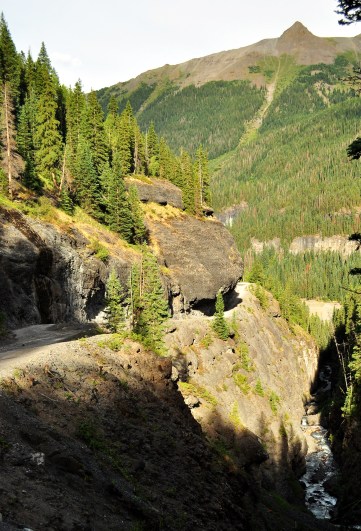
Section of shelf road cut into cliff heading back down towards Ouray from Yankee Boy Basin
Mind you, merely walking around on a level surface at nearly 13,000 feet involves a fair bit of effort and energy expenditure. Altitude acclimatization definitely makes things easier but even then, running around in excitement is definitely not recommended since I imagine the scenery would not be as greatly appreciated if you are passed out on the floor of the basin. Amazingly, over 1500 individuals each year blatantly ignore this advice during an annual 17 mile footrace up and over nearby 13,114′ Imogene Pass. In an additional twist that can only be explained as a classic example of male one-up-manship, in the early 1990’s, some folks decided that running 17 miles at extremely high altitude was not torturous enough and thus the Hardrock 100 was born. Participants in this masochistic race traverse 100 miles of rough terrain at an AVERAGE elevation of over 11,000 feet, climbing up the passes and peaks in the vicinity of Yankee Boy Basin. The total elevation gained and lost during the race is a mind-boggling 67,984 feet. Yeah, altitude does crazy things to people.
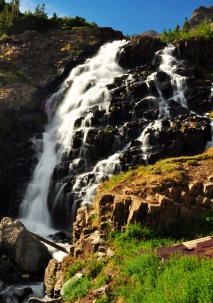

Trail headed up to Wright’s Lake
One of the neatest features of Yankee Boy Basin is a 50 yard wide body of water called Wright’s Lake. Wright’s Lake is bounded on the east by a terminal glacial moraine which forms a small ridge meaning that the lake does not come into view until you are practically wading into it. I had not seen any pictures of the lake prior to the hike so I was unsure what to expect. After smoking my little brother up the short trail from the road, I came around the edge of the moraine to see an enormous rock glacier flowing down from Gilpin Peak 1000 feet above me and terminating at the edge of an aquamarine blue lake, a sight which exceeded even my most hopeful expectations. The sight of a lake sourcing a not-insignificantly sized stream with no immediately obvious source of replenishment is an odd one indeed until you realize that the wall of talus on the far side of the lake is cored with ice.
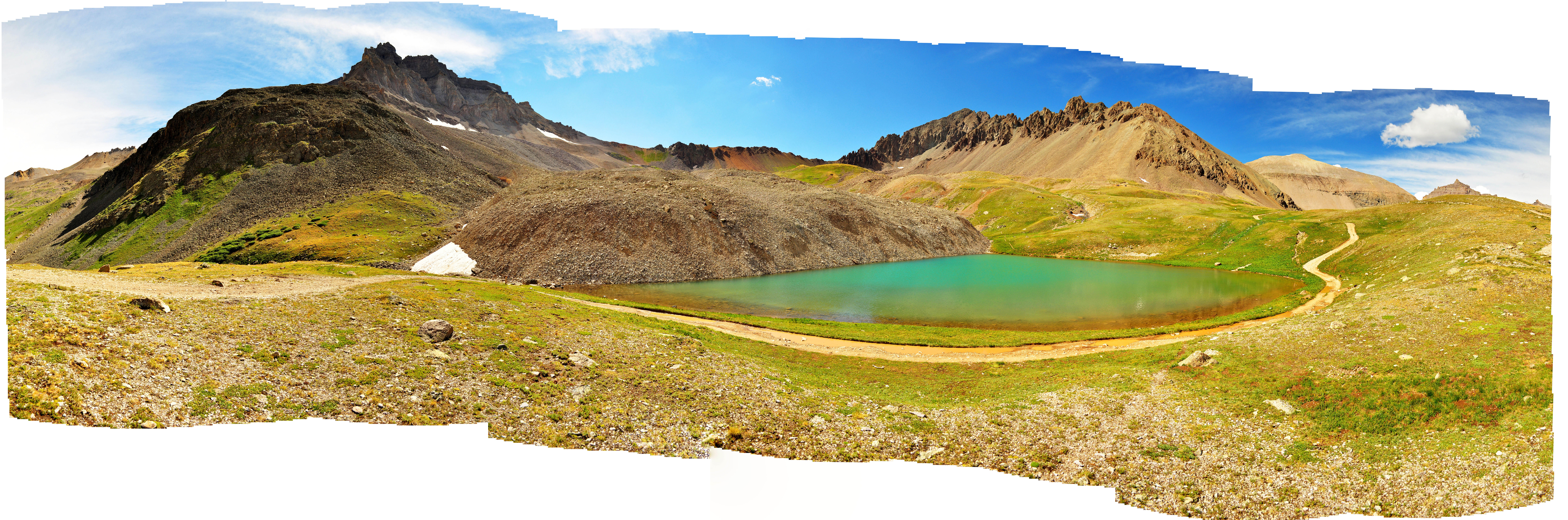
Panoramic View of Wright’s Lake. Gilpin Peak and rock glacier at left, Mt. Sneffels at right.
Rock glaciers are interesting beasts. They are essentially glaciers covered with a layer of rock that serves to insulates the ice which continues to flow downslope under the influence of gravity. To completely cover a glacier in rock, one naturally needs a lot of rock. The peaks in the San Juans generally consist of extremely crumbly, scuzzy volcanic tuff and ash deposits. Gilpin Peak, the summit from which the rock glacier descends, is no exception as it looks like the whole mountain could slough off into the valley during the next stiff breeze. Debris from the peak above the glacier falls from the sheer cliffs ringing the basin and accumulates on the surface of the ice. The insulating effect of the rock has allows these small remnants of ice (the San Juans were home to much more extensive glaciers during the most recent glacial period) to survive here even though the current climate in the San Juan’s is too warm and dry for traditional glaciers to survive.
From Wright’s Lake, it is about 1.5 miles and another 1500 feet up to the summit of Mt. Sneffels, one of Colorado’s famous 14ers (peaks over 14,000 feet high) and one that is not on anyone’s list of “easiest to climb”. On this day, the notoriously nasty conditions on the summit of Sneffels was apparently even from a quarter mile below. From the lake you could easily hear the wind whipping around on the summit ridge and thunderstorms were approaching from the west.
As I finally get around to finishing this post in early January, I am struck by the thought of how this amazing landscape is now buried under many, many feet of snow. While I am sure that the San Juan’s are equally inspiring in the winter, perhaps even more so to many people, thinking about this gives me an even greater appreciation for such places, given just how short of a window we have each year to experience alpine landscapes such as this one. The winter of 2011-2012 was an incredibly dry one in Colorado, and many places such as Yankee Boy Basin were mostly snow-free and accessible by May or June. In a normal snowfall year, vehicle access to these high altitude basins is often impossible well into July or even August, leaving potentially as little as 6 weeks before next winter’s snows begin to reclaim the land once again.

Yankee Boy Basin
The World’s Most Spectacular Meeting of Land and Sea: Big Sur, California
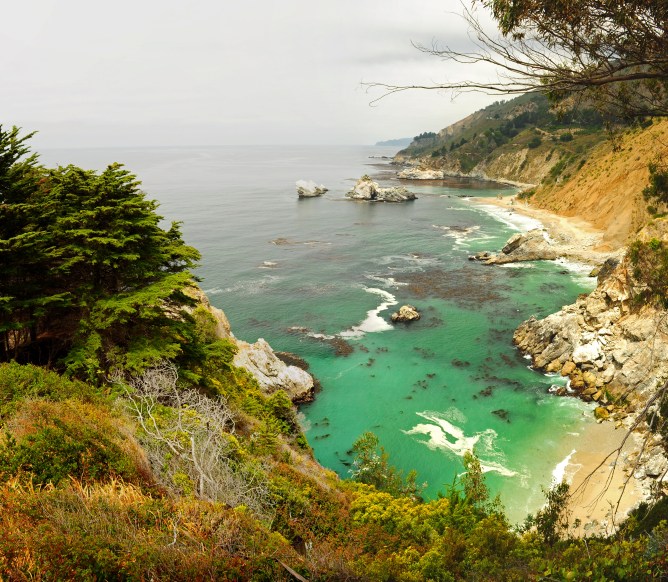
Big Sur coast looking south from Julia Pfeiffer Burns State Park
We interrupt the recent Colorado-centric nature of this website to bring you an important dispatch from the western shore of the North American continent, also known as the Golden State of California.
On a recent visit to Monterey, CA to visit my girlfriend, we decided to drive south along the famed Pacific Coast Highway and spend a night in the Big Sur region of central California. To invert the timeless words of Douglas Adams: “this has been widely regarded as a good move.” The local tourism bureaus like to tout the area as “The world’s most spectacular meeting of land and sea”. While I generally get somewhat uncomfortable and squirmy around such subjective superlatives, there is no denying that at Big Sur, the land does indeed meet the sea; as exemplified by the fact that, on more than one occasion, I would have quite easily been able to walk directly from solid earth into the ocean, had I chosen to do so. I didn’t choose to do so but the point is that I could have and I imagine it would have been quite a spectacular meeting if I had. Maybe next time.
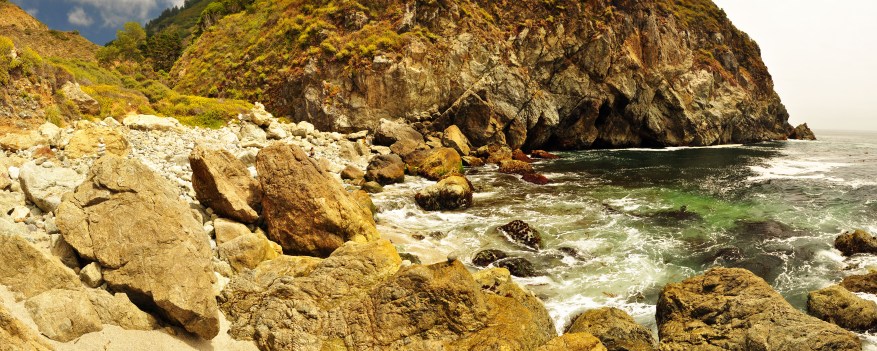
Partington Cove, Big Sur

McWay Falls, Big Sur
The Big Sur region is home to a plethora of beautiful and intriguing attractions, of which we had time to sample only a smattering. California Highway 1 meanders its way through Big Sur, rarely in a manner which permits one to safely exceed 30 miles per hour, but almost always in a manner which provides spectacular views of the jagged coastal cliffs along the Pacific Ocean below. Fortunately, pullouts are ample, thus avoiding the need to try and enjoy the view while simultaneously keeping the car from punching through the guardrails and plunging into The Sea.
One of the highlights is Juila Pfeiffer Burns State park, home to a 80-foot high waterfall that plunges into an aquamarine cove surrounded on three sides by ragged sea cliffs. Big Sur also marks the southern extent of the range of the Coast Redwood. Although these trees are not nearly as large or prevalent here as they are further north along the California coast, small gulches and canyons along the coast harbor small, yet impressive groves of these stately conifers.

Michelle admiring the redwood trees along the Canyon Trail in Julia Pfeiffer Burns State Park.
From the “proof that spending time amongst a large quantity of tourists is never boring” department, I present the following tale as a humorous anecdote. Looking at the above pictures, It doesn’t exactly take a trained eye to notice that the natural environment of the Pacific Coast is wholly different than just about anywhere else in the country. Nevertheless, while milling about a trailhead in Julia Pfeiffer Burns State Park, I had the pleasure of overhearing an exchange between two other groups of hikers in which one group proudly informed the other that “this place really reminds us of the time we visited the red rocks in Sedona, Arizona. It’s amazing how similar it looks.” For those of you unfortunate enough to not be familiar with Northern Arizona, Sedona looks ABSOLUTELY NOTHING like the above pictures but instead more like this.
Lest you doubt my incredulity over the above comparison, let’s do a brief comparison of the landscapes shall we:
Big Sur |
Sedona |
|
|
Color of rocks |
Everything but red |
Red |
|
Vegetation |
Coast Redwoods, Monterey Pine, Laurel, Oak |
Pinyon pine, juniper, sagebrush, manzanita, cacti |
|
Ocean |
Yes |
Yes, 300 million years ago |
|
Annual precipitation |
42 inches |
19 inches |
|
Commonly observed fauna |
Seals, otters, whales, evil seagulls |
Squirrels, javelina, rattlesnakes |
|
Elevation |
Duh…it’s the sea |
4,300 feet |
|
Geologic features |
Sea cliffs, sea arches, mountains, waterfalls |
Buttes, mesas, canyons, plateaus |
|
Extremely pricy resorts and hotels |
Yes |
Yes |
|
Highway frequented by excruciatingly slow RV’s |
Yes |
Yes |
Alright, so maybe there are some similarities after all. But not the kind that would lead one to compare a wet, foggy shoreline to a labyrinth of redrock canyons and mesas in the middle of a desert. I wanted to say something along the lines of “what have all y’all been smoking?” or “excluding hallucinations, have you ever actually BEEN to Arizona?” but I kept my mouth shut and moved on.
And last but not least, enjoy a few pictures of the native inhabitants of the area:
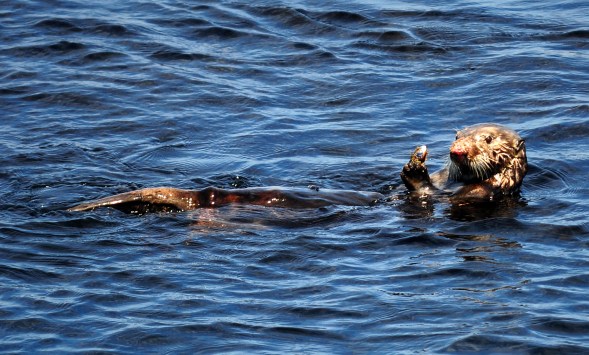
Sea otter in Monterey Bay willing to work for his/her afternoon snack. We watched this otter floating on his back cracking open various sea critters for a good twenty minutes.
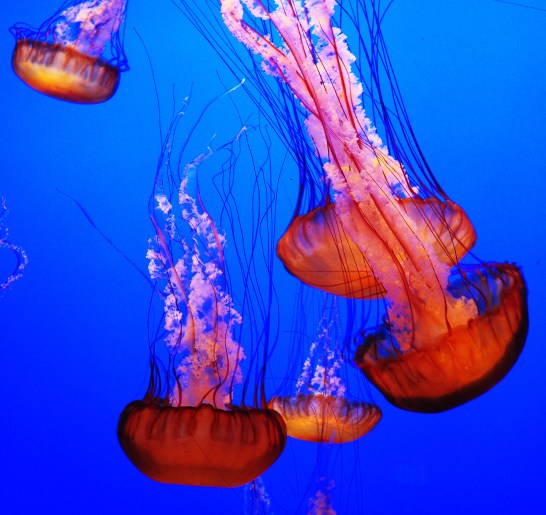
A bloom (or swarm…experts seem to disagree on the proper term for a group of jellyfish) of aquarium-bound jellyfish. We saw a whole bunch of these floating in the ocean from a pier in Monterey which sort of made me never want to go in the ocean again.
A Glacier, a Waterfall, and a Kayak walk into a bar…the Story of Palouse Falls
Growing up in northern Arizona, spring was always an exciting time to finally pack away the snow shovels and de-icer and get outside. If you want to see enough running water in the desert southwest to actually get your feet wet, spring snowmelt season and summer afternoon thunderstorms are pretty much your only hope.
Spring in the Pacific Northwest is similar…except that instead of going from no water to a little water, we go from a decent amount of water to A LOT of water. Nowhere is spring runoff more apparent than 187 foot high Palouse Falls, which is about 1-2 hours (depending on your driving speed) north of Walla Walla, on the Palouse River just upstream of its confluence with the Snake River.
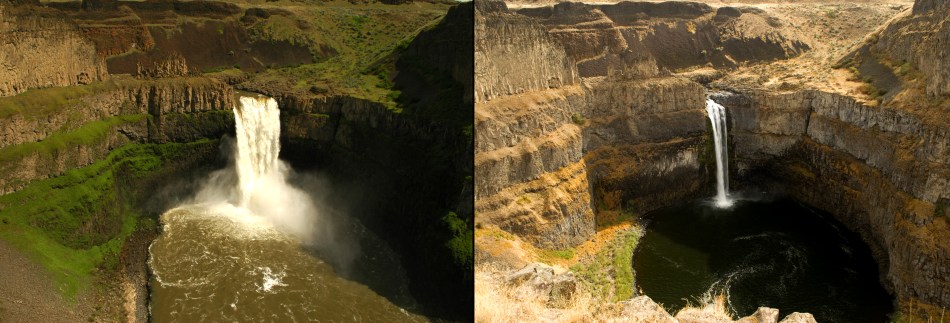
Palouse Falls in May (left) and September (right).
Normal people think lots of different things when they see Palouse Falls, among them “How do I get down there?”, “Wow, that’s pretty!”, “Where’s the snack shop?”, and “I really need to go to the bathroom after driving down that really bumpy, windy road”. All perfectly legitimate. Other people however see a kayak jump.
Palouse Falls garnered some attention in recent years when it became the site of the worlds largest kayak waterfall descent. In case that didn’t sink in, let me reiterate: someone paddled over that thing in a KAYAK.
As someone who has expertly piloted a kayak over 6″ riffles on the Palouse River below the falls, I can tell you that this is an impressive feat. Palouse Falls is nearly 200 feet; ants may be capable of surviving a fall off the kitchen counter but we aren’t designed to do such things. Just look at this picture.
If that was me, the discharge of the falls would be spiking dramatically right then due to the amount of bodily fluids I would have been emitting our of sheer terror.
The falls were formed by an phenomenon that comes in at #1 on our list of “Geological Terms That Make You Sound Like An Idiot If You Pronounce Them Correctly”: a jökulhlaup. If you are Icelandic, you’ll need no pronunciation guide. For the rest of you, that’s “yo-cooool-HOIP”. Once again, that’s “yo” as in the famous cellist Yo-Yo Ma, “coooool” as in “coooool Razor scooter man!”, and “HOIP” as in “House of International Pancakes.”
Now that we’ve got that squared away, lets set the scene: imagine you are an ice sheet, specifically the vast Cordilleran Ice sheet that covered the northern half of the North American continent during the last ice age. The climate is starting to warm; the mammoths are starting to die and those pesky humans are starting to increase in number. As the temperatures slowly increase, you start to feel a little sweaty and you begin to melt and retreat northwards to more suitable weather. All that glacial meltwater is getting funneled into river canyons that were cut tens of thousands of years earlier and are just now being uncovered by the retreating ice sheets. Even as a retreating ice sheet though, you will likely have a few appendages (called lobes) that reach several hundred kilometers south of the main ice front. These lobes block some of the river channels, forming a barrier that impedes the river’s progress. Massive quantities of water back up behind the ice dam, creating lakes larger than several of the Great Lakes. Remember though, you are a big piece of ice, and what does ice do in water? It floats. Once the lake becomes large enough, your appendages are no longer strong enough to maintain contact with the bottom of the canyon. The entire ice dam begins to rise slightly in the water, opening a seam at the base of the dam through which water begins to rush, eating away at the dam from underneath. Eventually, undermined by the water, the entire ice dam catastrophically collapses, draining the entire lake in a matter of hours and sending thousands of square kilometers of water rushing across the landscape. That’s a jökulhlaup. After the ice dam is blasted away, you, the glacier, slowly flow back down into the canyon over the next few years, creating a new dam and lake and starting the process all over again.

Palouse Falls cascades over basalt flows from the Columbia River Basalt Group

Rock formations near the brink of the falls
Anthropomorphized geologic features notwithstanding, this actually happened…at least 40 separate times at the end of the last ice age, from about 15,000 to 13,000 years ago. The river was the Clark Fork of the Columbia River, the ice dam was located near Lake Pend Oreille, Idaho, and the lake was glacial Lake Missoula, which stretched from northern Idaho almost all the way to Yellowstone National Park. The ice dam collapsed every few hundred years, sending a Lake Erie’s worth of water rushing down the Columbia River, across what is now Eastern Washington, all the way to the Pacific Ocean.
Look at what happens to your yard after a big storm and you know it doesn’t take that much water to carry out some significant erosion. Palouse Falls is located in one of thousands of scour marks, known as “coulees,” that were gouged out of the basalt bedrock of Eastern Washington by the force of these floods.

The Palouse River just upstream of the falls
 Zach Schierl Photography