Earth, Wind & Snow
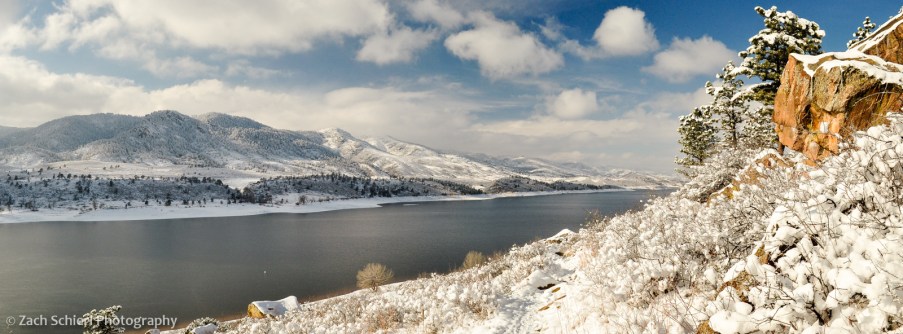
Horsetooth Reservoir after the first significant snowfall of 2015
After the first two winter storms of the year did nothing but lower Northern Colorado’s collective faith in local weather forecasters, we finally got our real snowfall of the year over the past few days. After a predominantly grey and shivery Thanksgiving weekend, the clouds finally revealed some blue sky today so I headed out to Horsetooth Reservoir for a few hours to grab some photos before the afternoon slate of NFL games kicked-off.
Horsetooth Reservoir is a local landmark and apart from the obvious water-based recreational opportunities, there are several world-class bouldering spots located along the east shore of the reservoir that make for some interesting winter scenes. I half expected to see some bold (feel free to pick a stronger word if you prefer…) boulderers throwing caution to the sheets of ice coating most surfaces, but despite this location’s proximity to Fort Collins (~10 minutes), I was pleasantly surprised to have the place all to myself. With no boats on the reservoir and two ridgelines separating me from the ongoing holiday shopping hustle and bustle down below, Horsetooth was unusually serene.

A popular bouldering spot at Horsetooth Reservoir; a bit slick today!

Snowy trails and trees along Horsetooth Reservoir
After wandering around for nearly an hour, I began to notice that nearly every branch and blade of grass was encrusted in about a half inch of crystal-clear ice. Not only that, but the ice had invariably accumulated on the east side of the vegetation, suggesting some fairly persistent west winds over the past few days. A far cry from the sunny serenity of Sunday afternoon!

Ice accumulation on dry grass blades

Ice accumulation on shrubs after a recent winter storm
The grand old Rocky Mountains!
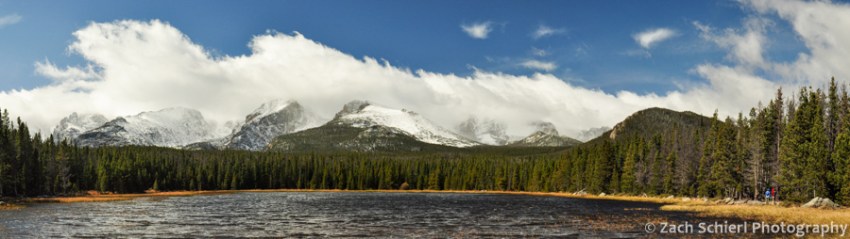
Clouds linger over the Continental Divide as seen from Bierstadt Lake
The grand old Rocky Mountains!
Their bold and massive forms,
Like Pyramids of age,
Defy the sweeping storms!
-Enos A. Mills, 1887
A hectic few months has kept me away from the website recently but fortunately not from my camera. My recent move to Fort Collins, CO means that my new backyard playground is Rocky Mountain National Park, only an hour from my doorstep and home to some truly spectacular scenery, especially in the fall when the aspens and willows turn golden and storms begin to dust the high alpine tundra with snow.

Fall colors along Bear Lake Road
My arrival in Fort Collins happened to coincide with the annual fall elk rut, in which bull elk gather large groups of females (called harems) together to mate. The many large grassy parks in RMNP are a popular gathering place for the elk and hundreds of people can be found lining the roads and trails skirting the meadows each evening to observe them in action. Even though I used to regularly see elk in our backyard growing up, this was a new experience for me. After an evening of watching and photographing the bull elk mate, lock antlers with other males, and toss back their heads to bugle, I can now confidently check “witness an elk rut” off my non-existent bucket list. I would share some of my photos of this unique spectacle, but in order to keep this website rated PG-13, I had better pass…
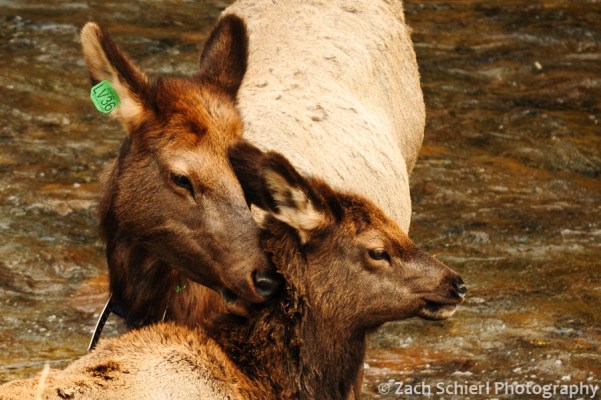
An elk cow shares a tender moment with her calf.
While snow starts to fall in the high Rockies in late September or early October, the weather usually remains pleasant well into October or even November. We’ve had a few storms the past few weeks that have dropped some not insignificant amounts of snow in the high country so every hike I’ve taken so far has been an exercise in scouting trails less likely to be covered in snow and ice.

The Loch Vale in Rocky Mountain National Park
Earlier this week I decided to hike to the base of the east face of Longs Peak and Chasm Lake. I was unsure if I would actually be able to make it to the lake given its 11,700 foot elevation but I had picked Chasm Lake because I had noticed that the last (and highest) mile of trail hugged a south facing slope. A south facing slope equals more direct sun and theoretically less snow. My scouting paid off; the trail was nearly snow free save for some hard packed, but easily traverse-able snow just above tree line and the final 200 yards to the lake. The final 200 yards presented a bit of a challenge: a 30 degree slope guarding the lake that was basically one gigantic ice rink. I wasn’t going to be getting up the main trail without crampons but thankfully, a series of rock ledges alongside the trail were solid and dry, providing an alternative route up the final 200 vertical feet to the lake with only a little Class 3 scrambling required. Upon finally reaching the lake, I was met by a wonderful late autumn scene and quite happy to have avoided the the colossal disappointment of hiking 4+ miles only to get turned around with only a few hundred yards to go.

The Ships Prow (left) and Longs Peak (14,259′, right) tower above Chasm Lake
The snow and ice had the added benefit of deterring the crowds that seem to linger in the park well into the fall. The previous week I had hiked to Loch Vale in a busier section of the park and just getting to the trailhead had involved being stuffed like sardines in a park shuttle bus. Chasm Lake though I had all to myself for over an hour, save for a pair of climbers descending from Longs Peak, the highest summit in the park. The east face of Longs Peak is an imposing sight, “abrupt and precipitous for three thousand feet” according to Enos A. Mills, an early resident of the area and the driving force behind the creation of Rocky Mountain National Park in 1915. The silence was stunning, save for the occasional high-pitched “eeeeeeeee” of a pika, the intermittent roar of the wind whipping up loose snow, and the din of fallen icicles and chunks of glacial ice crashing their way to the base of the cliffs.
At eve and morning lighted
With liquid gold all around,
Thy crests and hills and valleys
Gleam bright with glory crowned.
—Enos A. Mills, 1887
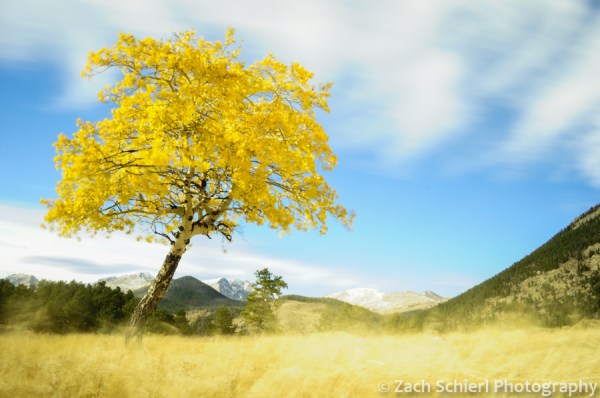
Aspen and grass waving in the wind in Horseshoe Park

Sunset and gibbous moon from Moraine Park
Larch Hunting in the North Cascades

Golden Larches at Blue Lake in the North Cascades.
Still reeling from the disappointment of having to leave Colorado a mere fortnight before the world’s largest Aspen forests exploded into their annual displays of color, I was determined to find some similar photo opportunities in Washington this fall. The “Aspen of the Pacific Northwest” is arguably the Western Larch. Most common in the Northern Rockies, a handful of Western Larch stands can be found east of the Cascade Crest in Washington state. Tall but unassuming for 50 weeks out of the year, and then drop-dead spectacular for two, the Western Larch looks all for the world like an evergreen, but it is decidedly deciduous. Most high-altitude Pacific Northwest forests are all evergreen, so unless seeing dead and decaying brown pine-needles pile up on the forest floor is your thing, autumn up in the high Cascades isn’t anything to get too excited about. Add larch though and it’s a different story. The yellowish-green needles of the larch go out with a bang, turning a glittering golden-yellow for just a few short weeks in the late fall before leaving the tree buck naked until the following spring.
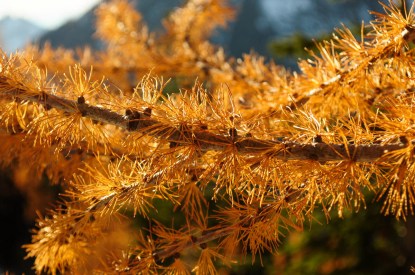

Golden larch season in the Cascades is an event that generally attracts hordes of needle-peeping Seattleites to the mountains. My hope was that the several feet of early-season snow the mountains had received in late September would be deep enough to temper the crowds. I was wrong. The parking lot at the Blue Lake Trailhead off of Highway 20 in the Okanogan National Forest was completely full, forcing us to park alongside the highway. Fortunately, photographers are born with an innate desire to bask in late-afternoon light which meant we were headed up the trail to Blue Lake late enough that most other folks were already on their way down. One advantage to having lots of folks on the trail was that we were alerted to the presence of a solitary mountain goat scrambling along a rocky gully a few hundred feet above the trail.
The lower portion of the trail was snow-free, but by the time we reached the goat and the larch groves, it was several feet deep. The main trail was hard-packed snow and ice due to all of the foot traffic but wandering off trail trying to take pictures of the larches sans people would definitely have been easier with a pair of snowshoes. The larches were nothing short of spectacular, especially against the snowy-white backdrop. In the late afternoon sun, the color of the needles was so resplendent that you could have painstakingly coated each needle in gold leaf and not known the difference. Individual larches on mountain ridges miles away could easily be picked out, their needles back lit by the sun, shining like beacons in a sea of mountains.

A surprisingly sunny and warm October afternoon in the North Cascades is perfect for larch hunting.
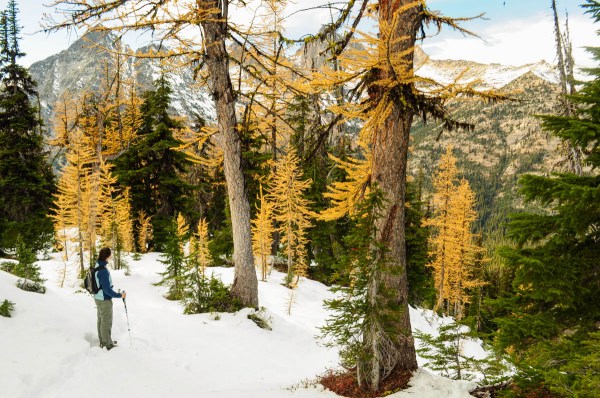
Exploring off trail, gazing out at the Cascades through the larches.
Later in the evening, headed to a lower-elevation (read: warmer) camping spot, I was able to catch the very last rays of sunlight on Liberty Bell Mountain. And just in case larches and a spectacular sunset weren’t enough, the clear skies and nearly full moon were ideal conditions for some nightscapes of the North Cascades!

Sunset along the North Cascade Highway.
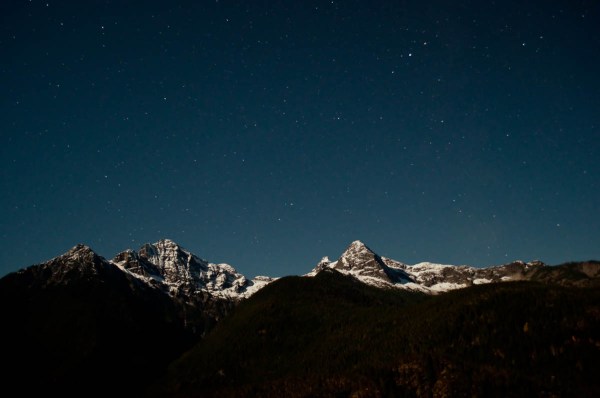
The constellation of Aquila sets over North Cascade peaks illuminated by the Full Moon .
 Zach Schierl Photography