Rocky Mountain High…literally
When hiking, alone and sleepy, though a dark, pre-dawn, dense forest of tall lodgepole pine, every shadow and tree stump looks like a bear. It’s a great way to get your heart rate going early in the morning. I had risen from my restful (save for some early morning screaming and yelling coming from the campground across the road) sleep at 4:30 A.M. in an attempt to climb Colorado’s highest peak, Mt. Elbert, without getting myself electrocuted. I found myself mentally preparing to defend my White Chocolate Macadamia Nut ClifBar to the death at least half a dozen times over a 1 hour period. Not only is Mt. Elbert the highest point in Colorado, it is also the highest point in the Rocky Mountains as well as the 2nd highest point in the entire continental United States, just 65 feet lower than California’s Mt. Whitney. Despite its height, the summit of Mt. Elbert can be reached via several well-traveled trails. All require a fair bit of elevation gain but the one I was forced to use as a result of not possessing a 4WD vehicle climbs 4,900 feet in 4.5 miles, a healthy climb regardless of altitude.
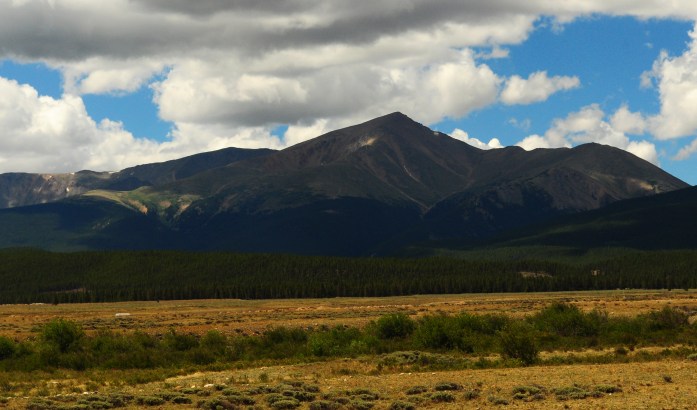
Summer is generally considered a bad time to climb any peak that involves spending time above treeline because of the summer monsoon thunderstorms that are ubiquitous across the southwest. Unlike its Indian counterpart, the southwest monsoon generally doesn’t deposit several feet of rain on the surface (although they can produce some locally heavy, but brief, downpours) but they can, and often do, produce copious quantities of lightning. Lightning, as you most likely know, hits high places. Mt. Elbert is the highest point in Colorado. A person standing on Mt. Elbert, would then, by extension, temporarily be the highest thing still attached to the ground in Colorado. Put two and two together and you can see this makes for a potentially life-threatening situation. The problem with these lightning storms is that they can develop incredibly rapidly and without warning out of clear blue sky. Your best chances of avoiding them is to hike early….really early.
I camped about 100 yards from the Mt. Elbert trailhead the night before the hike. A developed forest service campground was located directly across from the trailhead whose “services” I could utilized for $15 per night. Option #2 was to drive across the road and set up camp in a small clearing for $0 per night. The only things I would be missing (considering that I could simply walk across the road to use the water spigots) were the fire pit and picnic tables located in each developd campsite. Considering that I was alone (thus making a picnic table a bit unnecessary) and that a complete fire ban was in effect, I decided to save my hard-earned moolah.
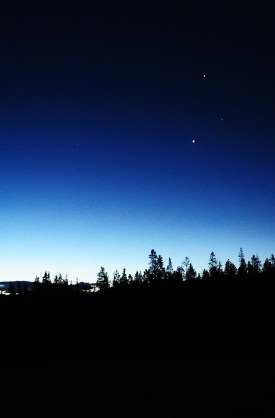
Venus and Jupiter in the pre-dawn sky at the trailhead
Several vehicles were in the parking lot upon my arrival at 5 A.M. By the midway point of the ascent, I had managed to pass all of these groups, save for a pack of Boy Scouts who had ascended beginning at 1 A.M. in order to see the sunrise from the summit. Lunatics. After about an hour or so of hiking through the forest, the Sun rose above the horizon just as I hit timberline at about 11,500 feet. If you climb mountains on any regular basis, you’re probably aware that treeline on many peaks is a welcome sight. The lack of foliage generally provides reassurance that you’re almost there, in addition to providing spectacular vistas of the surrounding countryside. In other words, treeline often tells you: “Hang in there! Just a little bit longer!”
Treeline on Mt. Elbert invokes no such warm and fuzzy feelings. Rather, treeline on Mt. Elbert is merely a courtesy reminder that you are less than halfway there and that you still have more than 3,000 vertical feet to climb through ever decreasing oxygen levels. And the vistas aren’t anything to write home about from this point to boot.

Breaking out of the trees at 11,500’…still 3,000′ to go!

One of the few inhabitants of the upper mountain, the American Pika is a small, elusive rodent that call the scree slopes its humble home.
Mt. Elbert also redefines the term “false summit.” Fortunately, for my sanity, I had thoroughly read a number of guidebooks and was well prepared for this matter. Good thing otherwise I probably would have consider hanging myself after reaching the 2nd one and finding the true summit still out of my reach (fortunately, the lack of trees would have made this a tricky proposition…). On the way down, I encountered a number of weary and inquisitive hiking parties just below the lower-most and most evil false summit (still nearly 1000 vertical feet from the true summit) whom I regrettably had to inform that they still had a good hour or more of trudging to go. Judging by their reactions and creative use of profane adjectives, they were not as well-prepared for this as I was.

Nearing the first of the false summits. This one is particularly nasty since it is in plain view from the beginning of the trail.
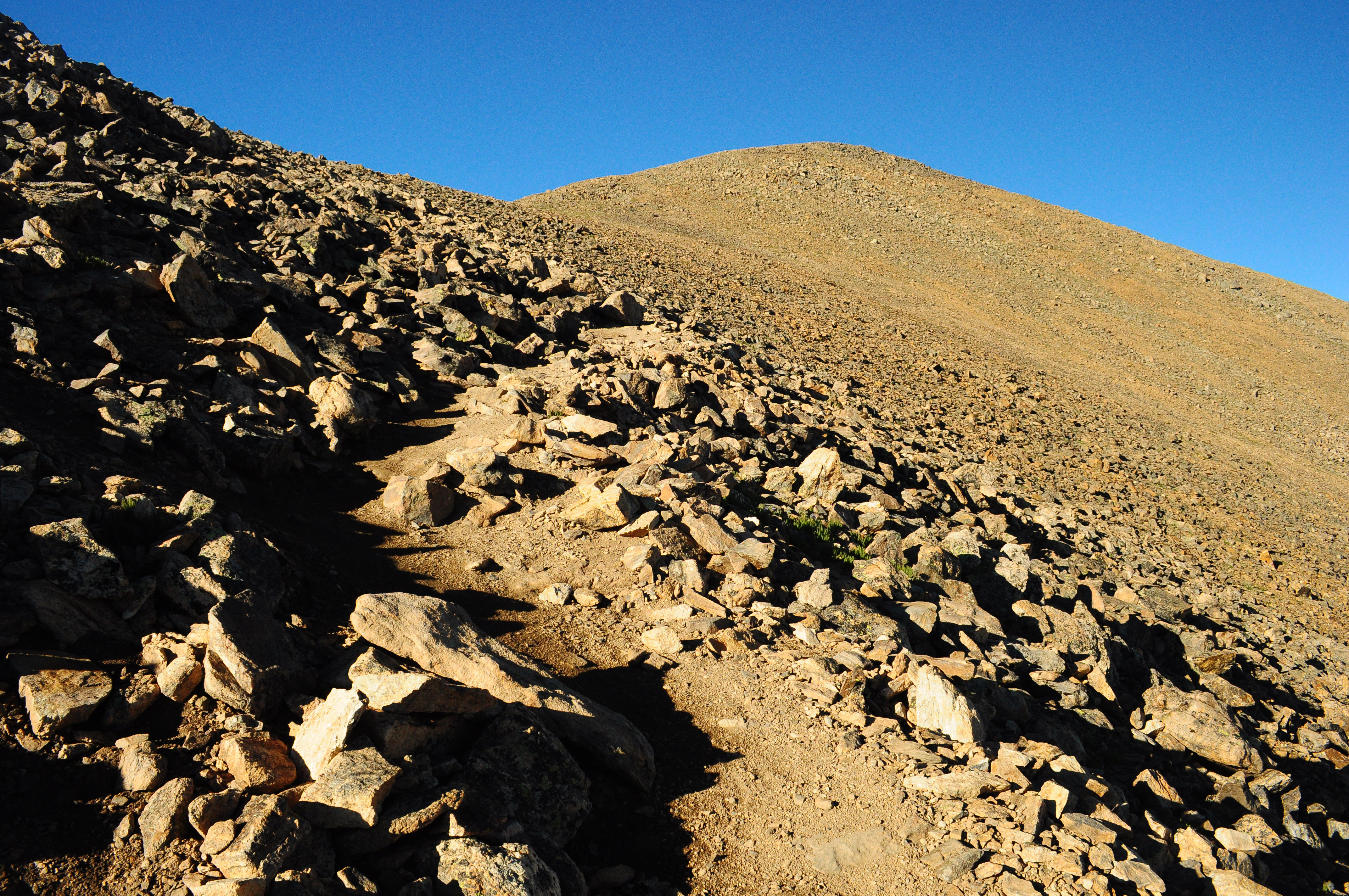
Skirting around the edge of false summit #1, false summit #2 comes into view….

…and then the true summit finally appears on the horizon!
The view from the summit is, as would be expected, spectacular, although not necessarily any better than a number of other, lesser peaks in Colorado. Mountains fill the field of view as far as the eye can see in all directions. Several other Sawatch Range 14ers are visible from the summit including Colorado’s 2nd highest peak, Mt. Massive to the north (Mt. Massive is aptly named, it consists of four individual peaks of 14,000+feet along a 5 mile ridge) and La Plata Peak to the south. The view on a clear day (which it was) stretches all the way to Pikes Peak outside of Colorado Springs, almost 100 miles to the southeast, and the Maroon Bells outside of Aspen. Being the first person apart from the overachieving group of scouts to summit that morning, I had the place all to myself for about half an hour. By the time summit-er #2 showed up at about quarter to 9, clouds were already starting to build up around the mountain so I decided to head back down.

View to the south along the Sawatch Range from Mt. Elbert. 14,000 foot peaks and other notable summits are labeled.
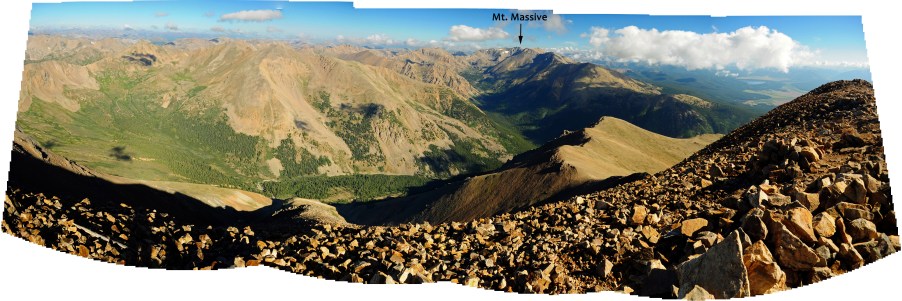
View to the north from Mt. Elbert. The mutiple peaks of Mt. Massive are at right. The prominent ridgeline in front of Mt. Massive is the ridge followed by the Mt. Elbert trail.
Sadly, having reached the highest peak in the Rockies, my options for setting a new personal elevation record are now somewhat limited unless Warren Buffet unexpectedly names me in his inheritance or I find a big bag of money on the street (those are pretty much the same if you think about it…) and decide to go to Alaska or South America (to make a donation, you can find my contact information on the About page). Or, on a slightly cheaper thought, Mt. Whitney anyone?

14,433 feet!
Mountains of Sand

Sunset over the Great Sand Dunes. Note the sunlight catching the thin layer of sand being blown across the surface, no more than a few inches above the ground. Saltation in action!
I’ve been to my fair share of sand dunes; St. Anthony Dunes and Bruneau Dunes in Idaho, Oregon Dunes on the Pacific Coast, Coral Pink Sand Dunes in southern Utah, Juniper Dunes near Walla Walla, and a handful of dunes in New Zealand that I don’t remember how to pronounce much less spell. By comparison though, the Great Sand Dunes in south-central Colorado truly deserve their title. In fact, one feels somewhat uncomfortable using the term “dune” due to its complete and total inability to convey the grandiose scale of this geological wonder. A weary traveler approaching them might be liable to exclaim “That’s no dune!” (if you didn’t catch that cleverly placed Star Wars pun, you should watch this short video clip immediately) upon the realization that these are no ordinary dunes. No, they are perhaps better described as a small mountain range made of sand. When one first looks upon the dunes, it seems inconceivable that the entire massif could be made of sand. After slogging my way to their summit though, I assure you that they are.

Approaching the dunes from the south…Sangre de Cristo Mountains in the background.
Before beginning to ascend the dunes, one must first cross Medano Creek, a small stream originating in the Sangre de Cristo Mountains that flows between the mountains and the dunes. Due to the abnormally low snowfall in the Colorado mountains this past winter, by the time I visited in mid-June, this was a non-issue. The creek was only a few inches deep and therefore easily traversed. Medano Creek is nevertheless just one of many features that makes the Great Sand Dunes stand out from their sand dune brethren around the world. The presence of a reasonably reliable water source along the base of the dunes creates a beach-like environment that, judging by the number of families with small children, is very conducive to building sand-castles.
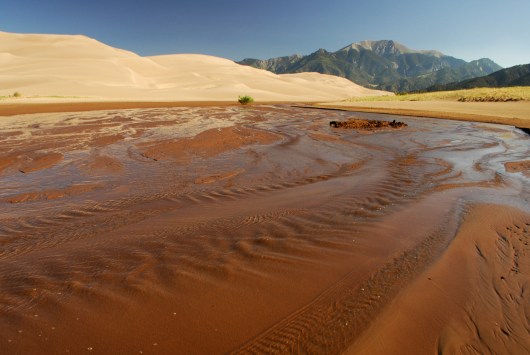
Medano Creek meanders its way across the sand flats
The hike up to High Dune (which confusingly is NOT the highest dune; that title belongs to nearby Star Dune which is about 100 feet higher) is well-traveled yet there is no official trail so everyone ends up taking a slightly different route making it difficult to find footprint-free sand for good photographs. Hike past High Dune though and you are almost immediately alone in the midst of many, many square miles of untrodden, pristine, windblown sand. Anyone who has ever hiked up a sand dune before knows that you have to expend quite a bit of energy to extract your sinking foot from the sand after each step. The somewhat demoralizing thing about hiking through sand dunes is that what takes you an hour to hike up, you can run down in less than a minute. Given that the running down part is thoroughly enjoyable; hiking the sand dunes is, in a way, analogous to waiting in line at Disneyland for two and half hours in order to go on Splash Mountain for two minutes. The analogy fails in that Splash Mountain doesn’t leave you picking sand out of every part of your body for the next three months and you don’t get an on-ride photo running down the sand dunes. However, even hiking up the dunes, while difficult, is still a very enjoyable experience.

A lone hiker trudging up a small foredune on the way to High Dune provides an excellent sense of scale

Hikers cross the final ridge to High Dune underneath a 3rd quarter Moon
Wow, I’ve written three entire paragraphs without even MENTIONING geology yet! This must stop now before they make me give my degree back. Anyhoo, most of the sand originates in the San Juan Mountains to the west, is transported to the edge of the vast San Luis Valley and then blown eastward by prevailing winds for many miles before the sand slams into the Sangre de Cristo Mountains and accumulates in a ginormous pile at their base. The color of the sand is a bit difficult to describe. During the day, it appears slightly off-white, cream, or ivory you might even say. However look at the sand closely and you’ll see that it consists of many orange to pink to yellow colored grains; colors which are brought out in all their glory at sunset. In a few spots on my hike/run down the dunes, the innards of the dunes were visible, exposing the intricate bedding pattern that results from sand being blown up the shallow side of the dune and then cascading down the slipface.
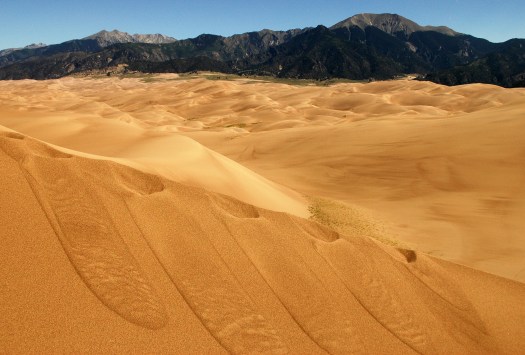
A series of 1-m scale sand avalanches slide down a steep slipface

A rare outcrop of sand reveals the layering that underlies the sand dunes
Sunset in the dunes was one of the most indescribable experiences I’ve ever…umm…experienced. Never mind that positioning yourself correctly on the dunes allows you to watch the sunset half a dozen times if you start at the top and slowly move your way downhill, the colors and patterns in the dunes brought out by the Sun setting through the smoke and haze in the western sky (much of it regrettably emanating from wildfires in New Mexico fires) were spectacular. The low angle of the sun revealed the small-scale dunes that are ubiquitous yet nearly invisible in the harsh mid-day lighting (see photo at top of page).

Looking north towards the Sangre de Cristo Mountains at sunset.
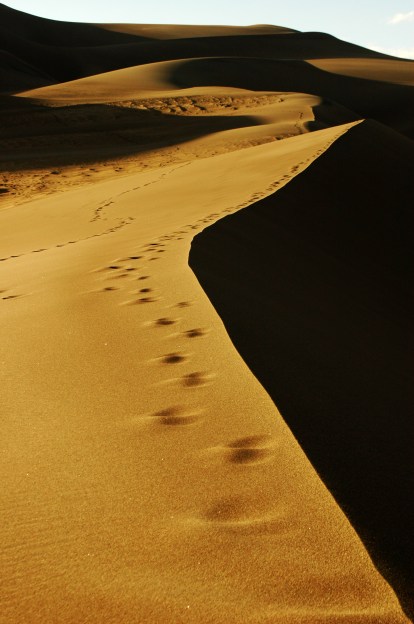
Walking along the dune crests at sunset.
Since this has already ballooned to one of my longer entries, let’s go ahead and make this Part 1 of 2. The dunes are just one of many attractions in the San Luis Valley/Sangre de Cristo region. The other attractions that I will detail soon may or may not include an alligator farm…
And that my friends, is called a “cliffhanger.”

Obituary for a DSLR
My trusty Nikon D70 died today after nearly 35,000 shutter actuations, in a beautiful place no less; more than 10,000 feet above sea level along the West Fork of the Cimarron River, high in the ice-sculpted pinnacles of the San Juan Mountains of southwestern Colorado. Given that it had pluckily survived numerous 5+ foot drops onto hard, rocky surfaces, many torrential downpours, hitchhiking across the sheep-filled land known as New Zealand, and being partially submerged in mineral-rich water as I uncontrollably floated down Havasu Creek, it seems odd that a light bump against a ratty-looking old lodgepole pine is what ultimately brought it to what in hindsight seems a rather ignominious end. Alas, this accidental tap caused the camera’s shutter to cease operating, casting the camera’s 6.3 megapixel CCD chip into a state of eternal darkness, never again to capture the majestic photons emitted by the incomparable scenery of this great Earth.

The final shot…
Not even the most exquisitely crafted prose can capture the stunning allure of the natural setting in which the D70 ultimately met its demise. Its final hours were spent summiting the rocky, yet green and verdant slopes of 12,152 foot Courthouse Mountain, a impressive edifice that is but a mere foothill to the soaring 14,000 foot peaks of the San Juan’s above. Despite it’s striking appearance, more than 1200 other peaks in the state of Colorado exceed it in height, although after today’s passing, none will exceed it in sentimental significance. A more glorious and perfect day could nary have been found; the weather gods were beaming upon the landscape below, basking the D70 in warm, unintterupted sunlight as it ascended the mountain, strapped to the shoulders of its loving owner.
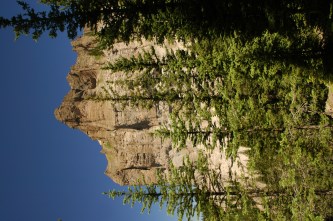
The south face of Courthouse Mountain, composed of layer upon layer of volcanic tuff and breccia.

Courthouse Mountain Trail

The last photo with a human being in it…
From the summit, the D70 faithfully recorded its final panorama; a wide swath that included the jagged crags of Dunsinane Mountain and Precipice Peak, the dark green lodgepole stands of the Uncompahgre Wilderness, and the distant summits of Uncompaghre Peak and Mt. Sneffels, gripping tightly to their last vestiges of winter snow. To the north, beyond the exquisitely layered deposits of Chimney Rock belaying its violent volcanic history, lay the verdant Uncompahgre Valley, home to the towns of Ridgway, Montrose, and Delta. Along the eastern base of the mountain lay the valley carved by the West Fork of the Cimarron River, on an arrow straight path north to eventually meet the mighty Gunnison River.

Panoramic View from Courthouse Mountain, looking east into West Fork Cimarron River valley. Chimney Rock and Silverjack Reservoir visible at left, Precipice Peak at right.

View from Courthouse Mountain looking south and west towards San Juan Mountains.
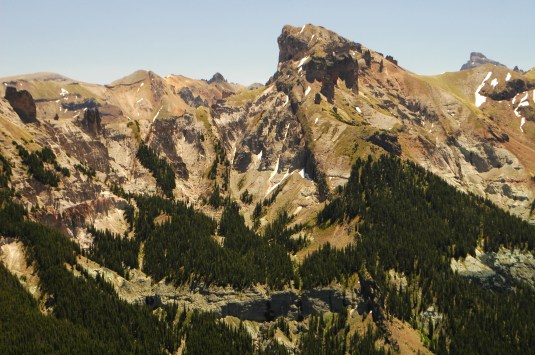
The perilous promontory of Precipice Peak
Until such time that a suitable replacement can be procured, the D70 will be replaced by a small, yet capable Canon point-and-shoot camera. In lieu of flowers, please send Amazon.com or B&H Photo gift cards.
 Zach Schierl Photography