Top 10 from 2014
As in past years, with the coming of the New Year I decided to take a look back at all the photos I took in 2014 and select some of my favorites to share with you here on the blog. Between finishing graduate school (yippee!) and making a permanent (for now) move from the Pacific Northwest to Colorado, I had less time to devote to photography than in previous years. Nevertheless, picking out my favorite photos was difficult as usual and a good reminder that I was fortunate to have the opportunity to experience and photograph a a number of new places in the past year, from the coasts of Olympic National Park to remote alpine basins in the Rocky Mountains.
Without further ado, here are my ten favorite photos from 2014 in chronological order. Here’s wishing you all a healthy and happy new year!
1. Tulip Fields at Sunset, Skagit Valley Tulip Festival, Washington

Held annually in April, the Skagit Valley Tulip Festival is a must see for any spring visitor to NW Washington, photography buff or not. On weekends, especially sunny ones, the tulip fields that spread out across the Skagit Valley about an hour north of Seattle are overrun, making photography difficult. Fortunately, I lived only about a half hour away and was able to visit on a less-busy weekday evening in order to photograph the picture-perfect bulbs in their prime and without the crowds.
2. American Bison, Yellowstone National Park

I’m going to come clean: this is the only photo on this list taken from the confines of my car! I was departing Yellowstone at the end of an impromptu day-trip to the park while attending a geology conference in Bozeman when I spotted this solitary bison along the road. Fortunately, no vehicles were coming up behind me so I was able to grab my camera and capture the glow of the late afternoon sunlight and the diffuse reflection of the bison in a pool of late-season snow melt.
3. Milky Way, Airglow, and Light Pollution from Hurricane Ridge, Olympic National Park, Washington

Living near Seattle doesn’t exactly do wonders for one’s chances of observing rare celestial events. What’s one to do? Get above the clouds of course! I was thrilled to be visiting Olympic National Park during the peak of the Cameleopardalids meteor shower in May. In order to get an unobstructed view, we made the drive up to Hurricane Ridge just before midnight in hopes of catching some meteors. As you may recall, the meteor shower fizzled spectacularly but all was not lost: I was able to capture this panorama of the summer Milky Way emerging from the disgusting Seattle light dome (over 50 miles away as the crow flies) as it rose in the west. Despite the light pollution, I also managed to capture the ghostly green glow of an atmospheric phenomenon known as “airglow” (which I’ve written about previously) and the low lying clouds smothering the Elwah River Valley several thousand feet below.
4. Giant Green Anemone (Anthopleura xanthogrammica), Olympic National Park

I developed a slight infatuation with seeking out and photographing marine life during my two years in Western Washington. Timing trips to the coast with some of the lowest tides of the year helped me discover a wide variety of anemones, nudibranchs, sea stars, urchins, and much more. Anemones were perhaps my favorite group to photograph, their neon-colored and delicate tentacles waving back and forth in the surf.
5. Panorama from Hole-in-the-Wall, Rialto Beach, Olympic National Park
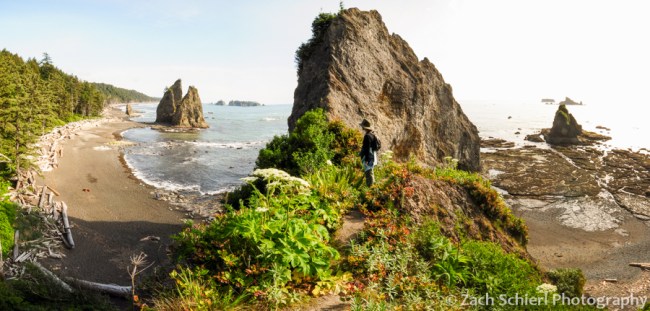
Rialto Beach is one of the most popular spots in Olympic National Park…for obvious reasons. The short 2-mile hike to Hole-in-the-Wall was one of my favorite experiences this year. Once reaching the famous rock formation, we found an nearly entirely overgrown path that led us up to a viewpoint on the crest of Hole-in-the-Wall, getting us away from the surprisingly scant Memorial Day crowds and immersing us in expansive views of sea stacks, rocks, and islands along the Olympic coast.
6. Summer Wildflowers at Ice Lake, San Juan Mountains, Colorado

Despite my ravings about Rialto Beach in the previous photo, our trek to Ice Lake in the San Juan Mountains of Colorado was hands down my favorite hike of the year, and one of my most memorable ever. My only regret about this day was that we weren’t prepared for an overnight (or at least a hike back to the car in the dark!), which means I missed out on what was surely a epic sunset from the basin. Click the link above for more photos of this spectacular place.
7. Ice Lake Panorama, San Juan Mountains, Colorado
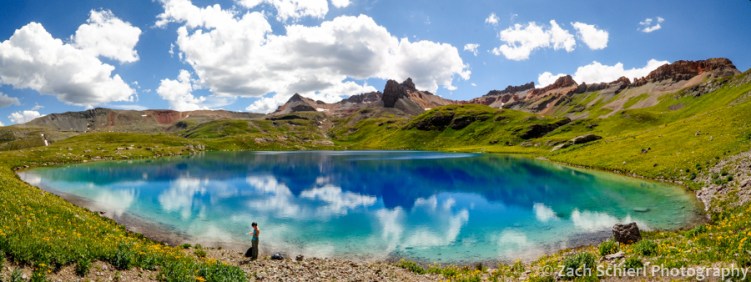
Did I mention Ice Lake was spectacular? It snagged two of the coveted spots on the top 10 list. That means you have to go.
8. Circumpolar Star Trails from Escalante Canyon, Colorado

Photographing star trails is a bit more complex in the digital age than it was with film. This was only my second legitimate attempt, but I was happy with how it turned out. Extremely long single exposures suffer from a variety of maladies so this photo is actually a composite of over 100 consecutive 30″ exposures (for the stars), and one 3″ exposure for the foreground juniper which I illuminated with a headlamp. In post-processing, I had the pleasure of removing more than a dozen aircraft which passed overhead during the hour or so it took to gather the series of exposures. I elected not to remove the two meteors (astronomical objects flashing through the frame are fine by me) but I’m looking forward to doing some more star trail photography from places not on major transcontinental flight paths.
9. Exclamation Point, Black Canyon of the Gunnison, Colorado
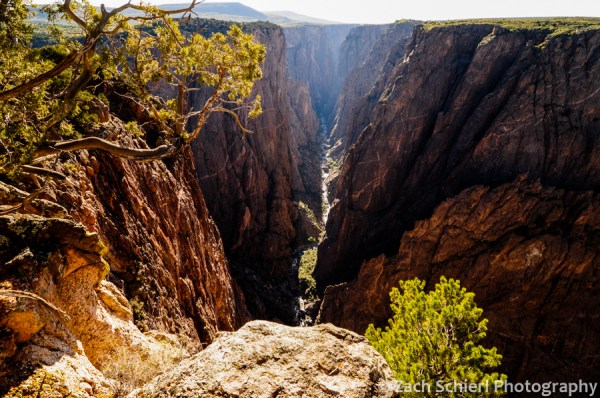
I love this photo because it exemplifies how the canyon got its name. Despite being taken at 10 o’clock in the morning, the narrow gorge carved into dark Precambrian metamorphic rocks remained shrouded in shadow, while its surroundings (and portions of the canyon bottom) are basking in the bright, mid-morning sunshine. This photo was taken from an overlook on the remote and seldom visited North Rim of Black Canyon, which offers the most spectacular views into the narrowest portion of this amazing gorge and is truly worth the effort to visit.
10. Waving Aspen and Grasses, Rocky Mountain National Park, Colorado

I didn’t purchase any new camera gear this year, but was the recipient of a 9-stop neutral density filter for my birthday, a filter I’ve been wanting to experiment with for a while now. That filter allowed me to take this photo, a 30″ exposure at f/22 in broad daylight, and capture the motion of a colorful aspen and meadow grasses waving in the wind on a autumn day in Rocky Mountain National Park.


A Sheep, a Sheep! My Kingdom for a Sheep!


Two bighorn sheep ewes in Big Thompson Canyon, Colorado.
After some memorable elk encounters this past fall, I’ve been on the lookout for more wildlife viewing opportunities over the past few months. A flock of several thousand Canadian geese passing overhead while extricating my car from a foot of snow at the Denver airport didn’t quite cut it so on a recent weekend, we headed out in search of one of Colorado’s most iconic creatures: the Rocky Mountain Bighorn Sheep.
It turns out that late November and early December is the best time of year to view Rocky Mountain Bighorn Sheep here in the foothills of the Colorado Rockies. This time period marks the annual bighorn sheep rut, or mating period. While the bighorn sheep rut attracts far less attention than the fall elk rut, at this time the sheep descend from higher elevations to avoid deep snowpack and are frequently seen along canyons such as the Big Thompson, just a short half hour drive from Fort Collins (where I now live).
If that name sounds familiar, it’s because Big Thompson Canyon is better known as the site of a number of large and particularly deadly floods in the past few decades than as prime bighorn territory. But in late autumn and early winter, this is the place to be for some serious sheep spotting and shooting (with a camera of course!). This is not to say the sheep are always easy to spot. The beige bighorns, with the exception of their white butts, blend into the brown and shrubby landscape extraordinarily well. Here’s a view of the second pack of sheep we spotted to better illustrate the challenge:

Find the FOUR bighorns!
You can see the problem: brown vegetation + brown rocks + (mostly) brown sheep = hard to spot sheep. It’s like Where’s Waldo, only in real life and with sheep instead of fictional characters with questionable fashion sense. Anyways, when whizzing by at 50 mph (the minimum speed required to avoid being rear-ended by folks hellbent on getting to Estes Park) on a road with little to no shoulder, it helps to have at least one pair of eyes apart from the driver to scan the cliffs and ledges so loved by the sheep for movement or a flash of a white rump.
In the end we spotted two groups of bighorns in about two hours in the late morning, the first group containing one ram and three ewes, the second two rams and three ewes. The first group was bedded down right along the Big Thompson River, just a stone’s throw from the highway right at the entrance to the canyon. With a little creative parking and scrambling, I was able to get some good close-ups of the sheep (see top photo and below). The second group was larger and more active, but was in a gully across the river over a hundred yards from the road, well outside the range of my pathetic telephoto equipment.
The presence of two rams in the second group was exciting because it afforded the possibility of seeing the famous bighorn sheep head-butting combat ritual in action. Alas though, these rams seemed much more interested in quietly grazing on the scant remaining greenery than in slamming their heads together at speeds of more than 30 mph (who wouldn’t?)

A good look at the large curved horns on the male bighorns, used in head-butting competitions with other males for the right to mate with prime females.

The bighorn sheep will continue to be visible in the Big Thompson area throughout the winter (as they avoid the deep snowpack at higher elevations) although once the rut concludes they become much more averse to human contact and populated areas. Unlike some other notable large mammals of the Rockies, bighorn sheep tend to be most active during daytime hours, making them relatively easy to spot if you have a keen eye.
Photographing the Night Sky from Colorado

Colorado is a great place for those of you who, like me, are perpetually torn between looking up and looking down. Colorado’s spectacular geologic landscapes keep me occupied during the day, but at night a whole different world opens up overhead. Colorado is a great place to look at and photograph the night sky for several reasons:
- It’s relatively dark. With the exception of the Front Range megalopolis (where I now live), there are few egregious sources of light pollution, especially when compared to just about every state east of here.
- It has the highest average elevation of any state. This is important because looking through the Earth’s atmosphere at the stars is like looking through a glass of water at a friend sitting next to you. The higher you go, the thinner the atmosphere becomes, and the better and steadier your view of the night sky.
- It has good weather. Clear skies can be found regularly throughout the year, unlike in the black hole of astronomy known as the Pacific Northwest.
- It has lots of public land where you can theoretically spend all night outside taking photos without fear of getting shot.
I spent a good chunk of this past summer honing my astrophotography skills and if you’ve never tried your hand at it, I encourage you to give it a try. It has certainly made me a better all-around photographer. First and foremost, astrophotography is an exercise in patience, both at the camera itself and then in front of the computer afterwards, and patience is a valuable virtue in all aspects of photography. Ironically, as comfortable as I am outside under the stars, astrophotography actually pushes out of my comfort zone photographically. Apart from minor brightness or contrast adjustments and cropping, I tend to eschew significant post-processing of my photos. When photographing the night sky though, some quality alone time with Photoshop and Lightroom is pretty much a necessity in order to get something that looks good.

The summer Milky Way spans the sky from horizon to horizon as seen from near Delta, Colorado. The galactic center is located just above the southern horizon (right).
I’m not here to give you a step-by-step guide to night sky photography, that’s been done before (try here, here, or here), but simply to encourage you to try it. All you really need to get started is a DSLR, a tripod, some patience, and somewhere dark. Like ACTUALLY dark. Sadly, light pollution has gotten so bad that most people reading this will have never seen a truly pristine night sky. Driving to the suburbs does not qualify as “dark”. Here in the Denver/Boulder/Fort Collins light pollution-opolis, even after driving two hours up to 12,000 feet in Rocky Mountain National Park, you’ll still only see roughly HALF as many stars as can be seen with the naked eye from a truly dark location. To see if there are any pristine night skies near you, check out this nifty site, which is basically Google Maps with an overlay of light pollution severity. You’re looking for areas with the darkest black color and as you’ll see, they are becoming few and far between.
What’s great is how many different ways there are to incorporate the night sky into your photos. With wide-field astrophotography, the entire night sky is the star of the show (pun intended). Accomplished by using fast, wide-angle lenses combined with relatively short exposures (30 seconds or less, unless you have a motorized mount), this method can reveal spectacular detail in the night sky unseen by the human eye, such as the spectacular interstellar dust lanes in the Milky Way. If you pair the Milky Way with a terrestrial landscape illuminated by moonlight, the possibilities for composing spectacular nightscapes become nearly infinite.

Close-up of the center of the Milky Way Galaxy. Dark arms of starlight-obscuring dust, star clusters, and emission nebulae (pink) are visible in this 1-minute exposure.
Longer exposures (or lots of short ones “stacked” together) document the motion of the stars across the night sky. I have a soft spot for star trails because they are a beautiful reminder that the world we live in is in constant motion; the dramatic and graceful arcs traced out by the stars are due to OUR rotation, not the stars. Star trails centered around the North Star (Polaris) can be especially striking since the north star is almost exactly above the rotational axis of the Earth, and thus moves very little throughout the night.
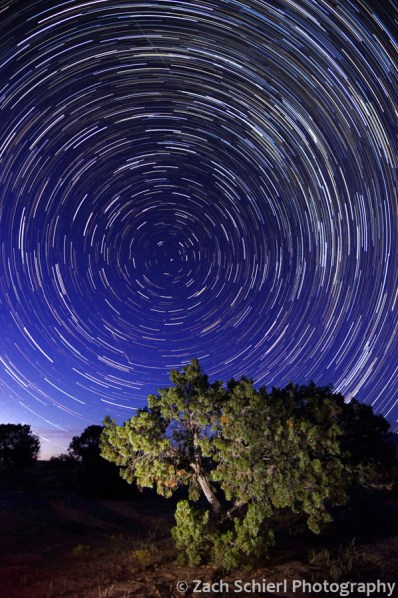
Star trails (centered on Polaris) over Escalante Canyon, Colorado
Probably the most challenging type of astrophotography, and really the only one that requires specialized (often expensive) equipment, is telescopic imaging. My experience in this category is limited, given the aforementioned factors (donations always happily accepted!), but I’ve tried it on a handful of occasions by using friend’s equipment or telescopes at observatories I have worked at. Telescopic astrophotography allows detailed images of galaxies, star clusters, and nebulae, many of which are not even visible to the naked eye. While good images can be obtained by fitting a DSLR to a telescope (below, center and right), the best images are obtained using stand-alone CCD cameras optimized for astrophotography (below, left).

A variety of galaxies and nebulae imaged via telescope.
Some objects, like the Moon, are big and bright enough that a telescope is not needed to get decent images. I got this photo of last month’s total lunar eclipse with a standard 55-200mm zoom lens, and even had enough light gathering ability to capture the planet Uranus less than a degree away from the Moon!
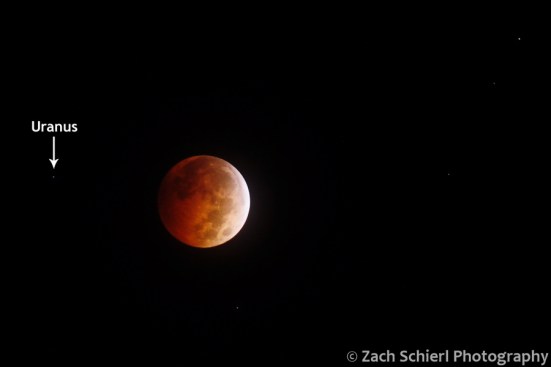
Total lunar eclipse on October 8 2014, as seen from Fort Collins, CO
Beyond the technical challenge, what ultimately thrills me most about astrophotography is being able to capture photons that have been en route towards us across the vast universe for dozens, hundreds, or even millions of years. After that long of a journey, it feels like our duty to ensure that at least some of those photons have the honor of being recorded in some state of permanence. Give it a try and it won’t be long before you find yourself in the middle of nowhere waiting for your camera to finish a 1-hour exposure. A perfect change to sit back and ponder the vastness of the universe looming over your head.
 Zach Schierl Photography