A Little Southern Utah in Western Colorado: the Dominguez Canyon Wilderness

Pedestrian bridge over the Gunnison River at the entrance to Dominguez Canyon
Colorado is known for its mountains, and with an average elevation of 6,800 feet rightfully so, but tucked away in the far western part of the state are a number of spectacular red rock canyons and landscapes that look like they were lifted straight out of a Southern Utah travel guide by some sort of magical, three dimensional silly putty. Colorado National Monument is home to the perhaps the best known of these canyons but several equally impressive chasms can be found just to the south in the Dominguez Canyon Wilderness Area.
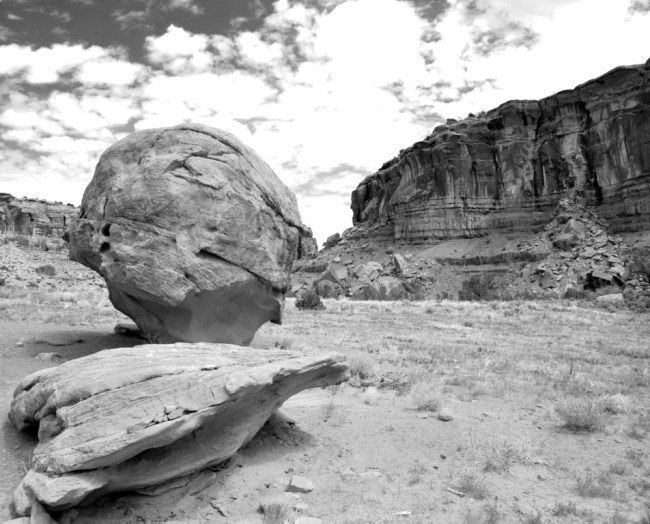
Wind-sculpted boulders in Dominguez Canyon
Dominguez Creek is a tributary of the Gunnison River just north of Delta, CO that flows year-round through a series of spectacular canyons cut into sedimentary rock of varying red, orange, and pink hues. About a mile upstream of its confluence with the Gunnison, the canyon splits; Big Dominguez Canyon to the west, and Little Dominguez Canyon to the south. Gentle trails undulate along the floors of both canyons for dozens of miles, all the way up into the headwaters of the drainage system on the Uncompahgre Plateau. I chose to hike up Big Dominguez Canyon, which I knew was home to some year-round waterfalls (ended up being nearly dry…) and impressive rock art. This turned out to be a really good decision as you’ll see shortly. Since most of my hiking recently has involved steep mountain trails at elevations often 11,000 feet, trekking along a relatively flat trail at 5,000 feet was a welcome respite that allowed me to cover quite a bit of ground.
Dominguez Canyon is located within a federally designated wilderness area, one of 43 such areas in Colorado. The Wilderness Act of 1964, which celebrates its 50th anniversary next year, defines wilderness as “an area where the earth and its community of life are untrammeled by man, where man himself is a visitor who does not remain.”
In many ways, these values were on display in Dominguez Canyon; despite the area’s proximity to Grand Junction, I hiked about 15 miles (told you it was flat) and didn’t see another human soul until I was almost back to the trailhead. Apart from some rumbles of thunder that echoed magnificently through the canyon in the early afternoon, the landscape was perfectly silent, despite its location only a half dozen miles from U.S. Highway 50. In other ways they were not, such as when I came across piles of metal equipment associated with an old mine (likely copper based on the abundance of azurite and malachite in the surrounding rocks), although being geologically inclined I’m never one to complain about this sort of thing since there are few things as fun and adrenaline-inducing as poking around old mine dumps for an hour!
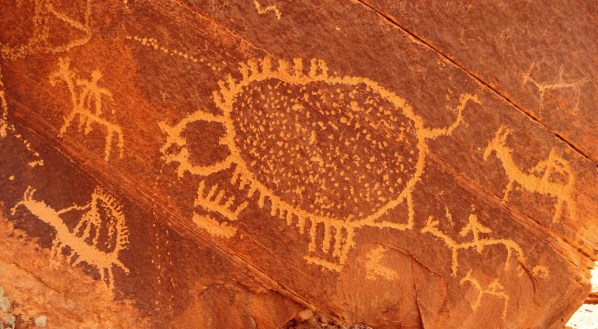
One of the larger petroglyphs in Dominguez Canyon? A turtle? A chunky centipede? Other ideas?
Dominguez Canyon is also known for being prime Rocky Mountain Bighorn Sheep habitat, yet a quick glance at the trailhead register told me that seeing these creatures is by no means guaranteed. The BLM asks people to record the number of sheep they spot in the register on their way out, and I noticed that the handful of groups that had visited in the last few weeks had either A) seen more than 20 sheep or B) seen zero sheep. Hit or miss indeed. Despite my best attempts at making convincing sounding sheep noises, my visit was sadly a miss; I had the pleasure of recording a big fat zero in the register as I departed, despite frequently taking breaks to scan the red cliffs for any sign of movement and feeling insanely jealous of the groups just days before that had hit the bighorn sheep jackpot. Despite the lack of sheep, some smaller and less wooly residents of the canyon made themselves known and were even nice enough to pose for a few photos:

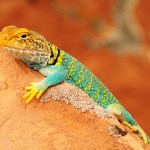
Western Collared Lizard, Dominguez Canyon Wilderness, CO
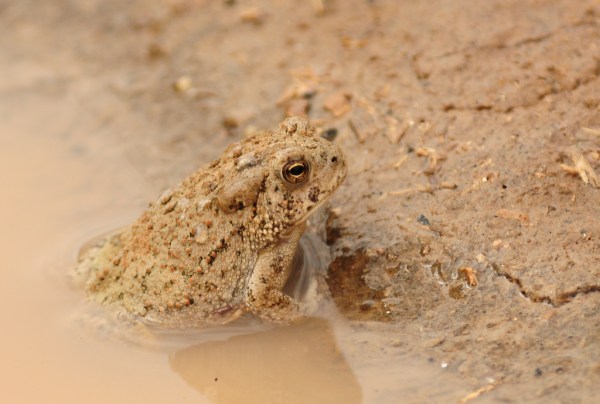
Canyon Treefrog, Dominguez Canyon Wilderness, CO
Despite the nearly continuous presence of distant thunder, which almost prompted me to turn back about an hour into the hike, I didn’t feel a single drop of rain the entire day. Yet when I returned to the junction between Little and Big Dominguez Canyons late in the afternoon, I discovered that the creek coming out of Little Dominguez Canyon, which had been nothing more than a pathetic looking transparent trickle at 10 A.M., had been transformed into a thick brown torrent of mud and debris accompanied by the extremely potent aroma of fresh cow pie. Yum.

This waterfall along Dominguez Creek had been nearly dry just a few hours earlier.
In hindsight I wish I had taken a “before” picture for comparison but that morning the creek was flowing with less gusto than your typical garden hose so my camera and I weren’t exactly drawn to it. Clearly the headwaters of Little Dominguez had gotten a lot of rain in a short amount of time and seeing this dramatic transformation was a good reminder that flash floods can strike areas far removed from any significant precipitation and validated my decision to hike Big Dominguez Canyon instead.
As spectacular as the canyon was, I can only imagine how enchanting it would be at sunrise or sunset when the low-angle of the Sun illuminates the fantastic geology or in the spring when snow melt swells the creek. Always good to have an excuse to go back!
From the San Juans to the San Juans
They are separated by more than 1600 kilometers. One barely rises above sea level while the other boasts six peaks exceeding 14,000 feet in elevation. One is most easily accessed by kayak or porpoise, while in the other it is difficult to escape the incessant drone of Jeeps, dirt bikes, and ATVs that trawl the vast network of old mining roads. One is beset by a deluge of by rain eight months out of the year, whereas the other is inaccessible except by ski, snowshoe, or helicopter for six. To the untrained eye, the San Juan Islands of NW Washington and the San Juan Mountains of SW Colorado couldn’t be more different. My current job situation has me living about an hour away from the mountains for 3 months out of the year, and an hour or less away from the islands for the other 9 months. And viewed through the lens of a camera, I have discovered that there are more similarities that you might expect. The first of which will probably be rather obvious:
They both posses stunning scenery:

View from Deception Pass State Park on Fidalgo Island looking southwest across the water towards the Olympic Peninsula.
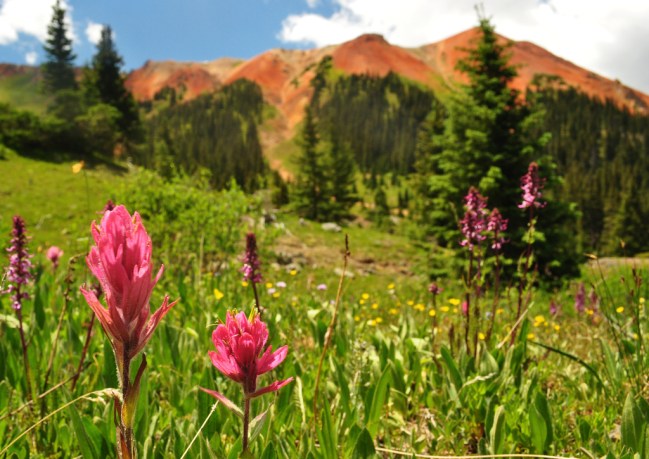
Rosy Paintbrush in an alpine meadow near Red Mountain #1 (yes, nearby can be found Red Mountain’s #2 and #3. The old miners were a creative bunch.) in the San Juan Mountains.
Both offer opportunities for “extreme” sports:
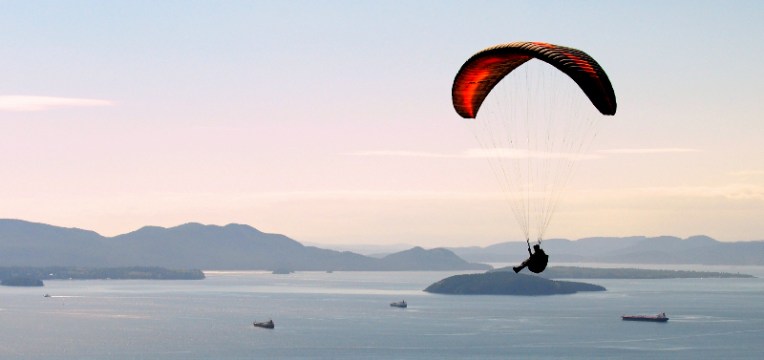
A paraglider enjoys a serene aerial view of the San Juan Islands and several tankers headed for the oil refineries in Anacortes, WA.
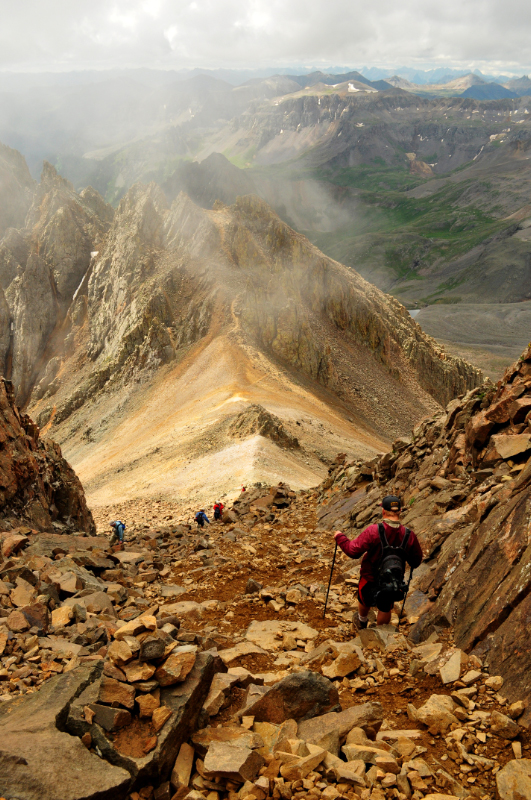
Descending a scree-filled colouir after summiting 14.150′ Mt. Sneffels in the San Juan Mountains. While most of the climb is straightforward and requires only a hefty amount of scrambling, there is one tricky section near the summit during which a fall would likely mean the end of one’s mountain climbing days…or any other days for that matter.
Both were shaped and sculpted by vast quantities of ice:
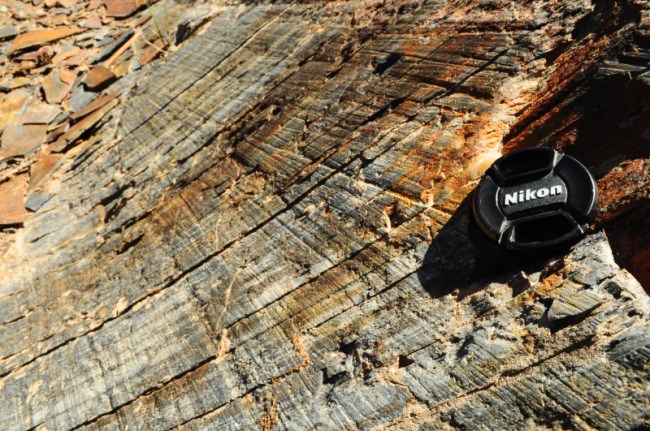
Glacial striations in slate high above the Uncompahgre Gorge in the San Juan Mountains. The parallel grooves in the rock were carved by rocky debris trapped along the base of a long-gone glacier that was partially responsible for scouring out the gorge.
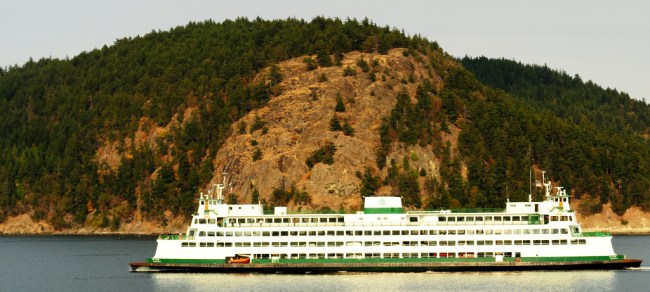
A Washington State Ferry passes a cliff of glacially scoured rock in the San Juan Islands. Glacial striations identical to those in the previous photo are ubiquitous throughout the San Juan Islands, evidence that the area was buried beneath more than a mile of ice during the peak of the last glaciation, about 15,000 years ago.
And finally, both are home to curious wildlife:
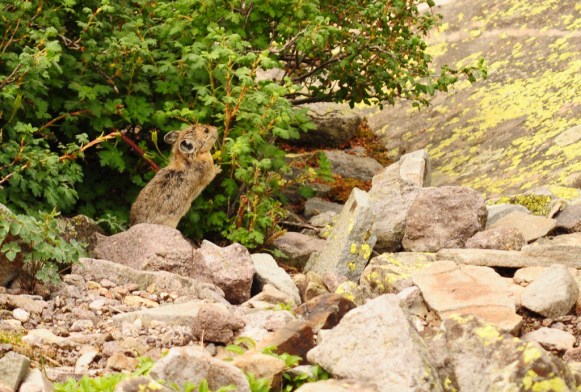
An American Pika investigates a bush at 11,000 feet in the San Juan Mountains.
 A Blood Star investigates a California mussel below sea level in the Strait of Juan de Fuca.
In case you didn’t know, that’s what starfish look like when they are curious.
Starfish. Starfish Everywhere!
Twice a month, the positions of the Sun, the Moon, and the Earth all lie in a straight line. It is during this time that we see the Moon as either “new” or “full”, depending on whether the Moon lies between us and the Sun, or we between the Sun and Moon. Never content with a simple geometrical description, astronomers call this alignment of celestial bodies a syzygy, a word that surprisingly will net you just 21 points in Scrabble given that it requires a worthless blank tile in order to play. While a syzygy’s effect on your board game exploits may be negligible (unless you manage to plunk that “Z” down on a double letter score and the final “Y” on a coveted triple word score…in which case, whoa! You’re up to 93 points and the game is most assuredly yours to lose!), the effect of such an alignment on our planet is actually quite pronounced. The gravitational fields of the Sun and the Moon exert an attractive force on us; the difference in the magnitude of this attraction on opposite sides of the Earth is, in part, what gives rise to the phenomenon we know as tides (for an explanation longer than two sentences, I refer you to NOAA). During a syzygy, the force from the Sun and the force from the Moon are aligned, with the result being that the range in tides we observe is larger. In other words, high tides are higher. Low tides are lower. And when low tides are lower:

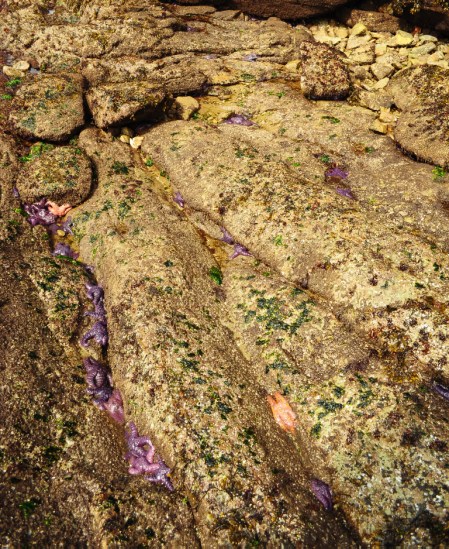
You can’t quite see them all in this photo, but by my count there were about five dozen starfish visible in the field of view when I took this photo. The first syzygy of March 2013 provided me with some abnormally low, mid-day low tides and consequently the opportunity to photograph the plethora of starfish that call Larrabee State Park just outside Bellingham home. During typical low tides, such as the ones we get when the Sun and Moon are at right angles to each other and their gravitational pulls partially cancel each other out, most of these starfish are comfortable below sea level. Even then, a little searching will undoubtedly reveal a handful of starfish clustered beneath rocks or under piles of slimy, green, washed-up seaweed. But when the tide drops below the typical low tide level, the most common starfish in the area, Pisaster ochraceus, the purple or ochre sea star, is literally EVERYWHERE. The quantities can actually start to make you feel somewhat threatened until you remember that starfish move at like 0.0003 miles per hour and have something called “tube feet”. As you can see, the starfish tend to cluster in cracks and crevices within the rock. This is annoying because the cracks and crevices are about the only place you can put your feet without running the risk of losing your footing and smashing your skull open on the sandstone and exposing your brains for the seagulls to pick at, given that most of the rock is covered in slick seaweed that makes banana peels look like coarse sandpaper when it comes to the degree of traction provided.
Pisaster ochraceus comes in three different flavors…err, I mean colors. The purple stars dominate, but orange and pink individuals are not uncommon. I was able to locate one extremely diverse constellation of starfish (I have absolutely no idea what the collective noun for starfish is, but it would be pretty cool if it was “constellation”…) hanging out under a rock:

The wide range of color variation exhibited by Pisaster ochraceus.
I never cease to be fascinated by the robust rigidity of starfish. The purple ones in particular look like they should be nothing more than wet, sticky, gelatinous blobs of silly putty, but alas you can’t even copy newsprint with them, much less mold them into an sphere, which is the ACTUAL shape of a star—that is unless the star is rotating rapidly, in which case its shape may be more closely approximated by an oblate spheroid.
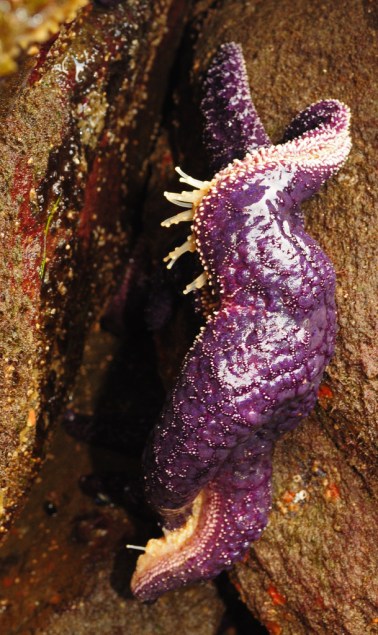
I have no idea what this starfish is trying to accomplish here…
Some of the stars exhibit signs of multiple personality disorder, giving us some bizarre orange and purple combination stars like this one here:
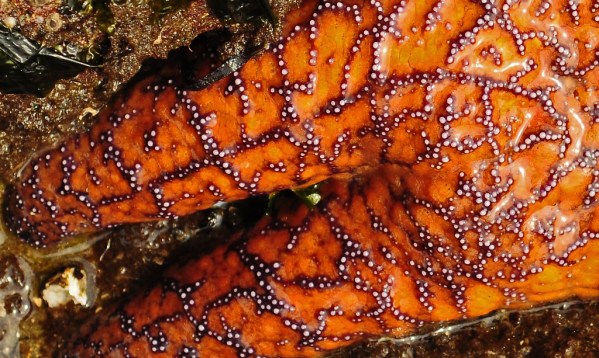
As brightly colored as they are, the sheer abundance of Pisaster ochraceus along the NW Washington coast makes them the black bear of the starfish world. Impressive surely, but not really what we came to see. A closer inspection reveals some less commonly spotted species. For example, meet the “grizzly bear” of sea stars:

The find of the day: a 20-armed sunflower star, otherwise known as Pycnopodia helianthoides.
I think we can all agree that Pycnopodia would be one of the most utterly terrifying species on the planet if it was capable of moving at any rate of speed that could be considered “fast”. Sure, it doesn’t eat humans but neither do spiders and this thing pretty much looks like a gigantic, orange, 20-armed spider with spikes. Given that I know plenty of folks who start to dial 911 at the sight of a spider the size of a pin-head, there is no doubt in my mind that there would exist an entire industry devoted exclusively to Pycnopodia extermination if it had managed to move more than the 3 inches that it did in the 20 minutes I sat there watching it. Clearly Alfred Hitchcock never encountered a sunflower star or I think his film-making career would have featured less birds and more marine life.

Two spotted arms of a leather star, Dermasterias imbricata, poke out from under a rock.
For a list of upcoming sygyzgies, check out this handy moon map, and to see when starfish viewing will be ideal along your favorite beach, you can find no better resource than the official NOAA Tides & Currents website.
 Zach Schierl Photography