On the road again
Two days til grad school starts: time for a quick post in list form! Here are some random musings, observations, rants, and pictures from a two-week, 2,500 mile end-of-summer road trip through Colorado, New Mexico, Arizona, Nevada, California, Oregon, and Washington:
- Packing everything you own into the backseat and trunk of a Toyota Corolla IS possible, if only for 15 miles until you get to the closest UPS store so you can pack 61 pounds of crap into a box and ship it so your car doesn’t bottom out going across every single expansion joint in the road
- A small passenger car with over 180,000 miles, power steering leaks, suspension maladies, and mysterious engine and electrical issues is nevertheless capable of successfully completing a 2,500 mile road-trip including travel up and over several 10,000 foot mountain passes, on roads through several deserts with temperatures soaring to 108 degrees, all while fully loaded with nary a squeak.
- Said road trip is also possible to complete without the aid of a GPS unit, smartphone, or other computerized mapping device.
- To anyone who claims their home town/state/country/etc has the best sunsets ever, please go to the Grand Canyon and watch the sun go down from Desert View. I’ll be expecting a formal, written retraction of your blasphemous statement in the mail any day now.

Grand Canyon from Mohave Point
- Pink Jeep Tour guides are really good at spotting Deeres.
- It is impossible to make money in Las Vegas. Even if you win a decent amount of dough, you will be tempted into spending your winnings on drinks served in three-foot-tall brightly-colored souvenir “cups” and $7 slices of crappy pizza in the casino food court at 2am. But you won’t know its 2am because there are no clocks anywhere.
- When traveling through particularly desolate stretches of Nevada, it is amazing how quickly your mind begins voluntarily generating thoughts such as “I wonder how many hours it’s been since I’ve seen another car…” and “I bet I could take my hands off the steering wheel for 10 whole minutes and not hit anything.”
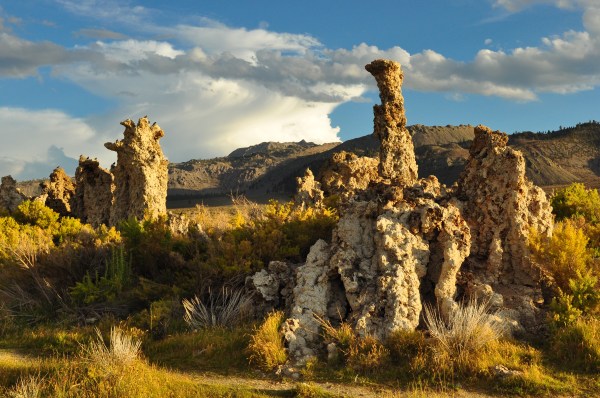
Tufa towers on the shores of Mono Lake, CA
- If you never thought you encounter a situation in which you would consider $4.89 a screaming good deal on a gallon of gasoline, go visit Lee Vining, California (and look at what the Chevron is charging first…)
- Americans like Yosemite more than they dislike getting hantavirus.
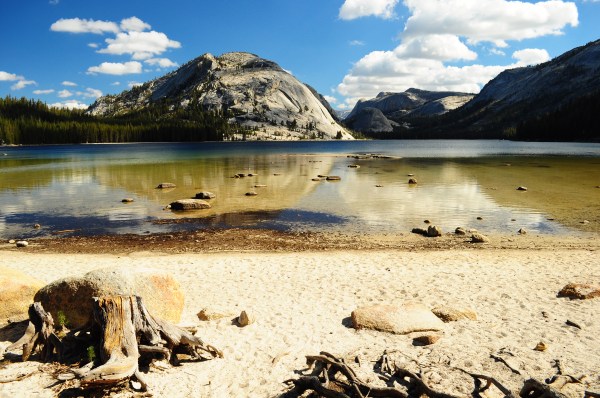
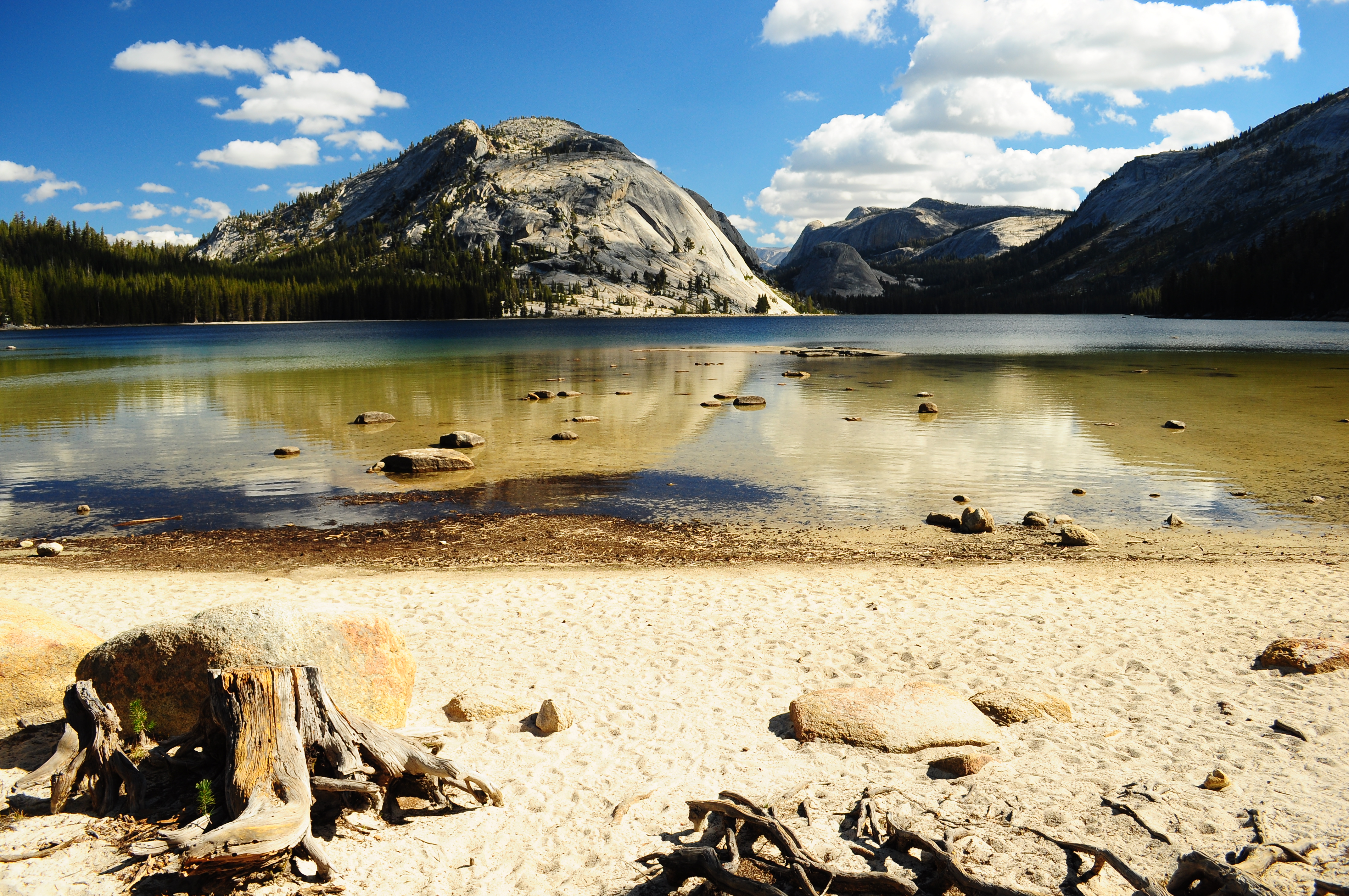
Tenaya Lake, Yosemite National Park
- Tropical plants will die if you leave them in the backseat of a hot car for a week with no access to food or water.
- Camping in bear country is a pain in the ass. A typical night terror in Yosemite consists of waking in the middle of the night in a panicked and frantic state wondering if you remembered to take that tube of mildly scented chapstick out of your pocket and put it in the bear box.

Bumpass Hell thermal area, Lassen Volcanic National Park
- Even if people say they aren’t buying you something from your Amazon wish-list, never buy anything from your Amazon wishlist.
- Eugene, Portland, and Bellingham should secede and create a new autonomous state called Hippie-gon-ton. Seriously, these are the kind of places where I deeply wish I had the courage to take pictures of random people I encounter on the street; I’d have a collection to rival People of Wal-Mart in no time, albeit in a very, very different way. Also, on a related note, Portland is the perfect city to arrive in when you haven’t showered for 3 days.

Yosemite Valley and Half Dome
- The awesomeness of Powell’s bookstore in Portland, OR is still difficult for me to comprehend…I could spend WEEKS there. One’s need for a smartphone with navigational capabilities is greater WITHIN THIS STORE than it is in perhaps any major metropolitan area in the country, with the possible exception of:
- Seattle, which has quite possibly the worst maintained and most confusing street network of ANY CITY ANYWHERE. Someone should probably go rescue the pothole crew because they clearly have been being held hostage somewhere…since the Eisenhower administration. Also, let’s stop it with the whole “Wouldn’t it be cool to make this street randomly dead-end and then reappear 5 blocks later?” thing. If I’m driving down a numbered street, it should be a thru-street and not be broken into 8 billion separate sections.
- On the plus side, if you can somehow manage to navigate Seattle streets without blowing a tire, breaking an axle, or needing to pull over somewhere and cry, there are a lot of good eats to be had, including the 3rd best Philly cheese steak restaurant this side of Philadelphia and some seriously good pizza.

- Sea anemones shrivel up when you poke them. Also, it is possible to be surrounded by so many fat purple starfish that you feel afraid.
- Randomly arriving in a new city where you know nobody and finding a place to live using Craigslist is way easier than it sounds. And no, I’m not living with a convicted felon.
- The Pacific Northwest is really nice and sunny in the summer…which is conveniently when I am never there.
- Finding that a “Vegan Revolution” bumper sticker has been pasted onto your car over a pro-meat sticker instantly turns you into a card-carrying vegan drives you to east as much meat as humanly possible the next day (such as a Philly cheese steak and a delicious bacon cheeseburger perhaps).
- On another related note, a maple long john topped with strips of bacon is just about the best thing e…….. (Zach has heart attack)

Sunset over the San Francisco Peaks, Flagstaff, AZ
A Glacier, a Waterfall, and a Kayak walk into a bar…the Story of Palouse Falls
Growing up in northern Arizona, spring was always an exciting time to finally pack away the snow shovels and de-icer and get outside. If you want to see enough running water in the desert southwest to actually get your feet wet, spring snowmelt season and summer afternoon thunderstorms are pretty much your only hope.
Spring in the Pacific Northwest is similar…except that instead of going from no water to a little water, we go from a decent amount of water to A LOT of water. Nowhere is spring runoff more apparent than 187 foot high Palouse Falls, which is about 1-2 hours (depending on your driving speed) north of Walla Walla, on the Palouse River just upstream of its confluence with the Snake River.
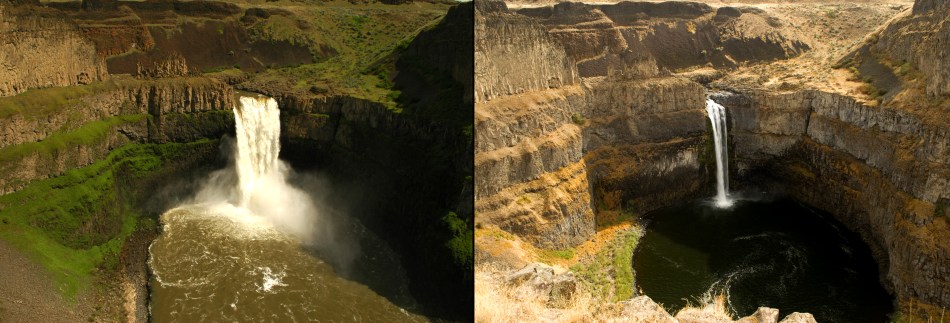
Palouse Falls in May (left) and September (right).
Normal people think lots of different things when they see Palouse Falls, among them “How do I get down there?”, “Wow, that’s pretty!”, “Where’s the snack shop?”, and “I really need to go to the bathroom after driving down that really bumpy, windy road”. All perfectly legitimate. Other people however see a kayak jump.
Palouse Falls garnered some attention in recent years when it became the site of the worlds largest kayak waterfall descent. In case that didn’t sink in, let me reiterate: someone paddled over that thing in a KAYAK.
As someone who has expertly piloted a kayak over 6″ riffles on the Palouse River below the falls, I can tell you that this is an impressive feat. Palouse Falls is nearly 200 feet; ants may be capable of surviving a fall off the kitchen counter but we aren’t designed to do such things. Just look at this picture.
If that was me, the discharge of the falls would be spiking dramatically right then due to the amount of bodily fluids I would have been emitting our of sheer terror.
The falls were formed by an phenomenon that comes in at #1 on our list of “Geological Terms That Make You Sound Like An Idiot If You Pronounce Them Correctly”: a jökulhlaup. If you are Icelandic, you’ll need no pronunciation guide. For the rest of you, that’s “yo-cooool-HOIP”. Once again, that’s “yo” as in the famous cellist Yo-Yo Ma, “coooool” as in “coooool Razor scooter man!”, and “HOIP” as in “House of International Pancakes.”
Now that we’ve got that squared away, lets set the scene: imagine you are an ice sheet, specifically the vast Cordilleran Ice sheet that covered the northern half of the North American continent during the last ice age. The climate is starting to warm; the mammoths are starting to die and those pesky humans are starting to increase in number. As the temperatures slowly increase, you start to feel a little sweaty and you begin to melt and retreat northwards to more suitable weather. All that glacial meltwater is getting funneled into river canyons that were cut tens of thousands of years earlier and are just now being uncovered by the retreating ice sheets. Even as a retreating ice sheet though, you will likely have a few appendages (called lobes) that reach several hundred kilometers south of the main ice front. These lobes block some of the river channels, forming a barrier that impedes the river’s progress. Massive quantities of water back up behind the ice dam, creating lakes larger than several of the Great Lakes. Remember though, you are a big piece of ice, and what does ice do in water? It floats. Once the lake becomes large enough, your appendages are no longer strong enough to maintain contact with the bottom of the canyon. The entire ice dam begins to rise slightly in the water, opening a seam at the base of the dam through which water begins to rush, eating away at the dam from underneath. Eventually, undermined by the water, the entire ice dam catastrophically collapses, draining the entire lake in a matter of hours and sending thousands of square kilometers of water rushing across the landscape. That’s a jökulhlaup. After the ice dam is blasted away, you, the glacier, slowly flow back down into the canyon over the next few years, creating a new dam and lake and starting the process all over again.

Palouse Falls cascades over basalt flows from the Columbia River Basalt Group

Rock formations near the brink of the falls
Anthropomorphized geologic features notwithstanding, this actually happened…at least 40 separate times at the end of the last ice age, from about 15,000 to 13,000 years ago. The river was the Clark Fork of the Columbia River, the ice dam was located near Lake Pend Oreille, Idaho, and the lake was glacial Lake Missoula, which stretched from northern Idaho almost all the way to Yellowstone National Park. The ice dam collapsed every few hundred years, sending a Lake Erie’s worth of water rushing down the Columbia River, across what is now Eastern Washington, all the way to the Pacific Ocean.
Look at what happens to your yard after a big storm and you know it doesn’t take that much water to carry out some significant erosion. Palouse Falls is located in one of thousands of scour marks, known as “coulees,” that were gouged out of the basalt bedrock of Eastern Washington by the force of these floods.

The Palouse River just upstream of the falls
In which Zeus makes a brief visit to Walla Walla…
Lightening and thunder usually avoid Eastern Washington like Jack Abramoff avoids paying taxes. In nearly four years here, I can recall just two other events that were worthy of association with the word “thunderstorm” and Monday evening’s outburst was of the finest bursts of hellfire I’ve seen in a while. Kudos to Brian Percival for extracting me from my room (thesis work be damned) and alerting me of the approaching storm.
My previous attempts at lightning photography have been severely hindered by rain and the fact that standing outside next to a metal tripod during a thunderstorm is generally considered a poor life decision. Fortunately, I live in an apartment located on the upper level of a building containing a winery and a fitness studio (one naturally wonders about the amount of overlap between the clientele of the two businesses…), thus providing me with a reasonably safe, elevated vantage point from which to view the storms. Being able to set up my tripod inside the front door and rattle off a couple hundred exposures ranging in length from 1-30 seconds made things pretty straightforward even once it started raining and lightning started hitting campus buildings. The extremely luminous building in the immediate foreground is a hotel known for relatively frequent drug busts, while the tall structure at left in some of the photos is the Marcus Whitman Hotel, the tallest building in Walla Walla and one which is located at the extreme opposite end of the Walla Walla lodging spectrum. Oddly enough, even once the storm was nearly on top of us, there was still very little thunder to be heard, just a fantastic light show and a brief period of intense rain and wind.
 Zach Schierl Photography