Rails Vanquished, Rails Reclaimed: Hiking the Iron Goat Trail

Driving west on Highway 2 over Stevens Pass last spring, I kept catching glances of what appeared to be some sort of elongate, dark grey, overgrown, man-made structure paralleling the highway on the opposite site of the Tye River valley. Whatever it was, only isolated chunks of it were visible through the dense vegetation and the deep, late-season snowpack. It appeared to me to be made of concrete, although it was hard to be 100% sure given that my primary goal at the time was to prevent a van full of people from careening off the highway and plummeting into the gorge below. Ironically, little did I know that the very existence of the mysterious object I was seeing was the result of a passenger train carrying hundreds of people doing exactly that 113 years earlier.
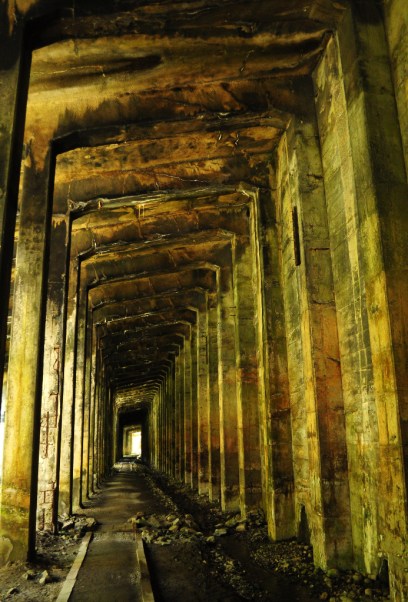 Walking through a large concrete snowshed along the Iron Goat Trail, built at the site of the 1910 Wellington disaster to prevent future avalanches from sweeping trains and passengers off the rails.

It didn’t take long after getting home to my internet connection to figure out that what I was seeing was the old grade of the Great Northern Railway, the northernmost of the transcontinental railway routes in the U.S. The Great Northern reached Seattle in 1893 and the route it took across the Cascades can best be described as “gnarly”. A series of extremely steep switchbacks, and eventually a 2.60 mile long tunnel completed in 1900, funneled trains safely, if not easily, over Stevens Pass to Seattle. In the summer at least. The biggest danger of the route lay in the combination of heavy winter snows and steep rugged topography. The railway built a number of snowsheds, large concrete or timber structures which covered the rails in avalanche prone areas to protect the locomotives. Avalanches don’t always play nicely though, and in March of 1910, during a storm in which 11 feet of snow fell in one day, a 10′ thick slab of snow detached from Windy Mountain several hundred feet above the tracks and swept two trains off the tracks just outside the railroad town of Wellington, Washington. 96 people perished in what remains the deadliest avalanche in U.S. history, and one of the worst railroad disasters in the country’s history to boot.
Despite the somber backstory, the old railroad grade has been turned into what has to be one of the most fascinating hiking trails in Washington: the Iron Goat Trail. Taking its name from the mountain goat on the logo of the Great Northern Railway, the Iron Goat trail follows the portion of the railroad grade that was abandoned in 1929 after the 8-mile long Cascade Tunnel (still in use by the BNSF today) opened, which for the first time allowed trains to bypass the pass and its deadly avalanche chutes entirely.

Looking into the abandoned Windy Point Tunnel along the Iron Goat Trail
While this hike may not provide a wilderness experience (Highway 2 and the associated drone of motor vehicles is just a stone’s throw away across the valley), it does provide a heavy dose of history and just enough eeriness to keep you from ever wanting to spend the night. In between the Wellington disaster and the opening of the Cascade Tunnel, a span of just 19 years, the Great Northern Railway heavily fortified the section of rails near Stevens Pass in an attempt to prevent another disaster. I hiked the four mile section of the trail from Highway 2 to the Wellington Townsite and nearly the entire stretch was engineered in some way: tunnels, timber snowsheds, concrete snowsheds, you name it, the Great Northern Railway spared no expense in attempting to tame the mountains and make this a viable travel route over the Cascades. They even gave the town of Wellington a new name, “Tye”, because of all the bad publicity. Ultimately though, the mountains emerged victorious: the line was abandoned in favor of the tunnel less than 30 years after it was first constructed, leaving the man-made structures built in response to the Wellington disaster to slowly decay and become re-assimilated into the mountain.
This process is already well underway. After decades of enduring heavy winter snows, timber snowsheds are now unrecognizable piles of rotting wood. Concrete snowsheds are crumbling, exposing their innards in a scene that my hiking partners likened to the post-apocalyptic visuals of the Hunger Games.
 Deep snow and avalanches ultimately get the better of anything man builds to lessen their impact
Many of the tunnels have partially collapsed, including the Old Cascade Tunnel, the longest in the world when it opened at the beginning of the 20th Century. In 2007, a portion of the roof collapsed, creating an unstable dam of debris which occasionally likes to rupture and send a deadly torrent of water rushing out the west end of the tunnel without warning. The Windy Point Tunnel, built to keep trains from derailing around a particularly sharp curve, is also slowly crumbling away while the entrances are slowly reclaimed by the forest:
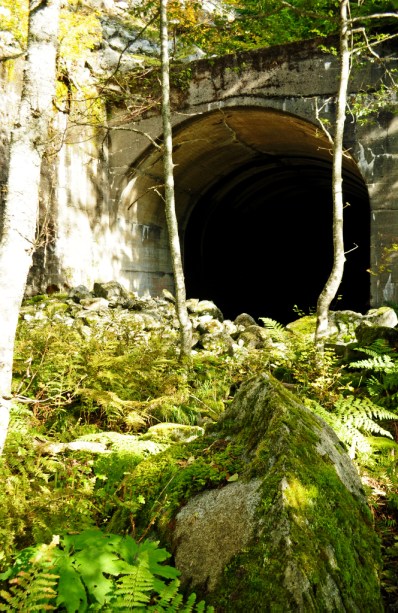
Moss and debris slowly reclaims the old grade of the Great Northern railway at the entrance to the Windy Point Tunnel

Portions of the Windy Point Tunnel have been heavily damaged by rockfall. Thankfully, Gary and the fall foliage escaped unscathed.
After a somewhat strenuous 700 foot climb from the trailhead up to the Windy Point Tunnel, the hike follows the gentle grade of the old rail bed for several miles in either direction. Thanks to impressive work by local volunteer groups, the trail is well-maintained and a series of interpretive signs explain the history of the Great Northern Railroad and the chain of events that led to the Wellington disaster. Several spots on the trail have great views of the Tye River valley and the surrounding peaks in the Cascades making for a beautiful, intriguing, and incredibly diverse hike. But stay away during the winter for obvious reasons, and like I said, not really somewhere you’d want to spend the night…

Fun graffiti inside the concrete snowshed
For more info, trail maps, and directions, check out http://www.irongoat.org/
From the San Juans to the San Juans
They are separated by more than 1600 kilometers. One barely rises above sea level while the other boasts six peaks exceeding 14,000 feet in elevation. One is most easily accessed by kayak or porpoise, while in the other it is difficult to escape the incessant drone of Jeeps, dirt bikes, and ATVs that trawl the vast network of old mining roads. One is beset by a deluge of by rain eight months out of the year, whereas the other is inaccessible except by ski, snowshoe, or helicopter for six. To the untrained eye, the San Juan Islands of NW Washington and the San Juan Mountains of SW Colorado couldn’t be more different. My current job situation has me living about an hour away from the mountains for 3 months out of the year, and an hour or less away from the islands for the other 9 months. And viewed through the lens of a camera, I have discovered that there are more similarities that you might expect. The first of which will probably be rather obvious:
They both posses stunning scenery:

View from Deception Pass State Park on Fidalgo Island looking southwest across the water towards the Olympic Peninsula.
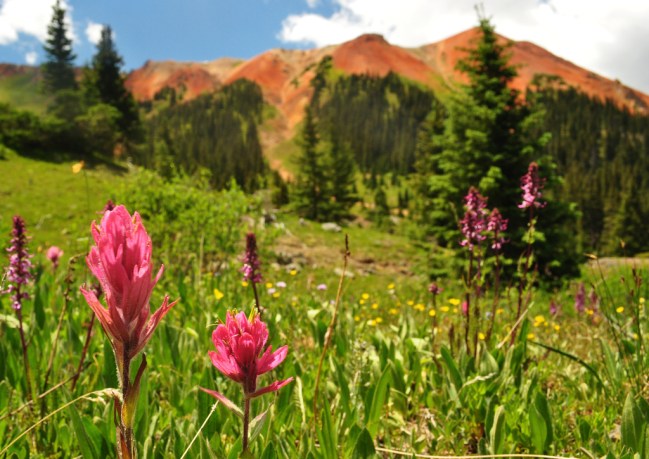
Rosy Paintbrush in an alpine meadow near Red Mountain #1 (yes, nearby can be found Red Mountain’s #2 and #3. The old miners were a creative bunch.) in the San Juan Mountains.
Both offer opportunities for “extreme” sports:
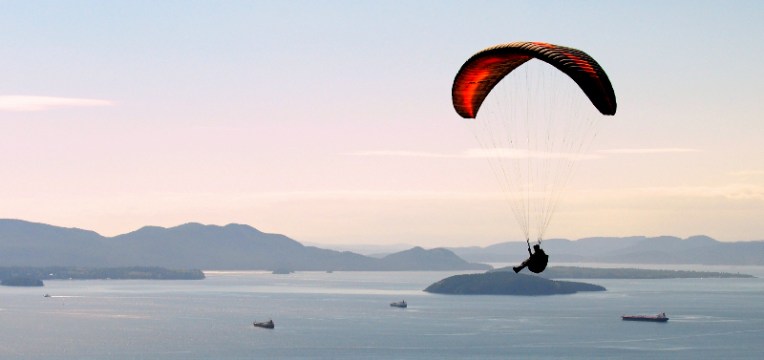
A paraglider enjoys a serene aerial view of the San Juan Islands and several tankers headed for the oil refineries in Anacortes, WA.
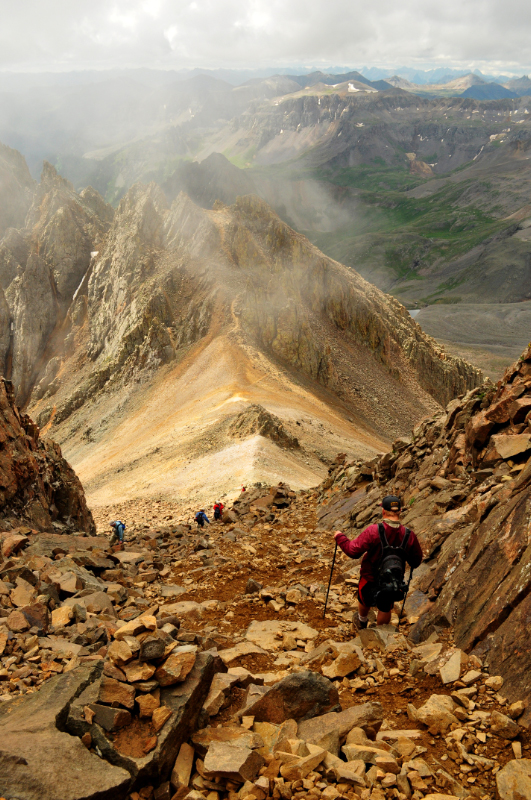
Descending a scree-filled colouir after summiting 14.150′ Mt. Sneffels in the San Juan Mountains. While most of the climb is straightforward and requires only a hefty amount of scrambling, there is one tricky section near the summit during which a fall would likely mean the end of one’s mountain climbing days…or any other days for that matter.
Both were shaped and sculpted by vast quantities of ice:
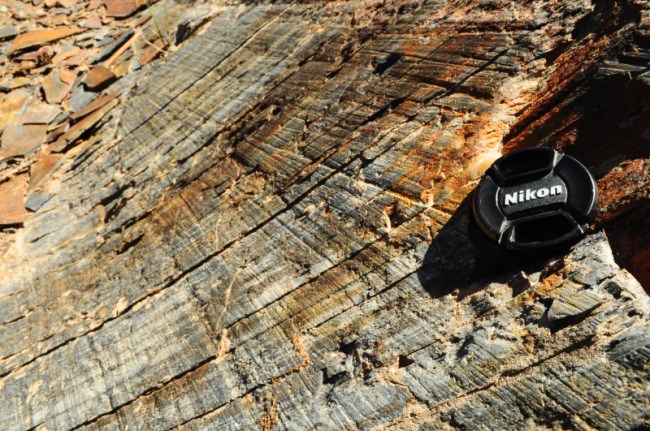
Glacial striations in slate high above the Uncompahgre Gorge in the San Juan Mountains. The parallel grooves in the rock were carved by rocky debris trapped along the base of a long-gone glacier that was partially responsible for scouring out the gorge.
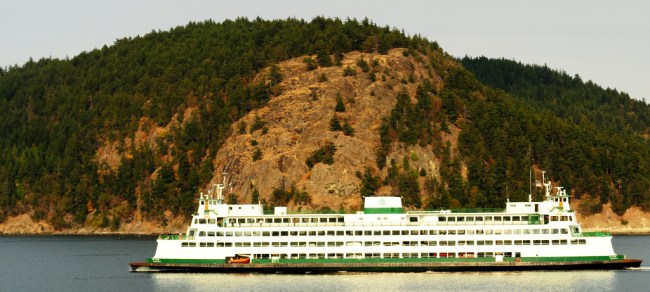
A Washington State Ferry passes a cliff of glacially scoured rock in the San Juan Islands. Glacial striations identical to those in the previous photo are ubiquitous throughout the San Juan Islands, evidence that the area was buried beneath more than a mile of ice during the peak of the last glaciation, about 15,000 years ago.
And finally, both are home to curious wildlife:
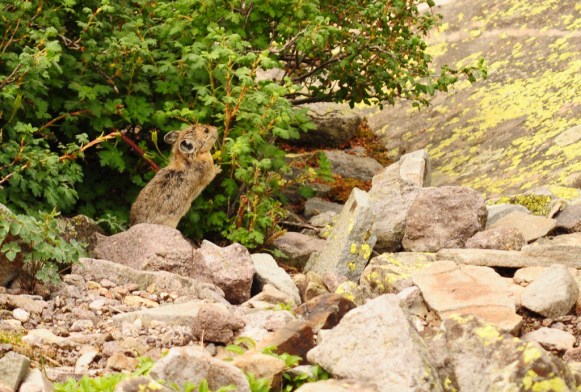
An American Pika investigates a bush at 11,000 feet in the San Juan Mountains.
 A Blood Star investigates a California mussel below sea level in the Strait of Juan de Fuca.
In case you didn’t know, that’s what starfish look like when they are curious.
New Life for the Elwah
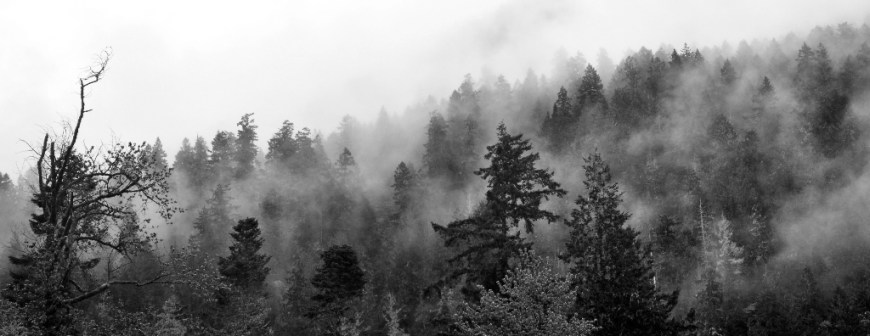
Remnants of early morning fog along the Elwah River
In 1910, the Elwah River on the Olympic Peninsula in Washington State underwent some changes. Big changes. Power was needed to support the burgeoning timber industry in and around Port Angeles, WA. A dam would be built. A 108 foot high dam that would transform the river upstream of it from from a wild, roaring river teeming with five different species of native salmon, into a flat and placid reservoir, filled not with salmon but with sediment. With no fish ladders, these salmon would be denied access to their spawning grounds upriver by a massive concrete block known as the Elwah Dam. Within a few decades, any fish that managed to miraculously jump over the 108 foot high dam would have a second nasty surprise waiting for them just a few miles further upstream, the 210 foot high Glines Canyon Dam, built in 1927.
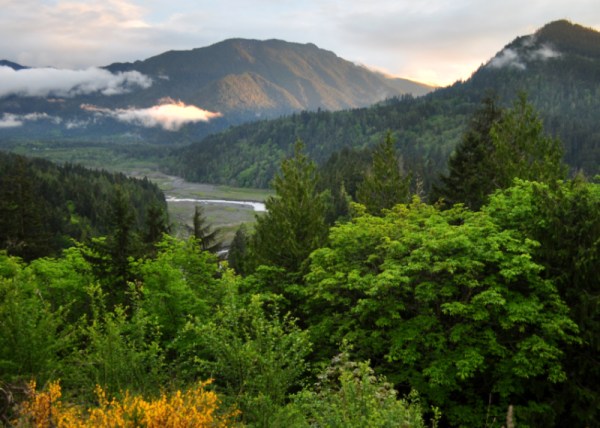
Sunset over the Elwah Valley from Highway 101, just west of Port Angeles, WA
Fast forward nearly a century, and big changes are occurring yet again. In just a few short months, these two barriers will have been completely and permanently removed and the Elwah River will once again flow, uninterrupted, from the permanent snowfields and glacier of the Olympic Mountains all the down to sea level and the Strait of Juan de Fuca. Even now (June 2013), only a small remaining stub of Glines Canyon Dam is preventing the salmon from moving back up into their traditional spawning grounds, and nearly 24 million cubic yards of sediment trapped behind the dams from moving down to the river’s mouth. To give you a sense of just how much material that is, 24 million cubic yards would be enough to bury an American football field under so much sediment that not even seven Empire State Buildings stacked on top of each other would reach the top of the pile. While numerous dams have been decommissioned and removed around the world over the past several decades, none have been as large as Elwah and Glines Canyon. Nor have any been as controversial, as indicated by the fact that Congress passed legislation to remove the dams in 1992, yet demolition did not begin until 2011.

The former site of the Elwah Dam, now occupied again by the free-flowing channel of the Elwah River

Groundwater containing dissolved iron was trapped beneath the reservoir for decades. With the reservoir gone, this water can escape and the iron rapidly oxidizes as it is exposed to oxygen in the air.
Controversy aside, it is not often that one gets the opportunity to walk along the bottom of a reservoir without fear of drowning. As removal of the two dams enters its final stages, there exists a fantastic opportunity to watch an entire ecosystem attempt to return to its natural state. I visited the Elwah River valley on a cloudy, yet pleasant by Olympic Peninsula standards, weekend in May to see the effects of dam removal first hand. My first stop was the former site of Lake Aldwell, the narrow, yet shallow reservoir, 4 km long and 30 meters deep, that once existed behind the Elwah Dam. Lake Aldwell was the lower of two reservoirs on the Elwah (the other being Lake Mills behind Glines Canyon Dam), just five miles upstream from where the river ends its 45-mile long journey from the mountains to the sea. It was also the first to be drained, in 2011, and consequently has already had an entire growing season to begin recovering from over a century of submersion. Assisted by planting efforts, so far, “recovery” consists of some small alders, grasses, and a handful of wildflowers that have taken root in the layers of extremely fine grained sediment that accumulated on the bottom of the reservoir from 1910 to 2011.
Prior to the construction of the dams, the Elwah River valley contained spectacular old growth forests, the proof of which can once again be seen today. It is is the stumps of these gargantuan trees that are perhaps the most impressive sight at Lake Aldwell. Giant cedar stumps, the result of early 20th century loggers who were understandably eager to harvest the enormous trees on land slated for inundation, have been exposed as the river rapidly washes away the layer-cake of sediment that piled up at the bottom of Lake Aldwell. The size of the stumps are humbling and they are shockingly well preserved; many of them still contain the deep, horizontal notches cut for logger’s springboards, some so fresh in their appearance that it’s hard to believe that they weren’t felled just a few years ago, a testament to the preservation power of the meters of silt and dozens of meters of water that covered them for a century.
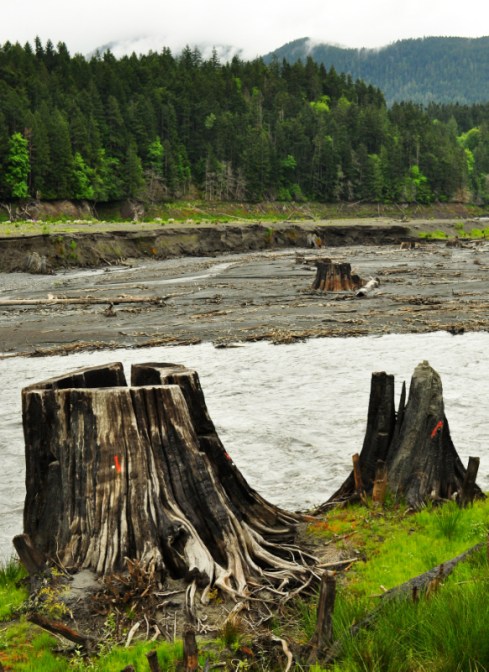
Giant Cedar stumps on the floor of Lake Aldwell. The former level of the reservoir can be clearly seen on the far bank.
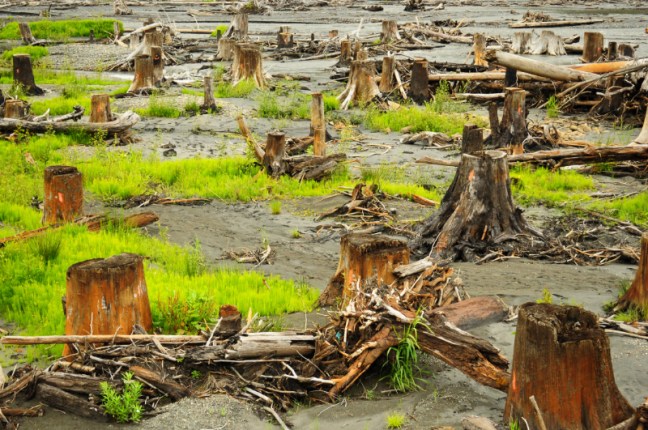
Century old stumps are joined by new vegetation just beginning to take root in the lakebed sediments.
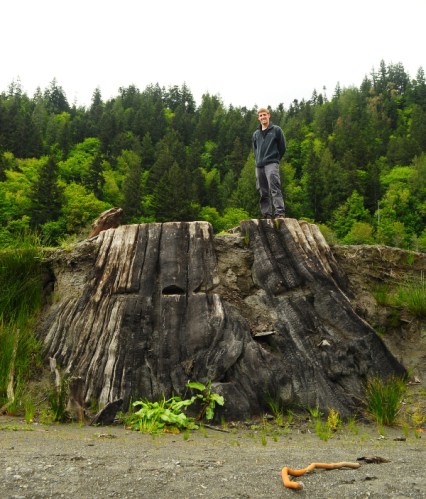
A stump that has been only partially exhumed from the sediment, with the six-foot tall photographer for scale.
The most powerful location from which to contemplate the restoration of the river is undoubtedly the site of the former Lake Mills. Unlike Lake Aldwell which is located right along US Hwy 101, Lake Mills requires a little bit of effort to get to. Located within the confines of Olympic National Park, the head of the now drained reservoir is reached only by driving up a narrow, one lane dirt road that winds through the rainforests of the Olympic Peninsula several hundred feet above the course of the Elwah. Near the end of this road, a narrow footpath leads down to what was once the lake’s edge.
Being the uppermost of the two reservoirs, Lake Mills was where nearly a centuries worth of sediment accrued, scoured out of the Olympic Mountains just as it had been for thousands of years, by storm after storm after storm blowing in off the Pacific, dousing the mountains in rain, and sweeping the sediment into rivulets, tributary creeks and streams, and eventually the cold, swift, and turbulent Elwah. Once Glines Canyon Dam was built in 1927, the whole system just shut off. Vast quantities of silt, sand, and gravel sediment that would normally create a delta at the mouth of the river began creating a delta in Lake Mills instead.
Immediately upon breaking out of the trees, one is taken aback by the sense that something drastic has happened here. Over a thousand vertical feet of dense, dark green, damp forest immediately transitions to a landscape that looks like it belongs on Mercury or the Moon rather than the lush Olympic Peninsula. One is greeted by a staircase of spectacular gravel terraces leading down to the river’s edge, terraces cut by a river eager to make up for 100 years of lost time. The river’s path is changing on a near daily basis as it cuts down through the canyons of sediment. The only sound that accompanies the roar of the river is the constant and somewhat unsettling sound of miniature rockfalls breaking loose and sending pebbles, cobbles, and sometimes boulders scurrying down slope, the sounds of a landscape still changing by the minute as the river tries to re-establish its old course through the valley.

Terraces carved out of delta sediments by the resurrected Elwah River as it runs through the valley formerly occupied by Lake Mills.
The erosive power of the Elwah can be seen just by observing its color as it runs through its former delta. When the river first exits the confining gorge of Rica Canyon and explodes out into the wide valley once occupied by Lake Mills, it shines with a brilliant aquamarine color, almost tropical in its hue, due to the presence of extremely fine grained sediment suspended in the river. The river does not retain this color for long though. For decades, any coarse sediment brought here by the river would be abruptly dropped at the entrance to Lake Mills, as the energy level of the river dropped precipitously entering the tranquil reservoir. Now, with the reservoir gone, all that sediment is there for the taking and the river quickly takes full advantage. Just a few hundred yards later, the river has turned the color of a late-afternoon summer thunderstorm, a deep and foreboding dark gray, as the Elwah picks up coarse sediment and begins moving it downstream where it naturally belongs.

While the dams may be gone, and the fish have already shown signs of returning, the story of the Elwah is, in reality, just beginning. All the effects, both positive and negative, of such a large scale experiment won’t be known for many decades. I encourage you to go see it for yourself; as I mentioned earlier, opportunities to experience a landscape changing at such a rapid rate are rare, much less one in as spectacular of a setting as the Elwah River.
More information about the Elwah River Restoration project can be found here. To get a better idea of the changes that have occurred so far, I strongly recommend checking out slideshows and time-lapse videos made from a series of webcams that have been monitoring the progress here.
 Zach Schierl Photography