(Petrified) Forests of Stone

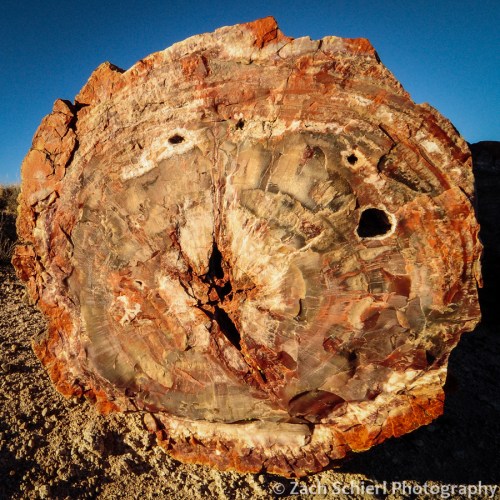
Despite being comprised almost entirely of quartz, trace amounts of elements like iron and manganese give petrified wood its myriad of colors.
I grew up about 90 minutes away from Petrified Forest National Park and, aside for a quick lunch stop about 10 years ago, had never visited before last week. While this is nowhere near as inexcusable as living in Arizona for decades and never visiting the Grand Canyon (yes, such individuals exist…I’ve met many), it still seemed like a bit of an oversight on my part. Or it could simply be a reflection of the inordinate number of outdoor activities that exist in northern Arizona; even living in the area for 10+ years isn’t enough time to hit everything. Either way, after finally venturing into the Petrified Forest, I can emphatically say that it should be mentioned with the best that northern Arizona has to offer.
Located amongst the vast Painted Desert of northeastern Arizona, the main attraction of Petrified Forest is of course the petrified wood. The formation of petrified wood is initiated when downed trees are quickly buried by sediment. Once entombed in the sediment, the lack of oxygen prevents the logs from decaying as they normally would when exposed directly to the atmosphere. In this case, the logs (none of which remain standing, despite the name “Petrified Forest”) were likely brought here in massive logjams along an ancient river system that existed during the Triassic period. A combination of sediment from the river and ash from nearby volcanoes buried the logs, not to be seen again for more than 200 million years. During this time, as the logs became buried under an increasingly deep pile of overlying sediment, dissolved silica began to crystallize in the pore spaces of the wood as quartz, eventually replacing all of the organic material while maintaining the original shape and structure of the log.

A brilliantly colored petrified wood fragment.
Petrified wood is not particularly rare. Good examples abound in Yellowstone National Park, Washington state, Utah, Colorado, Oregon, Alberta, New Zealand…the list goes on and on. What makes Petrified Forest National Park unique is the quantities found here. Due to the aforementioned Triassic log jams, large quantities of wood were concentrated in small areas. In a location known today as Jasper Forest (see photos below), movement was not possible without walking over a nearly uniform carpeting of small petrified wood fragments and frequently having to clamber over 2-3 foot diameter logs. Truly stunning!

Petrified wood in the Jasper Forest, Petrified Forest National Park.

Overlooking the Jasper Forest at sunset.
Another unique aspect of Petrified Forest is the colorful canvas on which the wood is found. The wood is eroding out of a rock unit known as the Chinle Formation, which essentially consists of all of the river sediment and volcanic ash the buried the trees in the first place. More than 1000 feet thick in the park, the Chinle Formation is composed primarily of extremely soft mudstones, clays, and volcanic ash. Water is able to easily sculpt the soft rock into fantastically colored and oddly shaped badlands that make a spectacular backdrop for the logs.
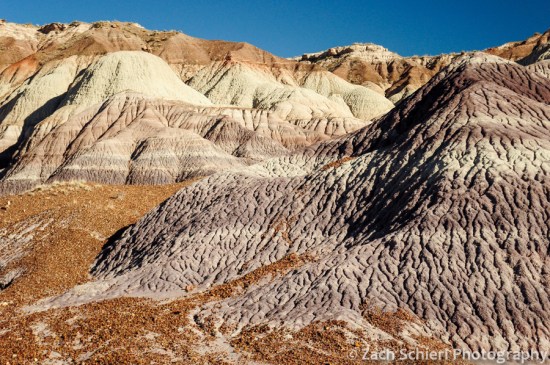
The soft muds and clays of the Chinle Formation are easily eroded, forming badlands-like topography throughout the Painted Desert.

Colorful badlands in the Chinle Formation at Blue Mesa.
Petrified Forest National Park faces an issue not encountered by most other national parks, namely, the wholesale theft of the very resource it was established to protect. For this reason, the park is only open during daylight hours (from 8-5 in the winter) to minimize opportunities for looting. It strike me as very sad that such measures are necessary. With a little geological perspective, it becomes clear how incredibly lucky we are to experience a landscape like Petrified Forest at this moment in time. So easily eroded is the Chinle Formation that in many locations, several inches of it are removed each year. This may not sound like much, but geologically speaking, that’s a veritable bullet train of erosion. While it took tens of millions of years for the Chinle to be deposited, it will be erased from our planet by the unceasing forces of weathering and erosion in a tiny fraction of that. The petrified logs, being comprised mostly of silica, are harder and will last a little longer, but are still brittle and will eventually be washed into the Little Colorado River and swept downstream along with the colorful Chinle badlands.
What all this means is that the colorful Painted Desert/Petrified Forest landscape we see today is one that is extremely temporary. While this is true of most landscapes we see on Earth today—our planet likes to re-build, re-arrange, re-shape, and remove constantly—the Painted Desert is even more ephemeral than most. While mountain ranges comprised of harder, erosion-resistant granite or quartzite (like most of the Rockies) can stand the test of time to some degree, the longevity of the Painted Desert, its soft sediments, and its brittle petrified wood is comparatively brief. Stealing this treasured natural resource only abbreviates our time with the Petrified Forest even more.

Pieces of petrified wood accumulate in small hollows in the extensively gullied Chinle Formation.

The soft sediment surrounding the logs is easily transported away by small streams and washes.

Relatively hard chunks of petrified wood and quartz protect the softer sediment of the Chinle Formation from erosion, forming pedestals small…

…and large!
The grand old Rocky Mountains!
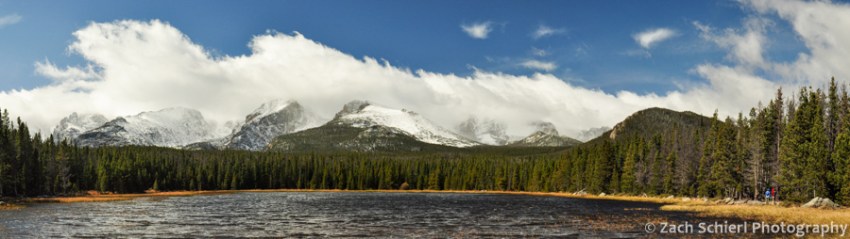
Clouds linger over the Continental Divide as seen from Bierstadt Lake
The grand old Rocky Mountains!
Their bold and massive forms,
Like Pyramids of age,
Defy the sweeping storms!
-Enos A. Mills, 1887
A hectic few months has kept me away from the website recently but fortunately not from my camera. My recent move to Fort Collins, CO means that my new backyard playground is Rocky Mountain National Park, only an hour from my doorstep and home to some truly spectacular scenery, especially in the fall when the aspens and willows turn golden and storms begin to dust the high alpine tundra with snow.

Fall colors along Bear Lake Road
My arrival in Fort Collins happened to coincide with the annual fall elk rut, in which bull elk gather large groups of females (called harems) together to mate. The many large grassy parks in RMNP are a popular gathering place for the elk and hundreds of people can be found lining the roads and trails skirting the meadows each evening to observe them in action. Even though I used to regularly see elk in our backyard growing up, this was a new experience for me. After an evening of watching and photographing the bull elk mate, lock antlers with other males, and toss back their heads to bugle, I can now confidently check “witness an elk rut” off my non-existent bucket list. I would share some of my photos of this unique spectacle, but in order to keep this website rated PG-13, I had better pass…
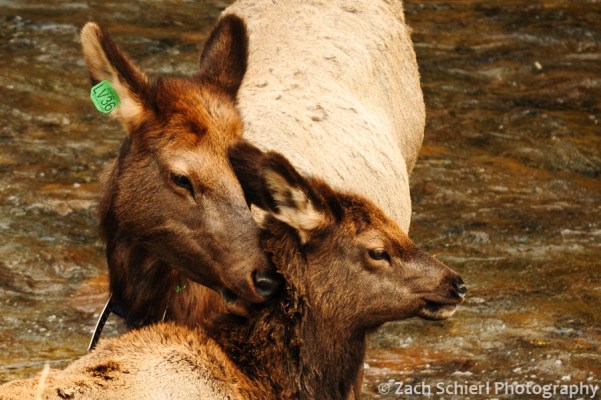
An elk cow shares a tender moment with her calf.
While snow starts to fall in the high Rockies in late September or early October, the weather usually remains pleasant well into October or even November. We’ve had a few storms the past few weeks that have dropped some not insignificant amounts of snow in the high country so every hike I’ve taken so far has been an exercise in scouting trails less likely to be covered in snow and ice.

The Loch Vale in Rocky Mountain National Park
Earlier this week I decided to hike to the base of the east face of Longs Peak and Chasm Lake. I was unsure if I would actually be able to make it to the lake given its 11,700 foot elevation but I had picked Chasm Lake because I had noticed that the last (and highest) mile of trail hugged a south facing slope. A south facing slope equals more direct sun and theoretically less snow. My scouting paid off; the trail was nearly snow free save for some hard packed, but easily traverse-able snow just above tree line and the final 200 yards to the lake. The final 200 yards presented a bit of a challenge: a 30 degree slope guarding the lake that was basically one gigantic ice rink. I wasn’t going to be getting up the main trail without crampons but thankfully, a series of rock ledges alongside the trail were solid and dry, providing an alternative route up the final 200 vertical feet to the lake with only a little Class 3 scrambling required. Upon finally reaching the lake, I was met by a wonderful late autumn scene and quite happy to have avoided the the colossal disappointment of hiking 4+ miles only to get turned around with only a few hundred yards to go.

The Ships Prow (left) and Longs Peak (14,259′, right) tower above Chasm Lake
The snow and ice had the added benefit of deterring the crowds that seem to linger in the park well into the fall. The previous week I had hiked to Loch Vale in a busier section of the park and just getting to the trailhead had involved being stuffed like sardines in a park shuttle bus. Chasm Lake though I had all to myself for over an hour, save for a pair of climbers descending from Longs Peak, the highest summit in the park. The east face of Longs Peak is an imposing sight, “abrupt and precipitous for three thousand feet” according to Enos A. Mills, an early resident of the area and the driving force behind the creation of Rocky Mountain National Park in 1915. The silence was stunning, save for the occasional high-pitched “eeeeeeeee” of a pika, the intermittent roar of the wind whipping up loose snow, and the din of fallen icicles and chunks of glacial ice crashing their way to the base of the cliffs.
At eve and morning lighted
With liquid gold all around,
Thy crests and hills and valleys
Gleam bright with glory crowned.
—Enos A. Mills, 1887
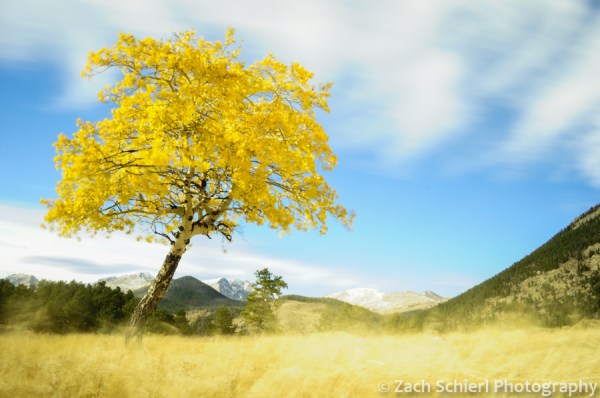
Aspen and grass waving in the wind in Horseshoe Park

Sunset and gibbous moon from Moraine Park
How to see Yellowstone in just 9 hours

Legend has it that many years ago at Yosemite National Park, when asked by a visitor what to do if she only had one day to see Yosemite, a park naturalist responded, “I’d go down to the Merced River, put my head in my hands, and cry.” By extension, if one day to visit Yosemite necessitates tears, then surely allotting just one day to see Yellowstone, a plot of land nearly 3 times larger, is some sort of federal crime. Yellowstone is after all, 3 times larger than the state of Rhode Island (Pyroclastic Pixels fun fact™: 16 of our 59 national parks are larger than Rhode Island). Recently I found myself in Bozeman, Montana (just an hour or so north of Yellowstone) for a geology conference with 24 hours to spare so I rented a car and headed to Yellowstone for the day. The key to seeing anything in such a large park in such a short amount of time is focusing on one very small area. Since I actually hadn’t seen any geysers during my last trip to the Yellowstone area a few years back , I decided to head to the Old Faithful and Upper Geyser Basin.

A beautiful aquamarine hot spring in Yellowstone’s Norris Geyser Basin.
Before I get to the geysers, let me take a moment to describe a game that I highly recommended you play when visiting Yellowstone. The game is titled “How long can you be in the park for before seeing someone taking an ill-advised wildlife photo” and my score on this visit was 23 seconds, shattering my previous personal best by several minutes. While still in sight of the Roosevelt Arch (the iconic stone portal erected at the north entrance to Yellowstone in 1903), I witnessed a family of four exit their minivan and the parents proceed to usher their children, with their backs turned, to within about 10 yards of a herd of grazing bison in order to take a photograph. Fortunately no one got gored, but not everyone is so lucky. As interesting as the geology and thermal features are, for me the preponderance of wildlife is unquestionably the prime appeal of Yellowstone. When one is bombarded by sightings of elk, bison, bears, coyotes, herons, swans, and bighorn sheep within 5 minutes of entering the park, it can be easy to feel like you are touring some sort of very large zoo. But it is important to remember that these animals are still very much wild and there are no cages or fences between you and a very, very, very bad day. If you want to get a close look at wildlife, bring a pair of binoculars or a good telephoto lens and keep your distance. There is, after all, a very good reason why these are handed out at the entrance station.
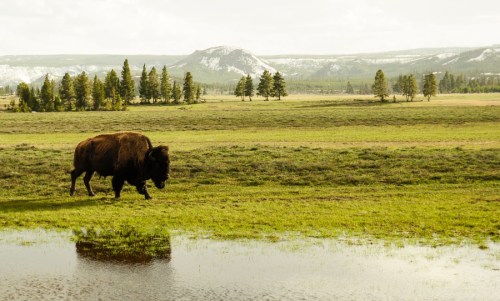
A solitary bison wanders along a pool filled with late-season snowmelt.

Terraces of mineral deposits surround Grand Prismatic Spring, the largest hot spring in the United States.
I arrived at Old Faithful just in time to witness an eruption (the crowds gathered around on benches tipped me off). After watching from amongst the masses, I decided I wanted to spend the rest of the day somewhere a little quieter. A long hike into the wilderness was sadly out of the question, in part because of time and in part because hiking alone in grizzly bear country is generally considered to be inadvisable. Instead I decided to head up the short trail to Observation Point which, while only about half a mile from Old Faithful, is still long enough to leave 99.99% of other park visitors behind. I watched the next eruption from the Point, several hundred feet above the geyser. Honestly the most fascinating part of watching from this vantage point was observing the number of people sitting on the benches ringing the geyser steadily increase over the half-hour preceding the eruption and then incredulously watching more than half of them leave before the eruption was even over.
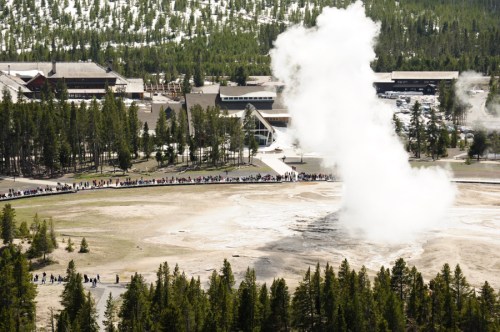
An eruption of Old Faithful is observed by hundreds of visitors.
At this point I got it in my head that it would be fun to make a time-lapse video of an eruption cycle, which involved me hiking back to my car to get my tripod and then climbing back up the hill. Once I had everything set up, I realized I had forgot my remote timer (not at the car but at home several states away) and would have to try to do the time-lapse by hand. This didn’t go so well for a couple of reasons. For one, whenever you set up a tripod anywhere, other people automatically assume you are some kind of expert on the area and start asking you lots of questions that you are in no way qualified to answer. And second, about a minute into the eruption itself, my focus shifted to a grizzly bear and cub that I spotted ambling out of the forest at the bottom of the hill (I ran into the same two bears on my hike back to the car about an hour later). The time-lapse didn’t turn out too well but it was still a fun day of people-watching, geyser-gawking, and wildlife-spotting. My tally after 9 hours in Yellowstone: three Old Faithful eruptions, hundreds of elk, dozens of bison and trumpeter swans, four grizzly bears, three marmots, one coyote, one bighorn sheep and 288 photographs!

An eruption of Beehive Geyser from Observation Point.
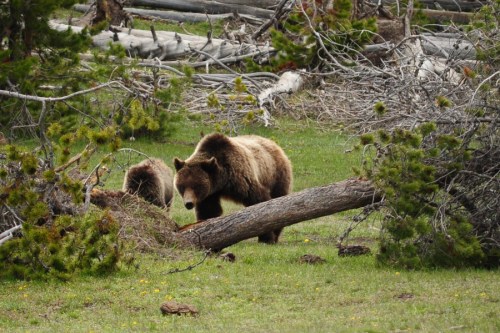
A mother grizzly and cub hanging out just a few hundred yards from Old Faithful.

Late-evening sun peeking through the clouds behind Clepsydra Geyser, which erupts nearly around-the-clock.
 Zach Schierl Photography
