A Serpentine Spectacle
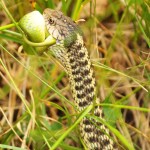
I’ve had some fascinating wildlife encounters the past few months. I’ve seen a mule deer give birth, encountered a herd of mountain goats at 14,000 feet, had some interesting run-ins with cows while camping (okay, cows aren’t technically WILD but still…), and even seen my first two porcupines. But the undisputed winner took place about five feet outside my bedroom door. The hill outside my door is covered in tall grass and shrubs. Anytime I have the door open, I hear the constant rustling of squirrels, chipmunks, cottontail rabbits, and the occasional coyote making their way through the grass. One day though, the rustling turned out to be this:
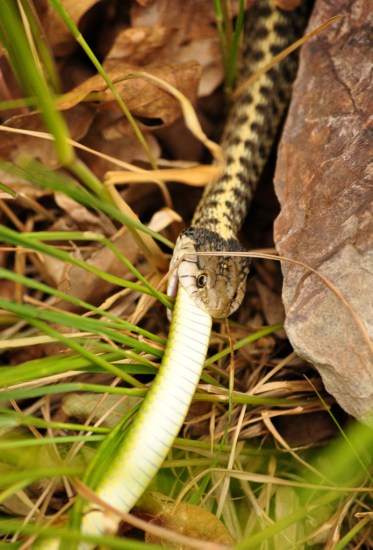
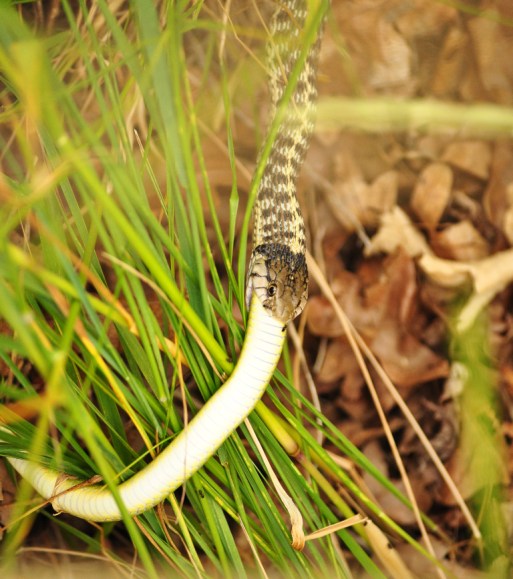
Just to be clear, that’s a garter snake (likely either Thamnophis elegans or Thamnophis marcianus…any snake people out there?) going NOM NOM NOM on a smooth green snake (Opheodrys vernalis). Now that’s not something you see every day.
I was fortunate enough to observe this spectacle in its near entirety, which in this case was almost two whole hours. The garter snake moved little; it was so focused on its meal that it seemed not even to notice me or the handful of other people watching the blatant act of serpentine cannibalism unfolding before our eyes. Every 30 seconds or so, the garter snake would open its mouth wide and constrict its jaw muscles slightly, entombing a few more millimeters of the green snake into its gullet. The green snake, which was consumed head-first, remained alive as it was being swallowed, as if being subjected to some diabolical form of medieval torture. Every few minutes it would engage in some futile thrashing for a few moments before the garter snake would wrestle it back into submission. At one point, a second green snake arrived on the scene and made a few jabs at the garter snake before retreating back into the grass.

Things got really wild in the final minutes. In what appeared to be a last ditch effort to avoid being completely ingested, or perhaps just a metaphorical middle finger to the garter snake, the green snake managed to tie the remaining few inches of its tail into an enormous knot. This befuddled the garter snake for a short while; it was already struggling with its decision to swallow a snake equivalent in size to itself and the knot didn’t make things any easier. After a few minutes though, the garter snake managed to open its mouth even wider and down the remainder of its meal, knot and all. Shortly after, the garter snake sluggishly slithered away, likely with a bad case of the meat sweats, and I went back inside feeling glad that I’m not as low on the food chain as the green snake.

Boulders to Bullion: A Tour Through the Mayflower Gold Mill
Spend enough time driving or hiking around western Colorado and you will inevitably be introduced to the rich mining history of the area. This is especially true in the San Juan Mountains where it’s hard to hike for more than a few miles without running into an assortment of old and dilapidated mining structures, ranging from head frames covering mine shafts that plunge hundreds or thousands of feet into the mountains, to bunkhouses that still contain the metal skeletons of the rickety old beds slept upon by early 20th Century miners. Most of these buildings have been abandoned; left to slowly decay and disintegrate under the weight of the dozens of feet of snow that accumulate in the mountains each winter. However a handful have been preserved or restored by local historical societies, such as the Mayflower Gold Mill just a few miles outside of Silverton, Colorado.
A mill is an integral part of any mining operation. While Hollywood seems to think that western gold rushes involved a handful of old grizzled, bearded men fishing fist-sized gold nuggets out of streams with their gold pans, the reality is that most of the rock mined in Colorado had concentrations of gold and silver that were best measured in parts per million, and concentrations of other metals like copper or zinc that were only somewhat higher. The purpose of a mill like the Mayflower was to take in this low-grade ore and spit out material concentrated in gold, silver, and a plethora of other valuable metals while leaving the rest of the rock, known as “gangue”, behind.
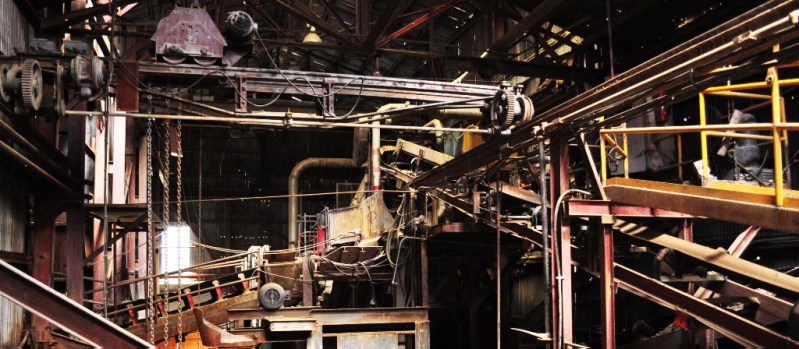
The crushing room inside the Mayflower Gold Mill.
The Mayflower Mill opened its doors in 1929 and was a technological marvel for its time. It was the last of the San Juan mills to close, in 1991, long after most of the mines in the area had ceased production. Ever since 1991, while the exterior of the mill has undergone stabilization at the hands of the San Juan County Historical Society, the interior of the mill has been left more or less untouched. The mill closed suddenly; one day it was open for business, the next it was shuttered for good as the prices of gold and silver plummeted and no one ever came in to clean up. Piles of partially crushed ore still lie on stationary conveyor belts, waiting patiently to continue their trip through the mill. Pairs of rubber gloves still lie on counters and railings, now covered with a thick layer of dust. Calendars with pictures of scantily clad women still hang from rusty thumb tacks in offices and control rooms. If all this wasn’t eerie enough, the power went out about five minutes after I entered the mill and from then on the only light source other than sunlight streaming through a handful of windows was the flashlight in my hand. Walking through you would never guess that it’s been closed for only 22 years; the place looks like its been abandoned for a good half-century and much of the equipment looks much older, yet somehow advanced for its age.
The tour through the mill is self-guided and costs $8 which at first seemed steep but ended up being well worth it. Not for the quality of the interpretive signs dispersed throughout the mill (despite the extremely friendly and helpful staff, the signs could use some serious work) but merely for the pleasure of exploring the mill itself, one of the most fascinating man-made structures I’ve ever been inside. My computer is telling me I have something like 48,000 photos on my hard drive at the moment. I’m willing to bet more than 95% of those were taken outside. Why? Well to be honest, I don’t generally find man-made buildings that fascinating so I’ve never been that much of an indoor photographer. Once in a while, I find myself somewhere like the Mayflower Mill that changes that, at least temporarily 😉

Piles of iron balls were bounced around in large drums to help mutilate the ore into pieces as small as a grain of sand!
While milling ore to produce gold and other metals may seem somewhat alchemistic, in essence the process consists of two phases: crushing the rock into very, very, VERY small pieces, and then using a variety of noxious chemicals to separate the metal from the rock based on their physical properties. Ore would arrive at the mill in large metal buckets that zipped downhill along an aerial tramway that connected the mill to the Mayflower Mine several miles and several thousand feet above the Mill in Arrastra Basin:
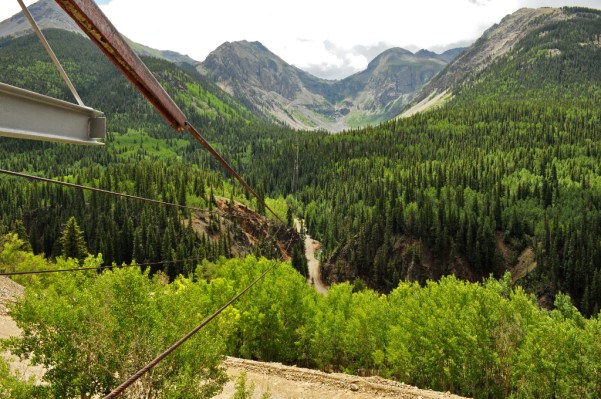
A view of the aerial tramway originating from the Mayflower Mine in Arrastra Gulch. The miners would often ride to work in the empty buckets headed back up to the mine. Hard to imagine a commute with a better view!
The crushing is then accomplished using a variety of progressively diabolical looking devices that to this day are covered in rock dust and surrounded by little piles of partially crushed ore that fell off of one of the many conveyor belts snaking through the mill. Normally there are buttons that you can press which turn on some of these devices for a short period of time but this was thwarted due to the aforementioned power outage. This was the device that I would have most liked to see in action:
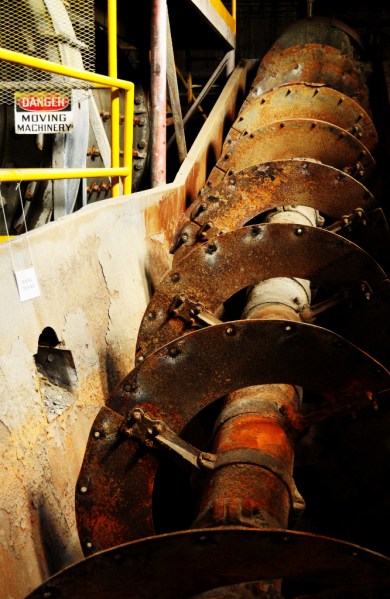
A spiral classifier, used to separate different sized pieces of crushed ore.
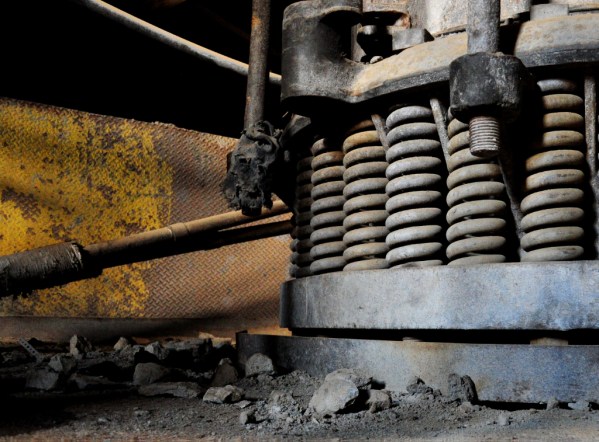
Pieces of partially crushed ore scattered around the base of an enormous jaw crusher.
The separation occurred in a series of tanks and vats that, while not visually impressive, still seemed to reek of the boiling concoction of lead and cyanide they once contained. My gut feeling was that hanging around this part of the mill for a long time would probably be a bad idea. The final product was rich-enough in gold that access to the areas where the final stages of separation took place was restricted to only a handful of employees who were continuously monitored by a network of security cameras. Unbelievably, even after all this, the ore would still need to be sent to a smelter for further purification and processing before pure gold bullion, or other metals were obtained.
Here are a few more random pictures from inside the Mayflower, which truly is a photographer’s dream, ESPECIALLY when the power is out. I was so caught up in taking pictures inside that I completely forgot to get a picture of the mill from the OUTSIDE!

Every size drill bit imaginable!

Piles of old equipment in a dark corner of the mill. Actually, since the power was out when I visited, just about the whole place was dark…
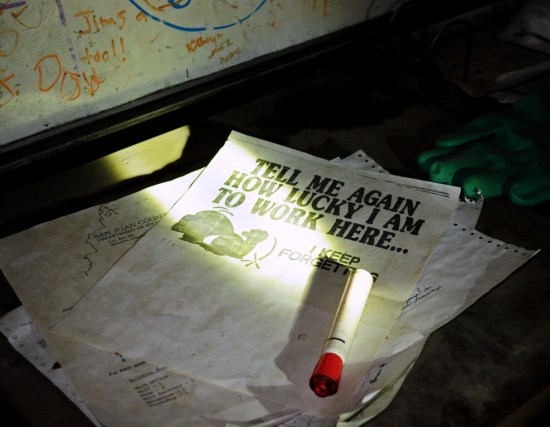
A little workplace humor for good measure!
A Little Southern Utah in Western Colorado: the Dominguez Canyon Wilderness

Pedestrian bridge over the Gunnison River at the entrance to Dominguez Canyon
Colorado is known for its mountains, and with an average elevation of 6,800 feet rightfully so, but tucked away in the far western part of the state are a number of spectacular red rock canyons and landscapes that look like they were lifted straight out of a Southern Utah travel guide by some sort of magical, three dimensional silly putty. Colorado National Monument is home to the perhaps the best known of these canyons but several equally impressive chasms can be found just to the south in the Dominguez Canyon Wilderness Area.
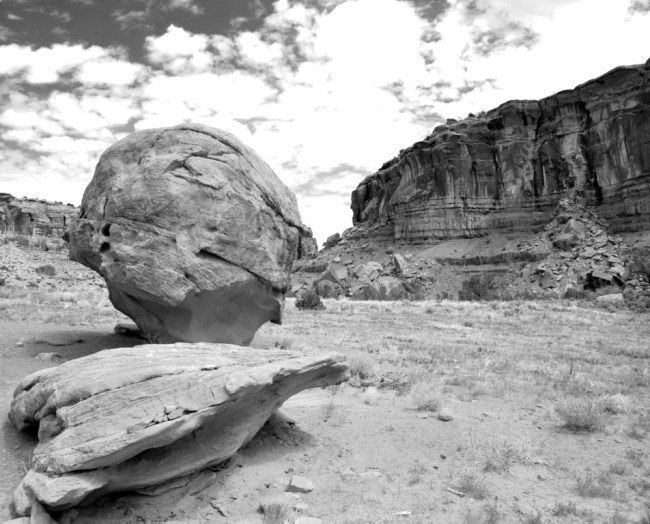
Wind-sculpted boulders in Dominguez Canyon
Dominguez Creek is a tributary of the Gunnison River just north of Delta, CO that flows year-round through a series of spectacular canyons cut into sedimentary rock of varying red, orange, and pink hues. About a mile upstream of its confluence with the Gunnison, the canyon splits; Big Dominguez Canyon to the west, and Little Dominguez Canyon to the south. Gentle trails undulate along the floors of both canyons for dozens of miles, all the way up into the headwaters of the drainage system on the Uncompahgre Plateau. I chose to hike up Big Dominguez Canyon, which I knew was home to some year-round waterfalls (ended up being nearly dry…) and impressive rock art. This turned out to be a really good decision as you’ll see shortly. Since most of my hiking recently has involved steep mountain trails at elevations often 11,000 feet, trekking along a relatively flat trail at 5,000 feet was a welcome respite that allowed me to cover quite a bit of ground.
Dominguez Canyon is located within a federally designated wilderness area, one of 43 such areas in Colorado. The Wilderness Act of 1964, which celebrates its 50th anniversary next year, defines wilderness as “an area where the earth and its community of life are untrammeled by man, where man himself is a visitor who does not remain.”
In many ways, these values were on display in Dominguez Canyon; despite the area’s proximity to Grand Junction, I hiked about 15 miles (told you it was flat) and didn’t see another human soul until I was almost back to the trailhead. Apart from some rumbles of thunder that echoed magnificently through the canyon in the early afternoon, the landscape was perfectly silent, despite its location only a half dozen miles from U.S. Highway 50. In other ways they were not, such as when I came across piles of metal equipment associated with an old mine (likely copper based on the abundance of azurite and malachite in the surrounding rocks), although being geologically inclined I’m never one to complain about this sort of thing since there are few things as fun and adrenaline-inducing as poking around old mine dumps for an hour!
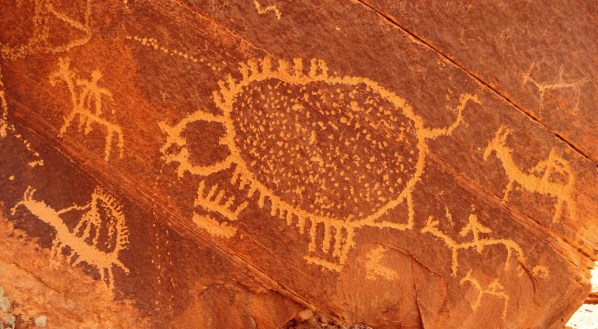
One of the larger petroglyphs in Dominguez Canyon? A turtle? A chunky centipede? Other ideas?
Dominguez Canyon is also known for being prime Rocky Mountain Bighorn Sheep habitat, yet a quick glance at the trailhead register told me that seeing these creatures is by no means guaranteed. The BLM asks people to record the number of sheep they spot in the register on their way out, and I noticed that the handful of groups that had visited in the last few weeks had either A) seen more than 20 sheep or B) seen zero sheep. Hit or miss indeed. Despite my best attempts at making convincing sounding sheep noises, my visit was sadly a miss; I had the pleasure of recording a big fat zero in the register as I departed, despite frequently taking breaks to scan the red cliffs for any sign of movement and feeling insanely jealous of the groups just days before that had hit the bighorn sheep jackpot. Despite the lack of sheep, some smaller and less wooly residents of the canyon made themselves known and were even nice enough to pose for a few photos:

Western Collared Lizard, Dominguez Canyon Wilderness, CO
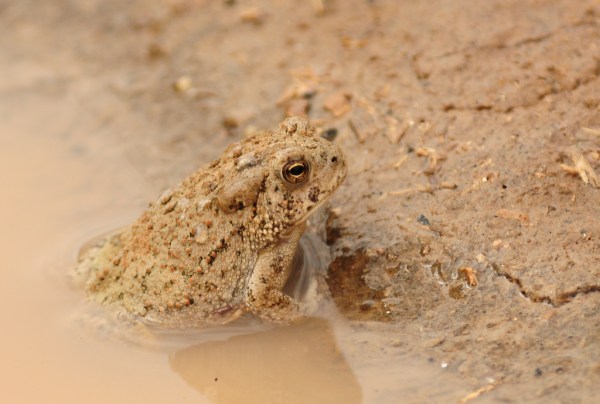
Canyon Treefrog, Dominguez Canyon Wilderness, CO
Despite the nearly continuous presence of distant thunder, which almost prompted me to turn back about an hour into the hike, I didn’t feel a single drop of rain the entire day. Yet when I returned to the junction between Little and Big Dominguez Canyons late in the afternoon, I discovered that the creek coming out of Little Dominguez Canyon, which had been nothing more than a pathetic looking transparent trickle at 10 A.M., had been transformed into a thick brown torrent of mud and debris accompanied by the extremely potent aroma of fresh cow pie. Yum.

This waterfall along Dominguez Creek had been nearly dry just a few hours earlier.
In hindsight I wish I had taken a “before” picture for comparison but that morning the creek was flowing with less gusto than your typical garden hose so my camera and I weren’t exactly drawn to it. Clearly the headwaters of Little Dominguez had gotten a lot of rain in a short amount of time and seeing this dramatic transformation was a good reminder that flash floods can strike areas far removed from any significant precipitation and validated my decision to hike Big Dominguez Canyon instead.
As spectacular as the canyon was, I can only imagine how enchanting it would be at sunrise or sunset when the low-angle of the Sun illuminates the fantastic geology or in the spring when snow melt swells the creek. Always good to have an excuse to go back!
 Zach Schierl Photography