Exploring the Earth and Sky of the West

Latest

(Petrified) Forests of Stone

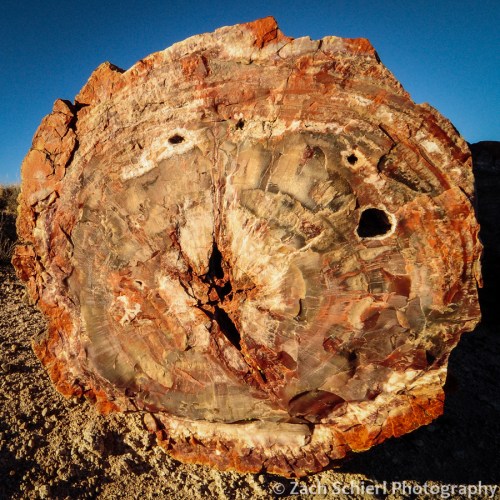
Close-up of log of petrified wood

Despite being comprised almost entirely of quartz, trace amounts of elements like iron and manganese give petrified wood its myriad of colors.

I grew up about 90 minutes away from Petrified Forest National Park and, aside for a quick lunch stop about 10 years ago, had never visited before last week. While this is nowhere near as inexcusable as living in Arizona for decades and never visiting the Grand Canyon (yes, such individuals exist…I’ve met many), it still seemed like a bit of an oversight on my part. Or it could simply be a reflection of the inordinate number of outdoor activities that exist in northern Arizona; even living in the area for 10+ years isn’t enough time to hit everything. Either way, after finally venturing into the Petrified Forest, I can emphatically say that it should be mentioned with the best that northern Arizona has to offer.

Located amongst the vast Painted Desert of northeastern Arizona, the main attraction of Petrified Forest is of course the petrified wood. The formation of petrified wood is initiated when downed trees are quickly buried by sediment. Once entombed in the sediment, the lack of oxygen prevents the logs from decaying as they normally would when exposed directly to the atmosphere. In this case, the logs (none of which remain standing, despite the name “Petrified Forest”) were likely brought here in massive logjams along an ancient river system that existed during the Triassic period. A combination of sediment from the river and ash from nearby volcanoes buried the logs, not to be seen again for more than 200 million years. During this time, as the logs became buried under an increasingly deep pile of overlying sediment, dissolved silica began to crystallize in the pore spaces of the wood as quartz, eventually replacing all of the organic material while maintaining the original shape and structure of the log.

Brilliantly colored petrified wood fragment

A brilliantly colored petrified wood fragment.

Petrified wood is not particularly rare. Good examples abound in Yellowstone National Park, Washington state, Utah, Colorado, Oregon, Alberta, New Zealand…the list goes on and on. What makes Petrified Forest National Park unique is the quantities found here. Due to the aforementioned Triassic log jams, large quantities of wood were concentrated in small areas. In a location known today as Jasper Forest (see photos below), movement was not possible without walking over a nearly uniform carpeting of small petrified wood fragments and frequently having to clamber over 2-3 foot diameter logs. Truly stunning!

Petrified wood in the Jasper Forest

Petrified wood in the Jasper Forest, Petrified Forest National Park.

Overlooking the Jasper Forest at sunset.

Overlooking the Jasper Forest at sunset.

Another unique aspect of Petrified Forest is the colorful canvas on which the wood is found. The wood is eroding out of a rock unit known as the Chinle Formation, which essentially consists of all of the river sediment and volcanic ash the buried the trees in the first place. More than 1000 feet thick in the park, the Chinle Formation is composed primarily of extremely soft mudstones, clays, and volcanic ash. Water is able to easily sculpt the soft rock into fantastically colored and oddly shaped badlands that make a spectacular backdrop for the logs.
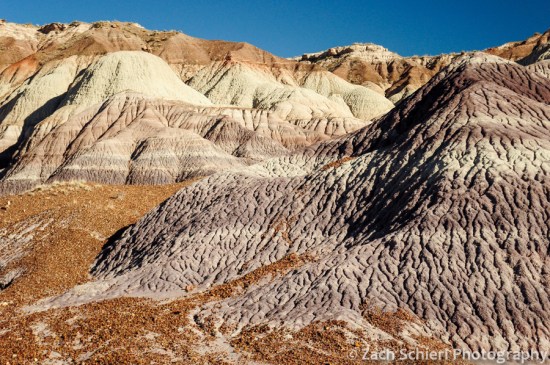
Chinle badlands

The soft muds and clays of the Chinle Formation are easily eroded, forming badlands-like topography throughout the Painted Desert.

Colorful badlands in the Chinle Formation

Colorful badlands in the Chinle Formation at Blue Mesa.

Petrified Forest National Park faces an issue not encountered by most other national parks, namely, the wholesale theft of the very resource it was established to protect. For this reason, the park is only open during daylight hours (from 8-5 in the winter) to minimize opportunities for looting. It strike me as very sad that such measures are necessary. With a little geological perspective, it becomes clear how incredibly lucky we are to experience a landscape like Petrified Forest at this moment in time. So easily eroded is the Chinle Formation that in many locations, several inches of it are removed each year. This may not sound like much, but geologically speaking, that’s a veritable bullet train of erosion. While it took tens of millions of years for the Chinle to be deposited, it will be erased from our planet by the unceasing forces of weathering and erosion in a tiny fraction of that. The petrified logs, being comprised mostly of silica, are harder and will last a little longer, but are still brittle and will eventually be washed into the Little Colorado River and swept downstream along with the colorful Chinle badlands.

What all this means is that the colorful Painted Desert/Petrified Forest landscape we see today is one that is extremely temporary. While this is true of most landscapes we see on Earth today—our planet likes to re-build, re-arrange, re-shape, and remove constantly—the Painted Desert is even more ephemeral than most. While mountain ranges comprised of harder, erosion-resistant granite or quartzite (like most of the Rockies) can stand the test of time to some degree, the longevity of the Painted Desert, its soft sediments, and its brittle petrified wood is comparatively brief. Stealing this treasured natural resource only abbreviates our time with the Petrified Forest even more.

Petrified wood in the Chinle Formation

Pieces of petrified wood accumulate in small hollows in the extensively gullied Chinle Formation.

Petrified logs in a small wash

The soft sediment surrounding the logs is easily transported away by small streams and washes.

Petrified wood and quartz on pedestals

Relatively hard chunks of petrified wood and quartz protect the softer sediment of the Chinle Formation from erosion, forming pedestals small…

Large piece of petrified wood in pedestal.

…and large!


2015 Photography Calendars Now Available!

And now for a bit of shameless self-promotion:

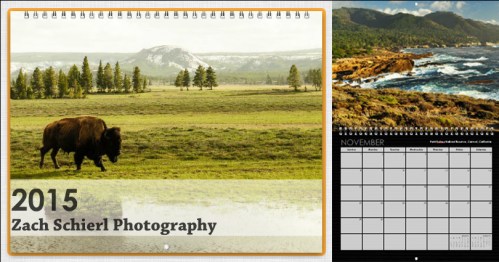
Looking for a holiday gift that doesn’t suck? For the second consecutive year, I’m offering a wall calendar featuring some of my favorite photos from the past 12 months. Mountains, canyons, wildlife, wildflowers…this 2015 calendar has it all! The calendars are spiral bound and available in two sizes, 8.5″x11″ and 11″x14″.

2015_Calendar

Visualize this on your wall…or on the wall of someone you are obligated to buy a Christmas present for!

You can order one by clicking the appropriate button below. All orders will be fulfilled through a secure PayPal link but you do not need a PayPal account to order. Prices include domestic shipping. If you wish to order multiple calendars or have any questions, please contact me by using this link. Discounts on shipping for multiple calendars are available.

As an added bonus, each calendar even comes with a free souvenir electronic receipt/invoice! Try getting that at Wal-Mart!

-Zach

2015 Calendar (8.5″x11″)—$22

2015 Calendar (11″x14″)—$27

2015_wall_calendars

Photographing the Night Sky from Colorado

Colorado is a great place for those of you who, like me, are perpetually torn between looking up and looking down. Colorado’s spectacular geologic landscapes keep me occupied during the day, but at night a whole different world opens up overhead. Colorado is a great place to look at and photograph the night sky for several reasons:

  • It’s relatively dark. With the exception of the Front Range megalopolis (where I now live), there are few egregious sources of light pollution, especially when compared to just about every state east of here.
  • It has the highest average elevation of any state. This is important because looking through the Earth’s atmosphere at the stars is like looking through a glass of water at a friend sitting next to you. The higher you go, the thinner the atmosphere becomes, and the better and steadier your view of the night sky.
  • It has good weather. Clear skies can be found regularly throughout the year, unlike in the black hole of astronomy known as the Pacific Northwest.
  • It has lots of public land where you can theoretically spend all night outside taking photos without fear of getting shot.

I spent a good chunk of this past summer honing my astrophotography skills and if you’ve never tried your hand at it, I encourage you to give it a try. It has certainly made me a better all-around photographer. First and foremost, astrophotography is an exercise in patience, both at the camera itself and then in front of the computer afterwards, and patience is a valuable virtue in all aspects of photography. Ironically, as comfortable as I am outside under the stars, astrophotography actually pushes out of my comfort zone photographically. Apart from minor brightness or contrast adjustments and cropping, I tend to eschew significant post-processing of my photos. When photographing the night sky though, some quality alone time with Photoshop and Lightroom is pretty much a necessity in order to get something that looks good.

Milky Way stretching from horizon to horizon.

The summer Milky Way spans the sky from horizon to horizon as seen from near Delta, Colorado. The galactic center is located just above the southern horizon (right).

I’m not here to give you a step-by-step guide to night sky photography, that’s been done before (try here, here, or here), but simply to encourage you to try it. All you really need to get started is a DSLR, a tripod, some patience, and somewhere dark. Like ACTUALLY dark. Sadly, light pollution has gotten so bad that most people reading this will have never seen a truly pristine night sky. Driving to the suburbs does not qualify as “dark”. Here in the Denver/Boulder/Fort Collins light pollution-opolis, even after driving two hours up to 12,000 feet in Rocky Mountain National Park, you’ll still only see roughly HALF as many stars as can be seen with the naked eye from a truly dark location. To see if there are any pristine night skies near you, check out this nifty site, which is basically Google Maps with an overlay of light pollution severity. You’re looking for areas with the darkest black color and as you’ll see, they are becoming few and far between.

What’s great is how many different ways there are to incorporate the night sky into your photos. With wide-field astrophotography, the entire night sky is the star of the show (pun intended). Accomplished by using fast, wide-angle lenses combined with relatively short exposures (30 seconds or less, unless you have a motorized mount), this method can reveal spectacular detail in the night sky unseen by the human eye, such as the spectacular interstellar dust lanes in the Milky Way. If you pair the Milky Way with a terrestrial landscape illuminated by moonlight, the possibilities for composing spectacular nightscapes become nearly infinite.

Milky Way center close-up

Close-up of the center of the Milky Way Galaxy. Dark arms of starlight-obscuring dust, star clusters, and emission nebulae (pink) are visible in this 1-minute exposure.

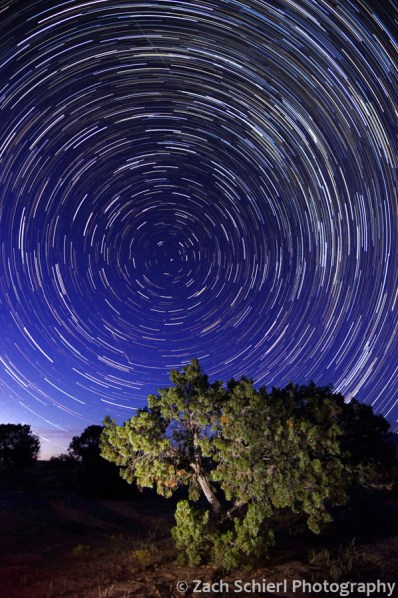
Longer exposures (or lots of short ones “stacked” together) document the motion of the stars across the night sky. I have a soft spot for star trails because they are a beautiful reminder that the world we live in is in constant motion; the dramatic and graceful arcs traced out by the stars are due to OUR rotation, not the stars.  Star trails centered around the North Star (Polaris) can be especially striking since the north star is almost exactly above the rotational axis of the Earth, and thus moves very little throughout the night.

Star Trails over Escalante Canyon, Colorado

Star trails (centered on Polaris) over Escalante Canyon, Colorado

Probably the most challenging type of astrophotography, and really the only one that requires specialized (often expensive) equipment, is telescopic imaging. My experience in this category is limited, given the aforementioned factors (donations always happily accepted!), but I’ve tried it on a handful of occasions by using friend’s equipment or telescopes at observatories I have worked at. Telescopic astrophotography allows detailed images of galaxies, star clusters, and nebulae, many of which are not even visible to the naked eye. While good images can be obtained by fitting a DSLR to a telescope (below, center and right), the best images are obtained using stand-alone CCD cameras optimized for astrophotography (below, left).

Deep-sky images taken with telescope

A variety of galaxies and nebulae imaged via telescope. 

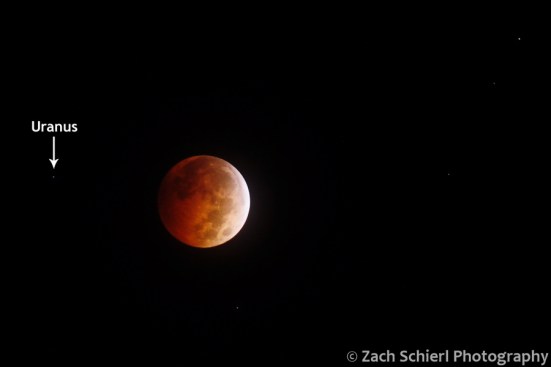
Some objects, like the Moon, are big and bright enough that a telescope is not needed to get decent images. I got this photo of last month’s total lunar eclipse with a standard 55-200mm zoom lens, and even had enough light gathering ability to capture the planet Uranus less than a degree away from the Moon!

Total lunar eclipse October 2014

Total lunar eclipse on October 8 2014, as seen from Fort Collins, CO

Beyond the technical challenge, what ultimately thrills me most about astrophotography is being able to capture photons that have been en route towards us across the vast universe for dozens, hundreds, or even millions of years. After that long of a journey, it feels like our duty to ensure that at least some of those photons have the honor of being recorded in some state of permanence. Give it a try and it won’t be long before you find yourself in the middle of nowhere waiting for your camera to finish a 1-hour exposure. A perfect change to sit back and ponder the vastness of the universe looming over your head.