Escape to the Snake Range: Great Basin National Park

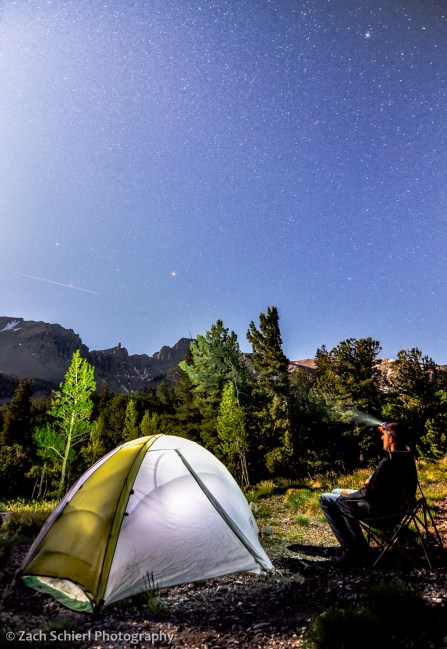
Wheeler Peak by full moonlight, Great Basin National Park, Nevada
At first glance, Nevada’s Snake Range is just one out of the hundreds of long, skinny mountain ridges that comprise the Basin and Range Province of the western United States. Clarence Dutton, a geologist associated with John Wesley Powell’s geographic and geologic surveys of the western United States in the late 1800s, once referred to the Basin & Range as “an army of caterpillars marching toward Mexico,” referring to the seemingly interminable landscape of north/south trending mountain ranges and intervening valleys that dominate Nevada, southern California, and western Utah & Arizona.
It is the presence of one of our nation’s least visited national parks, Great Basin, in the southern portion of the range that provides the first indication that the Snake Range might be somehow unique from its brethren. And indeed it is. Rising more than 7,000 feet above the surrounding terrain, the Snake Range is home to four of the five tallest peaks in the state of Nevada, culminating in 13,065′ Wheeler Peak, the second highest point in the state. The altitude and the lush spruce, fir, and aspen forests clinging to its slopes makes the area feel suspiciously like a piece of Colorado thrust up into the middle of the Nevada deserts.

Wheeler Peak just after sunset on the summer solstice
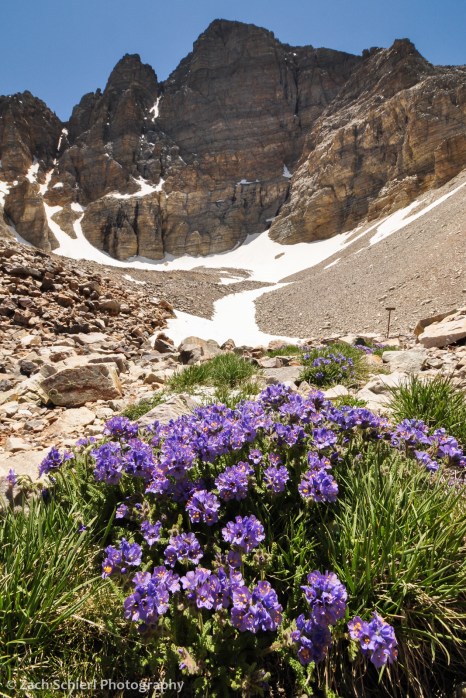
Abundant sky pilot (Polemonium viscosum) in a glacial cirque beneath Wheeler Peak, Great Basin National Park
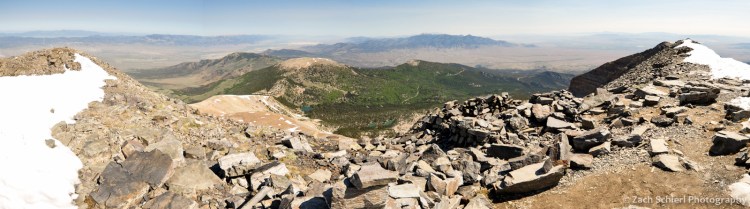
Looking north along the Snake Range from the summit of Wheeler Peak (13,065′) on a beautiful June day
Great Basin National Park is also famous for the groves of Great Basin bristlecone pine (Pinus longaeva) found on rocky slopes near treeline. Currently believed to be the longest-living non-clonal organism on Earth, many of the bristlecones in the park exceed 3000 years in age. In an infamous 1964 incident, a Snake Range bristlecone felled by a researcher (the area had not yet been designated as a national park at the time) was posthumously determined to be nearly 5000 years old, which would have made it the oldest known tree on earth were it not for the fact that the tree was now quite dead. More recently however, a bristlecone estimated to be 5,065 years old was found in the White Mountains of eastern California, slightly surpassing the age of the doomed Great Basin tree.

A twisted and contorted Great Basin bristlecone pine (Pinus longaeva) on the slopes of Wheeler Peak, Great Basin National Park
In the final hour of my recent drive across western Utah to reach Great Basin NP, I encountered only a single other vehicle before arriving at the park entrance. The relative isolation of the park leads to perhaps its most unique attribute; Great Basin National Park is by many measures the darkest national park in the U.S., and one of the darkest locations in the country period. Sadly, my visit coincided with a full moon which, while preventing me from experiencing a light pollution-free night sky, did make for some good nightscape opportunities:

Light from the rising full moon illuminates Wheeler Peak and Stella Lake, Great Basin National Park

A Western Tiger Swallowtail (Papilio rutulus) feeds from a crimson columbine (Aquilegia formosa) along Baker Creek, Great Basin National Park
If you get sick of exploring the surface world, Great Basin also harbors a subterranean spectacle, the ornately adorned limestone cavern known as Lehman Caves. With alpine peaks, caves, ancient trees, and inky black night skies, it may seem miraculous that Great Basin remains one of the least visited national parks in the country. In 2015, Great Basin was visited by 98% fewer people than that big hole in the ground known as the Grand Canyon. Hopefully the photos on this page encourage you to stay far, far away 🙂
Speechless in the San Juans: A Day at Ice Lake

It’s no secret that I love mountains. It’s also not much of a secret that the San Juan Mountains of Colorado are my favorite mountains. I love the San Juans for a number of reasons. One of them is geology. Look at a map and its easy to lump the San Juans in with the rest of the Rockies, but geologically speaking, they’re a whole different ballgame. Formed not by uplift but by some of the largest and most violent volcanic eruptions in Earth’s history (think Yellowstone only MUCH, MUCH larger…), the San Juans have a personality all their own. They are tall (12 peaks above 14,000 and 314 above 13,000), large (more than 10,000 square miles, as opposed to the long but skinny ranges that dominate the rest of Colorado), and so steep that only three ski resorts exist here.
I also love the San Juans for the solitude they can offer. 5+ hours from major metropolitan areas (*cough*Denver*cough*), escaping the crowds here is much easier than in the rest of the state’s mountains (*cough*Aspen*cough*).
As of last weekend though, my number one reason to love the San Juans is that the San Juans contain Ice Lake, which might be the most beautiful location I’ve visited on Earth to date.

Ice Lake reflecting Vermillion Peak, Golden Horn, and Pilot Knob
Ice Lake is a glacial tarn located at 12,300 feet not too far from the mining town of Silverton. Fortunately, it’s one of the few major destinations in the San Juans that you can’t get anywhere close to with a jeep, which drastically limits the number of people that you see and the number of engines that you hear. Instead, it is accessed via a steep 3.5 mile hike from a trailhead along South Mineral Creek. It’s been on my list of places to go for several years now and my girlfriend Michelle and I recently got a chance to spend a few days in the San Juans and make the short but steep trek up to the lake. Hiking in Colorado’s high mountains in the summertime can be challenging. Near daily vicious afternoon thunderstorms make it hard to spend any appreciable time above tree line. Despite the fact that a good chunk of this hike was above treeline, we didn’t hit the trail until a little after 8am but fortunately the weather gods cooperated on this day.
While the scenery along the trail is spectacular, all is forgotten once you catch your first glimpse of Ice Lake. One look at the brilliant neon blue water and you suddenly feel as if you’ve been hiking through a prison yard for the last few hours. I’ve never seen water so vividly colored; some of the hot springs in Yellowstone are the only things that come even remotely close. The color is caused by the presence of “rock flour” in the lake, extremely fine sediment left over from the days when large glaciers scoured out Ice Lake Basin and ground the fragile volcanic rocks into a powder. These sediment particles are so small that they remain suspended in the water, scattering blue light toward the eyes of every astounded hiker and backpacker that reaches the basin.
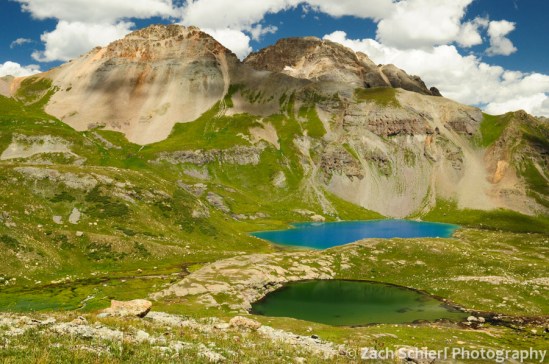
Ice Lake (blue) and unnamed lake (green) with U.S. Grant Peak (13,767′) towering overhead.
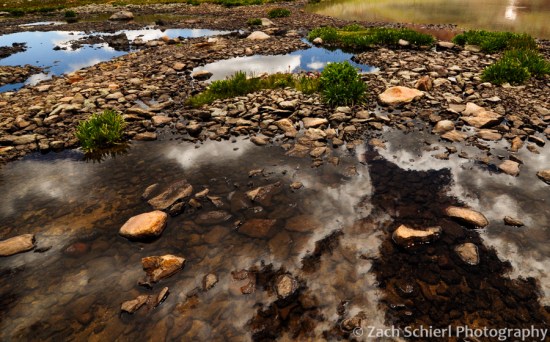
Late afternoon clouds reflected in a small pond in Ice Lake Basin
Unlike many of the other high alpine basins in the San Juans, Ice Lake Basin is HUGE! Covering nearing five square kilometers, the basin contains several other named and unnamed lakes as well as some of the most impressive wildflower fields I have ever seen. White, red, pink, and yellow varieties of paintbrush, elephant ears, asters, and columbines blanketed the basin. Wildflower season in the lower elevations has long past but up at 12,000 the show is just reaching it’s zenith!
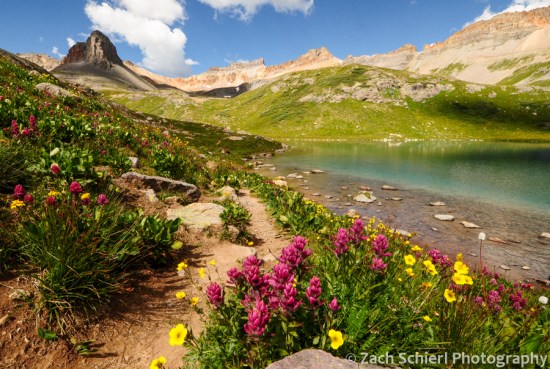
One of many colors of Paintbrush found in Ice Lake Basin.
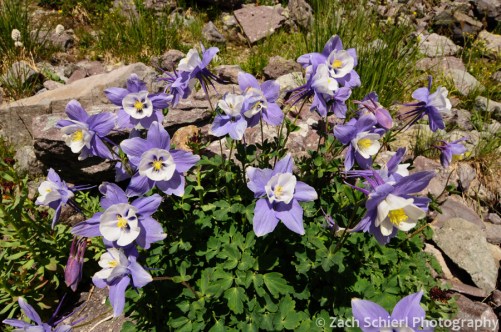
Hey look! Colorado’s state flower, the Rocky Mountain Columbine!
Interestingly, the other lakes in the basin were not nearly as brilliantly colored, but rather a more drab blue-ish green that was nevertheless spectacular, especially when the wind calmed and the waters began to reflect the ring of peaks surrounding the basin. We lucked into a day where the thunderstorms had trouble developing and so we were able to spend 5-6 hours exploring the basin, crossing fields bursting with wildflowers, and relaxing by the lakes. We were hoping to get a glimpse of the mountain goats that often frequent such basins, but we had to settle for a handful of marmots and a trio of llamas which another party had used to pack their overnight gear into the basin.

Unnamed lake below Vermillion Peak (13,894′)
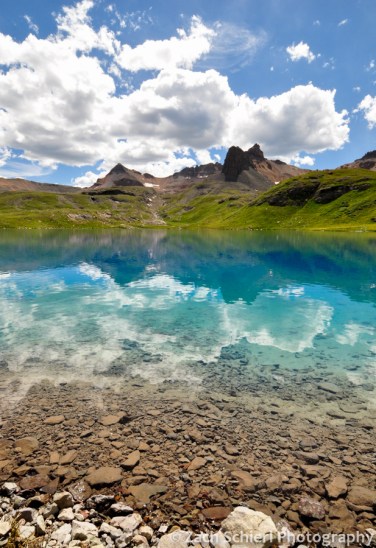
Golden Horn (13,769) reflected in Ice Lake.

Some of the views on the way up to Ice Lake. Here Corn Lily grows rampant in Lower Ice Lake Basin.
It’s not an exaggeration to say that this was one of the most beautiful landscapes I’ve ever seen. Walking through the basin, I was reminded of Robin Williams’ famous quip about Glacier National Park: “If this isn’t God’s backyard, then he certainly lives nearby.” Apparently God has now purchased a summer home in the San Juan Mountains because the scenery here is truly second to none.

Can’t remember ever being this sad about having to hike back to the car. Will have to come back and spend the night someday!
 Zach Schierl Photography