The “Less” White One: Mt. Baker and the Ever-Shrinking Easton Glacier

View of Mt. Baker (right), the Easton Glacier, and the Black Buttes (left) from the Railroad Grade moraine, evidence of the former extent of the Easton Glacier.
You’ll notice that the Sun is shining brightly in all of these photos which should immediately tip you off to the fact that I’m several months behind in posting, since getting pictures this radiant at the present time would require either a a 200-mile drive east, or a 500-mile drive south. I’ll gripe more about that in a future post, rest assured.
One of the consequences of the copious winter precipitation here in the Pacific Northwest is the simply massive quantities of snow that pile up in the Cascades, just a half hour or so to the east of my current, comparatively temperate residence. In many areas, not all of that snow can melt the following summer and having more snow than you can melt is one of the key ingredients for a glacier. Almost all of Washington state north of Seattle has been covered by glaciers or ice sheets at some point in the last 20,000 years but nowadays the only glaciers remaining in WA are those high in the North Cascades and Olympics, and the tendrils of ice that snake down from the summits of the mightiest Cascade Range peaks; Mt. Rainier, Mt. Adams, Mt. St. Helens, Glacier Peak, and Mt. Baker. Although the amount of glacial ice in Washington is getting ever smaller (Mt. St. Helens’ Crater Glacier is actually one of the few in the U.S. that is actually getting larger. Can you guess why?), according to the USGS Washington remains the 2nd most extensively glaciated state, 2nd only to Alaska. And they’re WAY further north so that’s sort of like cheating anyways.

The Easton Glacier descending from the summit of Mt. Baker.
The Easton Glacier on the southern slopes of Mt. Baker is one such glacier that has undergone rapid retreat over the past century. Covered by more than a dozen glaciers, Mt. Baker is an active volcano that was known by the Lummi as Koma Kulshan, which roughly translates to “Great White One”. Mt. Baker experiences some of the largest annual snowfalls anywhere in the world, including a U.S. record 1,140 inches (that’s 95 feet!) during the winter of 1998-1999 according to NOAA. So how could its glaciers possibly be getting smaller with that much snow? To understand that, we need to understand a bit more about how glaciers work. If you groaned at that last sentence and would rather skip ahead to the pictures at this point, go ahead. I won’t be offended. In fact, since this is a website, I won’t even know. But you’ll be missing a really great analogy that I use in just a bit here so you should probably just stick with me for another paragraph or two. Plus glaciers are really cool. Pun wholeheartedly intended.
Here’s the (very) quick and (very) dirty version: A glacier is a body of ice that flows downhill. During the winter, snow accumulates on the glacier, temporarily adding to its mass. When temperatures warm the next summer, the snow on the lower, warmer portion of the glacier will melt (as will some of the ice) but some of the snow on the upper, colder portions will survive and turn into ice, replenishing the glacier. If more ice is added in the upper part of the glacier than can melt in the lower part, then our glacier gets larger. If less ice is added than is lost, the glacier gets smaller. If they two equal, the glacier stays put. As hard as it might be to believe given the massive snowfall on Mt. Baker, rising global temperatures mean that in most years, the Baker glaciers lose more mass during the summer due to melting then they gain during the long, dreary, snowy winters. In geology speak, this is known as a “negative mass balance” and, if left unchecked, it spells doom for a glacier. Now, its completely normal for a glacier to have a negative mass balance year every once in a while. No biggie. Rather, it’s when negative becomes the new normal that the glacier will begin shrinking and will continue to shrink unless something changes to bring it back into balance.
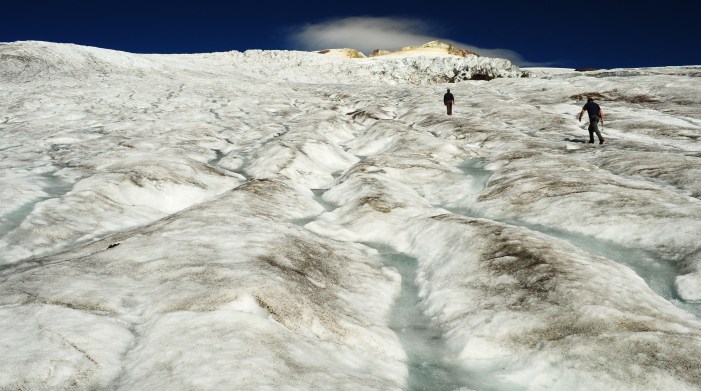
Meltwater flowing down the surface of the Easton Glacier in September.
Think of it this way: let’s say you wake up really hungry tomorrow morning and you decide to make yourself some bacon. Before you know it, you’ve gone right ahead and eaten that entire package of bacon all by yourself. I’m sure you can all empathize with THAT feeling. Anyways, while that may not be the healthiest breakfast you’ve ever had, doing so once probably isn’t going to have much of an effect on your long-term health. You’ll go for a run the next day and burn those calories right back off, much like a glacier might experience a low-snowfall year followed by a record breaking snowfall the next year to make up for it. (Note: by now you’ve hopefully noticed that this analogy starts to break down when you consider that a glacier LOSES weight during a negative mass balance year…) But if you start eating an entire package of bacon by yourself every few days, or even once a week, well….sad as it is to say, you might start having some serious health issues. Same is true for a glacier. If you lose mass one year, it probably won’t be that noticeable. But if temperatures increase, if the summer melting season becomes longer and you start losing mass year after year after year, then regardless of how much snow falls in the winter, it won’t take long before you start shrinking, and shrinking fast.
For example, here is a more expansive view of what the Easton Glacier and its surroundings looks like today:
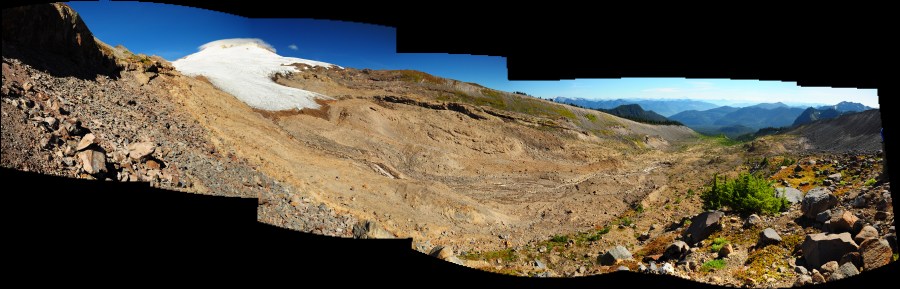
The long valley or trough stretching across the image represents the path carved out by the ice when the glacier was much larger than it is today. Just 25 years ago, much of the trough you see in the immediate foreground would have been filled with ice. The prominent ridge on the opposite side of the trough is a feature known as a “lateral moraine” (rhymes with “romaine” as in romaine lettuce, which I can emphatically say is far less tasty than bacon). A moraine consists of loose sediment that was once trapped within the ice. When a glacier is stable, i.e. when it doesn’t shrink or grow but rather sits in the same for an extended period of time, all that sediment gets deposited in large piles around the edges of the glacier when melting occurs. The presence of a moraine here tells us that the Easton Glacier once filled the entire trough to the level of the far ridge, and did so for a prolonged period of time. Considering that the ridge crest is more than 200 feet above the floor of the trough, we can see that not only is our glacier retreating, but that it was also once much thicker than it is today.
One way to get an estimate of how long the glacier has been gone from a particular area is to look at the vegetation (or lack thereof). While the time it takes for vegetation to sprout up in an area uncovered by a glacier varies widely (depending on factors such as soil development, climate, and species), often times smaller plants will begin to reestablish themselves within about 20 years or so of the glacier’s exit. In this case, much of the bare, brown/orange colored land in the center of the image was covered by ice as recently as the 1980s. Even more amazing: follow the valley downhill to the right. Look how far down we have to go before we encounter even the slightest sign of grasses, much less trees. Scale is a little tricky in this picture but see that greenery way way down at the downhill end of the trough? That point is over a mile away from where the picture was taken and it happens to mark the approximate terminus of the glacier in the mid 1800s, near the end of a cool period known as the Little Ice Age. The Bellingham Herald has a nice article on the retreat of the Easton Glacier over the past 100 years, with spectacular photos comparing the modern glacier to how is appeared in 1912, here. As you can see, it is now a shell of its former self. Other glaciers on Mt. Baker are in a similar predicament.
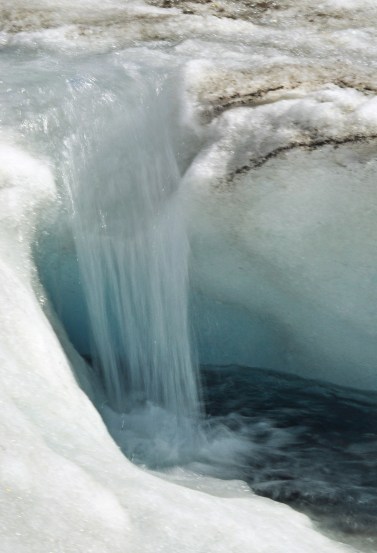
Easton Glacier remains one of the easiest glaciers to access anywhere in the continental U.S. The toe of the glacier can be reached by hiking for about 2 miles along a moderately strenuous but well-maintained hiking trail. Eventually this trail crosses a wooden swing-bridge over the meltwater creek that issues from the glacier. From here, you simply head off trail and hike up the old glacial trough for an additional mile and a half or so (at the time of publication at least…) until you hit ice. This part of the hike is decidedly more strenuous but as you can see from these photos, the scenery is spectacular! Exploring the terminus of the glacier is fascinating! Huge piles of mud and debris deposited by the melting glacier cover the ice near the toe, masking the ice and making travel treacherous. A large meltwater stream emerges from the base of the glacier through one of these piles as if by magic. The ice near the terminus is heavily crevassed so one must tread carefully when hiking on the ice itself.
So next time you’re in the area, check it out before it’s gone entirely. Who knows, maybe you’ll even burn off the calories from that pound of bacon you ate for breakfast!

Hiking back down the moraine towards the trailhead. Glacier Peak visible on the horizon at center-left.
A Glacier, a Waterfall, and a Kayak walk into a bar…the Story of Palouse Falls
Growing up in northern Arizona, spring was always an exciting time to finally pack away the snow shovels and de-icer and get outside. If you want to see enough running water in the desert southwest to actually get your feet wet, spring snowmelt season and summer afternoon thunderstorms are pretty much your only hope.
Spring in the Pacific Northwest is similar…except that instead of going from no water to a little water, we go from a decent amount of water to A LOT of water. Nowhere is spring runoff more apparent than 187 foot high Palouse Falls, which is about 1-2 hours (depending on your driving speed) north of Walla Walla, on the Palouse River just upstream of its confluence with the Snake River.
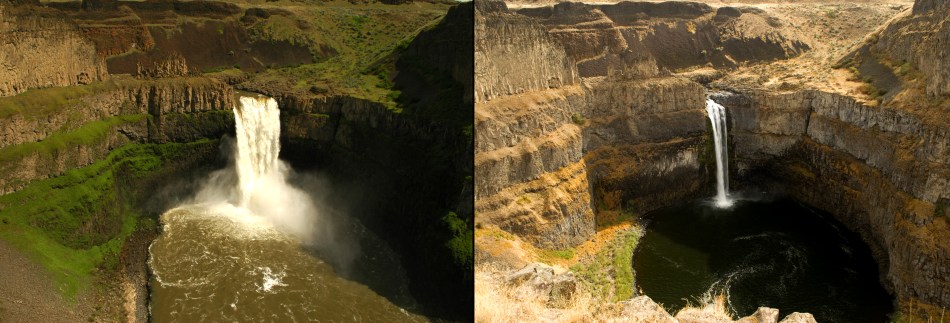
Palouse Falls in May (left) and September (right).
Normal people think lots of different things when they see Palouse Falls, among them “How do I get down there?”, “Wow, that’s pretty!”, “Where’s the snack shop?”, and “I really need to go to the bathroom after driving down that really bumpy, windy road”. All perfectly legitimate. Other people however see a kayak jump.
Palouse Falls garnered some attention in recent years when it became the site of the worlds largest kayak waterfall descent. In case that didn’t sink in, let me reiterate: someone paddled over that thing in a KAYAK.
As someone who has expertly piloted a kayak over 6″ riffles on the Palouse River below the falls, I can tell you that this is an impressive feat. Palouse Falls is nearly 200 feet; ants may be capable of surviving a fall off the kitchen counter but we aren’t designed to do such things. Just look at this picture.
If that was me, the discharge of the falls would be spiking dramatically right then due to the amount of bodily fluids I would have been emitting our of sheer terror.
The falls were formed by an phenomenon that comes in at #1 on our list of “Geological Terms That Make You Sound Like An Idiot If You Pronounce Them Correctly”: a jökulhlaup. If you are Icelandic, you’ll need no pronunciation guide. For the rest of you, that’s “yo-cooool-HOIP”. Once again, that’s “yo” as in the famous cellist Yo-Yo Ma, “coooool” as in “coooool Razor scooter man!”, and “HOIP” as in “House of International Pancakes.”
Now that we’ve got that squared away, lets set the scene: imagine you are an ice sheet, specifically the vast Cordilleran Ice sheet that covered the northern half of the North American continent during the last ice age. The climate is starting to warm; the mammoths are starting to die and those pesky humans are starting to increase in number. As the temperatures slowly increase, you start to feel a little sweaty and you begin to melt and retreat northwards to more suitable weather. All that glacial meltwater is getting funneled into river canyons that were cut tens of thousands of years earlier and are just now being uncovered by the retreating ice sheets. Even as a retreating ice sheet though, you will likely have a few appendages (called lobes) that reach several hundred kilometers south of the main ice front. These lobes block some of the river channels, forming a barrier that impedes the river’s progress. Massive quantities of water back up behind the ice dam, creating lakes larger than several of the Great Lakes. Remember though, you are a big piece of ice, and what does ice do in water? It floats. Once the lake becomes large enough, your appendages are no longer strong enough to maintain contact with the bottom of the canyon. The entire ice dam begins to rise slightly in the water, opening a seam at the base of the dam through which water begins to rush, eating away at the dam from underneath. Eventually, undermined by the water, the entire ice dam catastrophically collapses, draining the entire lake in a matter of hours and sending thousands of square kilometers of water rushing across the landscape. That’s a jökulhlaup. After the ice dam is blasted away, you, the glacier, slowly flow back down into the canyon over the next few years, creating a new dam and lake and starting the process all over again.

Palouse Falls cascades over basalt flows from the Columbia River Basalt Group

Rock formations near the brink of the falls
Anthropomorphized geologic features notwithstanding, this actually happened…at least 40 separate times at the end of the last ice age, from about 15,000 to 13,000 years ago. The river was the Clark Fork of the Columbia River, the ice dam was located near Lake Pend Oreille, Idaho, and the lake was glacial Lake Missoula, which stretched from northern Idaho almost all the way to Yellowstone National Park. The ice dam collapsed every few hundred years, sending a Lake Erie’s worth of water rushing down the Columbia River, across what is now Eastern Washington, all the way to the Pacific Ocean.
Look at what happens to your yard after a big storm and you know it doesn’t take that much water to carry out some significant erosion. Palouse Falls is located in one of thousands of scour marks, known as “coulees,” that were gouged out of the basalt bedrock of Eastern Washington by the force of these floods.

The Palouse River just upstream of the falls
 Zach Schierl Photography