2015 Photography Calendars Now Available!
And now for a bit of shameless self-promotion:
Looking for a holiday gift that doesn’t suck? For the second consecutive year, I’m offering a wall calendar featuring some of my favorite photos from the past 12 months. Mountains, canyons, wildlife, wildflowers…this 2015 calendar has it all! The calendars are spiral bound and available in two sizes, 8.5″x11″ and 11″x14″.
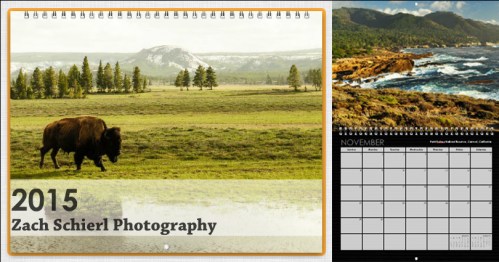
Visualize this on your wall…or on the wall of someone you are obligated to buy a Christmas present for!
You can order one by clicking the appropriate button below. All orders will be fulfilled through a secure PayPal link but you do not need a PayPal account to order. Prices include domestic shipping. If you wish to order multiple calendars or have any questions, please contact me by using this link. Discounts on shipping for multiple calendars are available.
As an added bonus, each calendar even comes with a free souvenir electronic receipt/invoice! Try getting that at Wal-Mart!
-Zach

2015 Calendar (8.5″x11″)—$22
2015 Calendar (11″x14″)—$27

Photographing the Night Sky from Colorado

Colorado is a great place for those of you who, like me, are perpetually torn between looking up and looking down. Colorado’s spectacular geologic landscapes keep me occupied during the day, but at night a whole different world opens up overhead. Colorado is a great place to look at and photograph the night sky for several reasons:
- It’s relatively dark. With the exception of the Front Range megalopolis (where I now live), there are few egregious sources of light pollution, especially when compared to just about every state east of here.
- It has the highest average elevation of any state. This is important because looking through the Earth’s atmosphere at the stars is like looking through a glass of water at a friend sitting next to you. The higher you go, the thinner the atmosphere becomes, and the better and steadier your view of the night sky.
- It has good weather. Clear skies can be found regularly throughout the year, unlike in the black hole of astronomy known as the Pacific Northwest.
- It has lots of public land where you can theoretically spend all night outside taking photos without fear of getting shot.
I spent a good chunk of this past summer honing my astrophotography skills and if you’ve never tried your hand at it, I encourage you to give it a try. It has certainly made me a better all-around photographer. First and foremost, astrophotography is an exercise in patience, both at the camera itself and then in front of the computer afterwards, and patience is a valuable virtue in all aspects of photography. Ironically, as comfortable as I am outside under the stars, astrophotography actually pushes out of my comfort zone photographically. Apart from minor brightness or contrast adjustments and cropping, I tend to eschew significant post-processing of my photos. When photographing the night sky though, some quality alone time with Photoshop and Lightroom is pretty much a necessity in order to get something that looks good.

The summer Milky Way spans the sky from horizon to horizon as seen from near Delta, Colorado. The galactic center is located just above the southern horizon (right).
I’m not here to give you a step-by-step guide to night sky photography, that’s been done before (try here, here, or here), but simply to encourage you to try it. All you really need to get started is a DSLR, a tripod, some patience, and somewhere dark. Like ACTUALLY dark. Sadly, light pollution has gotten so bad that most people reading this will have never seen a truly pristine night sky. Driving to the suburbs does not qualify as “dark”. Here in the Denver/Boulder/Fort Collins light pollution-opolis, even after driving two hours up to 12,000 feet in Rocky Mountain National Park, you’ll still only see roughly HALF as many stars as can be seen with the naked eye from a truly dark location. To see if there are any pristine night skies near you, check out this nifty site, which is basically Google Maps with an overlay of light pollution severity. You’re looking for areas with the darkest black color and as you’ll see, they are becoming few and far between.
What’s great is how many different ways there are to incorporate the night sky into your photos. With wide-field astrophotography, the entire night sky is the star of the show (pun intended). Accomplished by using fast, wide-angle lenses combined with relatively short exposures (30 seconds or less, unless you have a motorized mount), this method can reveal spectacular detail in the night sky unseen by the human eye, such as the spectacular interstellar dust lanes in the Milky Way. If you pair the Milky Way with a terrestrial landscape illuminated by moonlight, the possibilities for composing spectacular nightscapes become nearly infinite.

Close-up of the center of the Milky Way Galaxy. Dark arms of starlight-obscuring dust, star clusters, and emission nebulae (pink) are visible in this 1-minute exposure.
Longer exposures (or lots of short ones “stacked” together) document the motion of the stars across the night sky. I have a soft spot for star trails because they are a beautiful reminder that the world we live in is in constant motion; the dramatic and graceful arcs traced out by the stars are due to OUR rotation, not the stars. Star trails centered around the North Star (Polaris) can be especially striking since the north star is almost exactly above the rotational axis of the Earth, and thus moves very little throughout the night.
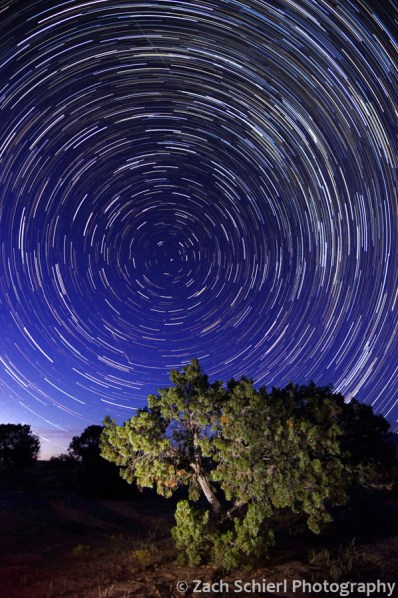
Star trails (centered on Polaris) over Escalante Canyon, Colorado
Probably the most challenging type of astrophotography, and really the only one that requires specialized (often expensive) equipment, is telescopic imaging. My experience in this category is limited, given the aforementioned factors (donations always happily accepted!), but I’ve tried it on a handful of occasions by using friend’s equipment or telescopes at observatories I have worked at. Telescopic astrophotography allows detailed images of galaxies, star clusters, and nebulae, many of which are not even visible to the naked eye. While good images can be obtained by fitting a DSLR to a telescope (below, center and right), the best images are obtained using stand-alone CCD cameras optimized for astrophotography (below, left).

A variety of galaxies and nebulae imaged via telescope.
Some objects, like the Moon, are big and bright enough that a telescope is not needed to get decent images. I got this photo of last month’s total lunar eclipse with a standard 55-200mm zoom lens, and even had enough light gathering ability to capture the planet Uranus less than a degree away from the Moon!
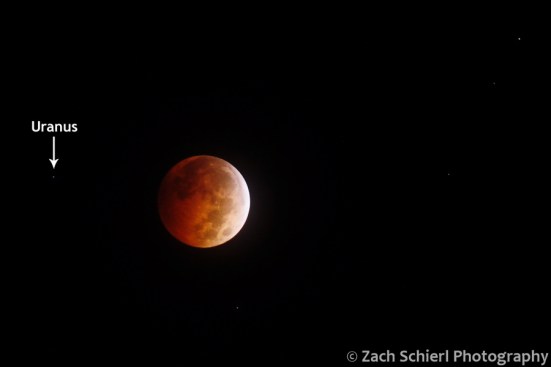
Total lunar eclipse on October 8 2014, as seen from Fort Collins, CO
Beyond the technical challenge, what ultimately thrills me most about astrophotography is being able to capture photons that have been en route towards us across the vast universe for dozens, hundreds, or even millions of years. After that long of a journey, it feels like our duty to ensure that at least some of those photons have the honor of being recorded in some state of permanence. Give it a try and it won’t be long before you find yourself in the middle of nowhere waiting for your camera to finish a 1-hour exposure. A perfect change to sit back and ponder the vastness of the universe looming over your head.
The View from Above: Panoramas from Colorado’s Peaks

Why do we climb mountains? For the sheer physical challenge. For the adrenaline rush. For the smell of danger that accompanies looking over the edge into 2,000 feet of nothing but thin air. For the mental high that comes from conquering a summit. To temporarily escape from the chaos of humanity stewing below. “Because it is there”. Your answers may vary. I climb mountains for all of these reasons, with different ones taking priority depending on my mood (although I have a limit to how much danger I am willing to smell…). Ultimately though, as a photographer, I climb mountains for the view.
With the highest average elevation of any state, Colorado has no shortage of mountains, and thus no shortage of views. Some of the best come from the summits of Colorado’s famous 14ers, a group of 53 peaks whose crests reach to more that 14,000 feet above sea level. At this altitude, other than birds and oncoming thunderheads, there is nothing left to look UP at. No mightier peaks obstruct your gaze and if you’re lucky, you might even catch a glimpse of a plane flying a few thousand feet below.
However there is not a direct correlation between higher elevation and better views. Far from it. After all, the 14ers have done nothing special to earn their fame, they have simply been the recipient of enough geologic good fortune that their summits exceed the ultimately meaningless and arbitrary 14,000′ mark. As a result, the Mount of the Holy Cross, topping out at 14,009′, is one of Colorado’s most famous mountains, in large part due to those uppermost nine feet. Meanwhile, Grizzly Peak, just 14 feet lower (13,995′), lies nearly forgotten just a few dozen miles away (lost in the shuffle of six—that’s right six—different Grizzly Peak’s in the state) yet provides an equally majestic vantage point.
Below I’ve put together a collection of panoramas shot from different summits around the state in an attempt to present the diversity of Colorado’s mountain peaks. Every summit, no matter how high, has a distinct atmosphere and feel, from suburban hills where you can down onto sprawling subdivisions and strip malls, to remote wilderness peaks where the only sign of mankind might just be the jet contrail 15,000 feet above you. Seeing summit panoramas always encourages me to get outside and fight Earth’s gravity once again. So go find any good chunk of rock that sticks up a bit above its surroundings, walk, hike, bike, climb, or crawl up it, and you are sure to be rewarded. My only specific advice is to find a peak without a road to the top. Views are best enjoyed in solitude and few things as demoralizing than spending hours trudging up a mountain only to find a gift shop, parking lot, or a family of six enjoying a three course meal in the back of their hummer at the top…or worse, a combination of all three.
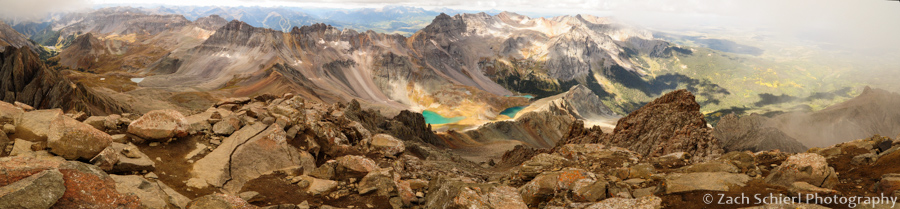
Mt Sneffels, San Juan Mountains, 14,158′
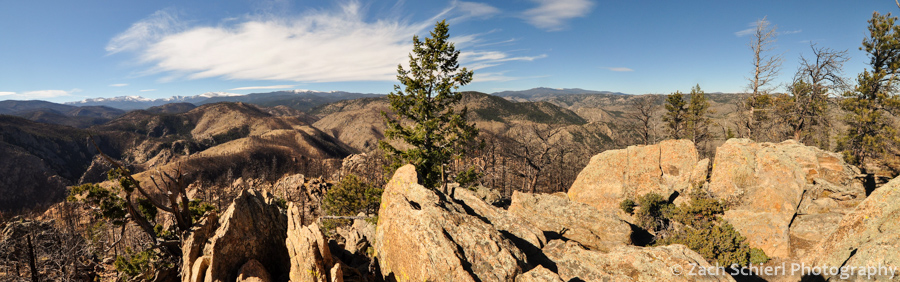
Mt. McConnel, Poudre Canyon, 8,008′

Twin Peaks, San Juan Mountains, 10,798′
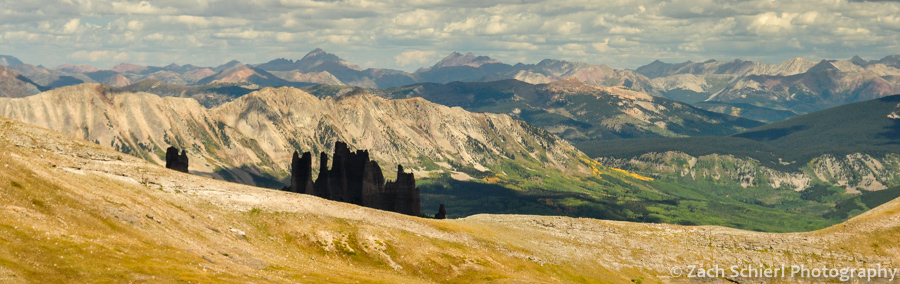
North Baldy Peak, West Elk Mountains, 12,850′
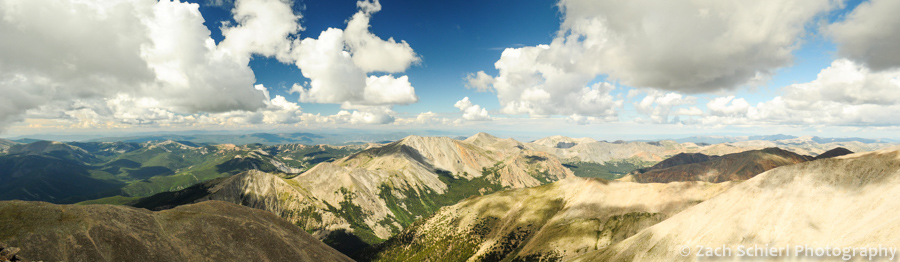
Mt. Shavano, Sawatch Range, 14,236′
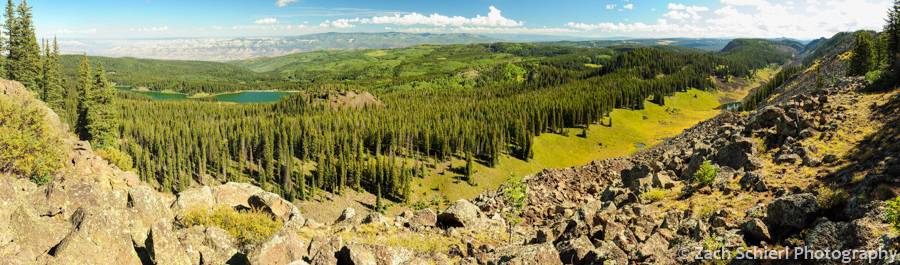
Crag Crest, Grand Mesa, 11,189′

Courthouse Mountain, San Juan Mountains, 12,152′

Mt. Elbert, Sawatch Range, 14,440′ (highest point in Rocky Mountains)
 Zach Schierl Photography