Upcoming Exhibition and Geology Talk
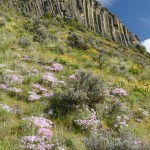

Every year, Cowiche Canyon Conservancy (an amazing non-profit land trust here in Yakima) partners with the Boxx Gallery in Tieton, WA to host “Images of the Shrub-Steppe“, a juried art exhibit featuring work inspired by the threatened sagebrush-steppe ecosystem of the Yakima Valley.
I’ve thoroughly enjoyed photographing this unique and wide-open landscape (especially during spring wildflower season!) since we moved to Yakima in 2019, and I was honored to have two of my images selected for the exhibition this year. The show will be open Friday-Sunday throughout September.
In addition, on the closing Saturday of the show (Sept 28), I’ll be giving a talk on the geology of the shrub-steppe from 1-2 pm at the Boxx Gallery. The focus will be on the two main lava flows that underlie the valley: the Columbia River Basalts and the Tieton Andesite, which form the backdrop for some of my favorite images from the Yakima area, such as the one above.
Full hours and details can be found in the flyer below:

An Aurora Storm for the Ages

Astronomy is a funny business. Sometimes it takes years of planning and many hard-earned dollars to be in position to see a rare celestial event (like April’s total solar eclipse), only to cross your fingers that the skies stay clear. Other times, a once-in-a-lifetime celestial experience drops into your lap on a random weekend in May.
That’s what happened on the evening of May 10/11, 2024, when a series of solar storms arrived at Earth, triggering one of the largest geomagnetic storms and aurora borealis (northern lights) displays in modern history. Seeing the northern lights from here in Washington state isn’t wildly uncommon, especially during periods of increased solar activity. Aurorae are caused by interactions between charged particles from the Sun and the Earth’s magnetic field and atmosphere. The Sun has an 11-year cycle of activity that is scheduled to peak in 2025, so opportunities to see aurorae have been fairly common over the past few years. I’ve seen them a handful of times since moving to Central Washington almost five years ago, but displays this far south are typically a modest affair. I’d always assumed that, to really see the northern lights, I’d need to plan a trip to Alaska or Iceland some winter and hope for the best.
I was wrong.
On May 9th, I started seeing forecasts calling for a sizeable geomagnetic storm the following day. Aurora forecasting is notoriously challenging though—there have been enough occasions where solar storms have fizzled upon arrival to merit a healthy dose of pessimism on my part—plus I was taking care of my five-day old newborn son, so the night sky wasn’t exactly the top thing on my mind. My first indication that something historic was happening was seeing a photo of brilliant red and pink auroras from Alabama pop up on my phone while eating dinner on the evening of the 10th. That got my attention in a way that the forecasts hadn’t. The fact that our skies were clear and the Moon was dark only added to the anticipation, but still, geomagnetic storms often last just a few hours and I figured the show would subside by the time darkness fell here in the Pacific Northwest.
I was wrong.
I set up my camera on our back porch shortly after sunset and before long a subtle but telltale green glow was visible in photos above the northeast horizon:

As the sky darkened, pale green curtains of light began to fill the entire sky. While they weren’t extraordinarily bright, the fact that they were visible from horizon to horizon made it easily the best aurora display I’d seen. We watched the faint lights dance across the sky for about half an hour before heading inside with the intention of preparing our newborn for bed. Thankfully, I popped my head back outside abut half an hour later to see if anything had changed.
It had.
Here is a time-lapse video I created of the entire event, starting at about 10:30 pm and lasting until sunrise. About two seconds in, you can see the dramatic transition from “good” to “once-in-a-lifetime” that occurred during the 30 minutes we were inside getting baby ready for sleep:
I never imagined that I’d get to witness a dusk-to-dawn all-sky aurora storm from my back porch in central Washington. Sitting here two weeks later, I am still dumbfounded scrolling through my pictures from that evening. Given that this is a photography blog and that I’m struggling to find the words to describe what witnessing this in person was like, I’m mostly going to let the photos do the talking from here:


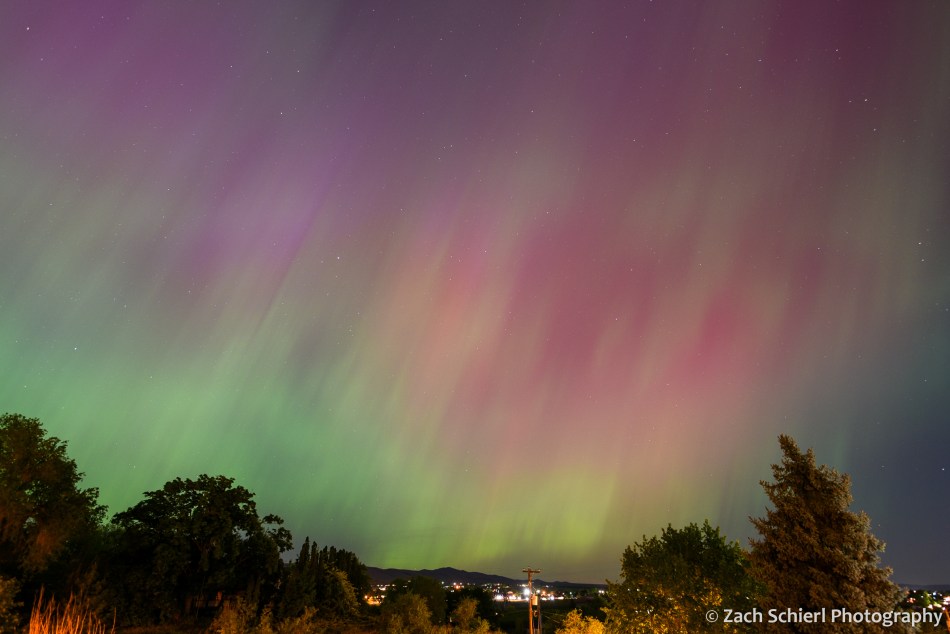
Two specific moments do stand out in hindsight. First, around 1:30 am, when a narrow band of green ribbons began “flowing” across the sky like a river of light. As they meandered across the sky, the ribbons alternately flashed on and off, as if controlled by some bizarre cosmic light switch. Again, I’m having trouble finding the right worlds to describe it, but it was one of the wildest things I’ve seen in 20+ years watching the night sky. Here’s a photo from this period of time:

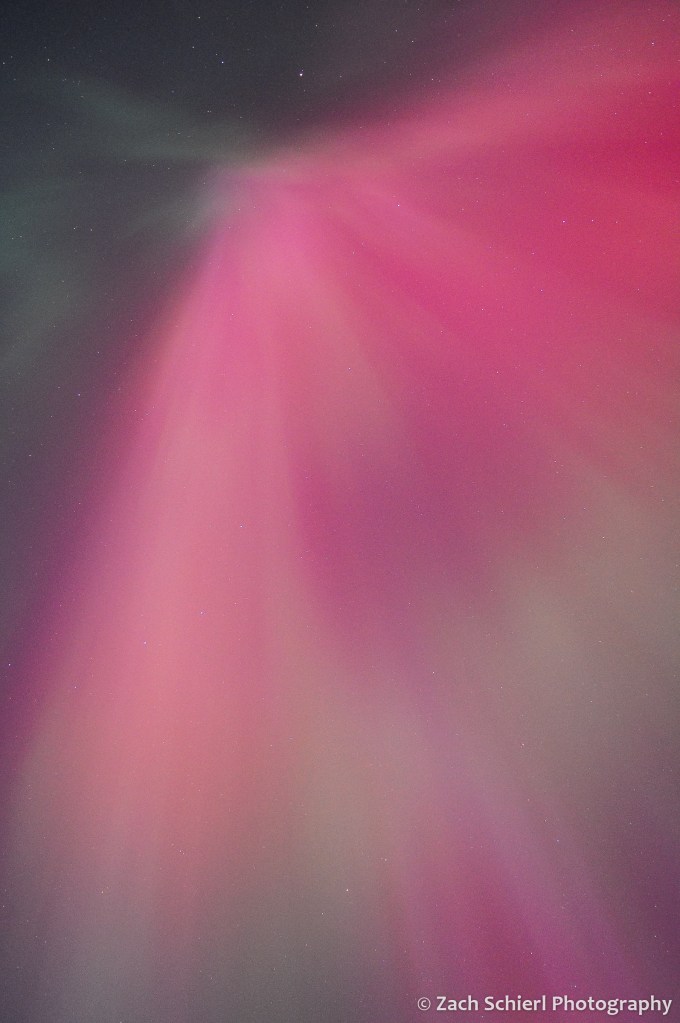
The other was a handful of minutes (I don’t know what time…) where nearly the entire sky was filled with a diffuse red aurora. (What shows up as pink in the photos definitely appeared more red to the naked eye.) The light that this cast on the surrounding landscape was eerie, and made me feel like I was standing under a heat lamp:

A few notes on color: in the days following the aurora storm, many of the conversations that I had with friends, family, and students revolved around why the color wasn’t as vibrant with the naked eye as it was on camera. There are several factors involved here.
One is light pollution. For example, folks in urban areas generally saw very little color, mostly just gray shapes shifting around in the sky. Where I live, on the outskirts of a mid-sized city (and thus still quite light polluted by astronomical standards), greens and reds were clearly visible to the naked eye throughout most of the event, though not to the degree visible in the photos. Those who observed the storm from very remote areas generally reported seeing much more vibrant colors (and possibly even hearing sounds!) In short, most folks saw little color because most folks live under light polluted skies.
The second factor involves some basic physiology of the human eye. I’ve written about this before with regard to photographing the Milky Way, but the cone cells that our eyes use to see color aren’t triggered in low-light situations. Cones need a minimum amount of light entering the eye in order to be activated, which is why objects appear in monochrome in a dimly lit room. A bright aurora is quite a bit brighter than the Milky Way, which means that it IS possible to see colors under the right conditions.
For comparison purposes, here’s the image from the top of the post again. I haven’t adjusted the color on this image at all; this is exactly how it came out of the camera after a five second exposure, save for a few small adjustments to brightness and contrast:
Here’s the same image again, this time desaturated in Lightroom to mimic approximately what I recall seeing with the naked eye:

Still colorful, but a good example of why digital imaging is the norm in professional astronomy these days. A common misconception is that astronomers spend most of their time looking through telescopes, when in reality everything is done with cameras. Our eyes can’t see squat!
Prior to May 10/11, my top 3 most memorable astronomy experiences were undoubtedly a pair of total solar eclipses (August 2017 and April 2024) and the 2001 Leonid Meteor Storm (during which I counted several hundred meteors every 15 minutes for over an hour.) It’s going to be hard to top a total solar eclipse, but the May 2024 aurora storm definitely earns a spot on this short list, in part due to sheer unexpectedness and the fact that I got to check off a “bucket list” item from the comfort of my own home. And, despite the fact that he was asleep most of the time and had no clue what was going on, it was still memorable to share the experience with my newborn son on his first weekend in this world!
Exploring the Mt. Adams Wilderness

Mt. Adams is the largest (by volume) and second highest volcano in the Cascade Range of Washington. Often overshadowed by its neighbors, Mt. Rainier, Mt. St. Helens, and Mt. Hood, we’ve taken a liking to Adams in part because its trails tend to be relatively deserted and in part because we have a fantastic view of the mountain’s east face from our neighborhood in the Yakima Valley. Recently we had the chance to complete a short backpacking trip on the north flank of the mountain which allowed us vantage points that far surpass anything we’ve seen on previous day hikes.
Our hike began and ended at a trailhead (Killen Creek) that is, as the crow flies, just 57 miles from our front door, but takes more than three hours to reach by car, giving some sense as to the relative remoteness of this area. Most of our ~20 mile loop was within the Mt. Adams Wilderness, a 48,000 acre wilderness area designated in 1964 with the original passage of the Wilderness Act.

On our first night, we camped at just under 7,000 feet on the north flank of the mountain in one of the most spectacular alpine meadows I’ve seen. No matter which way I turned, the views were extraordinary. To our south, the crumbling volcanic edifice of Mt. Adams loomed large, with the Adams Glacier descending in a stunning icefall from the summit plateau. To the north, broad expanses of dense evergreen forest stretched off into the distance, leading the eye to the massive Mt. Rainier and the rugged skyline of the Goat Rocks on the horizon. To the west, the truncated cone of Mt. St. Helens was backlit by the setting sun. Several lingering snowfields surrounded our campsite, providing a nice source of clear, cold water. A variety of diminutive alpine wildflowers were in full bloom, and the low rumble of rock and ice fall high on the mountain occasionally punctuated the silence, with clouds of dust the only clue as to their location. While this location is reachable by a long day hike, spending the night and being able to explore and photograph in the late afternoon and evening light is one of my favorite things about backpacking!


On Day 2, we descended to the Pacific Crest Trail before working our way around to the northeast side of Mt. Adams, passing through a series of wildflower-filled meadows and crossing several inviting streams cascading down from melting snowfields and glaciers higher on the mountain. These meadows also hosted a robust population of mosquitos and other biting insects….not unexpected for the Cascades in July, but an annoyance nonetheless, especially for an Arizona-born desert rat like me!
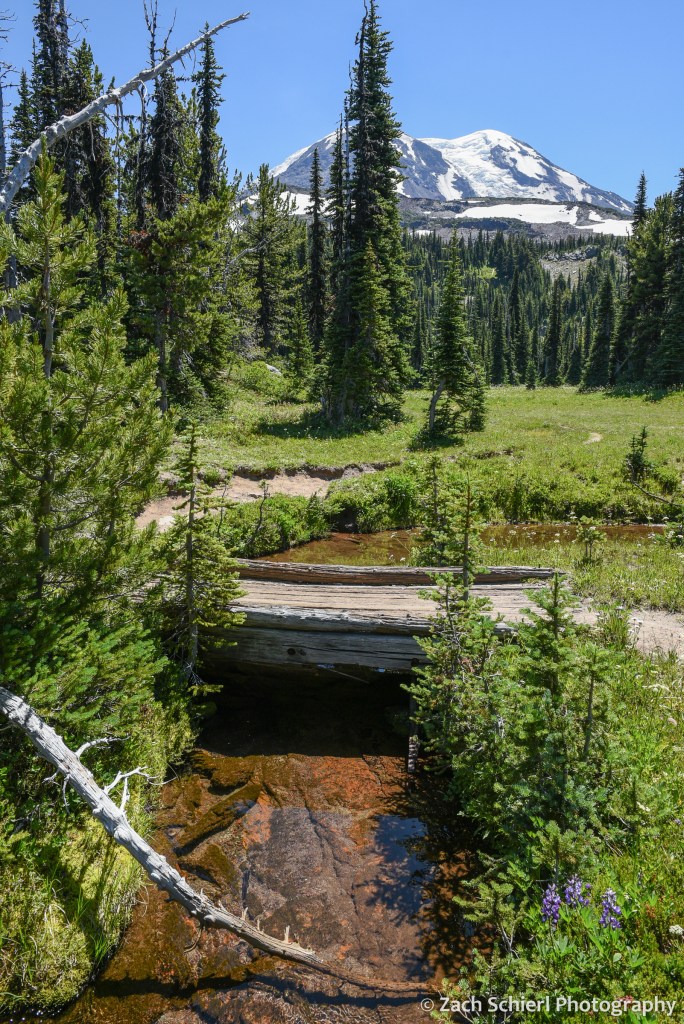

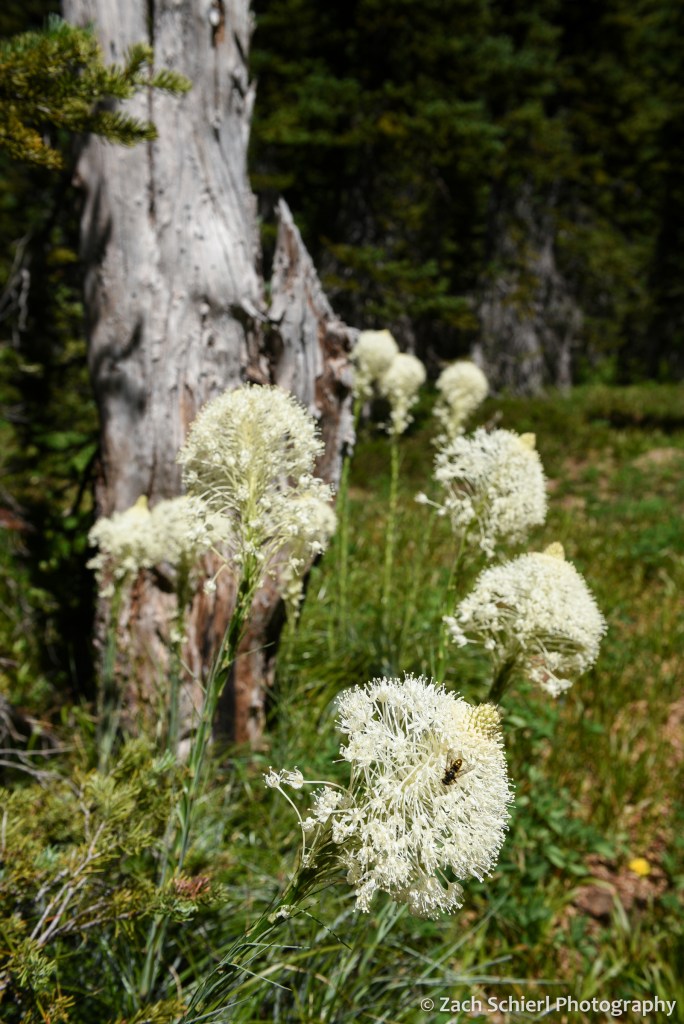
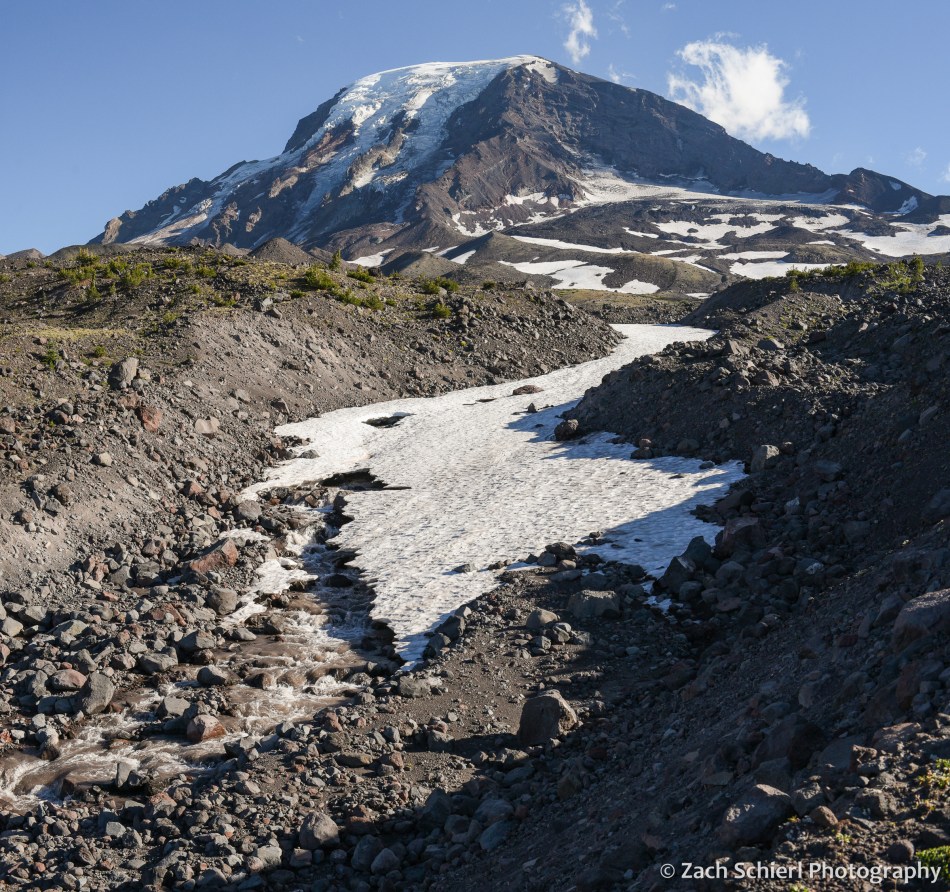
We had shared the trail with quite a few other hikers and backpackers on Day 1, but saw only a few other people from this point forward. Camp on night two was in a small clump of trees on the edge of a relatively recent lava flow. In contrast to the verdant alpine meadows of night one, this landscape was much more rugged, barren, and stark. After setting up our tent, we proceeded up the trail (with much lighter packs!) to find a spot for dinner. We quickly arrived at a stream crossing that we didn’t feel comfortable fording, so we left the trail behind and proceeded to pick our way up the rubbly bank until we arrived at a small knob with a spectacular view of the glaciers on Mt. Adams’ northeast face (Lava, Lyman, and Wilson). Here we enjoyed a delicious meal of instant mashed potatoes mixed with green chiles and an entire bag of bacon bits while listening to the roar of the creek.
Our best wildlife sighting of the trip actually occurred on the drive to the trailhead, when we happened upon a young barred owl sitting in the road. As we approached it flew into a nearby tree where it watched us warily for a few minutes before fleeing deeper into the forest:

Aside from this, we saw surprisingly little wildlife on this trip (unless you count mosquitos): only a few birds, chipmunks, squirrels, and a single marmot and mountain goat in the far distance from our first camp.
From our second camp, we were in a great position to catch sunrise on the final morning of our trip. There aren’t many things I’ll get up at 5:15 am for, but a Mt. Adams sunrise is definitely one of them!

After packing up, we hiked the eight downhill miles back to our car and drove back into the 100 degree blast furnace that is the Yakima Valley in late-July. We are thankful to have beautiful places like Mt. Adams so close to escape the heat this time of year!
 Zach Schierl Photography