Comet NEOWISE: Update and Photos
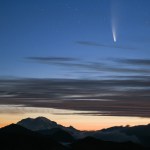
Comet C/2020 F3 (NEOWISE) continues to put on a stellar show for skywatchers in the northern hemisphere. Over the past week, the comet has moved into the evening sky, making a trip out to see it somewhat more palatable than it was when I first highlighted the comet 11 days ago. Last week, I had the pleasure of viewing the comet twice in one night while camping on the east flank of Mt. St. Helens. High clouds prevented a great view at sunset, but had mostly cleared just four hours later when the comet rose again in the northeast. Just below and to the left of the comet was the distant cone of Mt. Rainier. Low clouds in the river valleys below us made for a spectacular view:

Comet NEOWISE rises over the distant cone of Mt. Rainier as seen from Mt. St. Helens.

Comet NEOWISE on the morning of July 13, 2020.
Unfortunately, the comet has dimmed noticeably over the past few evenings. While we still have a few days until its closest approach to Earth, the comet has receded from the Sun enough that its activity is likely beginning to wane. The next few nights will likely provide the final chance to see this comet and its tail with the unaided eye (until it returns ~6,800 years from now that is!) The waxing moon will begin to interfere by later this week and by the time the moon leaves the evening sky a few weeks from now, the comet will likely have faded from naked eye visibility. To see it, look northwest 1-2 hours after sunset. The comet will appear a little below the bowl of the Big Dipper, and is far enough north now that viewing is significantly better from more northerly locations. More details on spotting the comet can be found here: https://earthsky.org/space/how-to-see-comet-c2020-f3-neowise
Good luck!
Views of Tahoma
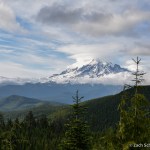

Light from a nearly full moon illuminates the glaciers and icefields on the summit of Mount Rainier.
At 14,411 feet, Mount Rainier is the highest peak in Washington and in the entire Cascade Range. British naval officer Peter Rainier never even saw the mountain that now bears his name, but he had a friend that did. Clearly, it paid to have connections in the 1700s. Oddly, Rainier did fight against the Americans during the Revolutionary War, making the fact that we continue to utter his name when referring to this grand peak all the more peculiar. Mount Rainier was originally known as Tahoma or Tacoma by the Salish-speaking indigenous tribes of the Pacific Northwest. There are periodic rumblings about renaming the peak, much like the name of Alaska’s Mount McKinley was officially reverted to Denali in 2015. Hopefully that will indeed happen someday…
Irrespective of name, Tahoma dominates the skyline from Seattle and much of the Puget Sound region. Tacoma and other towns to the south of Puget Sound are literally built on layers of debris deposited by gigantic lahars (volcanic mudflows) that periodically race down its flanks, filling river valleys on their way to the sea. The threat of future lahars and volcanic activity looms over those who live in its shadow. From my vantage point in the Yakima Valley of central Washington, the foothills of the Cascades obscure all but the uppermost few hundred feet of its glacier-clad summit (and which will, thankfully, block any future lahars). Obtaining a better view requires venturing into the mountains. Recently, we spent a weekend camping high on a ridge about a dozen miles to the south of the volcano’s summit. Our campsite in an old clear cut provided stellar, if slightly obscured views of Tahoma’s bulk.
The weather was quite variable throughout the weekend, ranging from mostly clear (but hazy) upon arrival, to partly cloudy, to overcast, to bouts of dense fog. Our view of the mountain was constantly changing. One evening I decided to capture a time-lapse of cloud movement and formation in the two hours leading up to sunset:
Sadly I did not notice the beer can stuck on top of the tree in the foreground until it was too late. Oh well. On another evening, a spectacular stack of lenticular clouds developed over the summit:
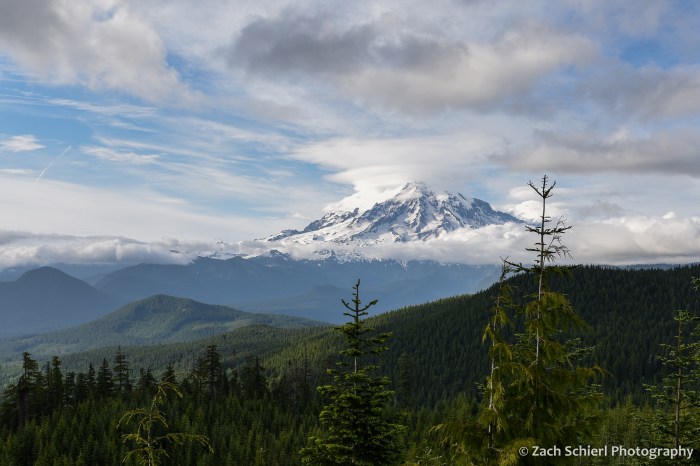
A series of stacked lenticular clouds above Mt. Rainier.

Closer view of the stacked lenticular clouds.
A nearly full moon provided sufficient light for photographing the mountain after dark:

Tahoma bathed in the light of a nearly full moon.
Not to be outdone by Tahoma, the pinnacle of High Rock just to our west also put on quite the show at sunset, with the light of the setting sun casting an amazing shadow of the peak and it’s summit lookout tower on the foreground mists:
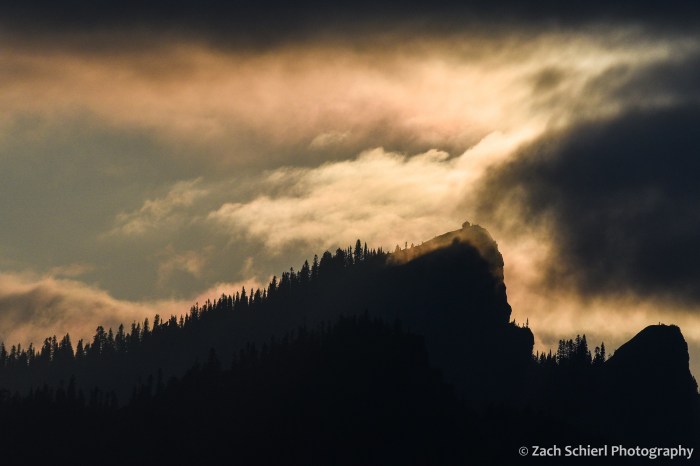
Sunset, High Rock, Gifford Pinchot National Forest, Washington
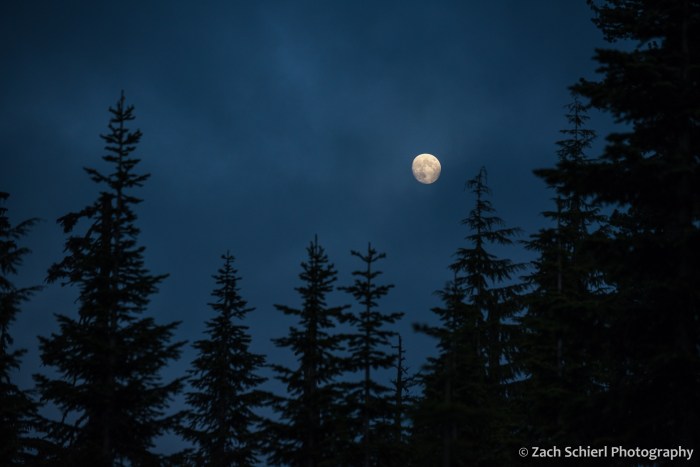
A nearly full moon rises over the forests of the Cascade Mountains.
After this trip and our stunning view of Mt. Adams a few weeks ago, our goal for the summer is now to camp in the shadow of all of Washington and northern Oregon’s stratovolcanoes. Next up: Mt. St. Helens!
Mt. Adams, Mosquitoes, and the Milky Way


Bright Jupiter rises above the summit of Mt. Adams, with the summer Milky Way reflected in the calm surface of Takhlakh Lake, Gifford Pinchot National Forest, Washington.
Mt. Adams is a striking feature of the western skyline from here in the Yakima Valley of Central Washington. Here’s what it looked like from our neighborhood at sunrise a few months back:
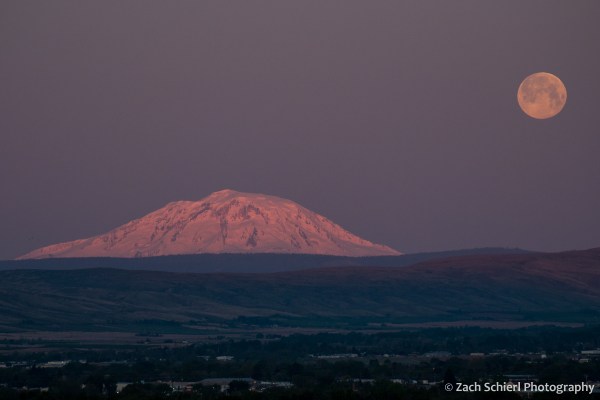
A setting full moon and sunrise light on Mt. Adams as seen from the Yakima Valley.
The towering volcanic cone looks close enough to touch, but in reality, reaching the base of Washington’s second highest peak requires a nearly three hour drive down a labyrinth of Forest Service roads. We’ve been wanting to explore the Mt. Adams area since we returned to Washington last year. With winter’s grip beginning to ease in the higher elevations of the Cascades, earlier this week we finally got the chance.
Mostly clear skies, calm wind, and a dark moon made for some great photo opportunities. While it may be debatable, I think some of these were worth their weight in mosquito bites. Several small ponds dot the lower flanks of Mt. Adams and snowdrifts still lingered in the shadier patches of forest, making the entire landscape somewhat damp. Consequently, the mosquitoes were ferocious! Sadly, our mosquito “repellent” only seemed to attract more. I was quickly reminded that a vastly underrated aspect of living in the southwest is the lack of bugs!

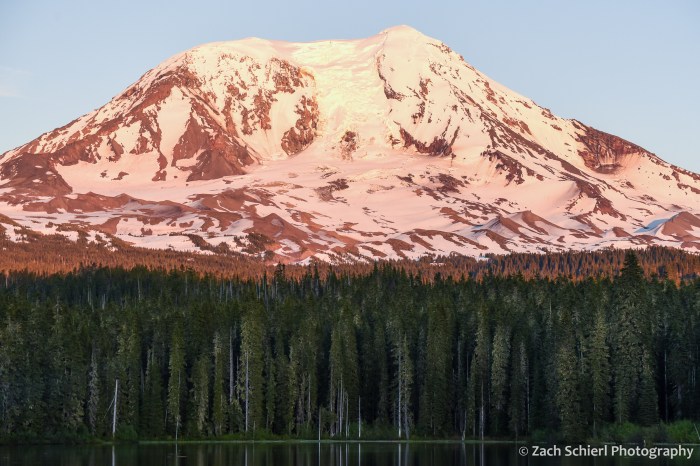
Mt. Adams reflected in Takhlakh Lake, Gifford Pinchot National Forest, Washington. (Not pictured: immense swarms of mosquitoes.)
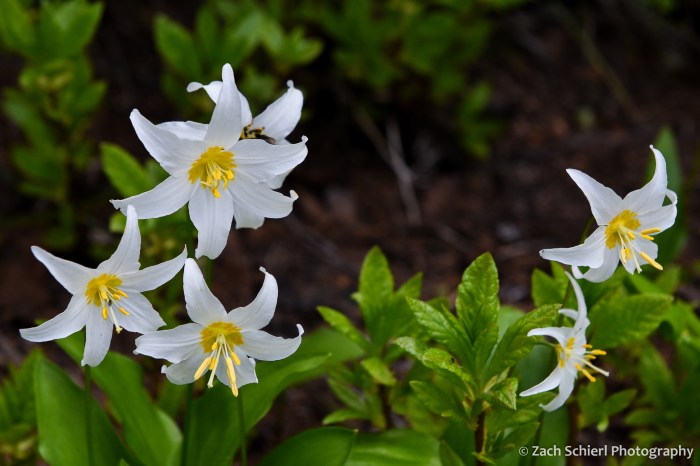
White avalanche lily (Erythronium montanum), one of the first wildflowers to emerge from the swampy ground as the snow melts away.

Mt. Adams reflected in Takhlakh Lake at sunset.
The forests just to the west of Mt. Adams happen to be located nearly in the center of the four large active stratovolcanoes of the south Cascades: Mt. Adams, Mt. Rainier to the north, Mt. St. Helens to the west, and Mt. Hood just across the Columbia River to the south in Oregon. A variety of relatively short but steep hikes in the area ascend lesser peaks, resulting in fantastic views of all four volcanoes, plus the dense forests of the Cascades:
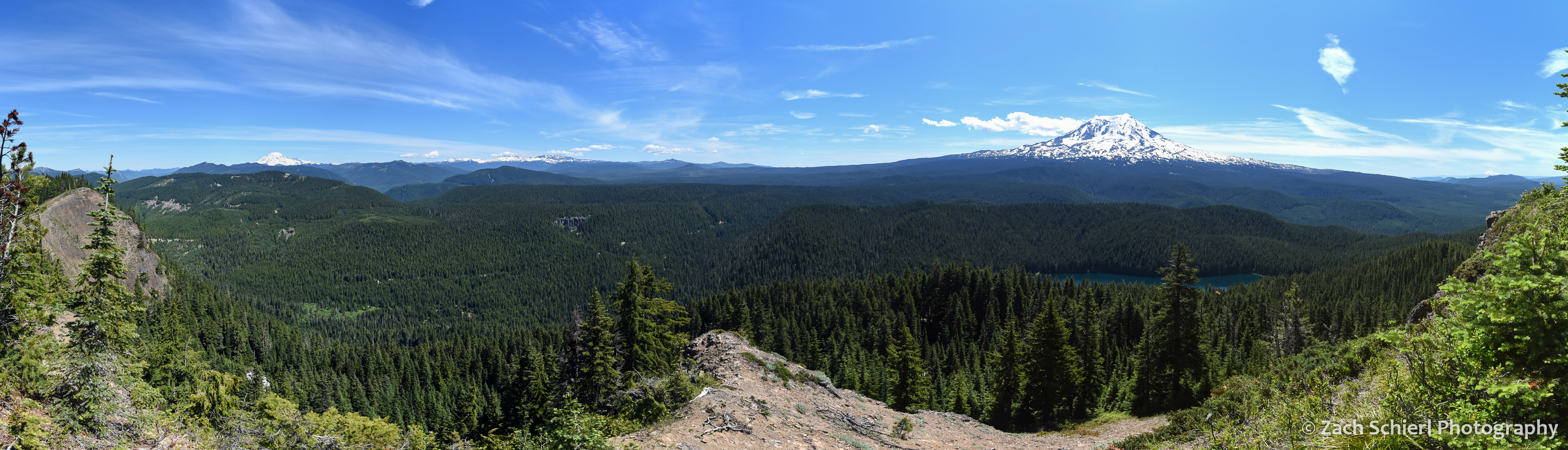
Panorama from Council Bluffs. Three Cascade Range stratovolcanoes (and the remains of a fourth) are visible (click to enlarge): Mt. Rainier (far left), the remains of the Goat Rocks volcano (center left), Mt. Adams (right), and Mt. Hood (far right). The upper portion of Mt. St. Helens’ eviscerated cone was also visible through the trees to the west.
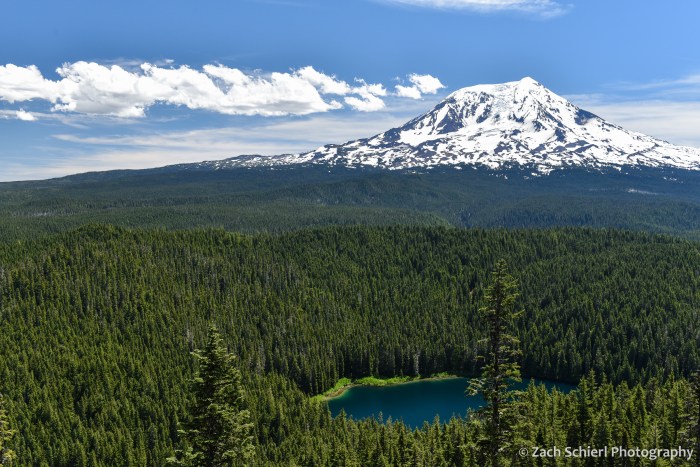
The dense forests on the west flanks of Mt. Adams. Council Lake at bottom.
The real fun came after nightfall. Dark skies are much harder to find in Washington than in Utah, and this was my first good look at the Milky Way since last summer. The calm weather allowed me to capture the Milky Way’s reflection in Takhlakh Lake. Jupiter was kind enough to rise directly above the summit of Mt. Adams. And I got lucky and captured the brightest meteor of the evening in one exposure. This was certainly a case of being in the right place at the right time! (One might argue that the “right time” would have been a few months from now, when all the mosquitoes are dead, but then the Milky Way would not have been positioned so perfectly.)
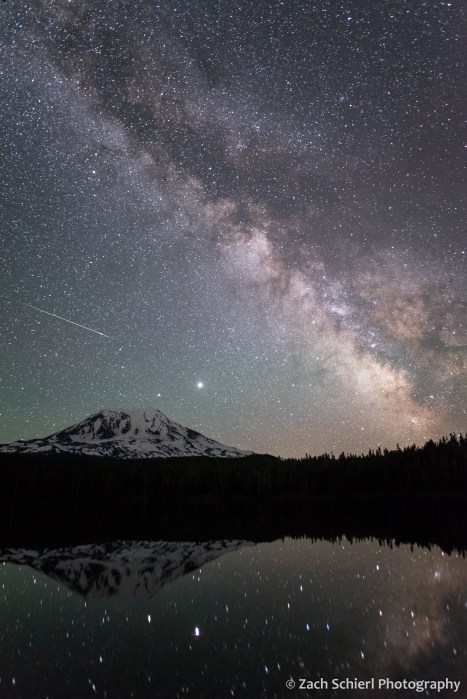
A meteor takes aim at Jupiter as Mt. Adams and the Milky Way are reflected in Takhlakh Lake.

The Milky Way begins to emerge from evening twilight.
 Zach Schierl Photography