A Glacier, a Waterfall, and a Kayak walk into a bar…the Story of Palouse Falls
Growing up in northern Arizona, spring was always an exciting time to finally pack away the snow shovels and de-icer and get outside. If you want to see enough running water in the desert southwest to actually get your feet wet, spring snowmelt season and summer afternoon thunderstorms are pretty much your only hope.
Spring in the Pacific Northwest is similar…except that instead of going from no water to a little water, we go from a decent amount of water to A LOT of water. Nowhere is spring runoff more apparent than 187 foot high Palouse Falls, which is about 1-2 hours (depending on your driving speed) north of Walla Walla, on the Palouse River just upstream of its confluence with the Snake River.
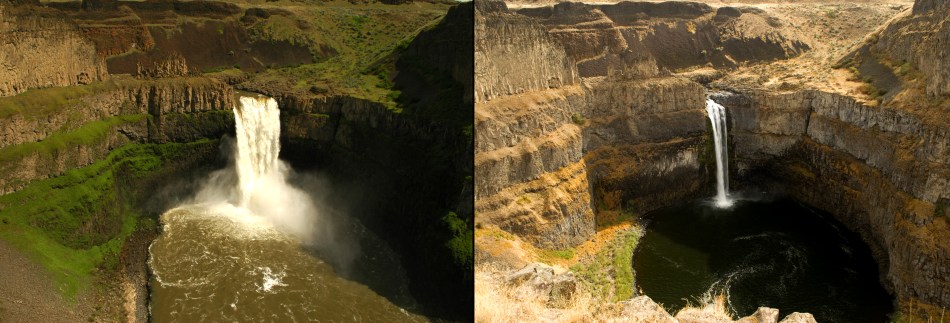
Palouse Falls in May (left) and September (right).
Normal people think lots of different things when they see Palouse Falls, among them “How do I get down there?”, “Wow, that’s pretty!”, “Where’s the snack shop?”, and “I really need to go to the bathroom after driving down that really bumpy, windy road”. All perfectly legitimate. Other people however see a kayak jump.
Palouse Falls garnered some attention in recent years when it became the site of the worlds largest kayak waterfall descent. In case that didn’t sink in, let me reiterate: someone paddled over that thing in a KAYAK.
As someone who has expertly piloted a kayak over 6″ riffles on the Palouse River below the falls, I can tell you that this is an impressive feat. Palouse Falls is nearly 200 feet; ants may be capable of surviving a fall off the kitchen counter but we aren’t designed to do such things. Just look at this picture.
If that was me, the discharge of the falls would be spiking dramatically right then due to the amount of bodily fluids I would have been emitting our of sheer terror.
The falls were formed by an phenomenon that comes in at #1 on our list of “Geological Terms That Make You Sound Like An Idiot If You Pronounce Them Correctly”: a jökulhlaup. If you are Icelandic, you’ll need no pronunciation guide. For the rest of you, that’s “yo-cooool-HOIP”. Once again, that’s “yo” as in the famous cellist Yo-Yo Ma, “coooool” as in “coooool Razor scooter man!”, and “HOIP” as in “House of International Pancakes.”
Now that we’ve got that squared away, lets set the scene: imagine you are an ice sheet, specifically the vast Cordilleran Ice sheet that covered the northern half of the North American continent during the last ice age. The climate is starting to warm; the mammoths are starting to die and those pesky humans are starting to increase in number. As the temperatures slowly increase, you start to feel a little sweaty and you begin to melt and retreat northwards to more suitable weather. All that glacial meltwater is getting funneled into river canyons that were cut tens of thousands of years earlier and are just now being uncovered by the retreating ice sheets. Even as a retreating ice sheet though, you will likely have a few appendages (called lobes) that reach several hundred kilometers south of the main ice front. These lobes block some of the river channels, forming a barrier that impedes the river’s progress. Massive quantities of water back up behind the ice dam, creating lakes larger than several of the Great Lakes. Remember though, you are a big piece of ice, and what does ice do in water? It floats. Once the lake becomes large enough, your appendages are no longer strong enough to maintain contact with the bottom of the canyon. The entire ice dam begins to rise slightly in the water, opening a seam at the base of the dam through which water begins to rush, eating away at the dam from underneath. Eventually, undermined by the water, the entire ice dam catastrophically collapses, draining the entire lake in a matter of hours and sending thousands of square kilometers of water rushing across the landscape. That’s a jökulhlaup. After the ice dam is blasted away, you, the glacier, slowly flow back down into the canyon over the next few years, creating a new dam and lake and starting the process all over again.

Palouse Falls cascades over basalt flows from the Columbia River Basalt Group

Rock formations near the brink of the falls
Anthropomorphized geologic features notwithstanding, this actually happened…at least 40 separate times at the end of the last ice age, from about 15,000 to 13,000 years ago. The river was the Clark Fork of the Columbia River, the ice dam was located near Lake Pend Oreille, Idaho, and the lake was glacial Lake Missoula, which stretched from northern Idaho almost all the way to Yellowstone National Park. The ice dam collapsed every few hundred years, sending a Lake Erie’s worth of water rushing down the Columbia River, across what is now Eastern Washington, all the way to the Pacific Ocean.
Look at what happens to your yard after a big storm and you know it doesn’t take that much water to carry out some significant erosion. Palouse Falls is located in one of thousands of scour marks, known as “coulees,” that were gouged out of the basalt bedrock of Eastern Washington by the force of these floods.

The Palouse River just upstream of the falls
Back to the Northwest: the Land of Homework and Geology
Yes, I am still alive. Although I imagine that someone who wasn’t would have marginally more time to attend to a photo blog than I have over the past few months. Between a full class schedule, 15 or more hours of work a week, writing a thesis, and occasionally taking time to interact with other human beings in a social setting leaves sadly little time for photo editing and blogging. But now that the annual bundle of happiness that is the four days off from school offered by Columbus Day weekend is here, I find myself with free time (gasp!) and no shortage of photos to sift through from the past several months.
My most recent excursion was the 4-day whirlwind of turtle tops, rock hammers, marshmallow volcanoes, humorous jokes, campfires, burritos, and all-around general merriment that is our bi-annual Regional Geology field trip. This year we made a circuit through central Oregon to look at the ancient Cascade volcanoes and some of the best preserved fossil beds in the world. Rather then bore you with my umpteen pictures of rock outcrops with my lens cap or pencil in them for scale, I’ll share the ones that show why trips like these are the biggest perk of being a geology student:

Smith Rock State Park, Oregon: a rock climbers paradise and caldera of an ancient supervolcano.
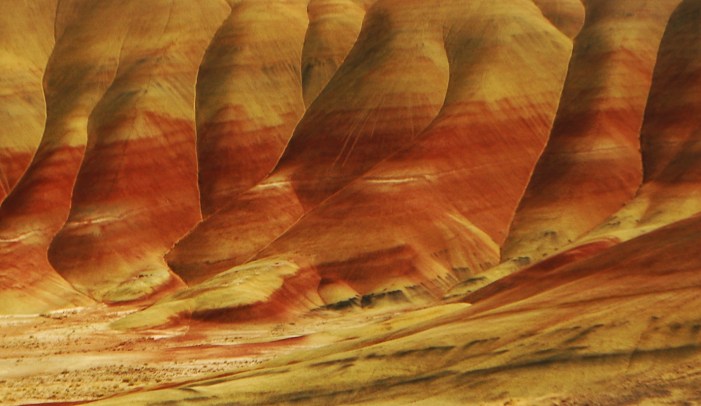
Preserved ancient soils in the Painted Hills, John Day Fossil Beds National Monument
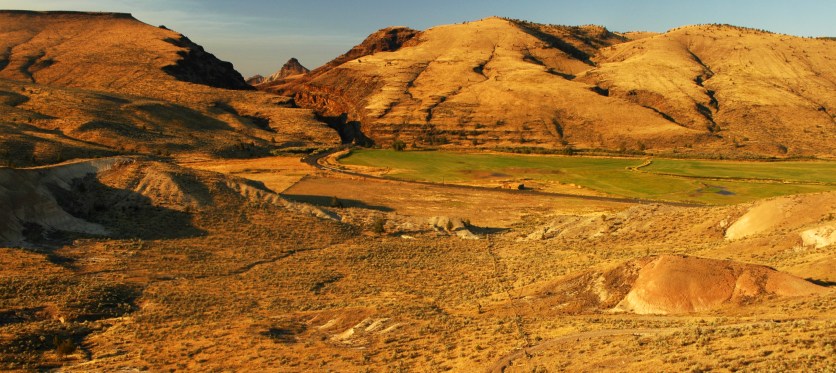
Mescall Overlook, John Day Valley, OR
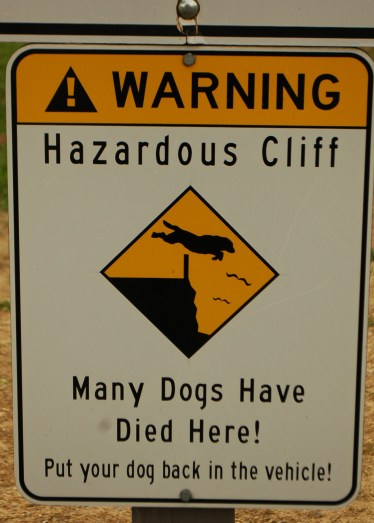
Dogs in Oregon apparently like chasing flying moustaches...who knew?!

Thick lava flows beneath the US 97 Bridge over the Crooked River, near Bend, OR

My big fossil find of the weekend: ammonites native to Asia plastered onto North America via plate tectonics!
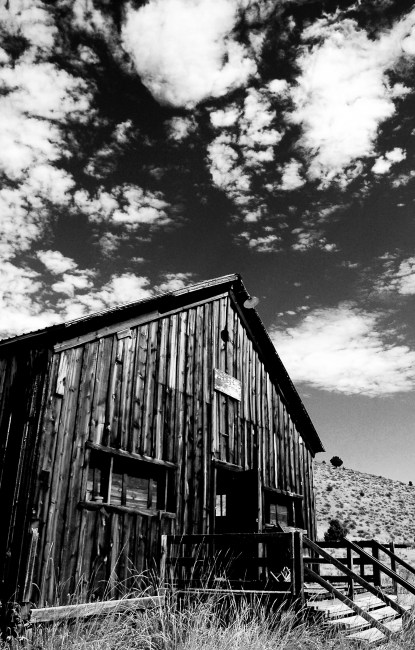
Community Hall in Izee, OR
P.S. For those of you stumped by the marshmallow volcano reference, watch this to see what to see a geology department tradition and learn what happens when you stuff several bags of marshmallows inside an empty beer can. Yes, this is how geologists entertain themselves.
Geology Research in Paradise
I have decided that there are few things in this world as gratifying as going for a swim on a tropical beach at sunset after spending all day in the field hiking over boot-shredding, leg-puncturing, sunburn inside your nostrils-inducing, lava flows. Such pleasures occur when one has the opportunity to do geology field work in Hawaii for a week, as I had the fortune of doing this past week as part of my senior thesis project. Oddly enough, I’m not actually studying Hawaii, but rather water and lava flows on Mars (more on that in a bit). However, since present-day Mars experiences very little in the way of surface erosion, many of the lava flows there look as fresh as the day they were erupted hundreds of millions of years ago. Since a field trip to Mars was a bit over the budget for this project (darn government cutbacks…), we instead must resort to trying to find places on Earth with fresh, unaltered lava flows in order to compare, contrast, and understand what we see on Mars. Hmm…I wonder where could I find some of those?

Hawaii in a nutshell: palm trees growing out of lava flows
Ah yes, Hawaii will do quite nicely, now won’t it? As luck would have it, Kilauea (the main active volcano in Hawaii) is currently going through a relatively dormant phase. When I visited Hawaii back in 2008, it obligingly started spewing massive quantities of lava into the ocean a few weeks before our arrival:
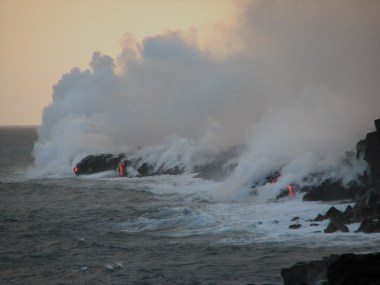
Kilauea lava flows, circa 2008

No such luck this time. This and this happened a few months ago and the volcano’s magma reservoir and crater has been slowly refilling ever since. (Seriously, watch the videos. And keep in mind that the 1st one takes place over the course of just 24 hours.) A geologist with the Hawaiian Volcano Observatory told us he though there was a decent, but not great, chance of an eruption during our time there but despite our sacrifice of several geology students to Pele, that never materialized. We did however get to see the main vent of Kilauea glowing bright orange at night due to a molten lake of lava lying about 150m beneath the surface:

Halema'uma'u Crater at night
Even if my childhood dream of roasting marshmallows over hot, molten, lava once again went unfulfilled, that sure as heck isn’t something you see everyday.
Anyways, from our base at the Apapane Lodge in the tiny settlement of Volcano, HI, we (myself, three other students, and two geologists) spent much of our time hiking across young (<200 years in most places) lava flows looking at features such as lava tubes, vents, channels, and collapse pits trying to decipher features that we see on Martian volcanoes. More specifically, the project I am involved in seeks to determine what causes features like this on Mars:
Conventional wisdom says that such features are formed by water, and especially since the Mars Exploration Rovers uncovered chemical evidence that water existed on Mars at some point in the past, this has been the prevailing view for some time. However, lava is capable of doing some very weird things and more recent work has shown that many of the features that have long thought to have been formed by water are more likely the work of lava flows. So why do we care? If this is indeed the case, it has serious consequences for our understanding of Mars as a whole. The presence of channels such as this one has long been one of the key pieces of evidence supporting the idea of flowing water on Mars in the past. If instead these features were formed by lava then we have a lot of questions to ask ourselves, most importantly: Did flowing water ever exist on the surface of Mars in large enough quantities to carve such channels? Water, of course, is the key to life (at least that’s what we think…) so figuring out if water flowed on Mars in the past (and if so, how much) is essential for understanding how planets evolve over the long term and for determining if life ever existed on Mars. The role of water on Mars is also important from a practical standpoint as we try to determine if Mars is potentially a habitable planet for humans in the future.

A typical scene in the field. This is a channel within a large lava flow thought to be analogous to some of the channels we see on Mars. On a side note, I never thought it was possible to completely destroy a perfectly good pair of hikin boots in just four days. Hawaii's infamous "a'a" lave like this proved me very wrong.

Younger lava flows pour into a channel formed by the collapse of an old lava tube

The team after a tour of the Hawaiian Volcano Observatory

When you see signs like this, you know you're having fun!
As sad as it was to leave Hawaii, the trip “home” was even less fun. Given that I arrived in Washington D.C about 10 hrs later than planned and sans any clothing apart from what I was wearing, I hereby nominate American Airlines for the “Worst Airline in the Universe” award. In addition, when I finally did get my luggage returned this afternoon, all my outdoor gear and camera equipment were intact but all but three of the rock samples I collected in Hawaii (NONE of which were from the National Park before anyone starts harping on me…) were missing. Explain that one to me…

Mauna Loa (left) and Mauna Kea (right background) at sunrise from Kilauea Summit
 Zach Schierl Photography