Exploring the Earth and Sky of the West

Latest

Alaska (Part One)

A cluster of bright pink wildflowers growing in a gravel bar along a river

Dwarf fireweed (Chamerion latifolium) along the banks of the Toklat River, Denali National Park, Alaska

A highlight of summer 2019 was a hastily arranged trip to Alaska at the end of June and beginning of July. With a summer of unemployment (translation: freedom) looming, we obtained surprisingly cheap tickets from Seattle to Anchorage and then rented a car for a two week journey around the state.

It was a fun yet somewhat strange trip, for a number of reasons. For one, Alaska was experiencing record high temperatures (90 degrees F in several places that we went) and extensive wildfires during our visit. Two words that summarize the trip would be “hot” and “smoky”. We were prepared with a LOT of warm clothes and rain gear and used hardly any of it.

We were not mentally prepared for the omnipresent light. Even though we never ventured above the Arctic Circle, and thus the Sun did technically set each day, it did so only for a few hours between about midnight and 3 am, never getting far enough below the horizon to result in true darkness. It’s one thing to know in your mind that it won’t get dark out, but another another to actually experience it. It’s even more disorienting when you are sleeping in a tent or the back of a Subaru Outback most nights. I hadn’t really considered (again, a hastily arranged trip…) the photographic implications either. With the ideal light for photos coming in around 11 pm-midnight and 3-4 am, it was hard to be out and about at the “golden hours” while also taking advantage of the few pseudo-dark hours to actually sleep.

Anyways, after a day of stocking up on supplies and food in Anchorage (I’m told there is a gorgeous mountain range at the edge of town, but we never really saw it), we headed north to our first stop: Denali National Park. We were fortunate enough to catch a distant and smoky view of Denali itself as we approached the park. While we would be much closer to North America’s highest mountain later in the trip, we wouldn’t see it again.

View of snowy peak through a layer of smoke

Denali, the highest point in North America, seen through the smoke from Denali State Park.

Denali National Park is unique in that, while a road does exist, you can’t take a private vehicle into the heart of the park. Travel along the main park road is on foot or via concessionaire-operated school buses. We opted for the cheapest bus option, the “un-guided” tour that allows you to get off the bus pretty much where ever you want in order to have a look around. We took the bus into Denali on two consecutive days, made a few short forays on foot into the backcountry, and explored some of the maintained trails near the park entrance:

Gray clouds hover over a landscape of scattered trees and shrubs

A roadside scene in Denali National Park, Alaska
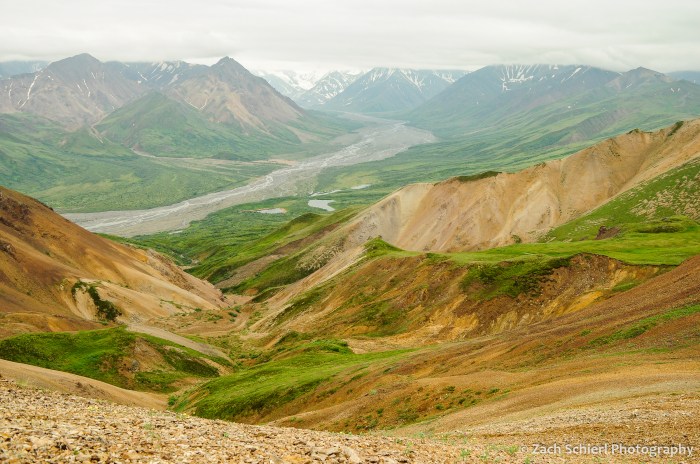
A landscape of barren rock, green vegetation, and distant glaciers and snowy peaks

View of the Teklanika River Valley and Alaska Range, Denali National Park, Alaska

A landscapce of brown and red rocks and soil, and green vegetation

Oxidized volcanic rocks of the Teklanika Formation on the slopes of Cathedral Mountain, Denali National Park, Alaska
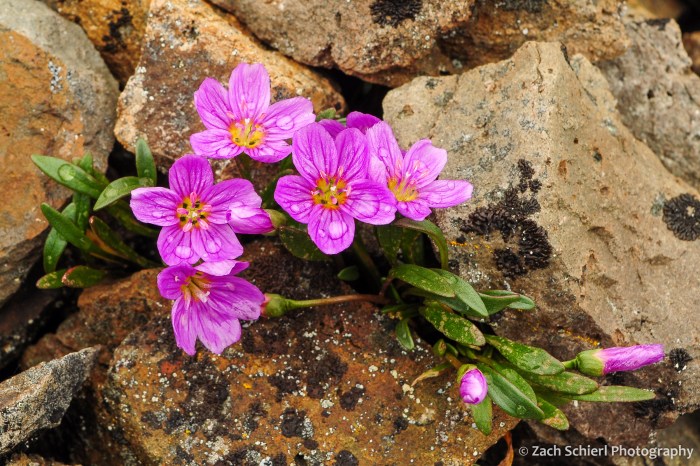
Bright pink wildflowers growing on a rocky slope

Scammon’s springbeauty (Claytonia scammaniana) clings to a rock slope on Cathedral Mountain, Denali National Park, Alaska

A river flows through rocky crags, as someone stands on a bridge over the river

Exploring a trail along the Savage River, Denali National Park, Alaska

A caribou stands alongside a river flowing out of a snowy mountain range

A caribou grazes along the banks of the Savage River, Denali National Park, Alaska

Aside from the geological scenery, Denali is also crawling with wildlife. I can emphatically say that the bus makes for a pleasant and safe place from which to observe grizzly bears, caribou, moose, and other potentially threatening organisms at close range. A few of the wildlife encounters we had off the bus were decidedly less enjoyable.

Three grizzly bears amble in a field of green grass

Three damp grizzly bears in a grassy meadow, Denali National Park, Alaska. Photo taken from the bus. 

Three moose forage in a pond

Three moose browse the bottom of a shallow pond, Denali National Park, Alaska. Not a bus photo, but we were at the top of a hill several hundred feet above the pond. 

Several white sheep clamber among a cliff of rocks

Three Dall sheep (Ovis dalli) scramble on rocky cliffs high above the Denali Park Road. 

A tourist stand alongside a river scanning the mountains with binoculars

One human (Homo sapiens) observes the previously pictured Dall sheep (Ovis dalli) through binoculars.

After four days in Denali, our rental car no longer possessed a complete set of safe and functional tires, resulting in a new rental car and an unscheduled detour to Fairbanks before our next destination: Kennecott and Wrangell-St. Elias National Park. Until next time!
Sands and Sage in Central Washington

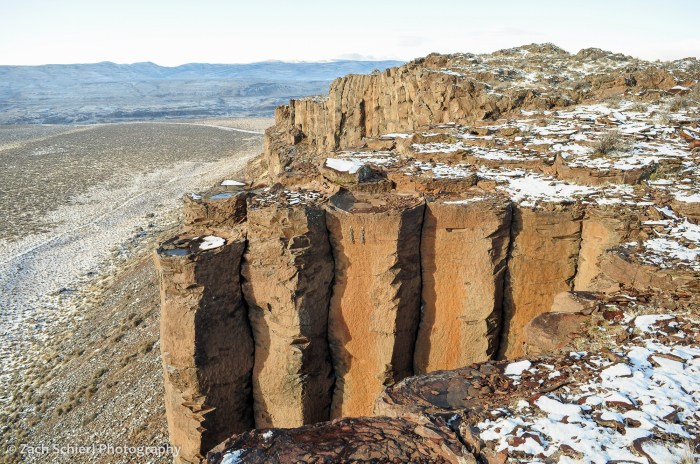
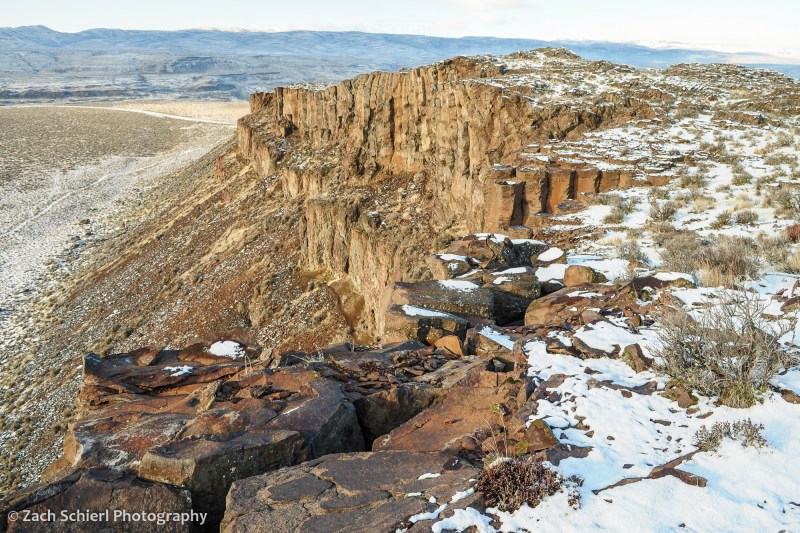
A cliff of basalt with patches of snow

Layers of basalt form the rim of Echo Basin, a large coulee in central Washington.

Apparently a global pandemic is what it takes for me to have time to post new photos. We are thankful to be healthy and safe here in Washington and hope you are as well. Just before things started getting rough, we were excitedly welcoming the end of winter’s icy gray grip and had begun exploring the desert landscapes of central Washington.

The Pacific Northwest may not be known for its sand dunes but about one hour north of the Tri-Cities (Kennewick, Pasco, and Richland) lies the Juniper Dunes Wilderness Area, a ~7,000 acre BLM-managed anomaly in the middle of privately-owned central Washington farmland. The dune field itself extends well beyond the wilderness area, and is used heavily by off-highway vehicles. Most of the year, reaching the wilderness area on foot requires a several mile sand slog through the OHV area. Fortunately, in the spring months, the owners of an adjacent ranch allow access through their property, permitting direct and quick access to the heart of the dune field.

Puffy white clouds over a field of sand dunes covered in sagebrush

Large swaths of the Juniper Dunes are mantled with sagebrush and grasses, as well as some of the northernmost juniper trees in North America.

I first visited the Juniper Dunes on a geology field trip a decade ago and it is been on my list of places to revisit ever since. The dunes are a mix of active, shifting, barren sand, and partially stabilized dunes covered in grasses, moss, and sagebrush. The area also represents the northernmost extent of the western juniper (Juniperus occidentalis), a few of whose berries will be proudly featured in an upcoming brew from the Pyroclastic Pixels brewery. 🙂

Ripples in a sand dune, grasses, and clouds

Juniper Dunes Wilderness Area, Washington

During our visit at the beginning of March, the first vestiges of spring were appearing: namely, abundant sunshine and a handful of small wildflowers poking their heads out of the sand:

Tiny bell shaped yellow and red flowers poke up out of the sand

One of the first wildflowers of the season, Yellow Fritillary (Fritillaria pudica), poking through the sand.

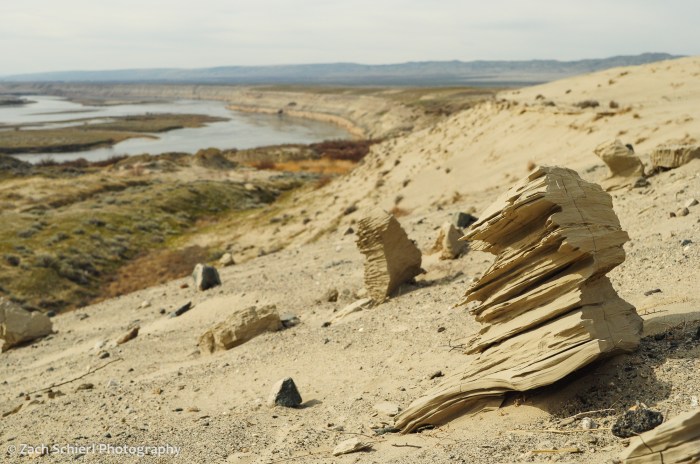
A few weeks later, and just a few days before a statewide shelter-in-place order took effect, we “socially distanced” ourselves by heading to the White Bluffs, a several mile-long stretch of chalk-colored cliffs along the banks of the Columbia River directly across from the Hanford Site. Part of the Hanford Reach National Monument, the bluffs are a mixture of fine sediment, some deposited by the ancient Columbia River itself, and some by massive floods that swept across central and eastern Washington during the last “ice age” 12,000 to 18,000 years ago. Persistent winds scour loose sand from the cliffs and associated landslides, depositing it in a large dune field along the crest of the bluff.

Rocks sculpted by the wind sit on the ground with a view of a large river in the background

Wind abraded chunks of sediment rest on the ground with the Columbia River in the background.

White, chalky cliffs above a river

The White Bluffs, Hanford Reach National Monument, Washington

White, chalky cliffs above a river

Cliffs and sand dunes, Hanford Reach National Monument, Washington

The aforementioned floods shaped much of the modern topography of central and eastern Washington. One of the most spectacular features formed by these floods are the broad, steep-sided ravines known as coulees. Formed when floodwaters aggressively plucked large columns out of the basaltic lava flows that blanket much of the Pacific Northwest, most of the coulees are eerily dry today and not until the 1920s did geologists unravel their true origin. Two of the most impressive and easily accessible are Frenchmen Coulee and Echo Basin, just off of I-90 between Seattle and Spokane. Crammed with rock climbers in the good weather months, in mid-January when we visited we had the coulees almost entirely to ourselves:

A cliff of basalt with patches of snow

Large hexagonal columns of basalt along the rim of Echo Basin, a popular site for rock climbing…in the warmer months!

A vista looking out across cliffs and grasslands toward a mountain with wind turbines on top

Looking west from Frenchman Coulee and Echo Basin toward Whisky Dick Mountain and the Wild Horse Wind Project.

More photos to come from the 2019 archives! I’ve also been working on creating a more comprehensive “Galleries” page where you can view my photos sorted by location. Check it out here.

Glacier National Park: Grinnell Glacier Trail

With one job ending in June and the next not starting until September, we spent most of this past summer on the road. It’s now mid-October, and I’m finally getting the chance to seriously sort through the resulting pictures.

Our last big stop of the summer was Glacier National Park in Montana and neighboring Waterton Lakes National Park in Canada. Glacier was one of the few remaining national parks in the west I had yet to visit, so I was excited that we were able to squeeze this trip in. Despite uncharacteristically foul weather for mid-August, a harrowing experience on the park shuttle bus, campgrounds with problem bears (and problem campers), and an unscheduled detour to an auto parts store in Cardston, Alberta, we managed to get in 60+ miles of hiking among some truly first-class scenery. Our most memorable hike was the trek to Grinnell Glacier in the northeast corner of the park. Here are a few photos from that journey:

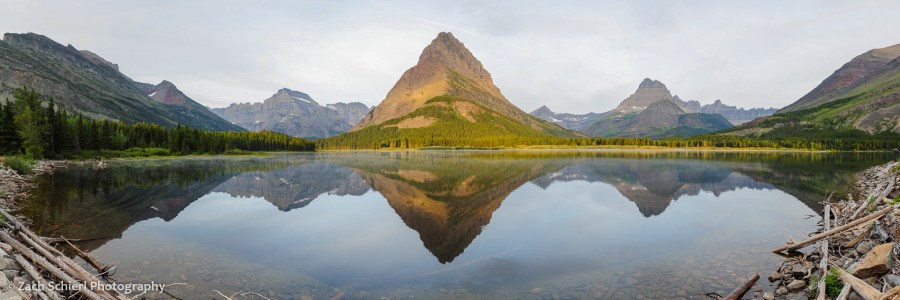
A series of sharp mountain peaks are reflected in a tranquil lake at sunrise.

Sunrise light on Mt. Grinnell, reflected in the tranquil waters of Swiftcurrent Lake, Glacier National Park, Montana.

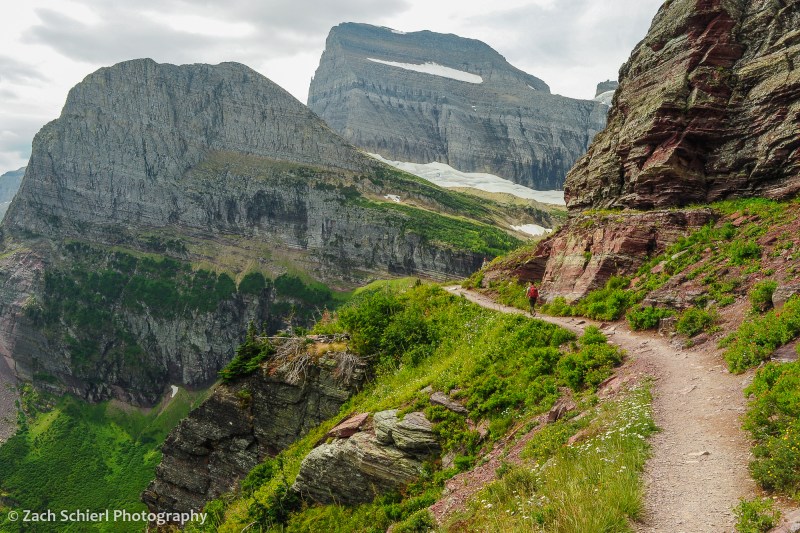
A hiker climbs a steep trail surrounded by green vegetation and wildflowers with large mountains in the background.

Hiking through the redbeds of the Grinnell Formation on the way to Grinnell Glacier. The Grinnell Formation, part of the Belt Supergroup, is a ~1.5 billion year old unit of sedimentary rock that preserves ancient ripple marks, mud cracks, rain drop imprints and more in its maroon layers. 

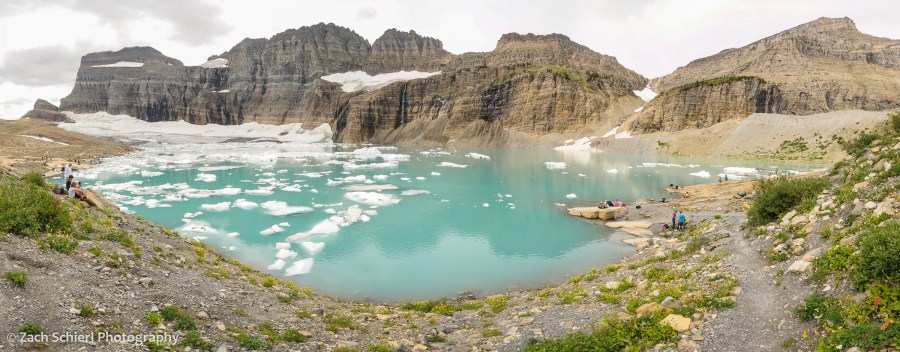
Cliffs of rock surround several glaciers and an azure-blue lake containing numerous icebergs.

Panoramic view of Grinnell Glacier (left) and Upper Grinnell Lake. The lake has existed only since the 1930s. In the early 1900s, Grinnell Glacier filled the basin now occupied by the lake, at one point depositing the sediment in the moraine the photographer is standing on. Today, only a small piece of Grinnell Glacier remains. As temperatures have warmed, the glacier has retreated leaving Upper Grinnell Lake in its place. The milky blue-green color of the lake is due to finely powdered rock (“glacial flour”) suspended in the water.

Gray cliffs of igneous and sedimentary rock tower over a aquamarine lake filled with icebergs

Cliffs of dark gray limestone belonging to the Helena Formation tower above Upper Grinnell Lake. The thin band of darker rock cutting horizontally across the cliffs is an igneous sill, formed when magma intruded along a plane of weakness in the limestone and then solidified. The lighter rock immediately above and below the sill is marble, created when the hot magma “cooked” the limestone into which it had intruded.

Dark clouds loom over a range of mountains and an azure-blue alpine lake

A thunderstorm approaches over the Garden Wall on the descent from Grinnell Glacier. This was the final photo I took on the hike. We spent most of the next hour running the several remaining miles back to the trailhead as thunder and flashes of lightning exploded behind us.

A bighorn sheep stands amongst vegetation with a glacier in the background

A bighorn sheep (Ovis canadensis) alongside the trail, with Grinnell Glacier in the background.