Mt. Shuksan in High Resolution
Introducing Mt. Shuksan:

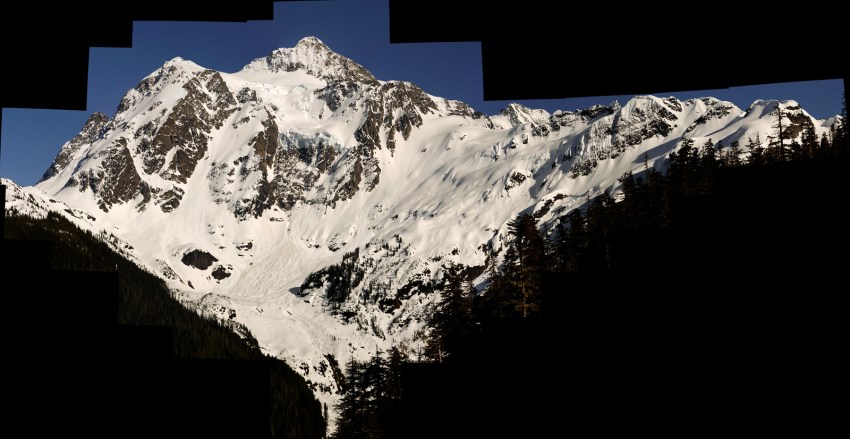
This image strip is just a small part of a 45 shot, 550 megapixel panorama I recently took of Mt. Shuksan from the Mt. Baker Ski Area. Since WordPress doesn’t offer me a way to display a picture of this size at full resolution, I’ve uploaded a (nearly) full resolution version of the image to GigaPan.com and included a link below (just click on the photo). There are lots of cool features that you can see if you play around with the image and zoom in; such as the terminus of the aptly named Hanging Glacier just below the summit peak, lots of cornices along the summit ridge, innumerable avalanche tracks, some really interesting linear and polygonal features in the snow (developing avalanche scarps?) and even some waterfalls and the entrance to an ice cave!
This was the first time I had made a panorama of this size and resolution. Photoshop’s Photomerge feature (which I n0rmally use for panoramas) had trouble handling so many images so I ended up using a free program called Microsoft Image Composite Editor to stitch and blend the images together. While this program doesn’t allow for editing of the final panorama, I was able to easily export the composite image and make minor adjustments to contrast and brightness in Photoshop. The individual frames were shot in RAW mode using a ball-head tripod and a 200mm zoom lens on a Nikon D90. Exposure settings were set manually and kept mostly constant in order to facilitate seamless integration of all 45 images.
Click the image below to explore the GigaPan:
An Ode to Waterfalls, or “Why I’m Never Moving to Delaware”

Nooksack Falls, Whatcom County, Washington
Composite of three images, 18mm, 4 sec, ISO 200, f/20, two-stop neutral density filter
The last week and a half has been rather pleasant here in the northwest. Most noticeably, the Sun has been out. The trees are finishing the process of filling out their summer foliage. Snowpack in the Cascades is melting rapidly. So in other words, hillsides that are normally green have gotten a little brighter-green. Rivers that are normally filled with water now have more water. People that are normally pasty white are now a little less pasty white. And finally, waterfalls that are normally impressive have gotten more impressive, as is evident by the above photo which I took at Nooksack Falls, about an hour’s drive east of Bellingham, last weekend. I’ve realized recently that I’m sort of a sucker for waterfalls. I won’t go into all the reasons but I tend to be a sucker for most things that are ruthlessly effective at converting potential energy into kinetic energy. It turns me on. If I’m driving and see a sign for a waterfall, I’m probably stopping, even if accessing it requires a 15-mile round-trip hike and my passenger has to be at the airport in an hour. You just have to admire water’s blatant disregard for personal safety as it routinely plunges tens, hundreds, or even thousands of feet before slamming into some poor boulder at its base that has sat absorbing a ruthless pounding for what must, at least to the boulder, seem like an eternity.
I love photographing waterfalls almost as much as I like the falls themselves. The day I discovered that, by simply stopping down the lens on my camera far enough, I could render almost any flowing mass of water smooth, silky, translucent, and white was probably one of the most crucial days in fueling my severe photography addiction. Waterfalls were my gateway drug you might say. I’ve accepted this addition and am no longer in denial but thankfully I don’t see a recovery in my immediate future, although my wallet may beg to differ.

Grand Falls, Little Colorado River, Arizona
I love waterfalls in part because they exhibit so much diversity and character. Waterfalls in Arizona might only run a few days out of the year, their water looking more like molten chocolate straight out of Willie Wonka’s chocolate factory when they do, the result of enormous quantities of suspended silt, sand, and debris pried loose from stream channels that may go many months without tasting a drop of water. Waterfalls in Washington are, for the most part, year-round affairs, impressive primarily in their persistence. (Except for on Mt. St. Helens where volcanic heat accelerates snowmelt leaving most streams, and backpackers who depend on them, high and dry. Ask me about that one sometime…). Even in the fall, the waterfalls seem to run as if they are tapping into some mysterious underground source of water (hint: they are) that keeps them replenished even after the rainy season has passed. The mighty waterfalls of Yosemite and the Sierra Nevada are the bullies of the waterfall world, tall, stocky, aggressive, and so powerful in their flow that they dare you to approach them without eight layers of waterproof clothing, a rowboat, and a bilge pump. They hit you in the face (literally), knock you down, and leave you lying bloodied on the cold granite, that is until summer when they shrivel to merely a trickle or disappear altogether.
Geologically speaking (hopefully I didn’t lose anyone there…), waterfalls are generally indicative of youth. This is because any waterfall worth its salt and pepper will eventually destroy itself; the constant force of the water flowing over the abrupt edge will eat away at the rock forming the brink of the falls, no matter how resistant it might be, moving it farther and farther back until eventually only a flat reach of stream remains. Locations where geologic conditions are causing, or have recently caused uplift of the land are more conducive to waterfall generation. In fact, the states of North Dakota and Delaware, both in relatively quiescent portions of the continent, are the ONLY two states in the U.S. that lack a single USGS mapped waterfall. Now let’s remember that a lot of waterfalls don’t show up on official USGS quads, and naturally both North Dakota and Delaware CLAIM to have waterfalls, so as to not lose out on the lucrative waterfall tourism market. However I have to say that while North Dakota appears to have a solid case, Delaware’s evidence is unconvincing. It’s really sort of embarrassing if you think about it. Heck, even Florida has a few pretty nice looking waterfalls and we all know that Florida is about as flat as a pan-fried fritter.
I’ve posted lots of waterfall pictures on this site in the past (like here, here, here, here, and here) but last week’s outing inspired me to reach back into my archives and pull out some of my favorite unpublished waterfall photos from the past few years:

Havasu Falls, Grand Canyon, Arizona

Upper Calf Creek Falls, Grand Staircase-Escalante National Monument, Utah
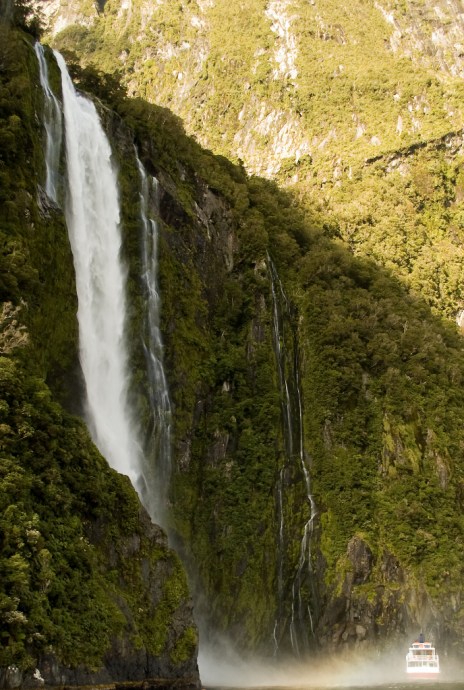
Stirling Falls (tour boat for scale), Milford Sound, New Zealand
Starfish. Starfish Everywhere!
Twice a month, the positions of the Sun, the Moon, and the Earth all lie in a straight line. It is during this time that we see the Moon as either “new” or “full”, depending on whether the Moon lies between us and the Sun, or we between the Sun and Moon. Never content with a simple geometrical description, astronomers call this alignment of celestial bodies a syzygy, a word that surprisingly will net you just 21 points in Scrabble given that it requires a worthless blank tile in order to play. While a syzygy’s effect on your board game exploits may be negligible (unless you manage to plunk that “Z” down on a double letter score and the final “Y” on a coveted triple word score…in which case, whoa! You’re up to 93 points and the game is most assuredly yours to lose!), the effect of such an alignment on our planet is actually quite pronounced. The gravitational fields of the Sun and the Moon exert an attractive force on us; the difference in the magnitude of this attraction on opposite sides of the Earth is, in part, what gives rise to the phenomenon we know as tides (for an explanation longer than two sentences, I refer you to NOAA). During a syzygy, the force from the Sun and the force from the Moon are aligned, with the result being that the range in tides we observe is larger. In other words, high tides are higher. Low tides are lower. And when low tides are lower:

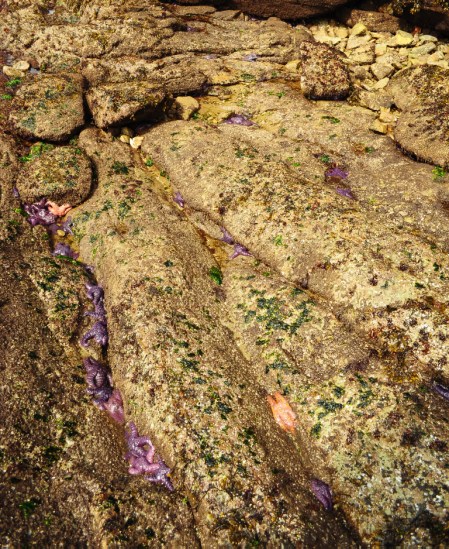
You can’t quite see them all in this photo, but by my count there were about five dozen starfish visible in the field of view when I took this photo. The first syzygy of March 2013 provided me with some abnormally low, mid-day low tides and consequently the opportunity to photograph the plethora of starfish that call Larrabee State Park just outside Bellingham home. During typical low tides, such as the ones we get when the Sun and Moon are at right angles to each other and their gravitational pulls partially cancel each other out, most of these starfish are comfortable below sea level. Even then, a little searching will undoubtedly reveal a handful of starfish clustered beneath rocks or under piles of slimy, green, washed-up seaweed. But when the tide drops below the typical low tide level, the most common starfish in the area, Pisaster ochraceus, the purple or ochre sea star, is literally EVERYWHERE. The quantities can actually start to make you feel somewhat threatened until you remember that starfish move at like 0.0003 miles per hour and have something called “tube feet”. As you can see, the starfish tend to cluster in cracks and crevices within the rock. This is annoying because the cracks and crevices are about the only place you can put your feet without running the risk of losing your footing and smashing your skull open on the sandstone and exposing your brains for the seagulls to pick at, given that most of the rock is covered in slick seaweed that makes banana peels look like coarse sandpaper when it comes to the degree of traction provided.
Pisaster ochraceus comes in three different flavors…err, I mean colors. The purple stars dominate, but orange and pink individuals are not uncommon. I was able to locate one extremely diverse constellation of starfish (I have absolutely no idea what the collective noun for starfish is, but it would be pretty cool if it was “constellation”…) hanging out under a rock:

The wide range of color variation exhibited by Pisaster ochraceus.
I never cease to be fascinated by the robust rigidity of starfish. The purple ones in particular look like they should be nothing more than wet, sticky, gelatinous blobs of silly putty, but alas you can’t even copy newsprint with them, much less mold them into an sphere, which is the ACTUAL shape of a star—that is unless the star is rotating rapidly, in which case its shape may be more closely approximated by an oblate spheroid.
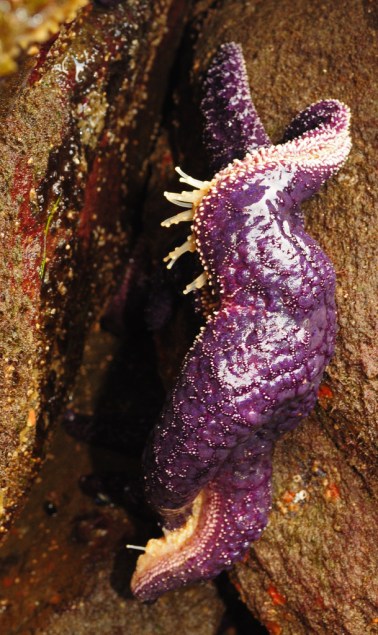
I have no idea what this starfish is trying to accomplish here…
Some of the stars exhibit signs of multiple personality disorder, giving us some bizarre orange and purple combination stars like this one here:
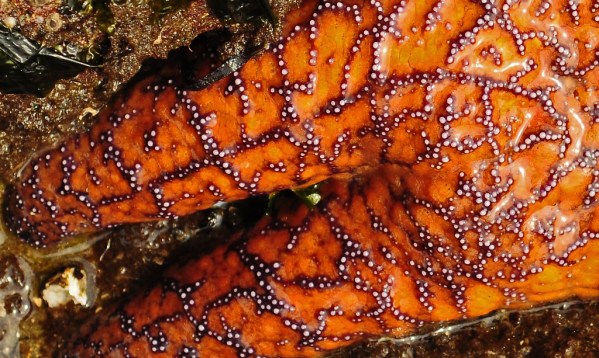
As brightly colored as they are, the sheer abundance of Pisaster ochraceus along the NW Washington coast makes them the black bear of the starfish world. Impressive surely, but not really what we came to see. A closer inspection reveals some less commonly spotted species. For example, meet the “grizzly bear” of sea stars:

The find of the day: a 20-armed sunflower star, otherwise known as Pycnopodia helianthoides.
I think we can all agree that Pycnopodia would be one of the most utterly terrifying species on the planet if it was capable of moving at any rate of speed that could be considered “fast”. Sure, it doesn’t eat humans but neither do spiders and this thing pretty much looks like a gigantic, orange, 20-armed spider with spikes. Given that I know plenty of folks who start to dial 911 at the sight of a spider the size of a pin-head, there is no doubt in my mind that there would exist an entire industry devoted exclusively to Pycnopodia extermination if it had managed to move more than the 3 inches that it did in the 20 minutes I sat there watching it. Clearly Alfred Hitchcock never encountered a sunflower star or I think his film-making career would have featured less birds and more marine life.

Two spotted arms of a leather star, Dermasterias imbricata, poke out from under a rock.
For a list of upcoming sygyzgies, check out this handy moon map, and to see when starfish viewing will be ideal along your favorite beach, you can find no better resource than the official NOAA Tides & Currents website.
 Zach Schierl Photography