An Aurora Storm for the Ages

Astronomy is a funny business. Sometimes it takes years of planning and many hard-earned dollars to be in position to see a rare celestial event (like April’s total solar eclipse), only to cross your fingers that the skies stay clear. Other times, a once-in-a-lifetime celestial experience drops into your lap on a random weekend in May.
That’s what happened on the evening of May 10/11, 2024, when a series of solar storms arrived at Earth, triggering one of the largest geomagnetic storms and aurora borealis (northern lights) displays in modern history. Seeing the northern lights from here in Washington state isn’t wildly uncommon, especially during periods of increased solar activity. Aurorae are caused by interactions between charged particles from the Sun and the Earth’s magnetic field and atmosphere. The Sun has an 11-year cycle of activity that is scheduled to peak in 2025, so opportunities to see aurorae have been fairly common over the past few years. I’ve seen them a handful of times since moving to Central Washington almost five years ago, but displays this far south are typically a modest affair. I’d always assumed that, to really see the northern lights, I’d need to plan a trip to Alaska or Iceland some winter and hope for the best.
I was wrong.
On May 9th, I started seeing forecasts calling for a sizeable geomagnetic storm the following day. Aurora forecasting is notoriously challenging though—there have been enough occasions where solar storms have fizzled upon arrival to merit a healthy dose of pessimism on my part—plus I was taking care of my five-day old newborn son, so the night sky wasn’t exactly the top thing on my mind. My first indication that something historic was happening was seeing a photo of brilliant red and pink auroras from Alabama pop up on my phone while eating dinner on the evening of the 10th. That got my attention in a way that the forecasts hadn’t. The fact that our skies were clear and the Moon was dark only added to the anticipation, but still, geomagnetic storms often last just a few hours and I figured the show would subside by the time darkness fell here in the Pacific Northwest.
I was wrong.
I set up my camera on our back porch shortly after sunset and before long a subtle but telltale green glow was visible in photos above the northeast horizon:

As the sky darkened, pale green curtains of light began to fill the entire sky. While they weren’t extraordinarily bright, the fact that they were visible from horizon to horizon made it easily the best aurora display I’d seen. We watched the faint lights dance across the sky for about half an hour before heading inside with the intention of preparing our newborn for bed. Thankfully, I popped my head back outside abut half an hour later to see if anything had changed.
It had.
Here is a time-lapse video I created of the entire event, starting at about 10:30 pm and lasting until sunrise. About two seconds in, you can see the dramatic transition from “good” to “once-in-a-lifetime” that occurred during the 30 minutes we were inside getting baby ready for sleep:
I never imagined that I’d get to witness a dusk-to-dawn all-sky aurora storm from my back porch in central Washington. Sitting here two weeks later, I am still dumbfounded scrolling through my pictures from that evening. Given that this is a photography blog and that I’m struggling to find the words to describe what witnessing this in person was like, I’m mostly going to let the photos do the talking from here:


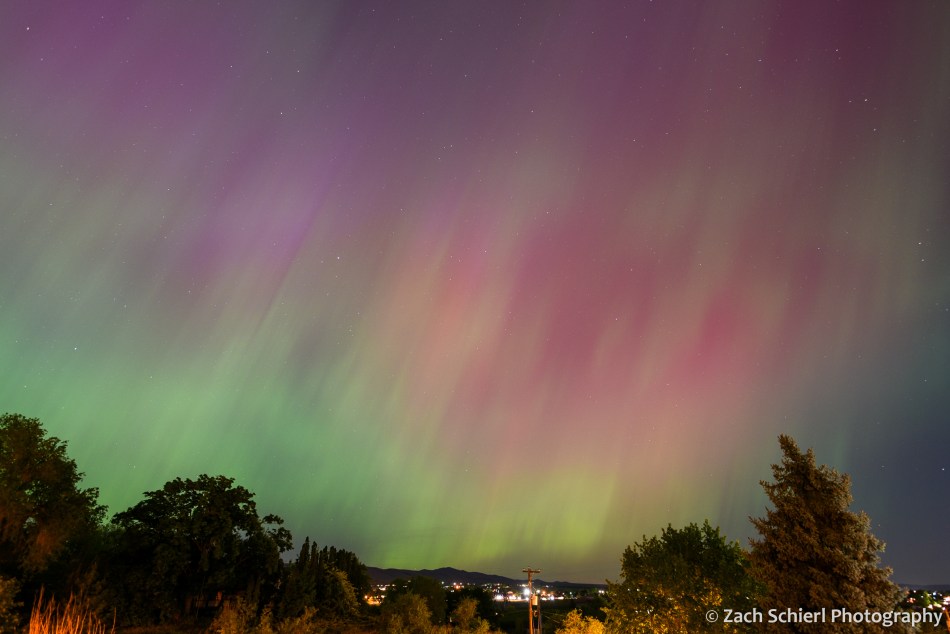
Two specific moments do stand out in hindsight. First, around 1:30 am, when a narrow band of green ribbons began “flowing” across the sky like a river of light. As they meandered across the sky, the ribbons alternately flashed on and off, as if controlled by some bizarre cosmic light switch. Again, I’m having trouble finding the right worlds to describe it, but it was one of the wildest things I’ve seen in 20+ years watching the night sky. Here’s a photo from this period of time:

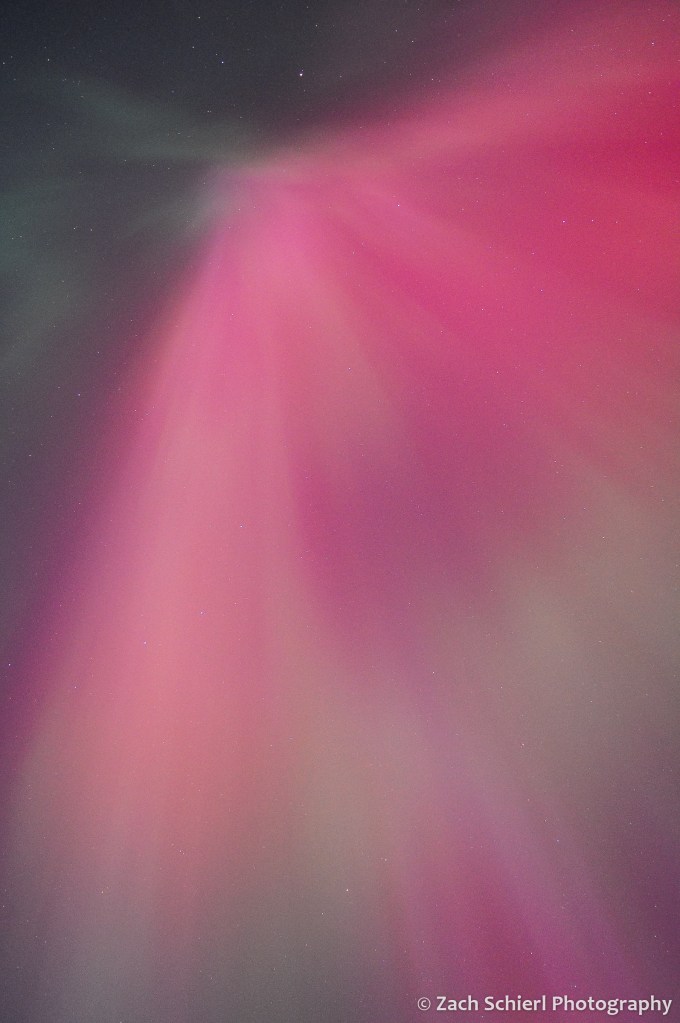
The other was a handful of minutes (I don’t know what time…) where nearly the entire sky was filled with a diffuse red aurora. (What shows up as pink in the photos definitely appeared more red to the naked eye.) The light that this cast on the surrounding landscape was eerie, and made me feel like I was standing under a heat lamp:

A few notes on color: in the days following the aurora storm, many of the conversations that I had with friends, family, and students revolved around why the color wasn’t as vibrant with the naked eye as it was on camera. There are several factors involved here.
One is light pollution. For example, folks in urban areas generally saw very little color, mostly just gray shapes shifting around in the sky. Where I live, on the outskirts of a mid-sized city (and thus still quite light polluted by astronomical standards), greens and reds were clearly visible to the naked eye throughout most of the event, though not to the degree visible in the photos. Those who observed the storm from very remote areas generally reported seeing much more vibrant colors (and possibly even hearing sounds!) In short, most folks saw little color because most folks live under light polluted skies.
The second factor involves some basic physiology of the human eye. I’ve written about this before with regard to photographing the Milky Way, but the cone cells that our eyes use to see color aren’t triggered in low-light situations. Cones need a minimum amount of light entering the eye in order to be activated, which is why objects appear in monochrome in a dimly lit room. A bright aurora is quite a bit brighter than the Milky Way, which means that it IS possible to see colors under the right conditions.
For comparison purposes, here’s the image from the top of the post again. I haven’t adjusted the color on this image at all; this is exactly how it came out of the camera after a five second exposure, save for a few small adjustments to brightness and contrast:
Here’s the same image again, this time desaturated in Lightroom to mimic approximately what I recall seeing with the naked eye:

Still colorful, but a good example of why digital imaging is the norm in professional astronomy these days. A common misconception is that astronomers spend most of their time looking through telescopes, when in reality everything is done with cameras. Our eyes can’t see squat!
Prior to May 10/11, my top 3 most memorable astronomy experiences were undoubtedly a pair of total solar eclipses (August 2017 and April 2024) and the 2001 Leonid Meteor Storm (during which I counted several hundred meteors every 15 minutes for over an hour.) It’s going to be hard to top a total solar eclipse, but the May 2024 aurora storm definitely earns a spot on this short list, in part due to sheer unexpectedness and the fact that I got to check off a “bucket list” item from the comfort of my own home. And, despite the fact that he was asleep most of the time and had no clue what was going on, it was still memorable to share the experience with my newborn son on his first weekend in this world!
Aurora Borealis from Washington

One of the great things about living in Washington is the occasional opportunity to see the aurora borealis (northern lights). While we rarely get the all-sky displays that are common in Alaska, Canada, or Scandinavia, there are typically at least a few nights per year where they are bright enough to see dancing on the northern horizon with the naked eye. This has been especially true this past year, as the Sun inches toward the next solar maximum in 2025. (Aurora are the result of interactions between our atmosphere, magnetic field, and charged particles spit out by the Sun. More solar activity generally means more opportunities to see aurorae.)
This past week, I witnessed a stellar (by Washington standards at least) auroral show. In a stroke of luck, I was already scheduled to lead a public stargazing event on the evening that Earth was hit by a large coronal mass ejection (CME), a burst of charged particles from the Sun that can trigger aurorae upon arrival at Earth. It was quite a treat for everyone, given that “see the northern lights” was not part of our event advertising. Instead, it was a nice bonus for everyone that braved the still-rather-chilly-and-windy spring weather.

This was my fourth time seeing the northern lights: three times from Washington, and once, oddly, from southern Utah. One big takeaway is that the show is a little different each time. This was the first time I had seen or photographed a red aurora. What’s more, the red color was easily visible to the naked eye. Seeing the sky glowing red was quite a strange sight; it felt like something was wrong with my eyes. In the photos, the aurora has an almost pink or magenta color, something that seems to be relatively uncommon. The display was brief: after less than 30 minutes, the lights dissipated.

Comparing these photos to one from my last sighting in October 2021, it’s almost hard to believe they are the same phenomenon. In October, the lights hugged the horizon and the green color was not nearly as apparent to the naked eye. (I find this odd given that the human eye is much more sensitive to green light than red light, especially at night…would expect it to be the other way around.)

These tantalizing glimpses of the aurora borealis the last few months are making me want to plan a winter trip to Alaska in the next few years while the Sun remains active. Fingers crossed we can make it happen!
Airglow: Denizen of the Dark Sky

I’ve been an astronomy nut ever since my parents gave me a small reflecting telescope for my 10th birthday. I located Saturn, complete with its too-good-to-be-true rings, within 10 minutes of setting it up for the first time, although my parents refused to believe me until they had a look for themselves. I majored in astronomy, own a telescope that barely fits in my car, and come to think of it, every “real” job I’ve ever had has involved astronomy. NASA’s Astronomy Picture of the Day has been my homepage for longer than I can remember.
Given my disposition towards both astronomy and photography, it seems superfluous to say that I’ve always enjoyed astrophotography. Taking photographs of celestial objects presents a set of challenges not encountered by photographers who go home after the sun dips below the horizon, the majority of which revolve around the fact that most astronomical objects are rather dim, requiring long exposure times and extra equipment to capture.
Quite frequently I’ll get asked if I’ve ever seen any UFOs while gazing up at the sky. My standard response is that, while I’ve certainly seen a lot of weird *#&@ in the sky, I’ve yet to see anything that didn’t ultimately have a logical explanation, even if it took a little head-scratching to figure it out (high altitude weather balloons are the worst!).
A prime example of this occurred this past summer during a nighttime observing and photography session. I was attempting to get a 180 degree panorama of our home galaxy, the Milky Way, stretching across the summer night sky. I had my camera mounted on a tripod head that compensates for the rotation of the Earth, allowing me to take exposures several minutes in length while avoiding star trails in my images. It was dark and clear enough that I was able to get some good shots of the summer Milky Way and its complex and sinuous inky-black interstellar dust lanes, as well as some decent shots of some galaxies and nebulae through a telescope:
 The Milky Way in the constellations of Scorpius and Sagittarius. This portion of the Milky Way is home to the nucleus of our galaxy, making the Milky Way appear brighter here than anywhere else in the sky.
 The Lagoon Nebula, also known as M8, a vast cloud of hydrogen gas giving birth to new stars. A “stellar nursery” as astronomers like to say.
While my shots of the galactic center in the southern sky were turning out well, as I began to pan my camera around to the east and then finally north, I noticed that faint but noticeable bands of diffuse red and green light were creeping into my image.

My immediate thought was sensor noise. The CCD chip on my old DSLR (a Nikon D70) had a habit of heating up during repeated long-exposures. This thermal radiation from the sensor manifested itself as a bright purple/pink haze occupying one corner of the photo, making any attempt at serious astrophotography futile. Perhaps something similar was happening here. I quickly ruled this out for a number of reasons. Most importantly, the apparition was showing itself only in photos taken towards the north, meaning that the source couldn’t be the camera, but rather something in the sky itself. The colors ruled out high clouds, and it wasn’t in the proper direction to be the result of artificial light pollution. The closest city of any significant size to the northeast was several hundred miles away.
Whatever it was, neither myself or any of my observing companions could see it with the naked eye. A bit eerie perhaps, but not at all uncommon. Many astronomical phenomenon are too faint to see without long-exposure photographs. In fact, the first time I saw the aurora borealis, I captured it with my camera several hours before it became bright enough to see with the naked eye.
A auroral display was actually my second thought. What I was seeing in my photos definitely resembled one. Red and green are the colors produced by nitrogen and oxygen, the two primary components of our atmosphere, after being excited by collisions with magnetic particles brought to Earth by the solar wind. Most auroral displays consist of some combination of these two colors and what I was photographing appeared only in the northern sky which fit the theory to a tee. Furthermore, the Sun had been especially active in the week or so prior. It was perfect except for one slight problem: I was in Colorado.
Auroras in Colorado are definitely not unheard of….but not exactly common either. One thing was certain: if an aurora HAD crept this far south, then the northern portions of the country would simultaneously be getting the show of a lifetime. A quick check of spaceweather.com, the one stop shop for up-to-the minute aurora information, showed this was not the case. Strike two.
I actually didn’t figure this one out until many days later, when I inadvertently ran across an article about some Pacific Northwest photographers who had captured something called “airglow” in some photos of the Milky Way taken at Mt. Rainier around the same time. A momentary glance at their photos and I knew I had my answer.

Here’s the final panorama I produced. The airglow (red and green splotches at left) was changing rapidly enough that it caused major headaches trying to stitch the images together. Consequently I didn’t quite get my 180 degree panorama, there’s a bit missing on the northern end (lower left).
Airglow is exactly what it sounds like (a rare thing in science, I know…): glowing air. Incoming solar radiation and cosmic rays ionize oxygen and nitrogen atoms in our atmosphere during the day and then then these atoms regain their electrons at night, emitting light in the process. This is similar to what happens during an aurora, except that it’s happening ALL THE TIME. Airglow is always there, it’s just really, really faint; you need to be somewhere extremely dark to have a chance of seeing it, even with a camera. Even a miniscule amount of light pollution will render it invisible. It does tend to be brighter when solar activity is high, although it is not nearly as dependent on the solar cycle as its brighter cousin, the aurora.
So what began as an unidentified and undesirable annoyance in my photos (and when trying to stitch together my panorama, boy it sure was!) turned out to be a rarely captured celestial phenomenon I had never even heard of, much less one that I had intended on photographing that evening. Next time someone asks me about UFOs, I’ll just refer them to this page.
 Zach Schierl Photography