Europe Part 4: Sarajevo and Mostar

Links to previous posts: Part 1, Part 2, Part 3
A short 45 minute flight on Croatia Airlines took us to Sarajevo, the capital and largest city of Bosnia and Herzegovina. We arrived around midnight and hailed a taxi from the airport to our lodging in the city center. I was immediately glad to not be piloting a rental car here! Even as the clock approached midnight, the taxi ride was…shall we say…exciting; hilly terrain, pedestrians at every turn, lots of traffic sharing the road with rumbling communist-era trams, and sidewalks seemingly used as an extension of roads and parking lots.
Chaotic start aside, Sarajevo ended up being one of our favorite stops on the entire trip. There is so much complex and fascinating history packed into this relatively small city. Sarajevo has been a meeting point of cultures and a model of religious tolerance for hundreds of years. Ironically and sadly, the city is perhaps best known for two darker moments: the assassination that sparked World War I, and a tragic four-year siege in the early 1990s during Bosnia’s war for independence from Yugoslavia.

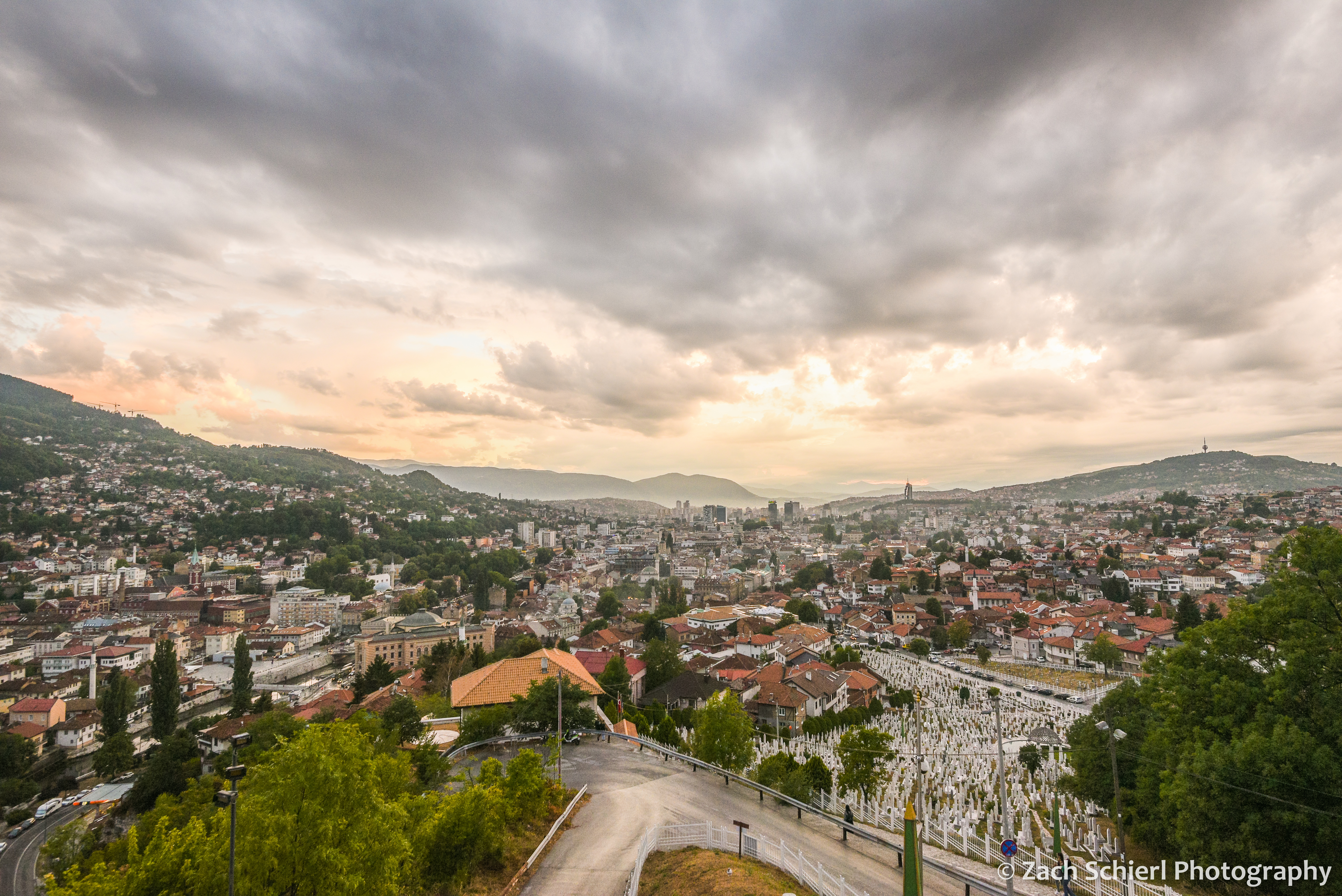
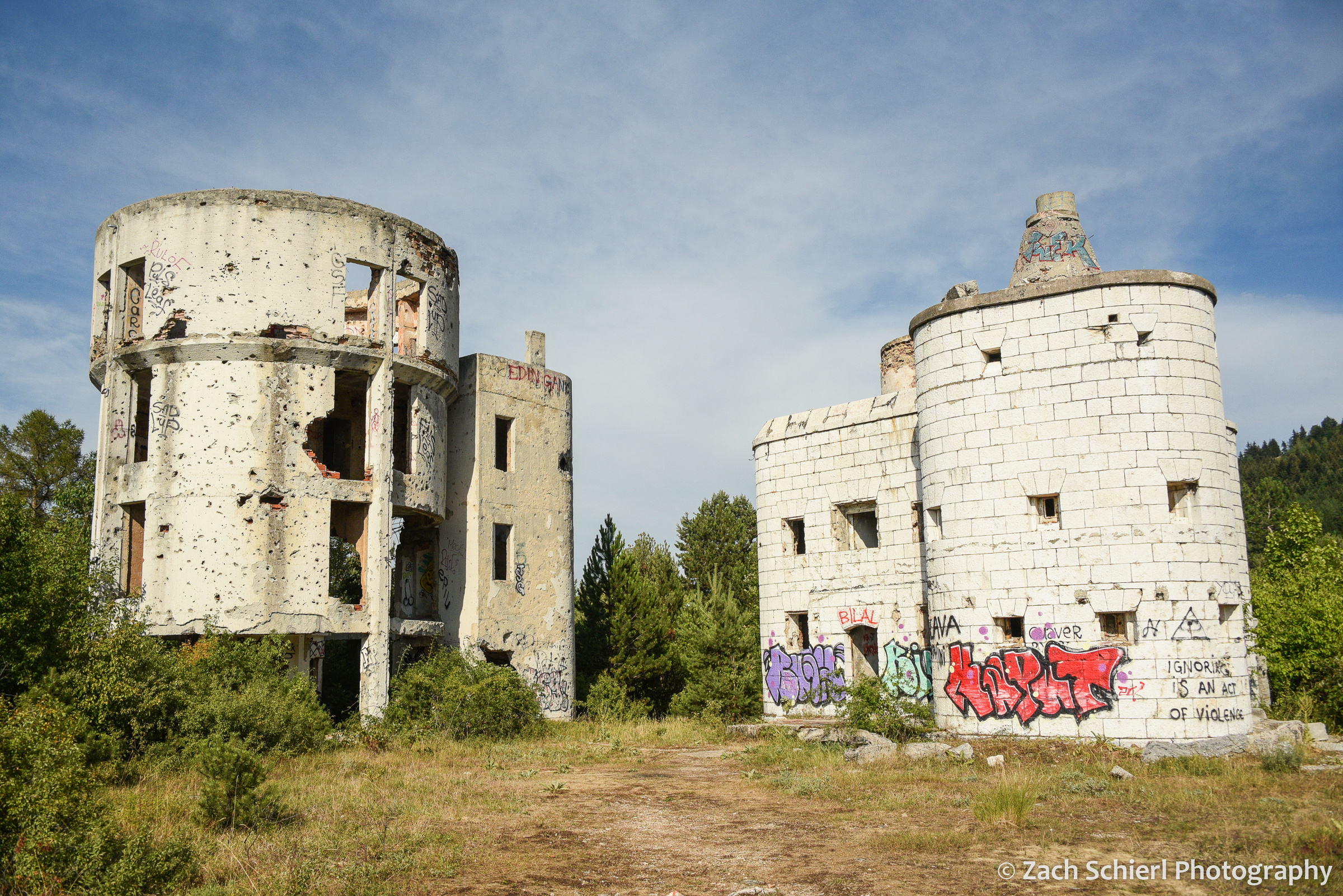
More on the history later, but the first thing that struck us when we looked out the window the following morning was that Sarajevo is situated in an absolutely gorgeous landscape. It’s one of the few cities I can recall that seems to complement the natural landscape rather than detract from it. The bulk of the city is confined to a long, narrow valley that slices through the Dinaric Alps, with the Miljacka River winding along its bottom. Mt. Trebević rises more than a thousand feet above the city to the south, while other hills bound the valley immediately to the north and east. While this makes for gorgeous scenery, the unique geography was what allowed the Bosnian Serb Army to besiege and terrorize residents of Sarajevo from 1992 to 1996. One prominent casualty of the siege is the bobsled track used in the 1984 Winter Olympics, located on the slopes of Trebević above town. The track was used as fortification during the war and is now abandoned, as are the shelled out remains of the Čolina Kapa Astronomical Observatory (the only professional observatory in Bosnia) nearby. We took the recently (2018) rebuilt cable car to the top of Trebević to get a bird’s eye view of Sarajevo and then enjoyed a pleasant, though at times eerie, hike back down into town, past the crumbling, graffiti covered bobsled track and through several residential neighborhoods perched above the main city.

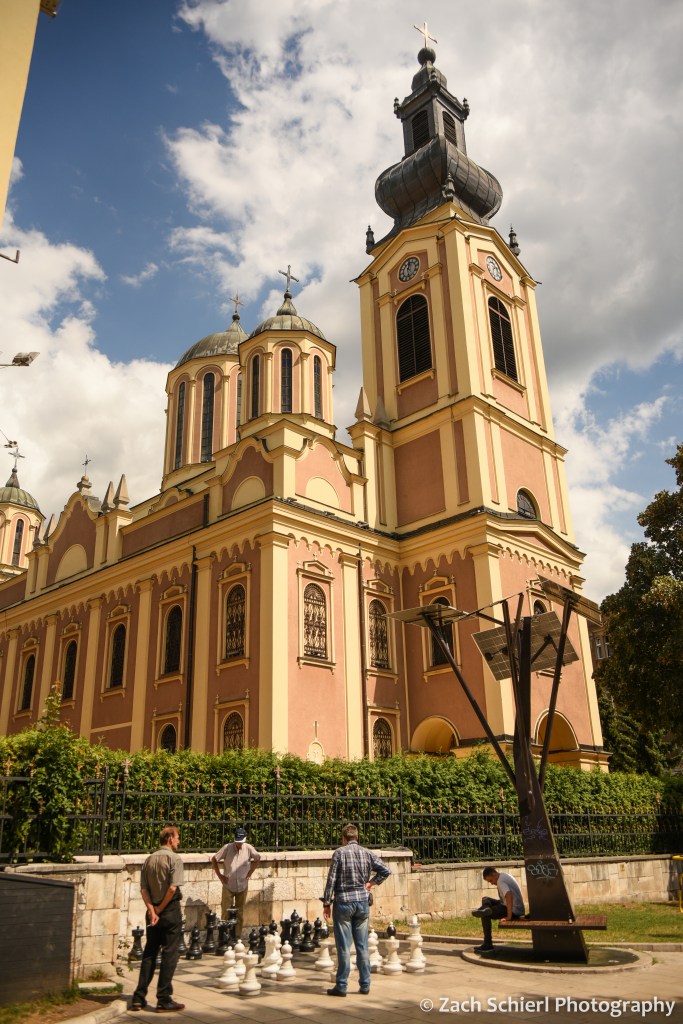
Today, Sarajevo (and Bosnia itself) is majority Muslim. Half a dozen mosques, with their pointy minarets, are visible from just about any point in town, and the city is punctuated with the sounds of the Adhan (Muslim call to prayer) issuing from the minaret loudspeakers five times a day. Interspersed among the mosques are several Catholic cathedral spires, eastern Orthodox churches, and a Jewish synagogue, indicative of how people of many faiths have converged and lived together peacefully in Sarajevo throughout most of its history.
At the east end of Sarajevo is the Baščaršija, the “old town” with architecture dating from the era when Bosnia was part of the Ottoman Empire. The tiled roofs, narrow lanes, and bazaars seem transported here from Turkey or the Middle East.


West of the Baščaršija is a newer section of town with buildings resembling those in Ljubljana, built during the late 1800s when Bosnia was part of Austria-Hungary. Speaking of Austria-Hungary, the heir to that throne, Archduke Franz Ferdinand, was on an official visit to Sarajevo in 1914 when he was assassinated by a Serbian separatist on a non-descript street corner along the Miljacka River. Austria-Hungary demanded that Serbia investigate the assassination, and when they refused, Austria-Hungary declared war on Serbia, triggering alliances that plunged the globe into World War I. The site today is home to a small museum and marked by a a plaque and metal plates showing where Ferdinand’s convertible was stopped during the shooting.
Even further west is the modern business and government district, with its large hotels, skyscrapers, shopping malls, and lots of traffic. It is also home to the U.S. Embassy, which appeared to be better fortified than the Bosnian parliament building across the street. We explored this area a bit on our final morning in Sarajevo, on our way to the nearby train station. After a short ride on one one of the extremely rickety but charismatic communist-era trams, we took the elevator up to the 35th floor of the Avaz Twist Tower skyscraper for an aerial view of the city.

We ended up spending almost an entire day with a local guide, journalist, and siege veteran, Amir Telibećirović, who wove a powerful narrative of Bosnian history, from ancient times up through the present day, while walking with us around town to visit a variety of sights. Especially striking were the many small cemeteries containing hundreds of white headstones from the siege. These cemeteries were located right in the middle of town, in strategic locations where the risk of sniper fire was minimized. Even then, residents typically waited to conduct burials during periods of heavy fog. While Sarajevo is a bustling city filled with tourists today, the scars of war are still quite obvious here, more so than anywhere else on our journey through the former Yugoslavia. Many buildings remain riddled with holes from shrapnel and bullets, especially if you stray away from the main tourist destinations. And beyond building facades, Bosnia’s economy has been slow to recover and unemployment remains quite high compared to other Balkan countries.
In addition to soaking up the local history, we also spent a fair amount of time soaking up calories by trying the many delicious local foods, including strong Bosnian coffee, burek (filo dough rolls stuffed with meat, cheeses, potatoes, etc) and Ćevapi (little sausages in pita-like bread with a creamy cheese called kajmak). All very tasty, and all very meaty. We frequently remarked on how it would be hard to be a vegetarian in Bosnia! Another highlight was sunset from atop an old fortification called the Yellow Fortress. From here we had a spectacular view looking west down the Miljacka River valley toward the setting sun. With residual clouds from a series of brief thunderstorms earlier in the day, the lighting was truly spectacular, and combined with the illuminated mosques and call to prayer, it made for a very unique and memorable experience.

After several days in Sarajevo, we boarded a train and headed south to Mostar. We were once again reminded of the ease and comfort of European train travel. (It’s a damn shame this mode of transportation isn’t more viable in the U.S.) As we rolled through the scenic mountains of Bosnia, the vegetation changed gradually, from the relatively verdant landscape near Sarajevo to a more desert-like, Mediterranean landscape as we neared Mostar.
From the train station in Mostar, it was a twenty minute walk to our hotel for the evening. It was getting close to sunset so we made a quick detour to see the primary attraction of Mostar: Stari Most (the “Old Bridge”). The Old Bridge is, not surprisingly, a bridge spanning the Neretva River, connecting the east and west halves of Mostar. It is not, however, very old. The bridge was originally built in the 1500s but was sadly destroyed during the Bosnian war in the early 1990s, along with much of Mostar. Today’s bridge was rebuilt in the early 2000s, using the same techniques, tools, and materials used in the original version. Shops and restaurants line the cliffs along the river on either side of the bridge, and it was PACKED! We had a somewhat forgettable dinner in an unforgettable setting on the banks of the river with a beautiful view of the bridge and city.

Mostar was a brief stop en route to the Adriatic coast, so we unfortunately didn’t have much time to explore beyond the main sights. After less than 24 hours, we were walking back to the train station to catch a bus to Dubrovnik, an experience that turned out to be the polar opposite of our train journeys in just about every way possible. That’s next time!

Europe Part 3: A Cavalcade of Capitals
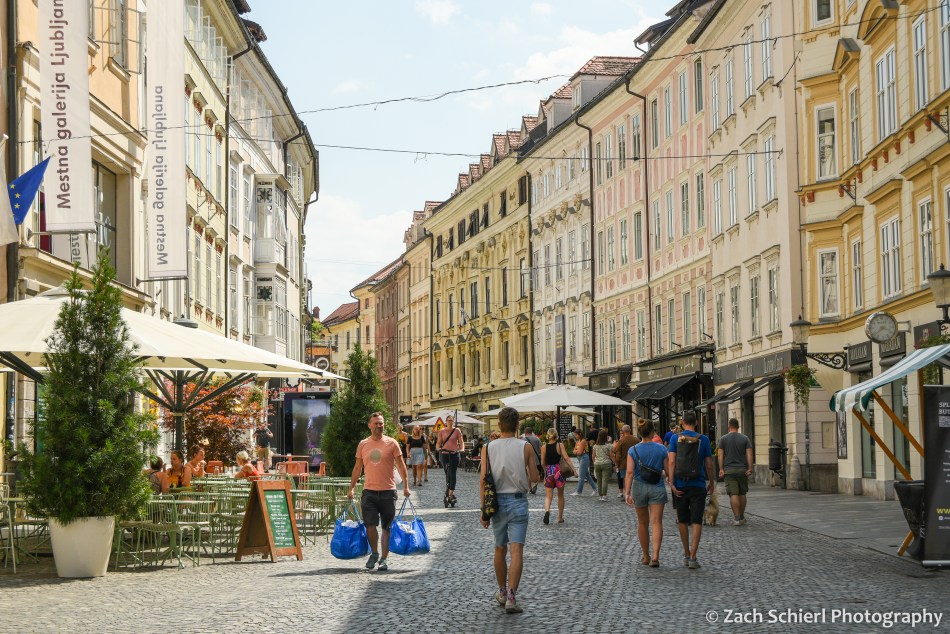
After starting off our trip with a foray through the mountains, the next leg was decidedly more urban as we toured a trio of capital cities: Ljubljana, Zagreb, and Sarajevo.
After returning our rental car at the Ljubljana Airport, we took a shuttle into the city center. Ljubljana, the capital of Slovenia, is relatively small for a European capital, with just a few hundred thousand residents. The city was heavily damaged during a large earthquake in 1895. At the time, Slovenia was part of the Austro-Hungarian Empire, so many of the buildings in the city center were rebuilt in the same architectural style prominent in cities like Prague and Vienna. For the last decade or so, the center of Ljubljana has been set aside as a pedestrian zone…no cars allowed! We enjoyed our limited time in town strolling the wonderfully car-free streets, crisscrossing the many bridges over the Ljubljanica River, and riding the funicular up to the castle that overlooks the old town. The highlight was a food and wine tour with a local guide and wine expert who introduced us to a variety of foods and wines from different regions of Slovenia: deep fried sardines from the Adriatic coast, homemade meats and cheeses from the Hungarian-influenced northeast, Carniolan sausages and barley stew from the southwest, and a delicious layered dessert with dumpling, nuts, raisin, breadcrumbs, and creamy cheese.

We also learned more about life in Slovenia and the recent history of the area from our guide. Most of the countries on our trip were part of the former communist republic of Yugoslavia. Slovenia was the first to declare independence in 1991 and fortunately did not experience the brutal conflicts that followed independence declarations in neighboring Croatia and Bosnia. Talking to our guide, we learned that Slovenia’s education system is well-funded, pre-K childcare costs only a little over $100/month, college and housing are relatively affordable, and new mothers are guaranteed a year of paid maternity leave. As a country, Slovenia also seems to be more environmentally conscious that most. After a week in Slovenia, we left with the impression that this is a progressive country that cares about making life better for its residents. What a concept!

Ljubljana was one of many stops where we wished we could stay longer, but after about 24 hours, we were on one of the few train journeys of our trip to Zagreb, the capital and largest city of Croatia. Zagreb is much larger than Ljubljana, with roughly one million inhabitants, and the difference was noticeable from the moment we stepped off the train. The overall atmosphere of Zagreb felt like a much larger, faster paced urban center compared to the relative tranquility of Ljubljana.
Most of Zagreb is relatively young by European standards, with much of the city center built up over just the past 150 years. (Quite a few buildings, including all of the major cathedrals, were in scaffolding during our visit, still under repair from damage incurred during a major earthquake in March 2020.) Our room for the night was in the small “old town” section of Zagreb, which consists of two adjacent hills with buildings dating back to the 1500s. At odds with one another for most of history, these two towns officially merged in the 1850s, leading to the creation of the greater Zagreb that exists today.
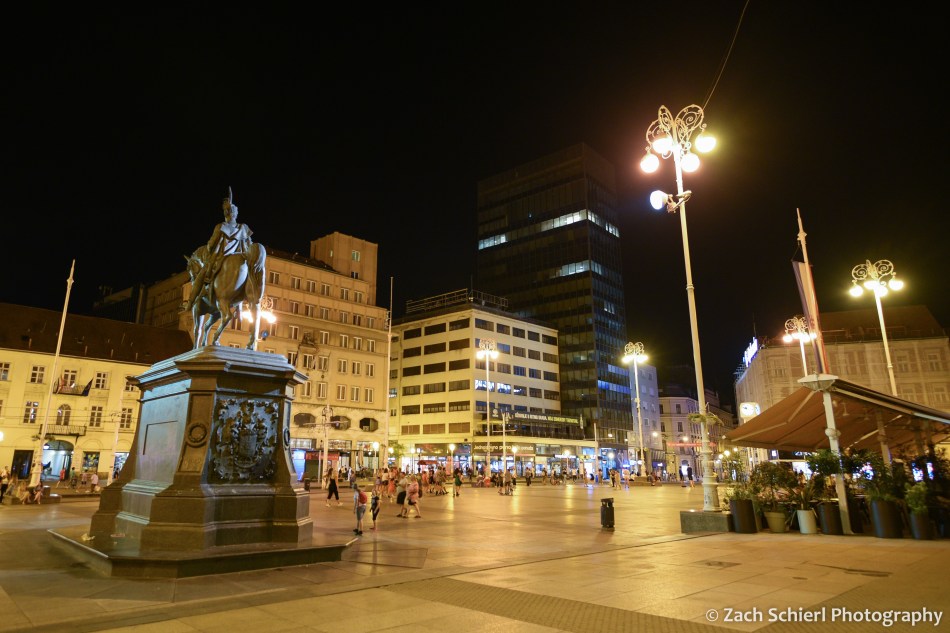
Like all of the cities we visited on this trip, Zagreb was bumping. We never ceased to be amazed by how many people (tourists and locals alike) were out and about late into the evening, regardless of whether it was a Tuesday, Thursday, or Saturday. Sitting on Jelačić Square (the central social and transportation hub of Zagreb, pictured above) late at night, watching a steady stream of electric trams whisk people back to all parts of the city, definitely made us reflect on how the U.S. cities we’ve lived in are built so differently.
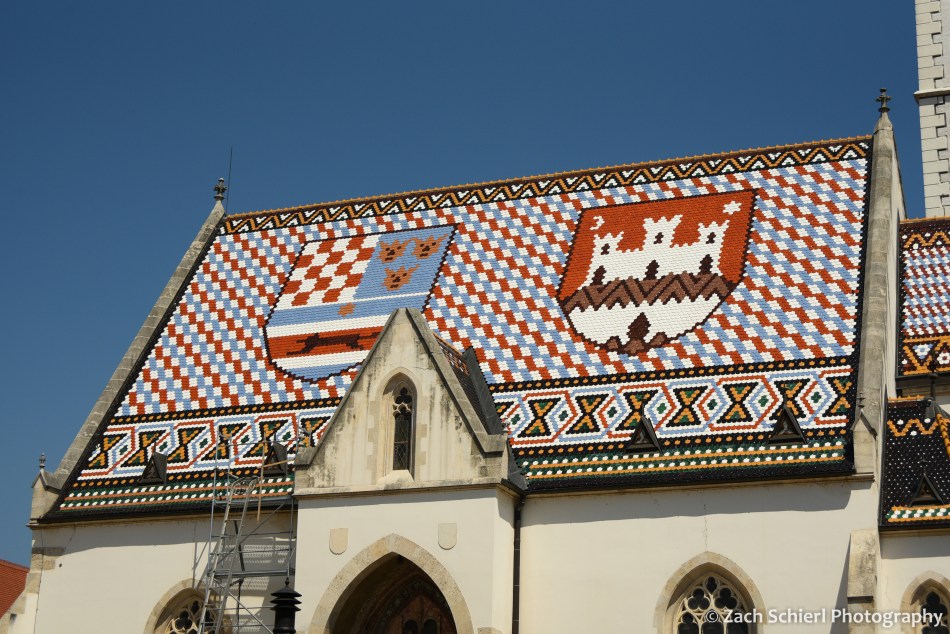
Our time in Zagreb was also limited, so the following morning we took a free walking tour to get our bearings. At the top of the town was St. Marks Church, with its unique roof covered in colorful tiles depicting the coat of arms of Croatia (left) and the city of Zagreb (right):
In the afternoon, we took another walking tour focusing on the war for Croatia’s independence in the early 1990s. The events that led to this war (and the others in the Balkans around the same time) are, of course, incredibly complex and require a good understanding of history going all the way back to at least World War I to truly understand. While summarizing this history is not really within the scope or intent of this photography blog, I will say that it was absolutely fascinating to hear the varying perspectives on these conflicts via museums, tours, and conversations in several different countries. On our tour in Zagreb, we walked through some of the underground tunnels and bunkers that were originally built during WWII and then used again as bomb shelters during the recent war. Today, many of these tunnels remain in use as “shortcuts” for residents to get from one part of the city to another. (As an added bonus, it was a solid 30 degrees cooler down there than on the surface!)
Ultimately, I didn’t take a ton of photos in Zagreb or Ljubljana. Both cities were at their best after nightfall, and I definitely could have used a tripod. Many of the night scenes I photographed turned out rather blurry. From Zagreb we caught a short, late evening flight to Sarajevo which ended up being one of the highlights of our trip and will get its own post next time!
Europe Part 2: The Julian Alps

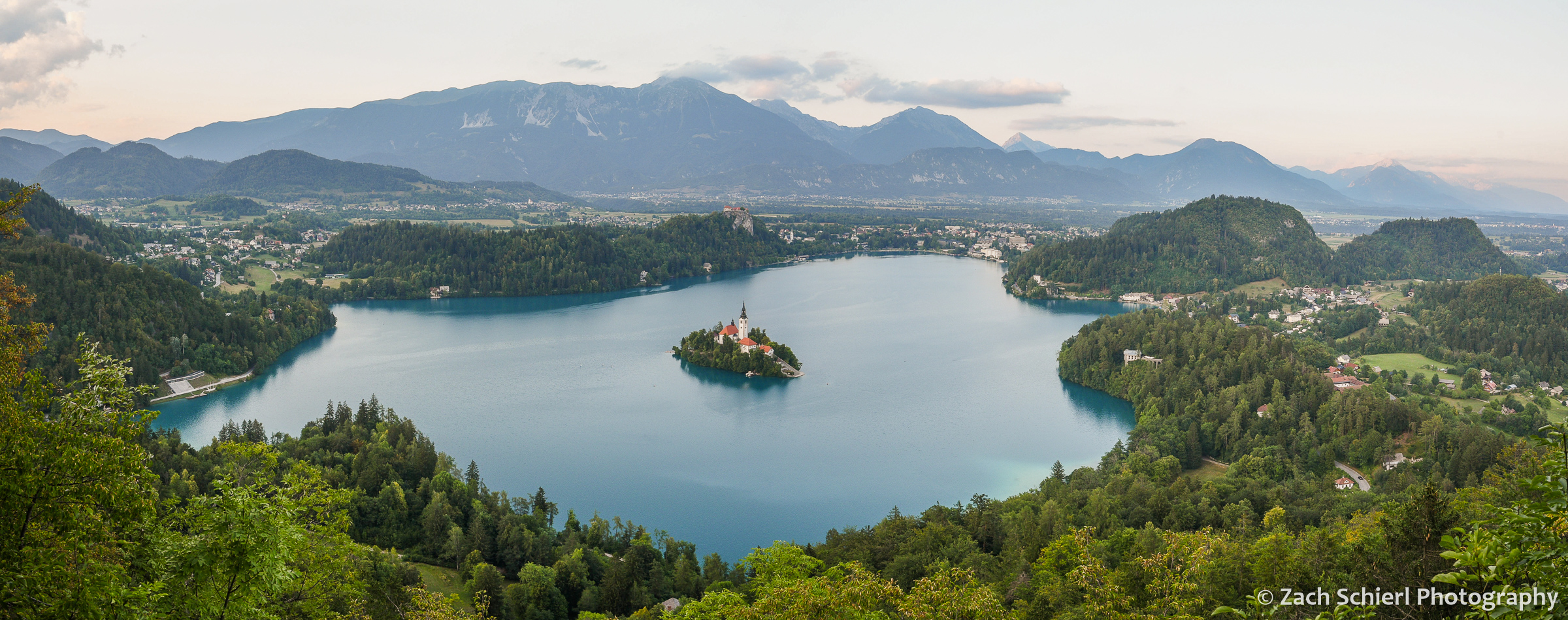
From the beginning, Slovenia was one of the destinations that drew us to eastern Europe, specifically the Julian Alps in the western corner of the tiny country. Just south of the Austrian border, the Julian Alps are an eastern extension of the famous European mountain range that, while still well-visited, are more off-the-beaten path than the Swiss or Italian Alps.
After our stopover in London, we hopped a British Airways flight to the capital of Slovenia, Ljubljana (pronounced “lube-lee-ah-nah“). After sitting on the tarmac in London for awhile, we arrived just in time to pick up our only rental car of the trip, which we had reserved to facilitate a driving loop through the mountains in areas where public transportation was lacking. We were pretty tired and jet-lagged after several full days of travel, so it was probably good that: 1, Slovenians drive on the right and 2, that our first destination was only a 30 minute drive from the airport. As is par for the course with us, the “low tire pressure” indicator on our rental car illuminated less than 10 minutes into our late-night drive through the Slovenian countryside to Lake Bled, where we would be staying for the next three nights. A visual inspection revealed a tire that looked perfectly normal, so we pushed onward. (The light stayed illuminated for all five days that we had the car, but none of the tires were visibly flat so we rolled with it, literally and figuratively.)
With nearly all of the Balkans to choose from, Josip Broz Tito, the president/dictator of the former Yugoslavia (which Slovenia was part of until 1991) chose Lake Bled as the location for his summer villa. It wasn’t hard to see why. Lake Bled was extremely beautiful and scenic, with deep blue water, a tiny island complete with picturesque church right in the middle, and a fairy tale castle perched on a cliff above the lake. The town of Bled, on the east shore of the lake, was quite busy, and overall the vibe reminded us of mountain towns like Aspen or Leavenworth (minus the castle). In what would be a theme of the entire trip, we encountered very few American tourists, but lots of English spoken, given that it serves as the default tongue for Europeans unfamiliar with each others’ languages.
Temperatures were toasty, in the high 80s to mid 90s, and the air was humid (by western US standards at least), so we spent as much time near or in the water as possible. We spent some time on the local swimming beach, and took a boat ride out to the island in the middle of the lake on a traditional wooden pletna rowboat:


Lake Bled sits at the foot of the Julian Alps and, despite the muggy conditions, we were determined to experience some of the fantastic hiking trails in the area. Our first hike took us on a short loop through the Pokljuka Gorge, a dry slot canyon carved into the ubiquitous limestone of the Julian Alps at the end of the last ice age. Exiting the slot canyon involved traversing a rickety little pathway bolted to the side of a cliff that I could have done without. The scenery was gorgeous though, and we encountered only a few others groups despite the proximity of the trailhead to bustling Bled.

About 30 minutes up into the mountains from Lake Bled is the larger Lake Bohinj. We were under the impression that Bohinj was a quieter, less visited lake (one guidebook described it as “sleepy”), but the scene was just as nuts, if not more so, than Lake Bled. Despite some trouble finding parking, we ended up having a lovely swim in Lake Bohinj in the late afternoon. Neither Bled nor Bohinj allow motorized boats, which, despite the crowds, made both of them seem very tranquil and peaceful, in contrast to many similarly-sized lakes here in the US.
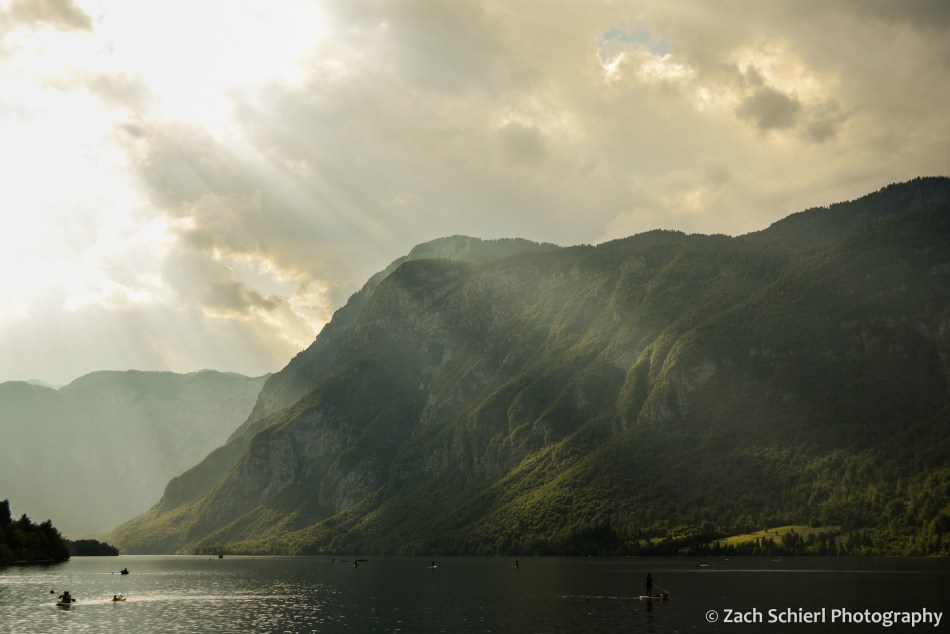
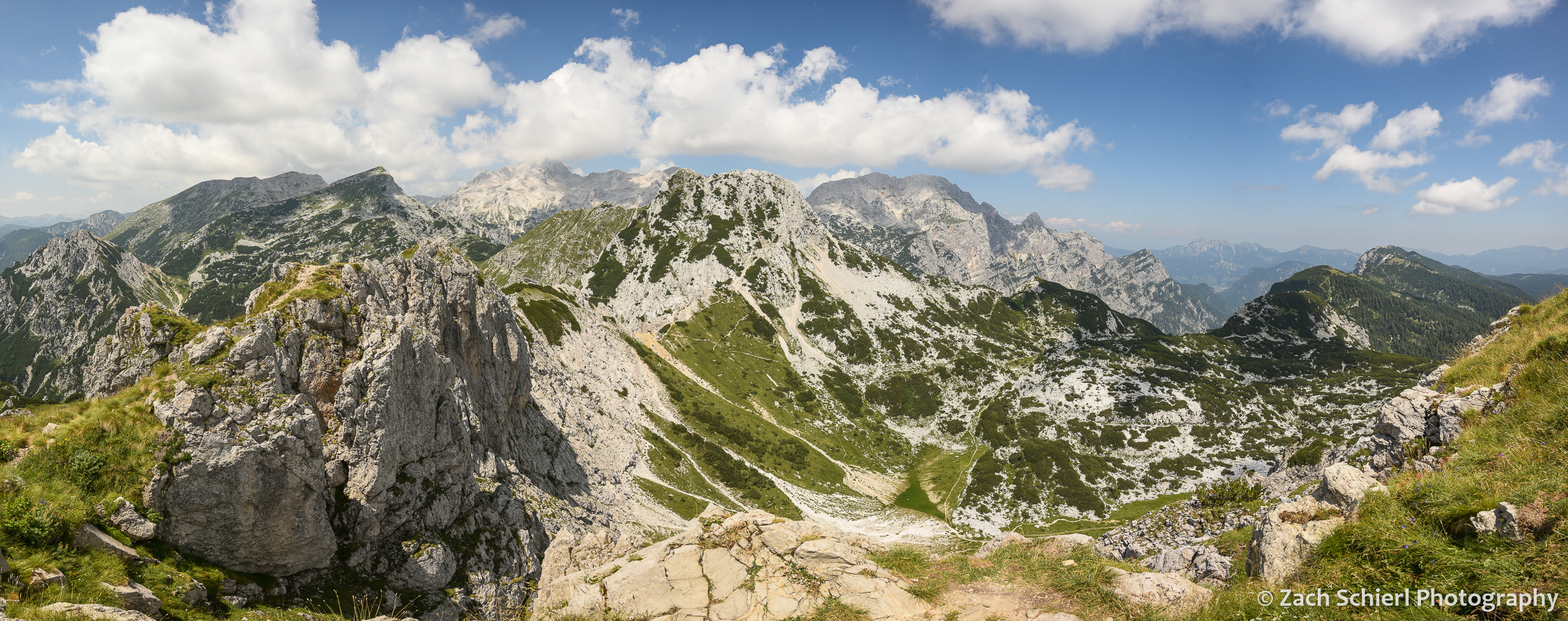
Later that evening, we rushed (literally) up to a spectacular overlook of Lake Bled from Mala Osojnica just in time for sunset (see photo at top of page). On our final morning in Bled, we drove about 30 minutes up into the mountains to hike Viševnik, a 2000 meter peak with amazing views of Triglav, the highest point in Slovenia. While only a few miles long, the trail shot straight up the side of the mountain, first along the margins of some ski slopes, then up a rocky chute, and then finally across broad grassy slopes with commanding views back toward Bled. We lost a few buckets of sweat, but the views of the sharp peaks hewn from bright white limestone were sublime. Thanks to a good map and well-signed trails, we were able to improvise a loop that took us on a more gradual descent back to the trailhead.
After a few days in Bled, we made the drive across the Julian Alps to the Soča River Valley via Vršič Pass. The gnarly road over the pass was built by Russian POWs during World War I to supply Austro–Hungarian troops on the front lines just over the pass. The road is narrow and steep, with 50 hairpin curves. We made a number of stops en route to admire the jagged peaks of the Alps and to let the engine (on the way up) and the brakes (on the way down) cool down a bit! On the downhill side of the pass, the road follows the beautiful Soča River Valley. As serene as the turquoise green river is today, this valley was home to some of the most intense fighting of WWI. Hundreds of thousands of Italian and Austro-Hungarian soldiers lost their lives in this valley and the surrounding mountains.

A few miles down the valley was the town of Bovec, our base for the next few nights. Bovec is known for being the adventure sports capital of Slovenia, with all manner of activities from rock climbing to canyoneering to whitewater rafting to zip lining to God knows what else. We did not partake (though our travel insurance policy did cover such activities!) in anything more adventurous than hiking however. Still somewhat jet-lagged and tired from our climb of Viševnik, we were fortunate that the prime hiking trail here was the relatively level Soča River Trail, a 20 km-long path that extends from the headwaters of the Soča all the way to Bovec. We hiked some of the more spectacular sections, including the portions along the Great and Small Soča River Gorges, where the river has carved a narrow slot into the limestone.

Just a little downstream from Bovec is the village of Kobarid, which figures prominently in Ernest Hemingway’s A Farewell to Arms, a novel based on his experiences as an ambulance driver on the Soča River front during WWI. (The area was part of Italy at the time; Kobarid is known as “Caporetto” in Italian.) Kobarid had a great little museum detailing the story of the WWI in the Soča River Valley. On a hill above town is an imposing mausoleum memorializing the thousands of Italian soldiers who died in the area over the course of the war.

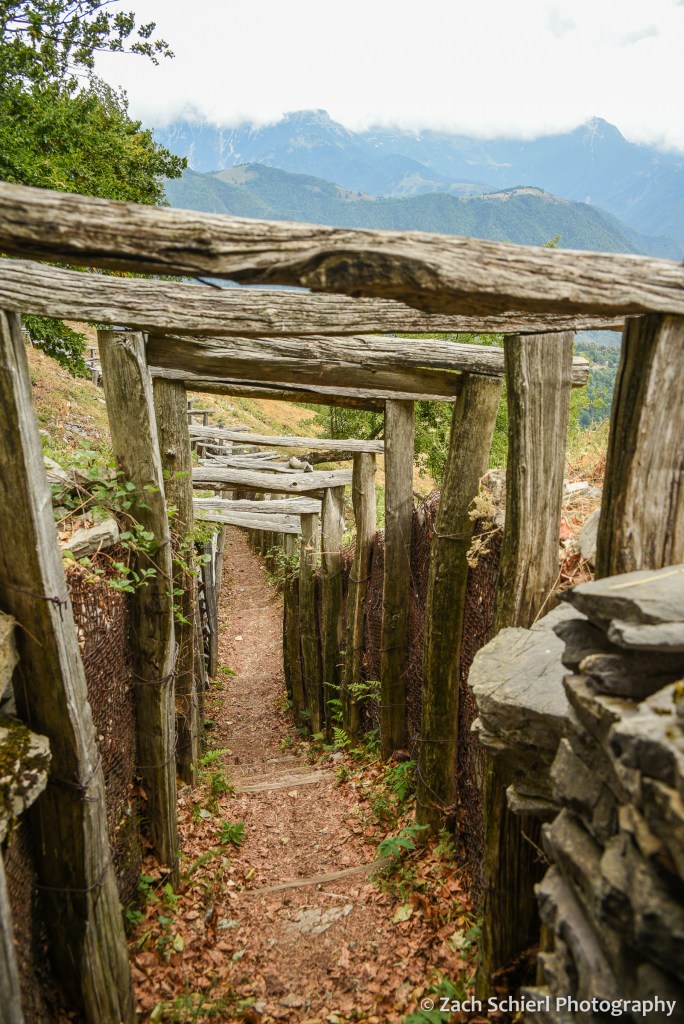
After five exciting days in the Julian Alps, it was time to head back to Ljubljana and return our rental car. En route, we detoured to a small outdoor museum on the border with Italy where you can walk through the remains of WWI trenches, bunkers, and tunnels on a high ridge overlooking the Soča River Valley. It was truly mind-boggling to imagine a massive war being fought in such rugged terrain, especially after seeing photos of the snowpack that accumulates in the winter.
Next up: a journey though three European capitals: Ljubljana, Zagreb, and Sarajevo!
 Zach Schierl Photography